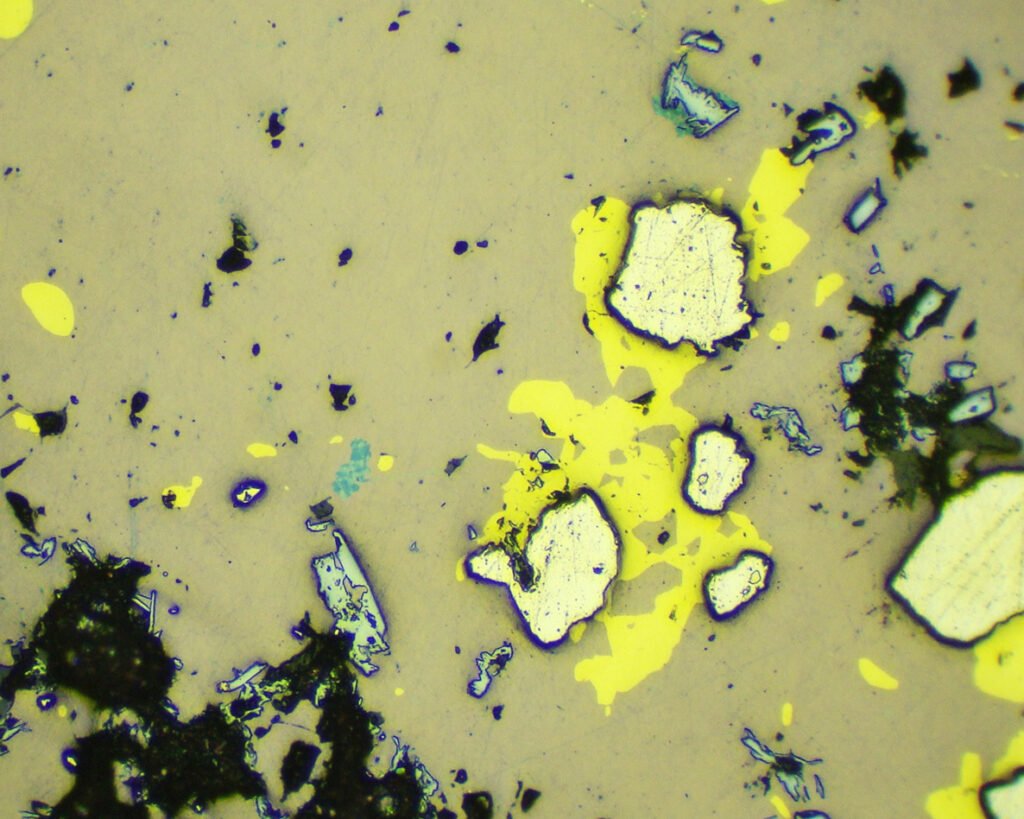
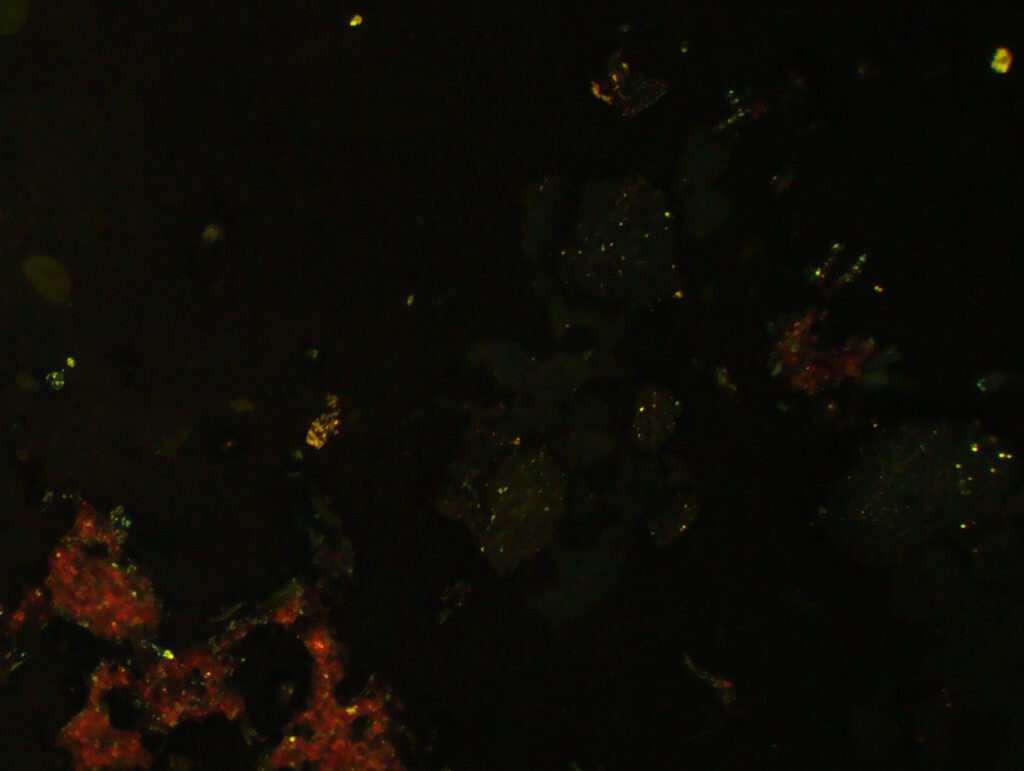
5. Reflected Light Microscopy
Sample preparation: due to its relatively low hardness, bornite acquires an excellent polish with great ease. It is suggested not to use coarse abrasives when grinding, otherwise deep polishing grooves will appear, the later removal of which requires a lot of work. The polishing hardness is approximately the same as that of chalcocite; it is a little less to that of chalcopyrite and a little superior to that of galena and covellite. Sphalerite is much harder.
PLANE POLARIZED LIGHT – PPL
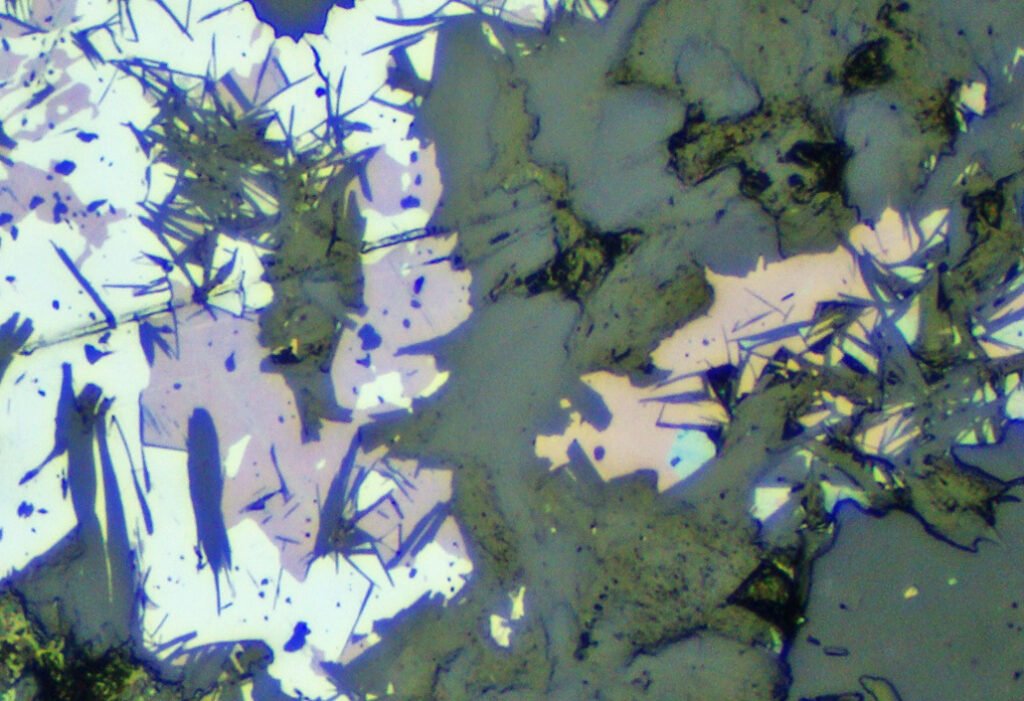
Reflection color: Light pink-brown, similar of the color of pyrrhotite, but the shade of pink is more pronounced. It tarnishes very quickly (10-15 minutes) to bluish and violet colors.
Compared to the color of pyrrhotite, the color of bornite is very similar, but more pink. And pyrrhotite does not tarnish to blue colors.
Compared to the colors of enargite and famatinite, the color of bornite is more colorful and much darker.
Compared to renierite and mawsonite colors, bornite color is less yellow and darker.
Compared with the color of germanite, the color of bornite is darker and stronger in tone, less shiny.
Pleochroism: Very weak, usually not observable. When noticeable, only on intergranular boundaries and twin lamellae.
Reflectivity: 25.08%
Bireflectance: No.
CROSSED POLARIZED LIGHT – XPL
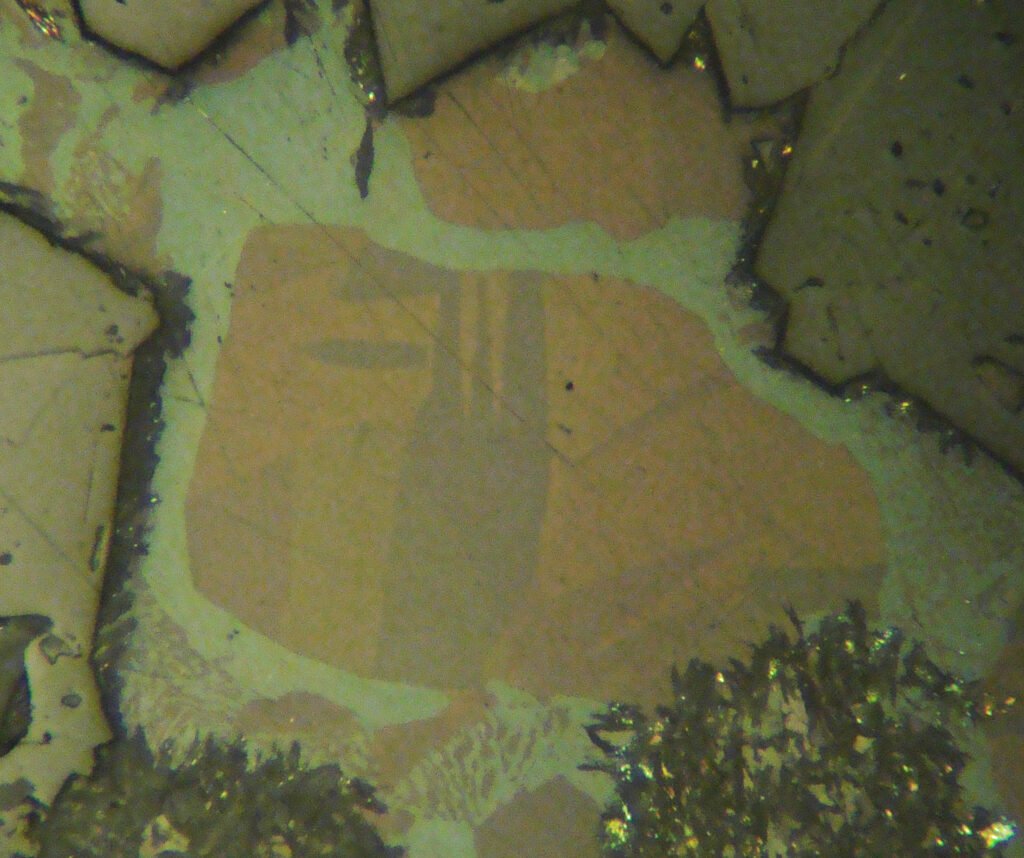
Isotropy / Anisotropy: Usually very weak anisotropy in very dark colors, often simulates isotropy when the aggregates are very fine-grained. In order to observe anisotropy, intense lighting is necessary; uncrossing the polarizers in 2º is useful to evaluate the behavior in CPL.
Sometimes the anisotropy allows individualizing grain boundaries and twins, other times the anisotropy is so weak that it is only detected through very careful observations.
Internal reflections: No.
May be confused with: few other minerals. In PPL, the color is extremely characteristic. Medium hardness with good polishing and rapid tarnishing to blue and violet are also very typical. Macroscopically, when tarnished, it can be confused with tarnished chalcopyrite.
Germanite is isotropic, lighter and very rare.
Pyrrhotite is much harder (worse quality polish, relief) and lighter.
Tenorite and delafossite are similar only when in small grains, larger grains show strong anisotropy and do not tarnish.
General Characteristics:
Grain shape: Bornite occurs almost exclusively in shapeless masses among other minerals in the ore. In some cases it is possible to observe that these are rounded grain aggregates. Grain size can be very small, submicroscopic, when bornite simulates isotropy in CPL. Well-formed crystals are extremely rare.
Cleavage can sometimes be recognized, but is usually not observable. These are the parallel cleavages at (100) and (111).
Air corrosion (clouding) occurs almost immediately after polishing, sometimes as early as in 15 minutes. The original reflection color changes initially to more red and then to a very characteristic violet, which can be in different degrees in the grains of the same polished section. Turbidity is faster in hand sample and slower in polished section. Bornites that occur together with other ore minerals tarnish more quickly than bornites that occur alone in gangue. Especially bornites interspersed with chalcocite tarnish very quickly.
Tarnish is the formation of a surface film and is different from cloudiness. Tarnish often occurs on sections that have not been properly cleaned or that have other defects and is markedly different depending on the grain cut section.
Twins are frequent, polysynthetic or orthogonal. These are usually lamellar growth twins or were formed by transformation of high-temperature bornite to low-temperature bornite. In some instances bornite does not show any twins. In very fine-grained aggregates, twins are also not observable. The second twins (111) seen in crystals macroscopically are seen in polished section only very rarely.
Zonation does not occur. In some cases the arrangement of inclusions suggests zoning.
Deformation occurs very rarely.
Cataclasis is rare and usually generates very fine fractures, which may be filled with chalcocite.
Substitutions are frequent. Bornite can be replaced by chalcopyrite, chalcocite, covellite, digenite and argentite. On the other hand, bornite replaces chalcopyrite, galena, pyrite, tetrahedrite, hematite, rammelsbergite, parkerite, pitchblende and biotite. Substitutions can follow crystallographic directions.
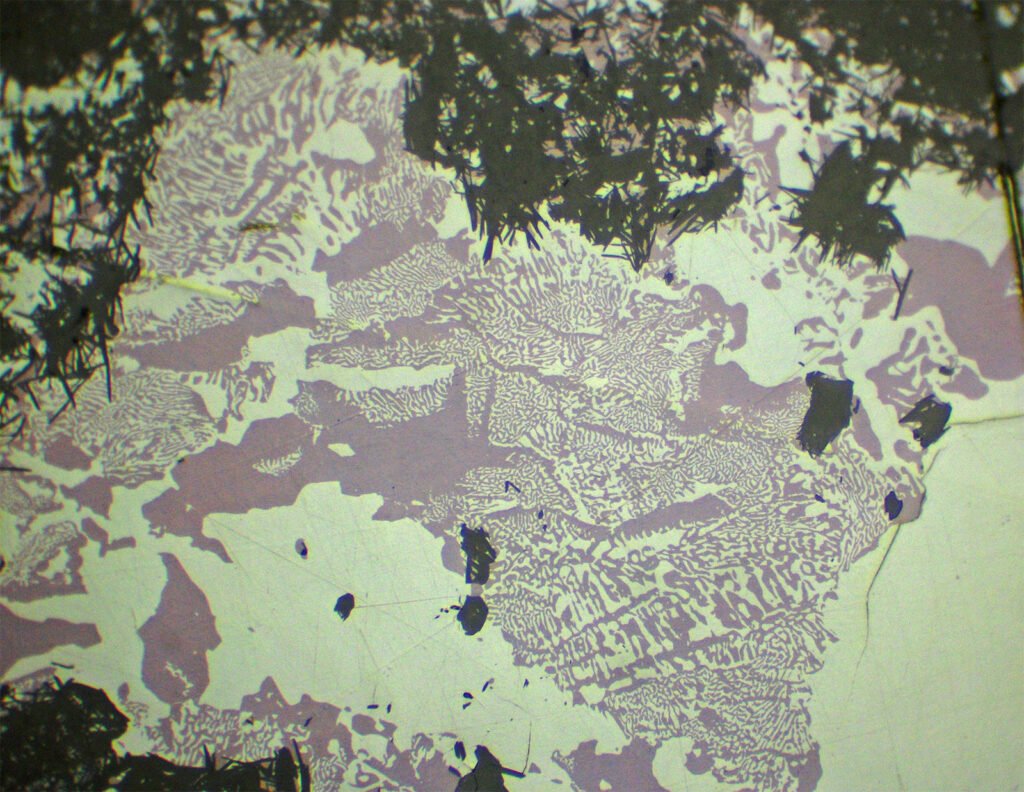
Intergrowths are common. Bornite can occur intergrown with chalcocite (forming very well-developed myrmekites or zigzag patterns), chalcopyrite (in the form of flames // to (100)), covellite, digenite, stromeyerite, “freibergite”, digenite, hematite (lamellae parallel to (111) bornite), magnetite, linnaeite, wittichenite, polybasite and pearceite. Probably several genetic processes can form very similar looking myrmekites. Textures resembling the “graphic texture” are also possible, but they can be so minute that they go unnoticed and bornite is considered homogeneous.
Inclusions, due to the many possibilities of substitution, are frequent. They can be made of cubanite, altaite, germanite, colusite, mawsonite, renierite, linnaeite, tetradymite, enargite, cobaltite, sphalerite, magnetite, coloradoite, hessite, sylvanite, melonite and stannite.
Rhythmic depositions of bornite with chalcopyrite form very well developed concentric structures, with the alternation of thin layers of chalcopyrite with varying contents of bornite, in addition to dendritic aggregates of bornite in the chalcopyrite.
Alteration of bornite generates a lamellar intergrowth of chalcopyrite and idaite. At a stage prior to the formation of idaite, bornite develops a typical texture, called “fracture disease” or “Sprungkrankheit”), which consists of the development of a network of fine fractures.
Bornites with excess S are slightly lighter in color than “normal” bornites and form elongated zones and layers within “normal” bornites.
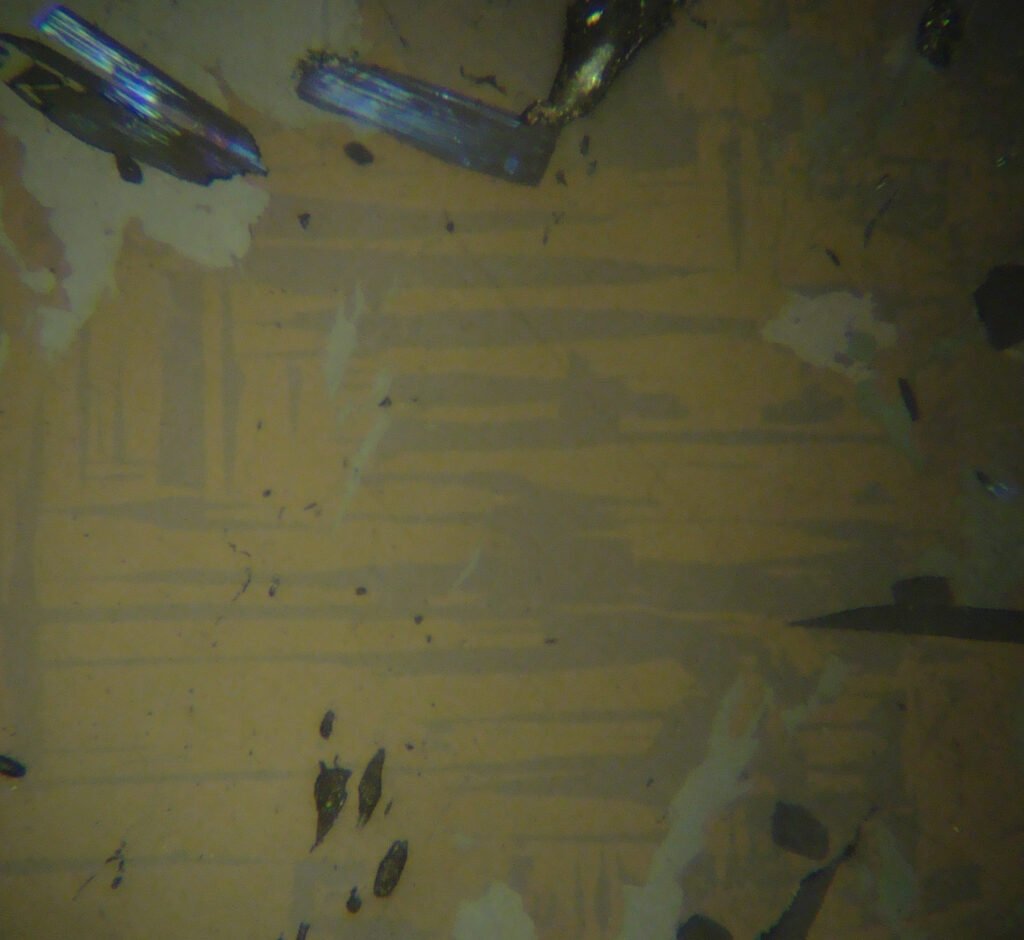
Unmixings are also common. If the bornite has undergone rapid cooling, the unmixings are oriented along the crystallographic planes of the bornite, for example a triangular pattern following the cleavages (111) of the bornite. If cooling was slow, the unmixings form a granular aggregate.
Chalcopyrite unmixings are frequent, in the form of lamellae and thin plates, more rarely of thick lenses, they can be fusiform, they can be arranged parallel to (100) of the bornite and they can present the form of “flames”. The lamellae often change shape, size and quantity in the bornite grains of the same sample. The “flames” are fusiform, relatively thick, that penetrate from intergranular edges and fractures into the bornite, very often arranged parallel to (100) the bornite. Several generations of chalcopyrite demixes can occur, arranged parallel to (100) and (111).
Chalcocite unmixings occasionally occur, in the form of very thin lamellae, only observable with the maximum magnification objective. Bornites with these chalcocite de-mixing nets fog up very quickly. Bornite demixes, on the other hand, only occur in chalcocite. In general, the intergrowths between bornite, chalcocite and chalcopyrite have many different appearances.