5. Reflected Light Microscopy
Sample preparation: Polishing bournonite is straightforward and yields sections of excellent quality, similar to galena. Despite its low hardness, polishing scratches can be completely eliminated. The polishing hardness of bournonite is slightly higher than that of galena. It is higher than that of boulangerite, jamesonite, and stibnite, and lower than that of sphalerite, chalcopyrite, and tetrahedrite.
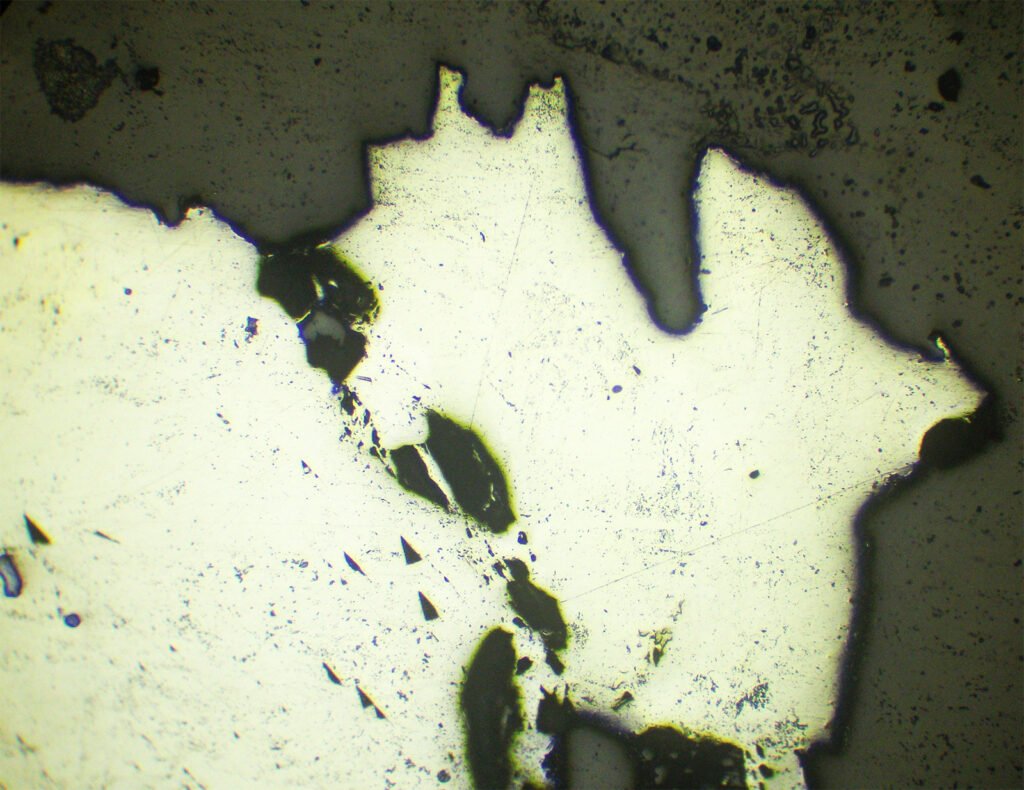
PLANE POLARIZED LIGHT – PPL
Reflection color: White, with a slight grayish or bluish-green tint.
Compared to the color of galena, bournonite is darker and more blue-green.
Compared to the color of tetrahedrite, bournonite is lighter and more bluish.
Compared to the color of boulangerite, bournonite is darker.
Pleochroism: Very weak, practically imperceptible. Sometimes it can be detected between adjacent grains, in twins, or when galena is present alongside.
Reflectivity: 33.33 – 35.23%
Bireflectance: No.
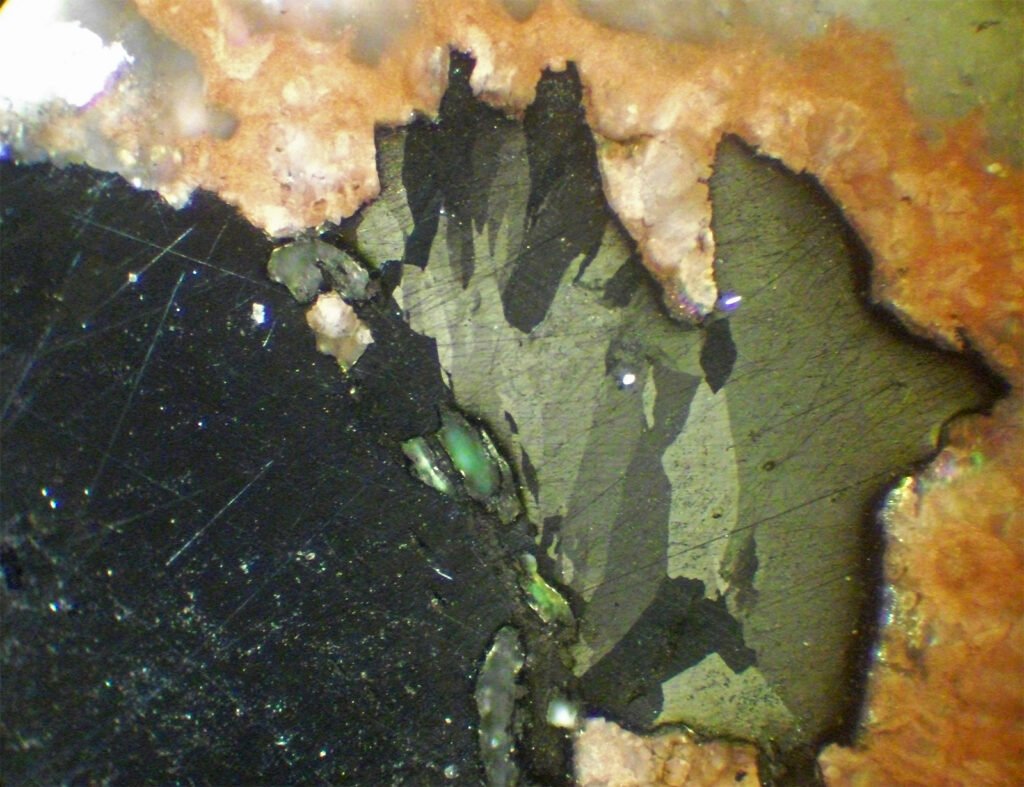
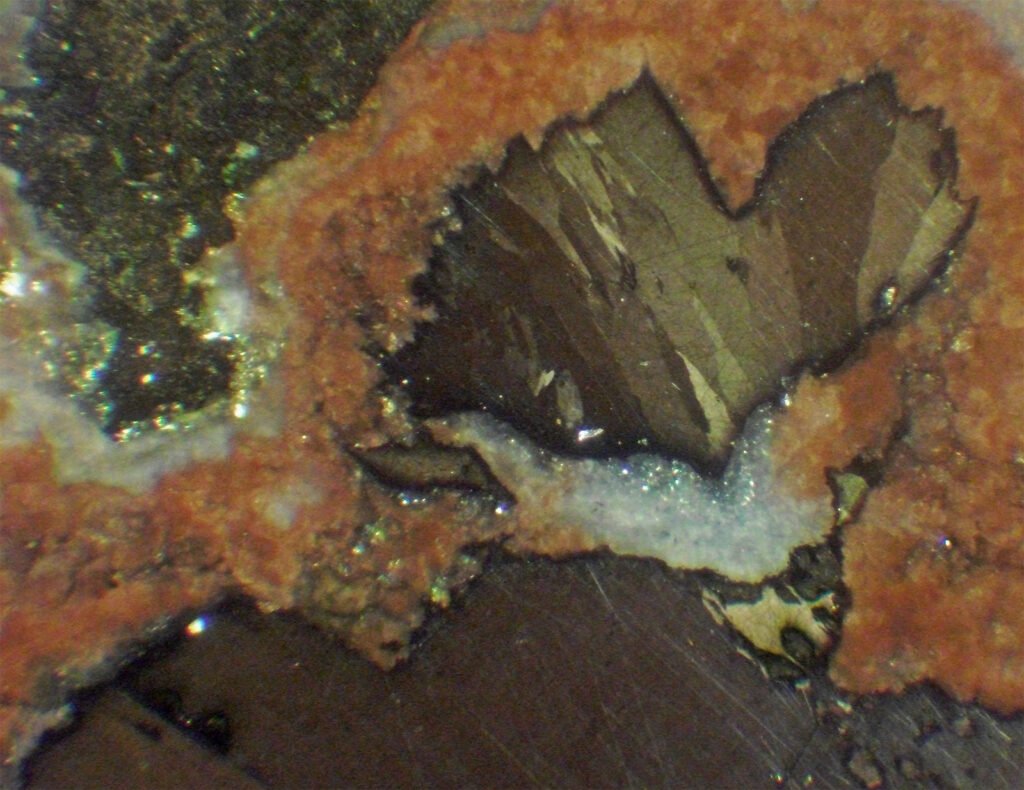
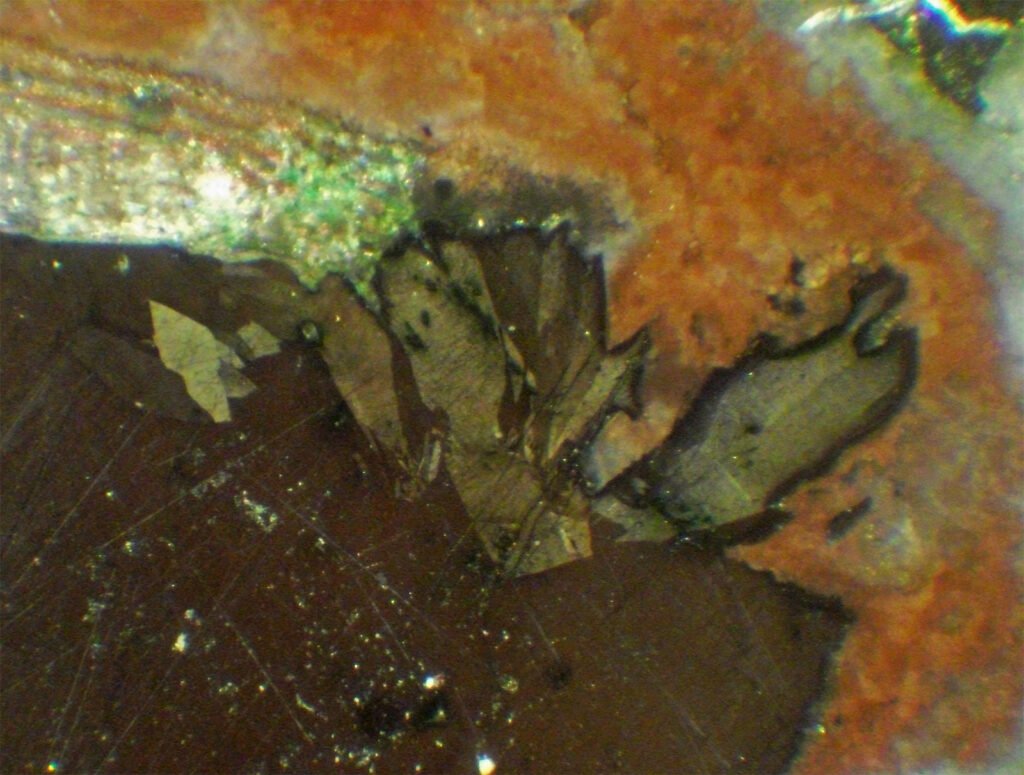
CROSSED POLARIZED LIGHT – XPL
Isotropy / Anisotropy: Weak anisotropy ranging from blue-green to violet. This observation should be made at grain boundaries, and uncrossing the nicols by 2° is useful.
Internal reflections: Very rare or absent; not diagnostic.
May be confused with: many other minerals, as it is an inconspicuous mineral.
Galena is white and isotropic.
Stibnite exhibits stronger pleochroism and anisotropy.
Boulangerite lacks twinning and has an isometric habit.
Tetrahedrite-tennantite are olive-brown and isotropic.
Chalcostibite is darker.
Wolfsbergite is lighter.
Other minerals with similar colors exhibit different habits.
General Characteristics:
Grain shape: When occurring in aggregates, the grain shape consists of highly interlocking polygonal grains. In this instance, the grains are subparallel. Crystals found in cavities can be large.
Cleavage is not visible in bournonite sections.
Polishing scratches are either absent or minimal—provided the polishing was well executed—contrasting with galena, a similar mineral that almost invariably displays such scratches.
Lamellar twinning on (110) is a constant, common, and highly characteristic diagnostic feature. Small grains exhibit isolated lamellae, whereas larger grains develop polysynthetic twinning in two directions. In basal sections, these twins intersect at approximately 90°, often creating a grid-like (checkerboard or parquet) pattern. They may appear deformed.
Cataclasis occurs, but bournonite recrystallizes easily.
Inclusions: rounded bournonite inclusions typically occur within galena, as well as in ullmannite and bornite. In galena, they can be very small (a few microns); larger inclusions are rounded and may be rimmed by tennantite-tetrahedrite.
Inclusions within bournonite may consist of boulangerite, galena, and chalcopyrite.
Replacements 1: Bournonite replaces galena, pyrargyrite, pyrite, arsenopyrite, chalcopyrite, and meneghinite.
Replacements 2: Bournonite is replaced by galena, tetrahedrite-tennantite, covellite, and famatinite. These replacements may follow a sequence of increasing lead content: tetrahedrite-tennantite to bournonite to jamesonite to boulangerite and finally to galena.
Myrmekitic intergrowths of bournonite with galena may occur.
Reaction rims involving bournonite can form between tetrahedrite-tennantite, chalcopyrite, geocronite, and galena; also between chalcopyrite and boulangerite, and between chalcopyrite and chalcostibite.
Incipient alteration initially produces chalcocite and subsequently covellite.
Alteration of geocronite can yield a mixture of bournonite, jamesonite, and galena.