BRAUNITE
Braunite – Mn2+Mn3+6[O8|SiO4] -, also called braunite-1 or heteroclase, is a relatively common nesosilicate, a component of oxidized Mn mineral deposits.
It is classified in the Braunite Group, forms a series with abswurmbachite, and is the Mn2+ analog of neltnerite. Braunite generally contains impurities such as Fe, Ca, B, Ba, Ti, Al, and Mg. A variety with Ca and Fe, called braunite-2 (Ca(Mn3+,Fe3+)14SiO24), was discovered and described in 1967 in Kalahari, Cape Province, South Africa.
Braunite is very weakly magnetic and exhibits a very weak reaction with H2O2 (hydrogen peroxide).
1. Characteristics
Crystal system: Tetragonal, ditetragonal bipyramidal.
Color: Blackish brown, steel gray
grayish black.
Habit: Dense granular or massive with overgrown crystals. Pyramidal or pseudo-octahedral crystals up to 5 cm.
Cleavage: {112} perfect. Striations on {001} and {201}, parallel to {010}.
Tenacity: Brittle.
Twinning: On {112}.
Fracture: Irregular to subconchoidal.
Mohs Hardness: 6 – 6.5
Parting: No.
Streak: Black with a brown tint.
Lustre: Submetallic to metallic.
Diaphaneity: Opaque.
Density (g/cm³): 4.72 – 4.83
2. Geology and Deposits
Braunite generally occurs as a product of metamorphism at high temperatures and, in part, under high pressure, from silicates and oxides and Mn.
It is not uncommon in veins of Mn ores formed under very low temperatures.
It can form with magmatic recrystallization in pegmatitic granites.
It often occurs in contact metasomatism or contact metamorphism environments.
It also forms by regional metamorphism.
Braunite can occur as a product of weathering.
3. Mineral Associations
It is associated with common gangue minerals such as quartz, calcite, and barite.
It naturally occurs with several other Mn minerals such as cryptomelane, pyrolusite, manganite, jacobsite, hausmannite, bixbyite, rhodonite, namansilite, crednerite, and hollandite.
Also with garnets (spessartine, andradite), piedmontite, winchite, magnetite, and hematite.
4. Transmitted Light Microscopy
This does not apply, as braunite is completely opaque.
5. Reflected Light Microscopy
Sample preparation:
Braunite takes on a good polish, but only with careful and slow preparation, as its hardness is very high. Its hardness on polish is:
– higher than the hardness of hematite and manganite,
– slightly higher than the hardness of magnetite,
– approximately equal to the hardness of hausmannite,
– slightly lower than the hardness of pyrite and bixbyite.
The polish varies slightly between sections parallel to [001] and those perpendicular to [001].
PLANE POLARIZED LIGHT – PPL
Reflection color: Grayish white with a brownish tint.
Compared to the color of magnetite, the color of braunite is very similar, but with a less distinct brown hue and without reddish tones.
Compared to the color of pyrolusite, the color of braunite is much darker.
Compared to the color of psilomelane, the color of braunite is darker.
Compared to the color of manganite and hausmannite, the color of braunite is very similar, but the bireflectance is much weaker.
Compared to the color of bixbyite, the color of braunite is a pure gray, without a yellowish tint.
Compared to the color of jacobsite, the color of braunite is grayer and does not show the yellowish or olive tints typical of jacobsite.
Compared to the color of galena, the color of braunite is very similar under weaker lighting.
Pleochroism: No.
Reflectivity: 18.4 – 19.3%
Bireflectance: Soft, in shades of dark gray.
CROSSED POLARIZED LIGHT – XPL
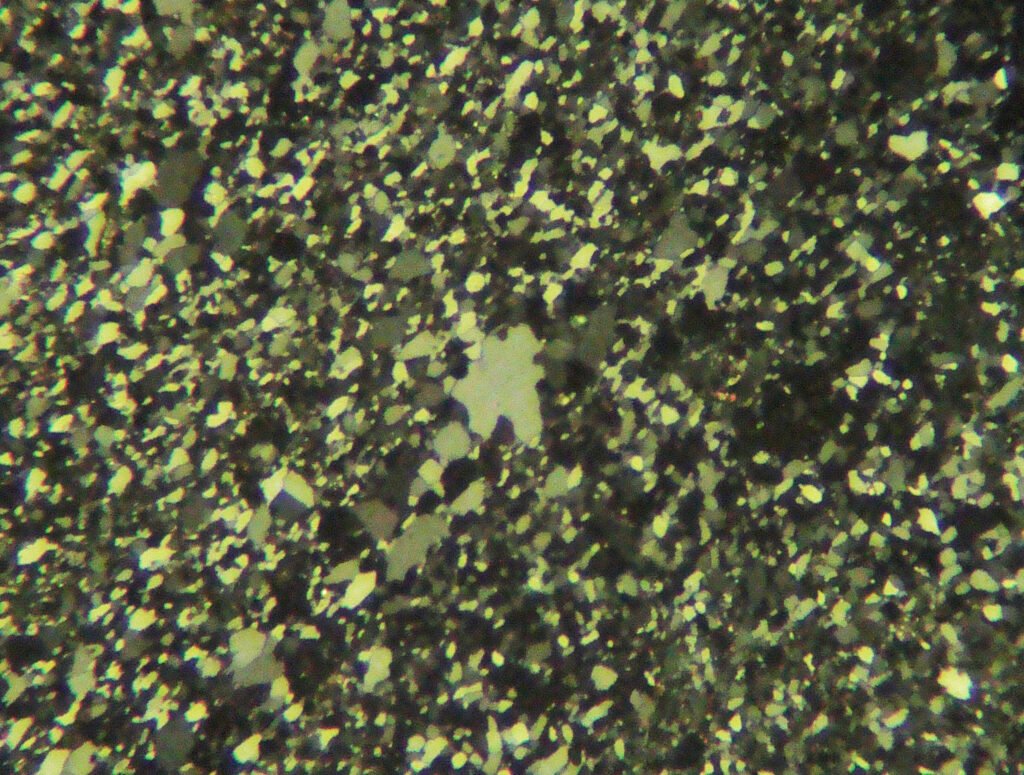
Isotropy / Anisotropy: Very weak, but distinct, anisotropy between light bluish gray and dark bluish gray (“dark to lighter slate gray”).
Other literature refers to grays with olive to brownish hues. Or to brownish-blue gray (“slate blue”).
Ondulating extinction is often characteristic!
Internal reflections: Internal reflections in dark brown to deep red are observed only in very rare cases, much more rarely than in hausmannite, manganite, and jacobsite.
May be confused with: Braunite is quite difficult to identify.
It is especially easy to confuse it with hausmannite, manganite, jacobsite, and magnetite.
Hausmannite exhibits many lamellar twins, strong anisotropy, and more frequent internal reflections.
Manganite is strongly anisotropic and exhibits internal reflections more frequently.
Jacobsite is isotropic, also exhibits internal reflections rarely, but they are deep red, not brown. Furthermore, it is magnetic.
Magnetite is magnetic and isotropic.
Sitaparite is very similar, but somewhat yellowish; its anisotropy is always distributed in patches within the individual crystals.
General Characteristics:
Grain shape: generally occurs in compact or finely granular masses. The grains are either idiomorphic pseudo-octahedral or form polygonal aggregates with subhedral tendencies (hypidiomorphic). In cavities, crystals with pseudo-octahedral habit occur with (111), frequently (001) and rarely (421). The grains are generally microscopic, rarely up to 1 cm, at most 5 cm. Sometimes the grains are internally less compact, frequently porous and only “clean” at their periphery. In these cases, they can be replaced from the inside out by pyrolusite.
Cleavage cannot be recognized in polished sections.
Twins according to (112) are rare and are not lamellar, both in aggregates and in isolated crystals.
Inclusions of braunite in hausmannite have a similar origin to porphyroblasts of other minerals. The braunite of typical contact rocks contains inclusions of many other minerals. Other minerals that occur as inclusions in braunite are jacobsite, hollandite, and remnants of bixbyite that braunite has replaced.
Myrmekites of hausmannite with braunite can occur. When hausmannite and braunite occur together, braunite is usually more idiomorphic, but the reverse also occurs.
Exsolutions of pyrolusite, arranged parallel to (001), are common. It is an alteration product.
Intergrowths of braunite occur with hematite, bixbyite, and pyrolusite.
Substitutions 1: braunite can be replaced by pyrolusite, which is very common. Other minerals that replace braunite are hausmannite and psilomelane.
Substitutions 2: braunite replaces bixbyite and hollandite along their cleavage planes. It also replaces hematite.
Unmixings parallel to [001], now consisting of pyrolusite, occur with some frequency.
Zoning was not observed, but in patches and perhaps in zones the colors are somewhat different, as well as there are somewhat different extinctions in points and lines.