5. Reflected Light Microscopy
Sample preparation: Breithauptite exhibits high polishing hardness and achieves a very good polish, behaving approximately similarly to nickeline.
Its hardness is lower than that of safflorite, rammelsbergite, arsenopyrite, and eskuterrudite, and significantly lower than that of cobaltite.
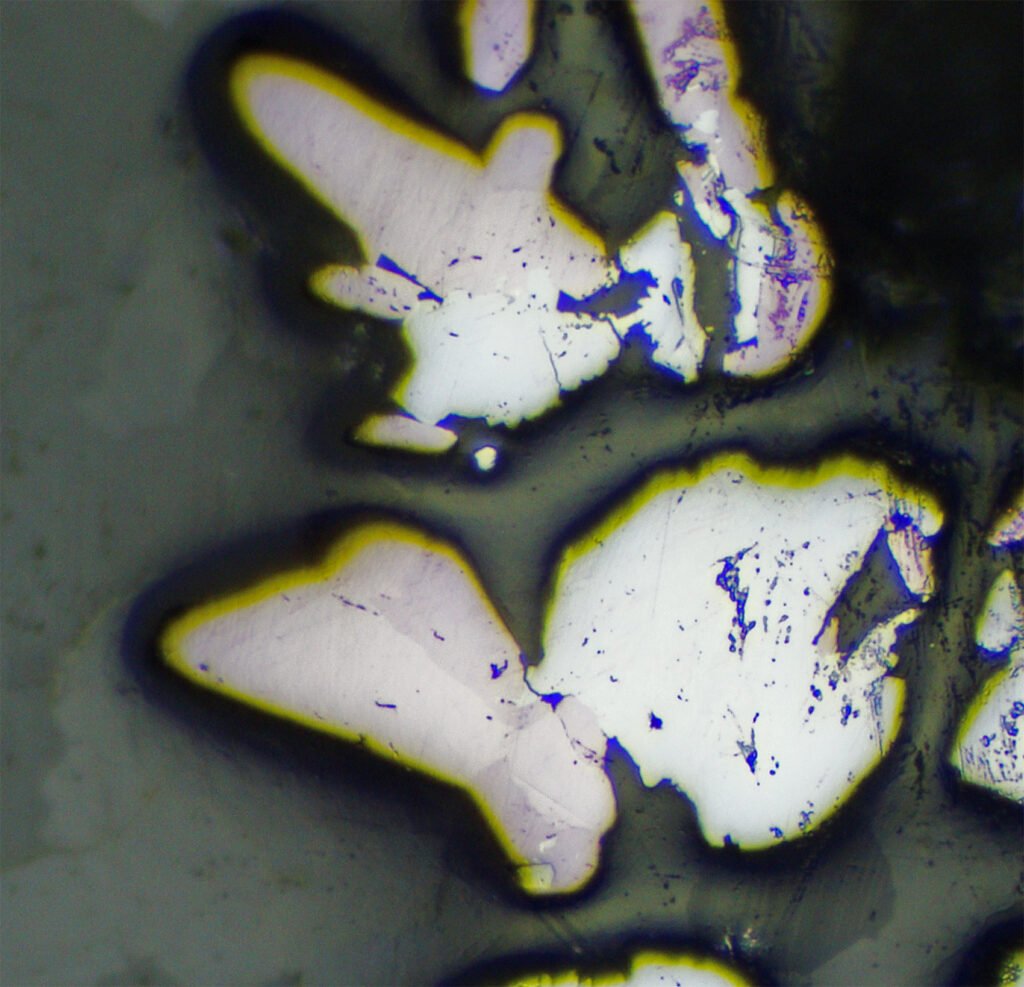
PLANE POLARIZED LIGHT – PPL
Reflection color: Pale copper-red (or intense pink) with a violet tint. Very characteristic and easy to observe.
Compared to the color of niqueline, the color of breithauptite is more colorful, darker, and with a violet hue.
Compared to the color of native copper, the color of breithauptite exhibits much lower reflectivity and fewer fine polishing scratches.
Pleochroism: Strong, ranging from yellow-red to light pink to pinkish-violet.
Reflectivity: 47,82 – 54,39%.
Bireflectance: from reddish-pink to violet.
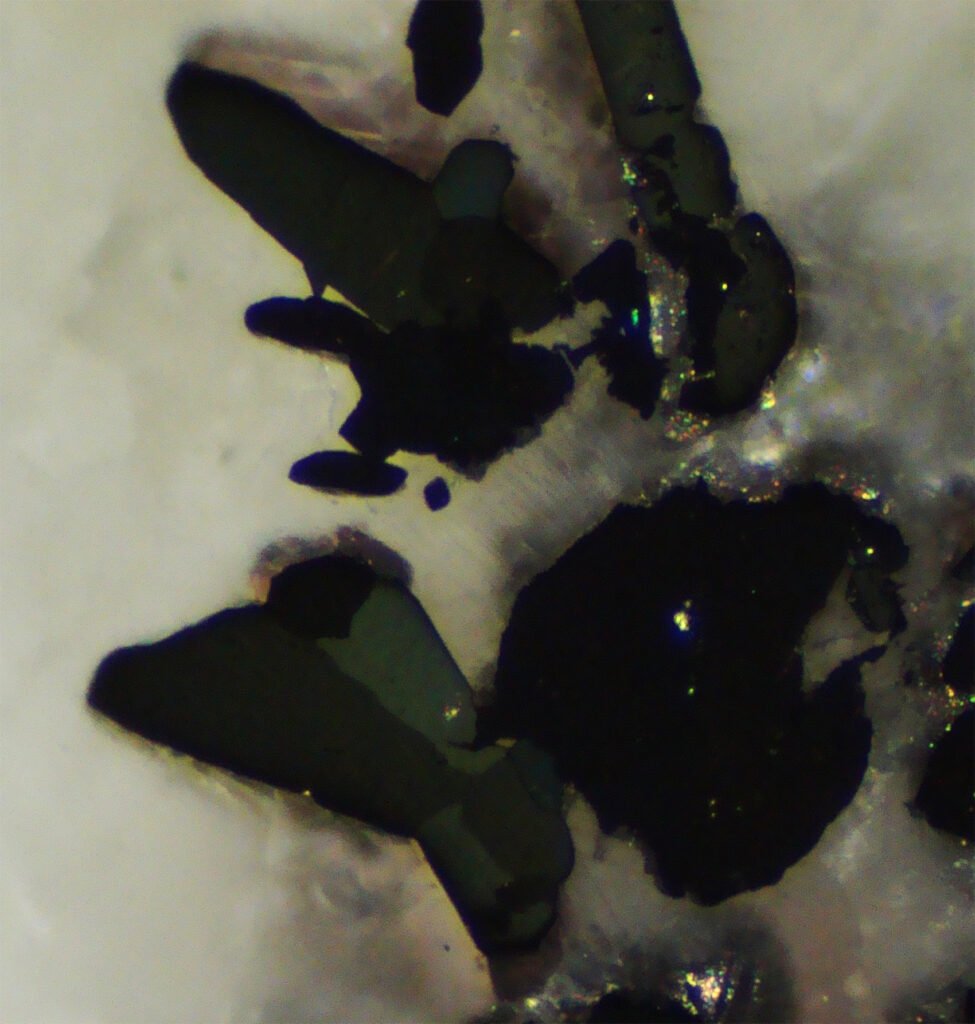
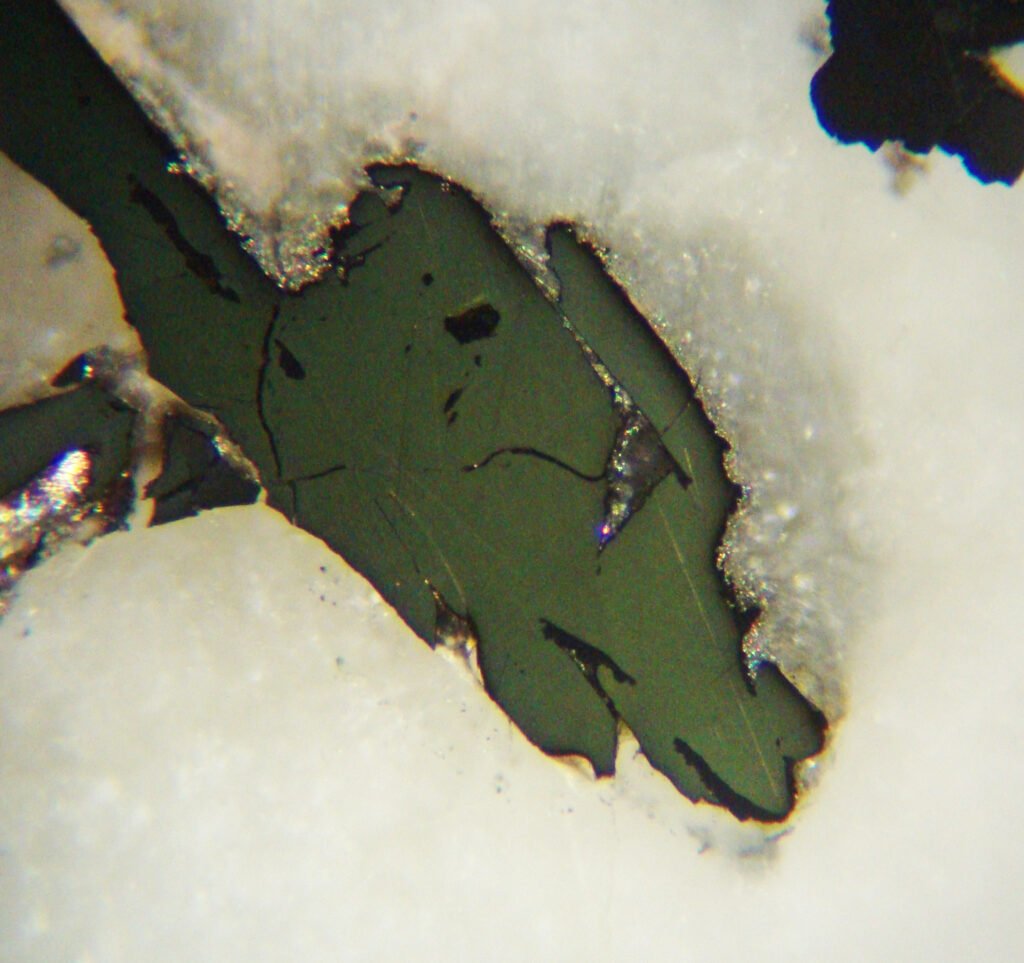
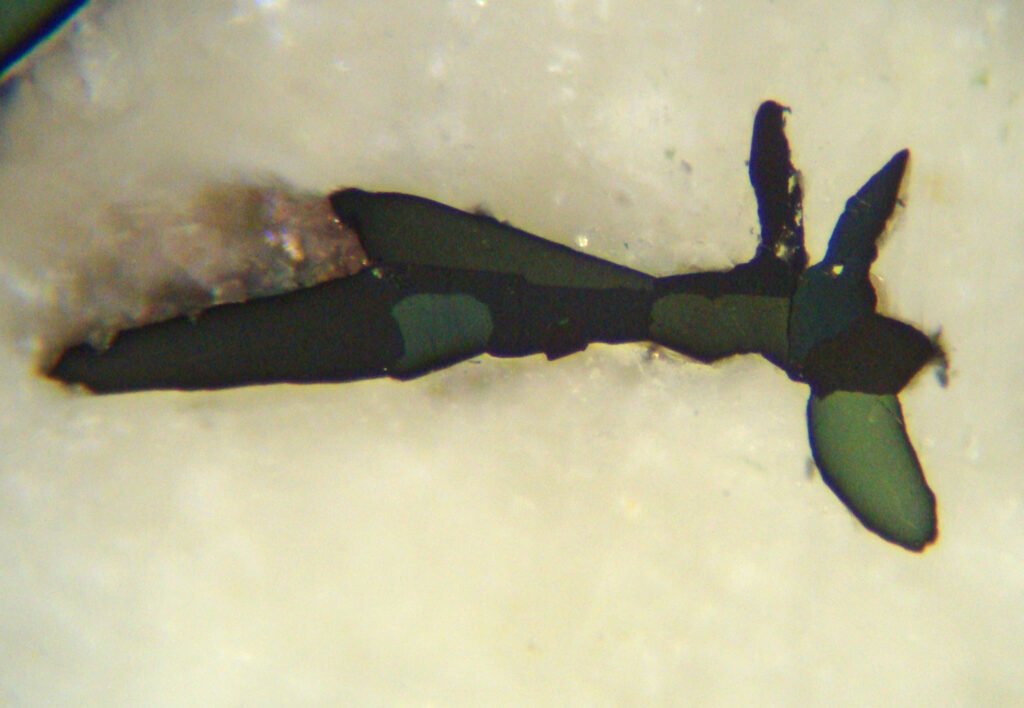
CROSSED POLARIZED LIGHT – XPL
Isotropy / Anisotropy: Anisotropia muito notável, com cores muito vivas e intensas: de oliva para marrom, tonalidades esverdeadas, verde intenso, cinza-azulado, verde-amarelado, verde-azulado a violeta-vermelho.
Internal reflections: No.
May be confused with: Few other minerals. Breithauptite is easily recognized even in unusual parageneses.
Nickeline is similar, especially in sections parallel to (0001), where the violet color does not appear, but nickeline is more orange. Nickeline exhibits weaker pleochroism and anisotropy.
Violarite is similar, but does not exhibit any type of zoning.
Freboldite is similar, but restricted to parageneses with Se.
General Characteristics:
Grain shape is generally anhedral granular. It can be euhedral, acicular, or tabular. Sometimes the grain size in the same sample varies greatly; they may all be anhedral.
Twinning is not present.
Cleavage is not present.
Zoning is very common, probably related to varying NiAs contents, through reflection pleochroism or by differentiated anisotropy effects: cores of more intense colors and edges of paler colors. Mainly in sections parallel to (0001) the zoning can be very evident. Sometimes the zoning is due to inclusions.
Zoning with nickeline is frequent, forming alternating bands of breithauptite and nickeline.
Inclusions of breithauptite, tiny and rounded, can occur in galena. Breithauptite inclusions can also occur in pentlandite, chromite, and safflorite.
Unmixings were not observed.
Deformations generate only cataclasis.
Substitutions: may be replaced by silver ores.
Rims of ullmannite, thin and white, may be present.
Substitutions 1: Breithauptite replaces safflorite.
Substitutions 2: Breithauptite is replaced by native silver, niquelite, Ag minerals, and safflorite.
Intergrowths of breithauptite occur with pyrrhotite.