1. Characteristics
Crystal system: Orthorhombic bipyramidal.
Color: Black, brown, yellowish-brown, reddish-brown, yellow, orange, red.
Habit: Tabular, pyramidal, prismatic, granular,
pseudo-hexagonal. Crystals up to 12 cm.
Cleavage: {120} poor, {001} in traces, Striations paralell to the elongation.
Tenacity: Brittle
Twinning: {120} uncertain.
Fracture: Subconchoidal to irregular.
Mohs Hardness: 5.5 – 6
Parting: No.
Streak: White, gray, or yellowish.
Lustre: Submetallic, metallic, adamantine, vitreous.
Diaphaneity: Transparent.
Density (g/cm³): 4.08 – 4.18
2. Geology and Deposits
Brookite occurs as an accessory mineral in some igneous and metamorphic rocks, but there it is usually of secondary origin. It occurs in low-temperature hydrothermal veins of the Alpine type in gneisses and schists. It can occur in contact metamorphic zones.
It forms secondarily, by alteration of ilmenite, integrating the “leucoxene,” a mixture of several minerals, mainly rutile and pseudorutile. Brookite is not always present in the “leucoxene,” but it can be one of the phases present.
It is a common detrital mineral in beach sands, in gold and diamond placers, as well as in sedimentary rocks (sandstones).
It can be authigenic in sediments and is occasionally found near hot springs.
3. Mineral Associations
It occurs with common rock-forming minerals such as quartz, orthoclase (adularia), albite, titanite, chlorite (clinochlore), and muscovite.
It also occurs with other TiO2 polymorphs (anatase, rutile) and with titanite.
In addition, with axinite, lorenzonite, hematite, pyrite, chalcopyrite, and calcite.
4. Transmitted Light Microscopy
Refraction indices: nα: 2,583 nβ: 2,584 nγ: 2,700
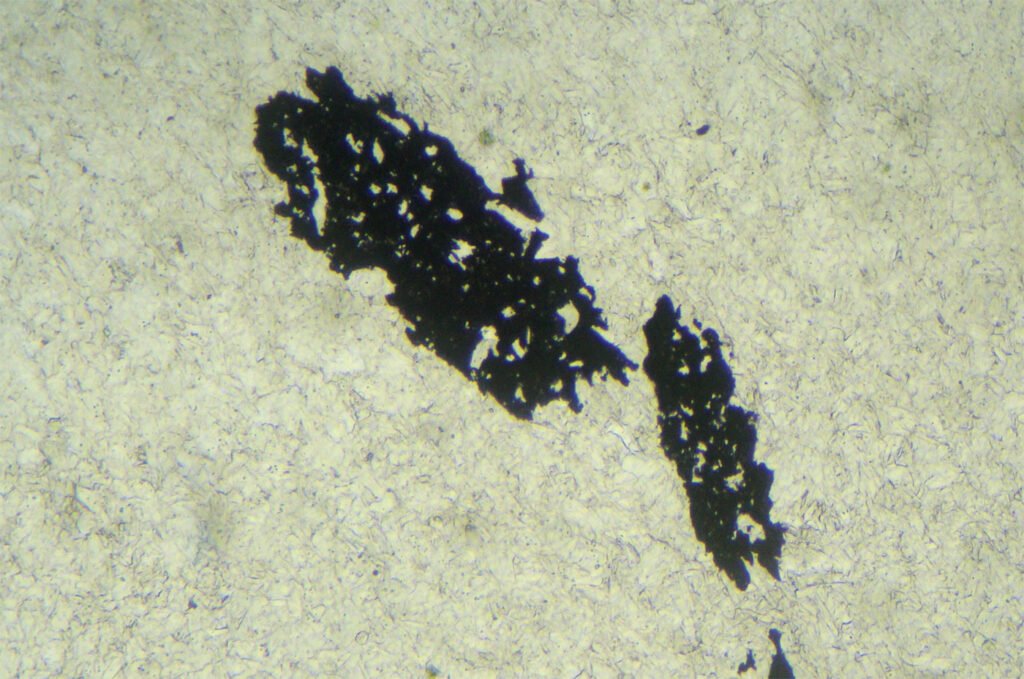
PLANE POLARIZED LIGHT – PPL
Color / Pleochroism: Yellowish-brown to dark brown with very weak pleochroism ranging from yellowish, reddish, orange to brown.
Deep-colored crystals can be mistaken for opaque crystals in thin section!
Relief: Very high.
Cleavage: {120} bad and {001} in traces, are not visible under a microscope.
Habits: Tabular, pyramidal, prismatic, granular, pseudohexagonal.
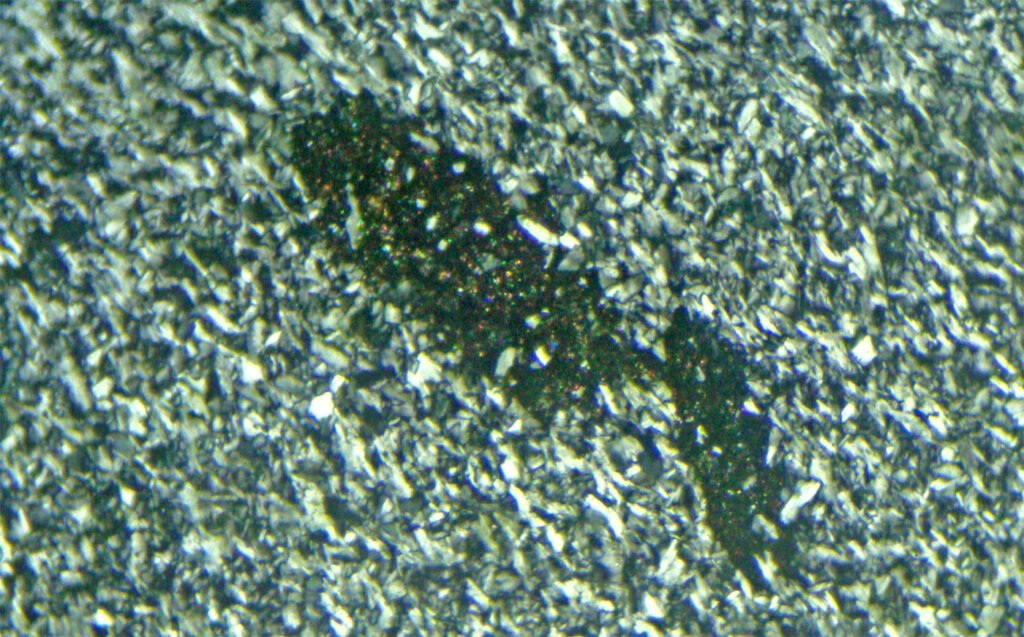
CROSSED POLARIZED LIGHT – XPL
Birefringence and Interference Colors: Maximum birefringence of 0.117: colors up to the 6th order (pearlescent colors that are difficult to define).
Extinction: Paralell.
Elongation sign: No information available.
Twins: No.
Zoning: In hand specimens, zoning may be present. Cores that are darker than the edges are the most common zoning.
CONVERGENT LIGHT
Character: B(+), can simulate being uniaxial.
2V angle: 0 – 28º or 0 – 30º
Alterations: alters to rutile, mainly.
May be confused with: Several other minerals, including other polymorphs of TiO2.
Anatase is very similar, theoretically exhibiting better cleavage, difficult to see in small grains.
Goethite can be very similar, but its colors tend more towards orange-red.
Pseudobrookite has a larger 2V angle.
Rutile generally has a different habit, but can be similar. It exhibits better cleavage and is U(+), but may have a small 2V angle.