1. Characteristics
Crystal system: Trigonal.
Color: White, greenish, blue, gray, honey yellow to red-brown and deep brown (when with Mn).
Habit: Tabular, fibrous, massive, foliate masses and rosettes.
Cleavage: {0001} perfect.
Tenacity: Sectile. Plates are flexible. Fibers are plastic.
Twinning: No.
Fracture: Irregular, fibrous, micaceous.
Mohs Hardness: 2.5 – 3
Parting: No.
Streak: White.
Lustre: Greasy, pearly.
Diaphaneity: Transparent.
Density (g/cm³): 2.39
2. Geology and Deposits
Brucite occurs as a product of alteration of periclase (MgO) in marbles formed by metamorphism on dolomitic limestones, in brucite-marbles (pencatite, predazzite). Also in magnesian scorns.
Furthermore, it occurs in low-temperature hydrothermal veins, in metamorphic limestones (marbles) and in chlorite-schists. Also in serpentinites, by serpentinization of dunites.
In concrete and cement with excess Mg, brucite neoformation occurs, causing problems.
3. Mineral Associations
In serpentinized ultramafic rocks it occurs with magnetite, chromite, nepheline, chlorite, serpentine, talc and chrysotile.
In dolomitic marbles and magnesian skarns, it is associated with carbonates (calcite, aragonite, dolomite, magnesite, hydromagnesite), wollastonite, forsterite, spinel, minerals from the Humite Group and periclase.
It also occurs with rare minerals such as sturmanite, ettringite, pyroaurite, jouravskite and artinite.
Also with quartz, manganite and anhydrite.
4. Transmitted Light Microscopy
Refraction indices: nω: 1.560 – 1.590 nε = 1.580 – 1.600
The indices increase with the increase of Fe and Mn contents.
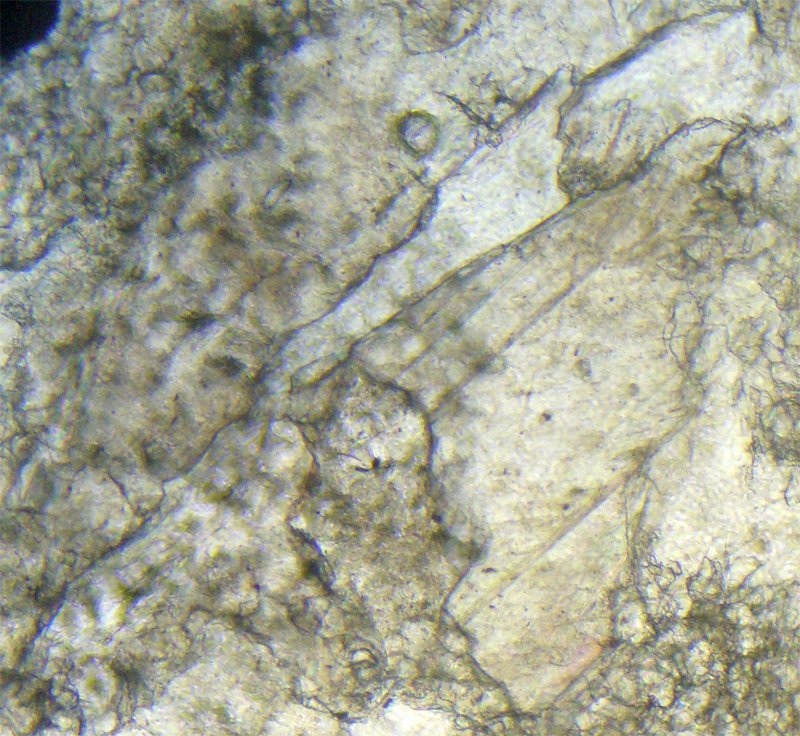
PLANE POLARIZED LIGHT – PPL
Color / Pleochroism: Colorless. Never shows pleochroism.
Relief: Moderate.
Cleavage: Perfect on {0001}.
Habits: Usually forms foliate or spiral masses. It can be tabular, micaceous, massive or fibrous. Fibrous brucite occurs around periclase grains, marking the beginning of periclase change.
In marbles it forms pseudomorphs (cubic, octahedral) on periclase.
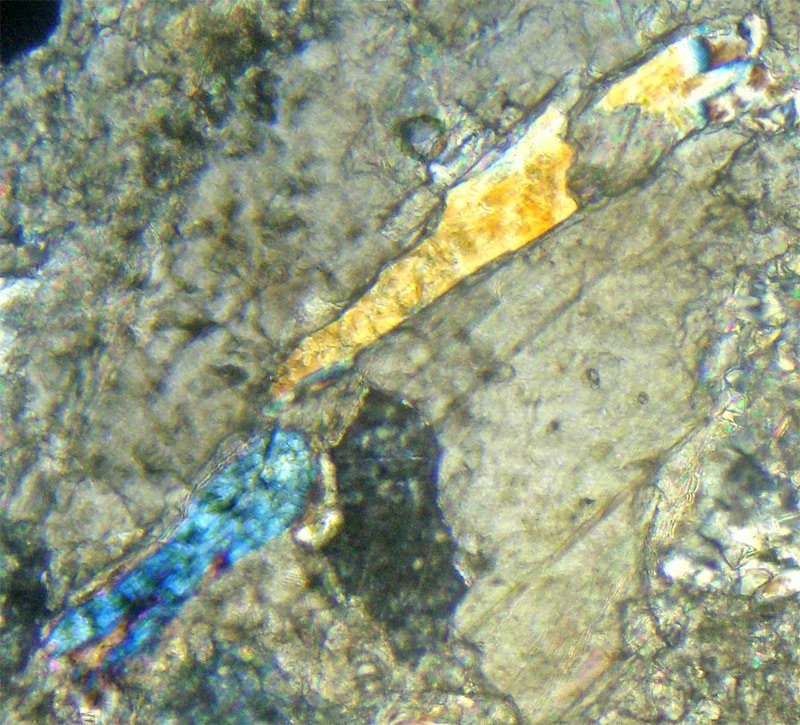
CROSSED POLARIZED LIGHT – XPL
Birefringence and Interference Colors: Birefringence between 0.010 and 0.020: colors up to the end of the 1st order: grey, yellow, orange, red, purple and deep blue.
When in fibers, it presents gray colors like serpentine.
It can present anomalous colors of up to 2nd order, can be red-brown or blue of 1st order.
Extinction: Parallel and mottled.
Elongation sign: ES(-). Important, because micas, talc and pyrophyllite have positive elongation sign!
Twins: No.
Zoning: No.
CONVERGENT LIGHT
Character: U(+), may be biaxial. Due to the tiny size of the grains, the figure is difficult to obtain.
2V angle: there may be, anomalous, small.
Alterations: is usually a product of alteration.
Magnesite can be partially altered to brucite.
Olivine, when it undergoes serpentinization, changes to serpentine, brucite, talc and carbonates.
Brucite, on the other hand, easily alters to hydromagnesite and sometimes serpentine, periclase, and other Mg-containing minerals.
May be confused with: other micas, so it is important to consider the paragenesis of the rock.
Talc, muscovite and pyrophyllite are very similar, but their interference colors are more intense, they are biaxial and have ES(+). This last feature is very important for differentiation.
Gypsum has lower interference colors, is biaxial, and has low relief.
Chlorite usually presents in PPL slightly greenish colors.
Serpentine is almost indistinguishable from brucite of fibrous habit and low interference colors (grays), but serpentine (=antigorite) has low relief.