5. Reflected Light Microscopy
Sample preparation: Chalcostibite is easy to polish and takes an excellent polish. Its polishing hardness is intermediate—greater than that of bournonite and native silver, and slightly lower than that of chalcopyrite and sphalerite.
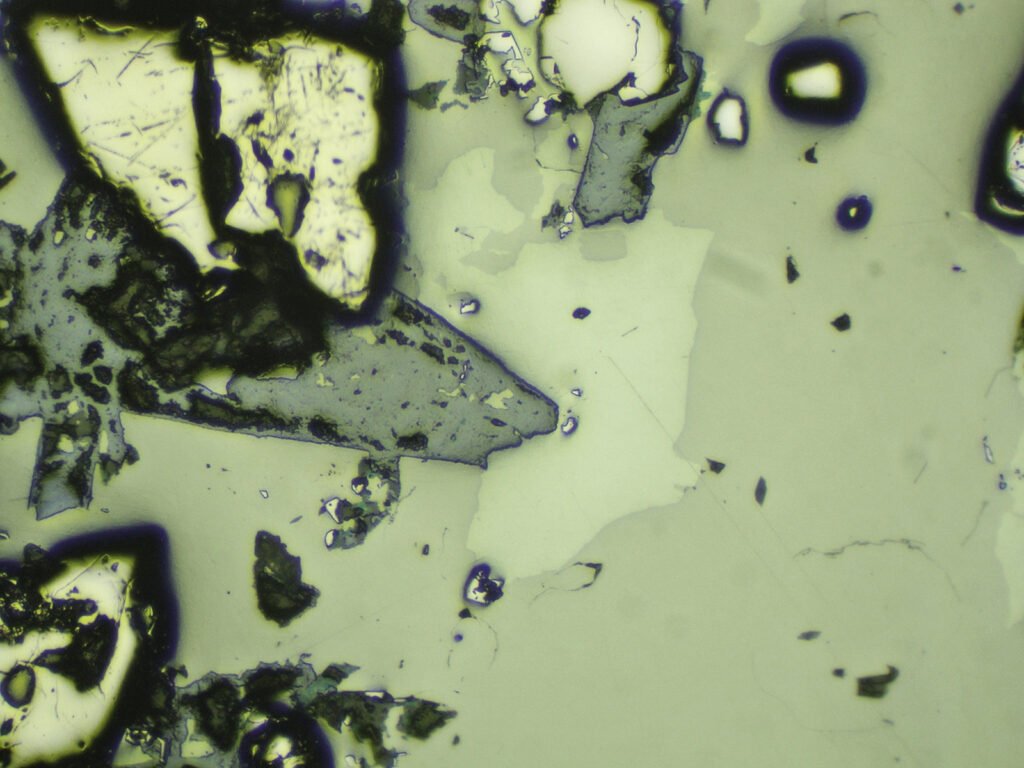
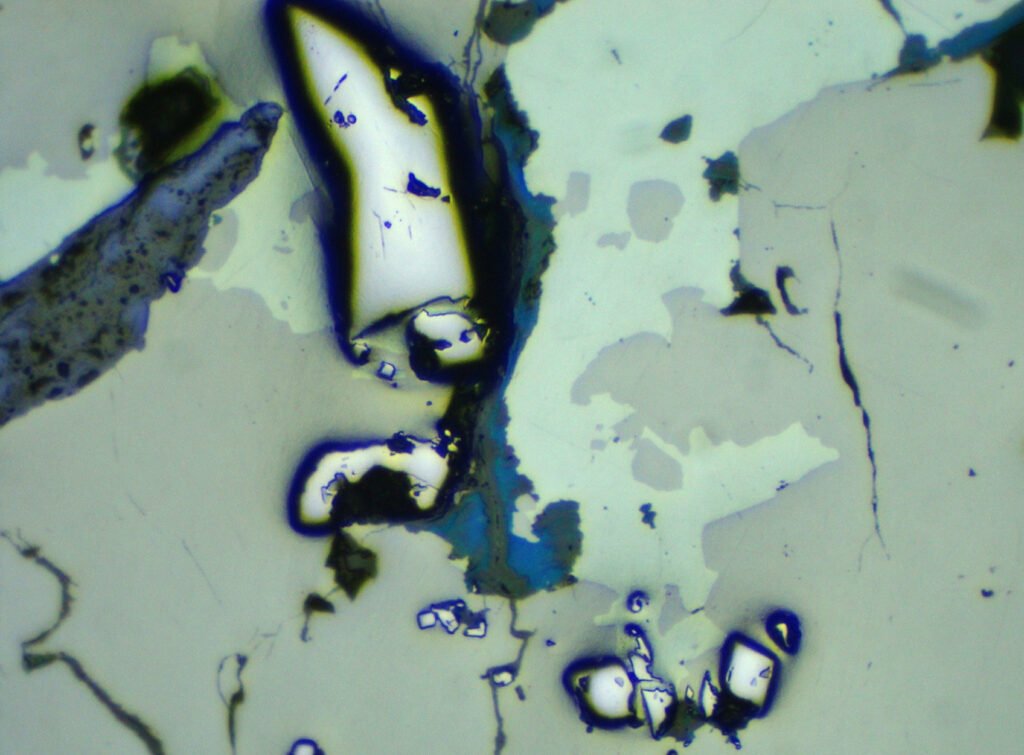
PLANE POLARIZED LIGHT – PPL
Reflection color: Bluish-gray or pinkish-gray. The color is also described as “white with a pinkish-gray tint.” The pinkish hue is very characteristic.
Compared to the color of bournonite, the color of chalcostibite is lighter and less pinkish.
Compared to the color of galena, the color of chalcostibite is darker and more yellowish-gray.
Compared to the color of native silver, the color of chalcostibite is grayish and darker.
Compared to the color of sphalerite, the color of chalcostibite is pinkish.
Compared to the color of tetrahedrite, the color of chalcostibite is distinctly lighter and slightly more bluish.
Pleochroism: Very weak. Even at intergranular boundaries it is difficult to see.
Reflectivity: 35.18 to 40.46%
Bireflectance: No.
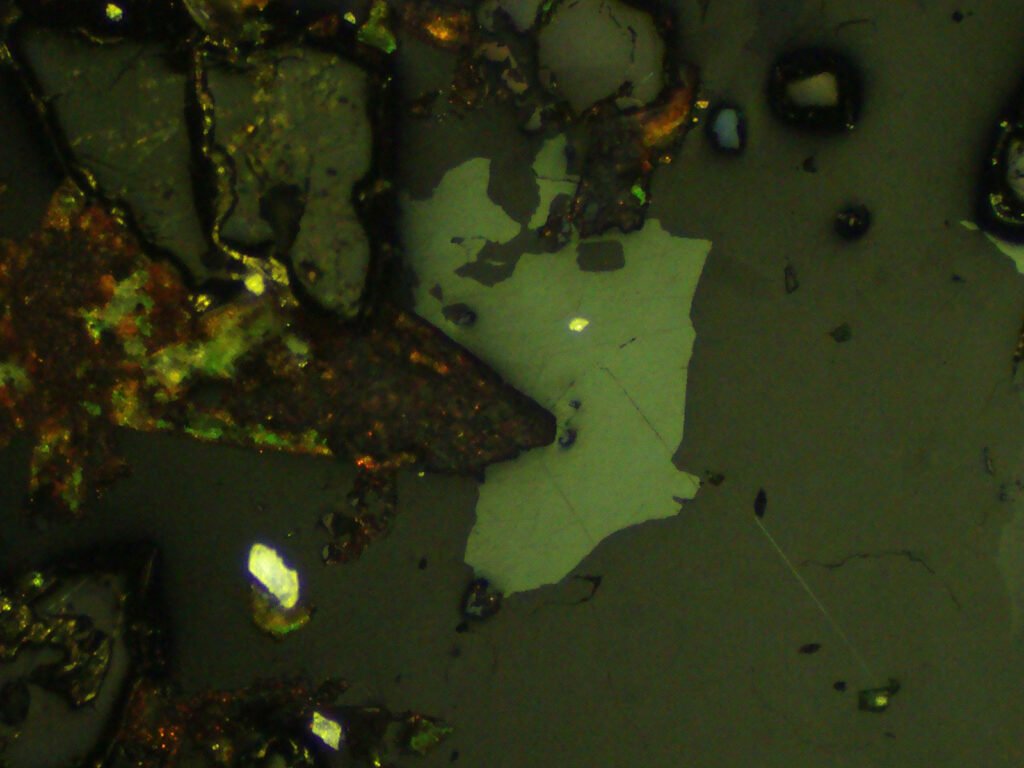
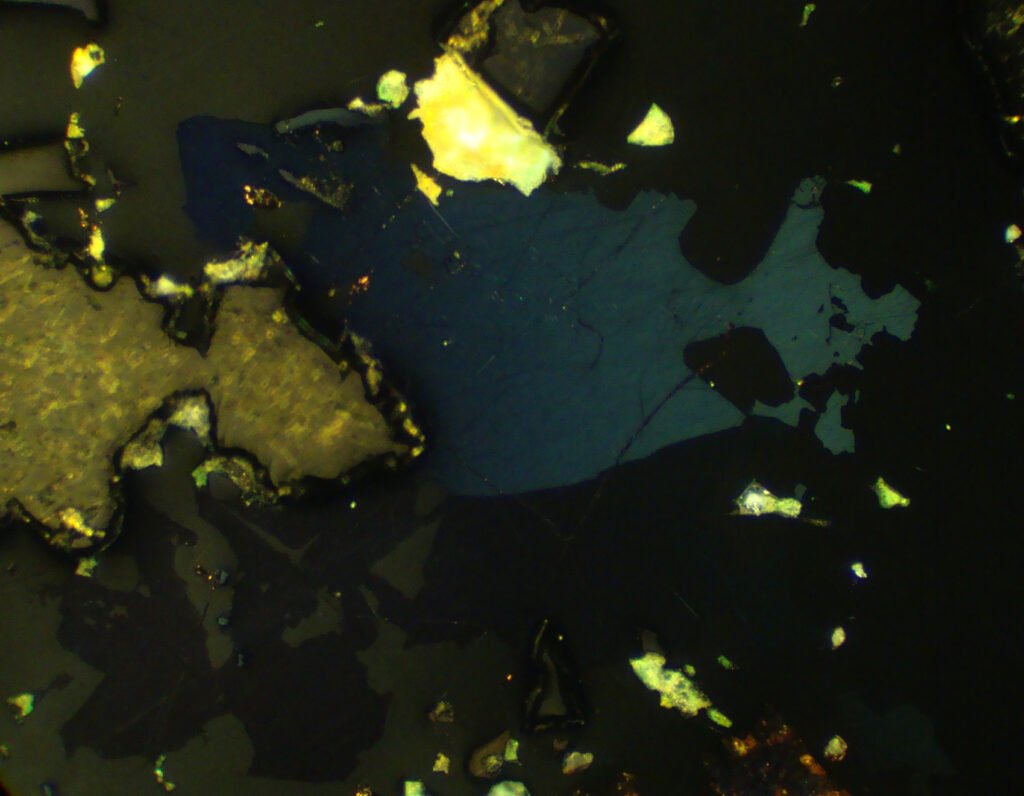
CROSSED POLARIZED LIGHT – XPL
Isotropy / Anisotropy: Moderate to strong anisotropy ranging from bluish-gray to brownish-gray; it may also appear pinkish-gray or greenish-gray. Bluish hues are quite characteristic.
It resembles the anisotropy of bournonite but displays more vivid colors.
In the extinction position, the mineral never appears completely black, but rather light gray.
Internal reflections: Rare, in pale red tones.
May be confused with: bournonite.
Chalcostibite’s cleavage and the absence of parquet (checkerboard) twinning make it easy to distinguish from bournonite, both macroscopically and microscopically. Undulose extinction is also diagnostic. Pleochroism and anisotropy are low compared to most other sulfosalts.
General Characteristics:
Grain shape: generally anhedral and coarse, with grains typically showing extensive mutual intergrowth. Crystals are rare; they may be prismatic, tabular (thick), or elongated parallel to (001).
Cleavage parallel to (001) is frequently visible in polished sections. Cleavage along the other two directions appears only in material subjected to tectonic stress; in such cases, triangular pits (resembling those found in galena) may occur.
Triangular pits similar to those seen in galena may be present.
Twinning is observed only locally, appearing as numerous fine lamellae; these may resemble stibnite twinning.
Zoning does not occur.
Deformation resulting from translation parallel to (001) and twisting around an axis within this plane is very common. In such instances, the deformed areas exhibit strong undulose extinction, as well as granulation and incipient recrystallization.
Reaction rims form between chalcostibite and chalcopyrite; these rims consist of bournonite, galena, and tetrahedrite.
Exsolution does not occur.
Intergrowths with enargite may occur.
Replacements 1: Replacement of chalcostibite by other minerals is common. Replacement occurs along fractures and deformed grains. Initially, galena and bournonite form, followed later by galena and tetrahedrite-tennantite; these, in turn, are subsequently replaced by bournonite and chalcopyrite, and partially by pyrrhotite. Galena may be absent, resulting in the sequence chalcostibite-bournonite-boulangerite-jamesonite. Other minerals replacing chalcostibite include native silver, tenorite, chalcocite, covellite, boulangerite, jamesonite, and pyrrhotite.
Replacements 2: Chalcostibite can replace sphalerite, pyrite, and chalcopyrite.
Alteration of chalcostibite—which has very low resistance to weathering—leads to the formation of covellite, chalcocite, azurite, and others.
Inclusions of chalcostibite in tetrahedrite may occur.