5. Reflected Light Microscopy
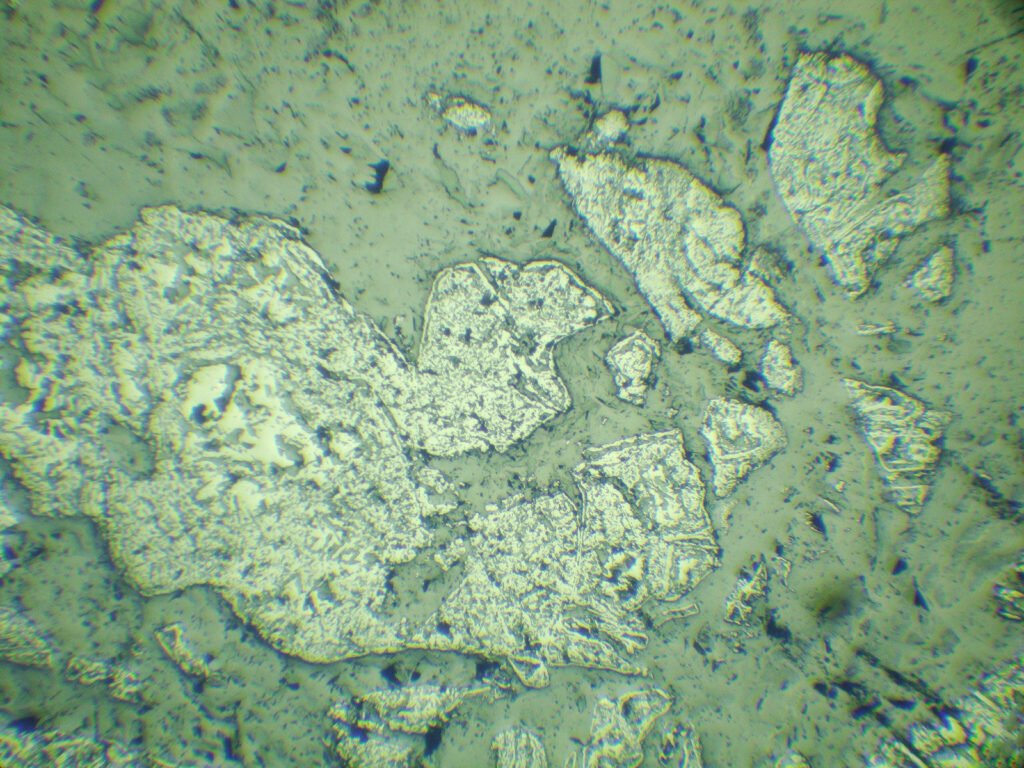
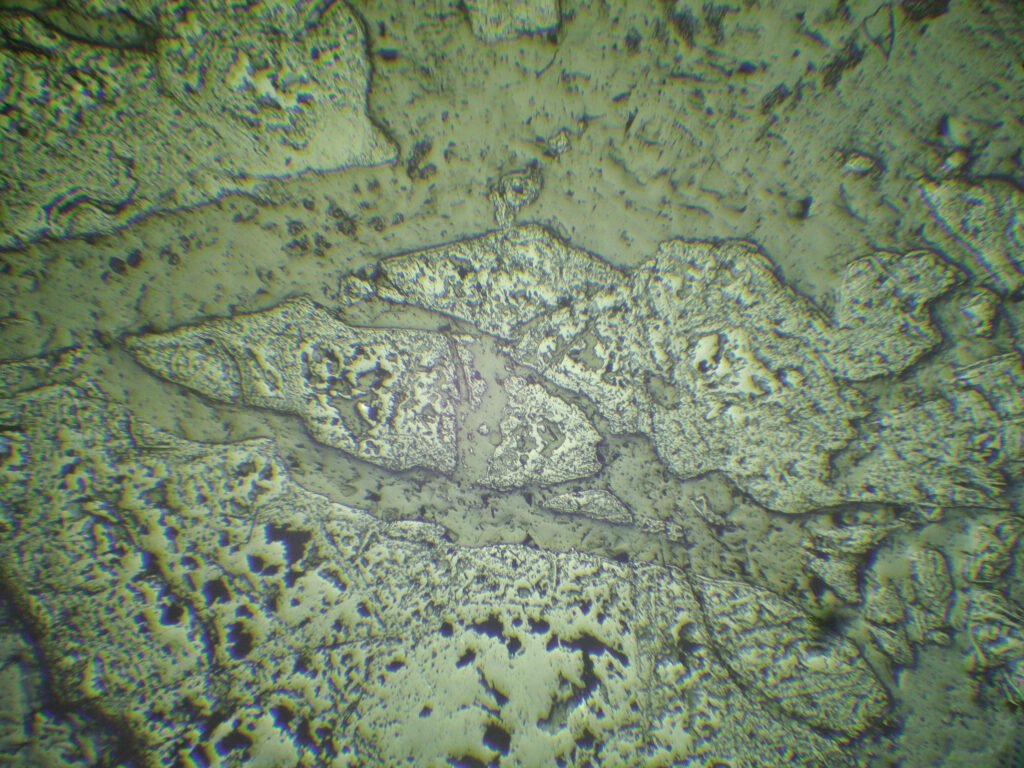
Sample preparation: Due to its high hardness, comparable to that of pyrite and magnetite, chromite acquires a good polish, but only very slowly. It is a little less hard than hematite. Literature insists on the difficulty of obtaining this good polish. Therefore, it is concluded that a low quality polish is still a diagnostic aspect for chromite.
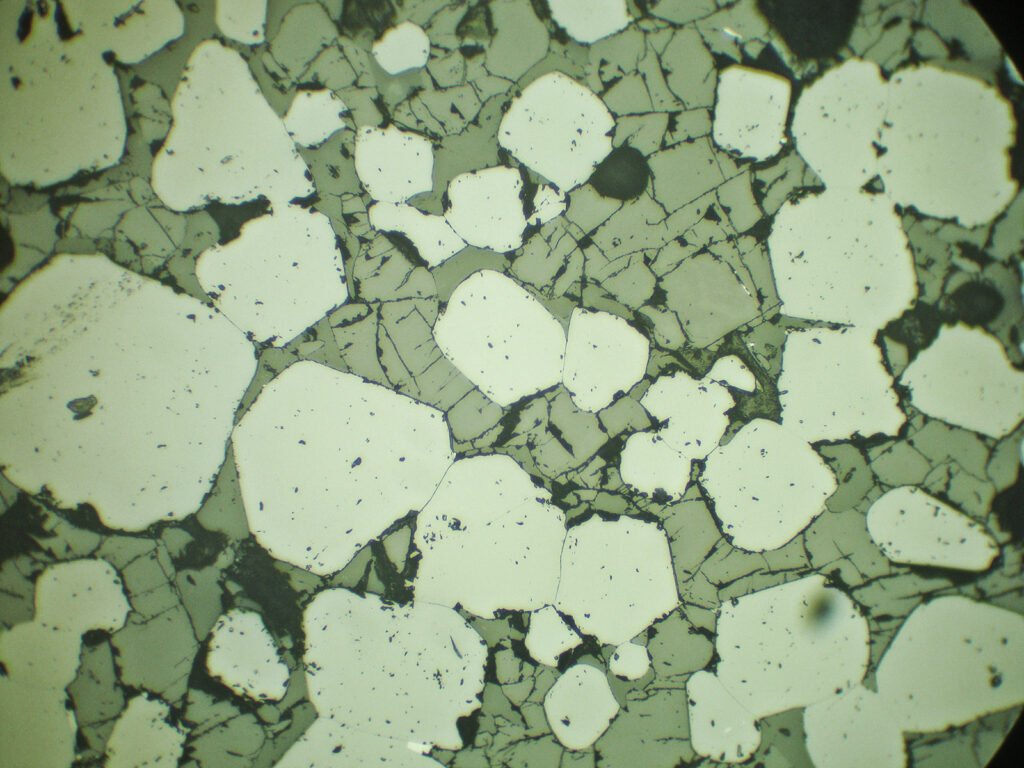
PLANE POLARIZED LIGHT – PPL
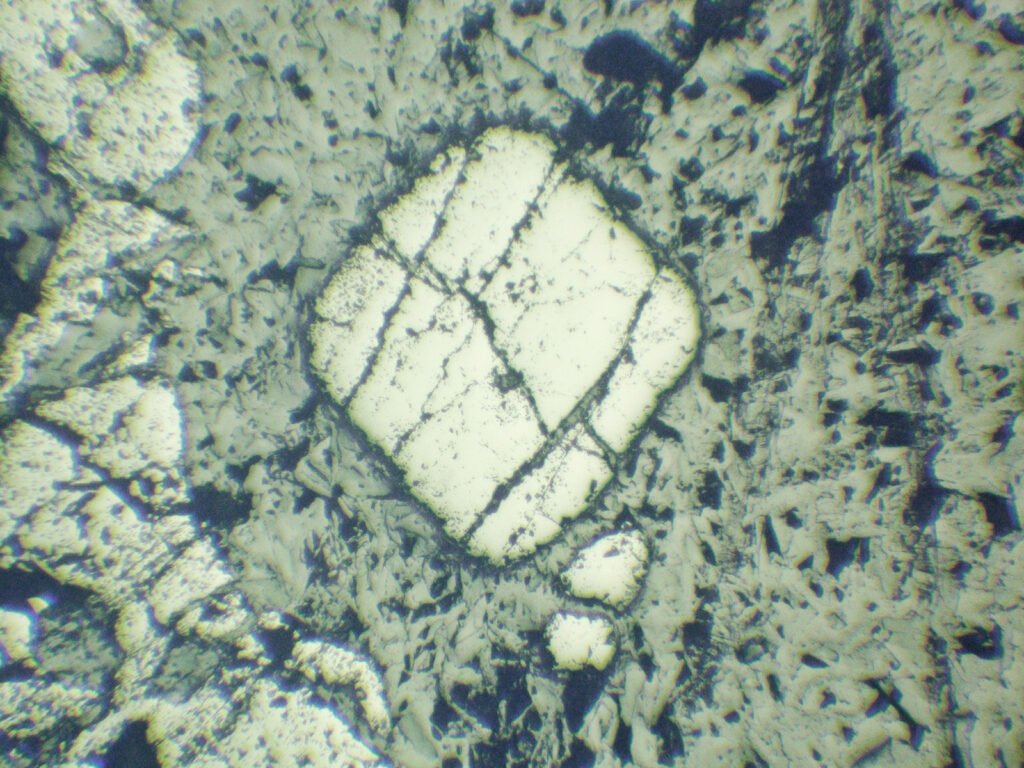
Reflection color: White gray with brown tones; shades vary with changes in chemical composition.
Compared with the color of magnetite, the color of chromite is much darker.
Compared with the color of sphalerite, the color of chromite is similar, a little darker.
Compared with the color of ilmenite, the color of chromite is much darker.
Pleochroism: No.
Reflectivity: Low (11.76%)
Bireflectance: No.
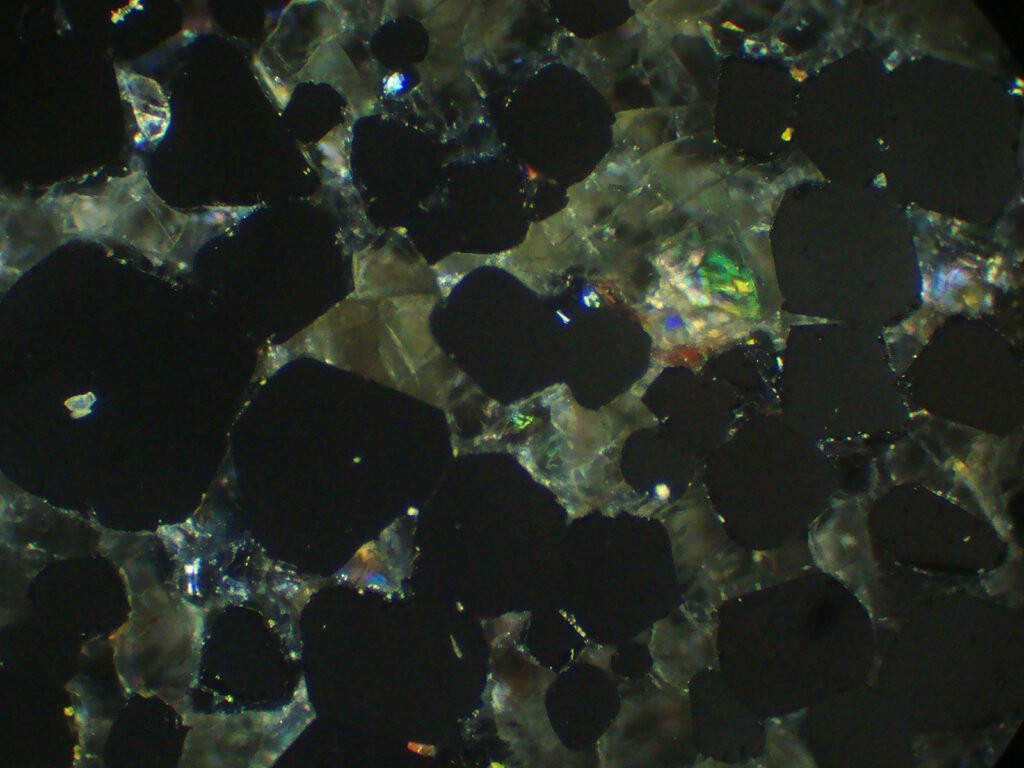
CROSSED POLARIZED LIGHT – XPL
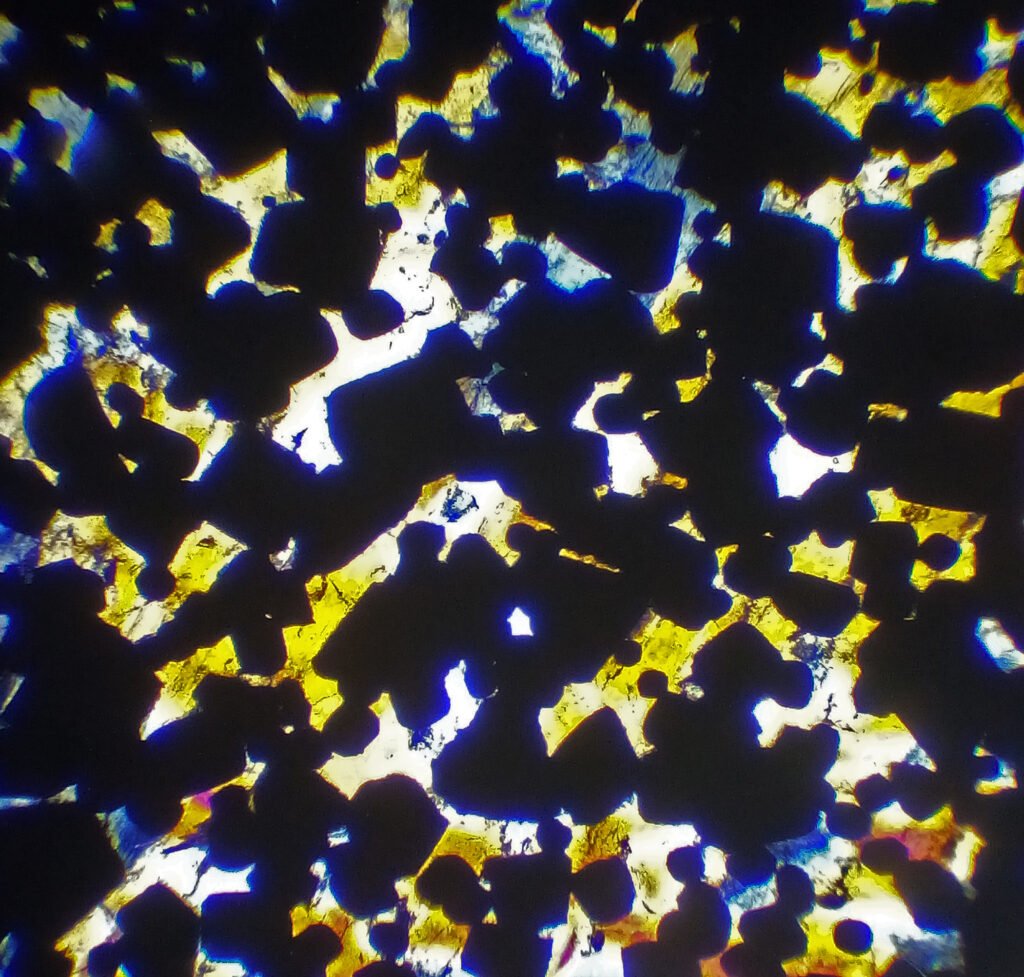
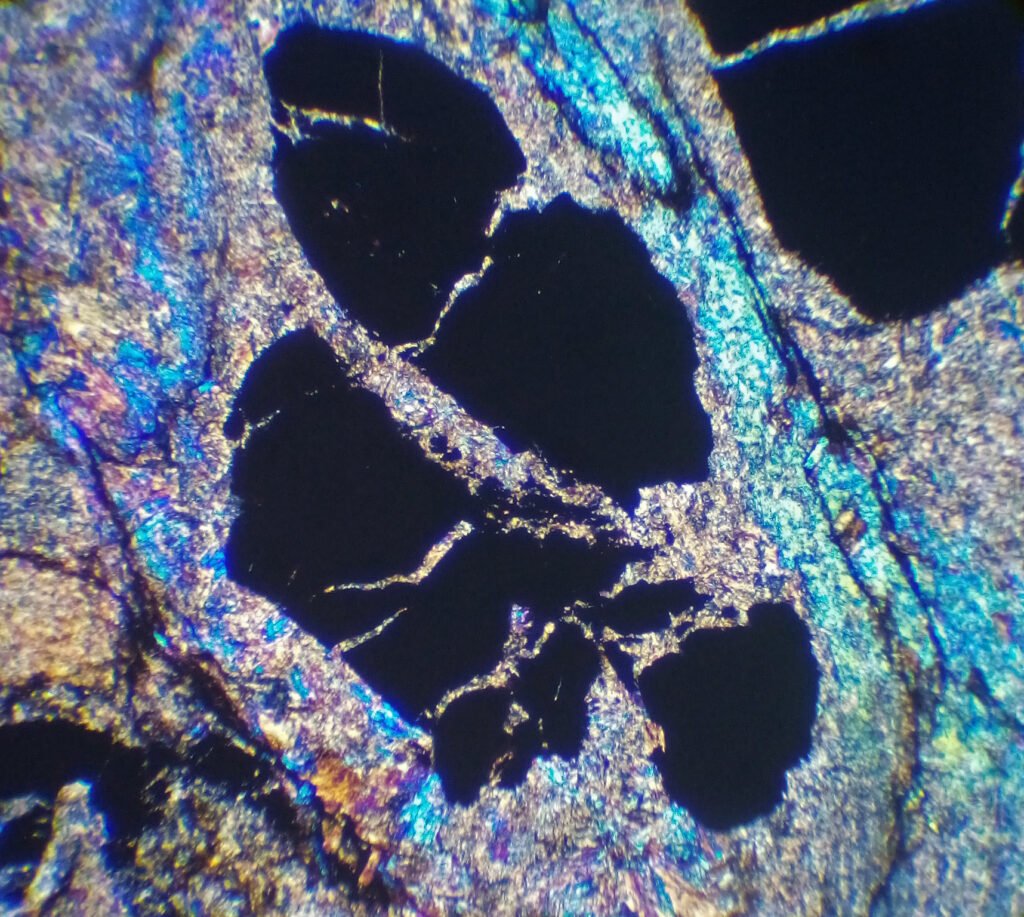
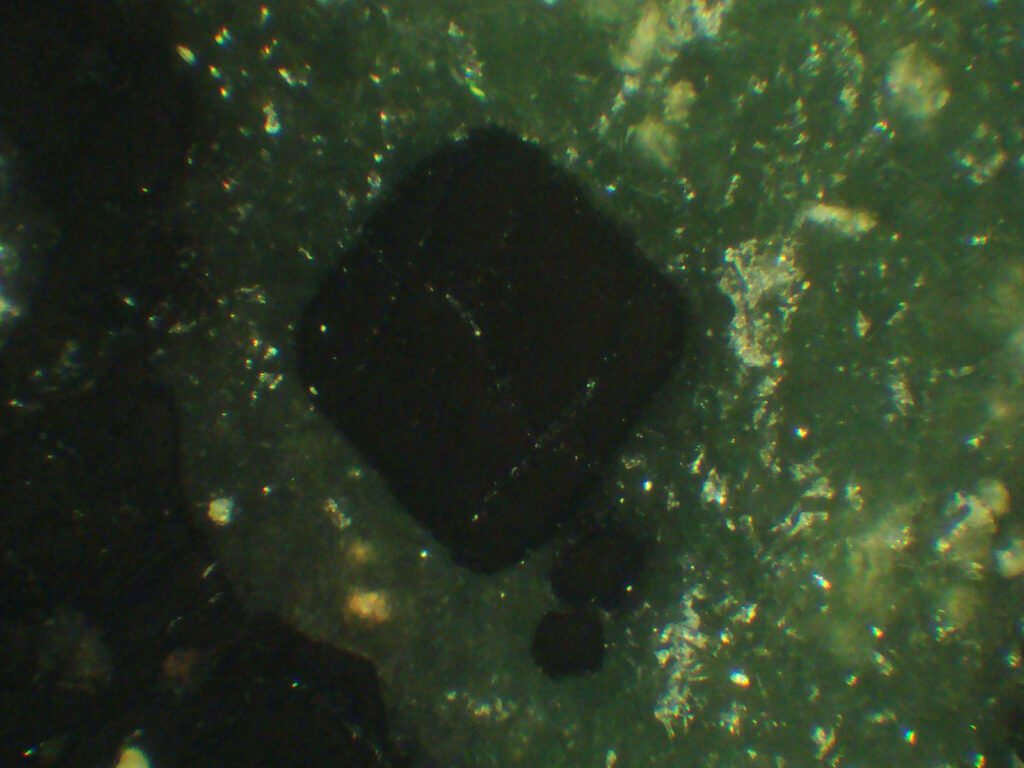
Isotropy / Anisotropy: Isotropic. May have a weak anomalous anisotropy if with zinc. This occurs especially in zoned crystals or in crystals whose structure has been deformed by tectonism.
Internal reflections: Occasional red-brown in the thinner portions and in chromites with Mg and Al. Chromites with high iron content do not show reflections. Reflections are usually absent.
May be confused with: several other minerals, including some dark colored silicates. Chromite does not have any easily recognizable diagnostic properties.
Magnetite is very similar and occurs in the same paragenesis. Its reflectivity is higher.
Ilmenite in PPL has a similar color but is anisotropic.
General Characteristics:
Grain shape: generally forms coarse granular aggregates with an uneven grain size, whose grains may be very fractured. It may have octahedral or cubic outlines, often rounded. Crystals are simple, with few combined shapes.
Cleavage does not shows, but sometimes the partition is distinct.
Cataclasis is very frequent, caused by tectonism or due to serpentinization. It can be very pronounced, with no evidence of cleavage, twin lamellae by pressure or recrystallization. In some cases the cataclasis is extremely pronounced and there is no mineral filling the fractures, making the chromites powdery like powdered chocolate, which makes their use as refractories difficult due to the “bursting” they present (they explode under dilatation).
Zonation is not uncommon, with crystals showing darker nuclei. In rare cases, the edges are darker. In zoned crystals, the edge is richer in Fe and Cr and is more reflective (lighter), while the core is richer in Mg and Al. Care must be taken not to confuse zonation with edge color changes caused by alteration.
Twins do not occur.
Partition is rarely visible, but it can be sharp. Inclusions and exsolutions arranged in parallel lines often simulate cleavage.
Substitutions are rare due to the chemical stability of chromite. If the host rock is completely serpentinized, chromites with corroded edges can occur. In this case, there are substitutions for serpentine. In some epi- and mesometamorphic ultrabasic rocks there are magnetite porphyroblasts that contain in their center a chromite fragment that survived metamorphism and was oriented in a magnetite manner.
Intergrowths with other minerals are infrequent, but can occur, sometimes oriented, with hematite, ilmenite, magnetite, rutile and ulvospinel.
Poikilitic textures generated by the intergrowth of chromite with olivine may occur.
Inclusions of gangue minerals as well-developed negative forms are frequent. Inclusions in the form of droplets of sulfides and silicates also occur. Radioactive inclusions can occur, with halos around them.
Unmixings are relatively rare. Unmixings of hematite and ilmenite occur. Hematite forms thin plates parallel to (111) or complete networks, which can constitute 20% of the mass. Very iron-rich chromites may show ilmenite demixes that disintegrate into hematite + ilmenite. But even iron-poor chromite can show ilmenite demixes. Rutile, a frequent accessory mineral, can form oriented crystals in chromite ((100) of rutile arranged parallel to (111) of chromite). Magnetite can form quasi-myrmekitic dismixtures (?) in chromite. Other “chromites” show dismixtures of magnetite + chromite, with chromite starting from intergranular films until it occupies the entire grain.
Magnetite crusts, which may be partially martitised, are common in many occurrences. Replacement of chromite by magnetite also occurs.
Porphyroblastic textures may occur, with porphyroblasts having a more iron-rich nucleus.
Alteration acts on chromites very slowly and normally cannot be noticed. Crystals of slightly different compositions show markedly different behavior in relation to alteration. Chromite can change to a mixture of at least three new chromium minerals.