1. Characteristics
Crystal system: Monoclinic prismatic.
Color: Light to dark green, can be brown, blue, white, gray, pale violet to colorless.
Habit: Prismatic with almost square basal sections. Granular, columnar, massive.
Cleavage: {110} good, typical of pyroxenes.
Tenacity: Brittle.
Twinning: Common, single or multiple, on {100} and {010}.
Fracture: Irregular.
Mohs Hardness: 5.5 – 6.5
Parting: On {100}.
Streak: White.
Lustre: Vitreous.
Diaphaneity: Transparent.
Density (g/cm³): 3.22 – 3.38
2. Geology and Deposits
Diopside-rich pyroxenes are common in Na- and K-rich (alkaline) magmatic rocks such as alkaline basalts, alkaline gabbros and related rocks (hawaiites, mugearites, latites, trachytes, monzonites, etc.). They are not so common in tephrites, basanites, phonotephrites and nephelinites, as augite-(Ti) is the most typical pyroxene in these types of rocks.
Diopside occurs in certain lamprophyres and ultrabasic rocks such as dunites and kimberlites (eclogites) (in the latter as emerald-green chromo-diopsides). It also occurs, more rarely, as phenocrysts in tholeiitic basalts and andesites.
Diopside is often found in Mg-rich metamorphic limestone rocks (marbles) and in associated contact metamorphic rocks such as skarns, where it is very common.
It is also found in rocks with melilite, lamproites, lamprophyres, lapis lazuli, granulites and gneisses. Some achondrites meteorites also have diopside.
3. Mineral Associations
In magmatic rocks it occurs with augite and pigeonite (generally in the matrix), plagioclase, olivine and with or without feldspathoids (nepheline and leucite).
In limestone rocks that have undergone contact metamorphism, it is typically associated with calcite, quartz, garnet (grossular), wollastonite, scapolite, vesuvianite, olivine (forsterite), phlogopite, minerals from the Humite Group, spinel, hessonite, tremolite and clinozoisite.
It is also associated with clinochlore, epidote, titanite and albite.
4. Transmitted Light Microscopy
Refraction indices: nα: 1.663 – 1.699 nβ: 1.671 – 1.705 nγ: 1.693 – 1.728
PLANE POLARIZED LIGHT – PPL
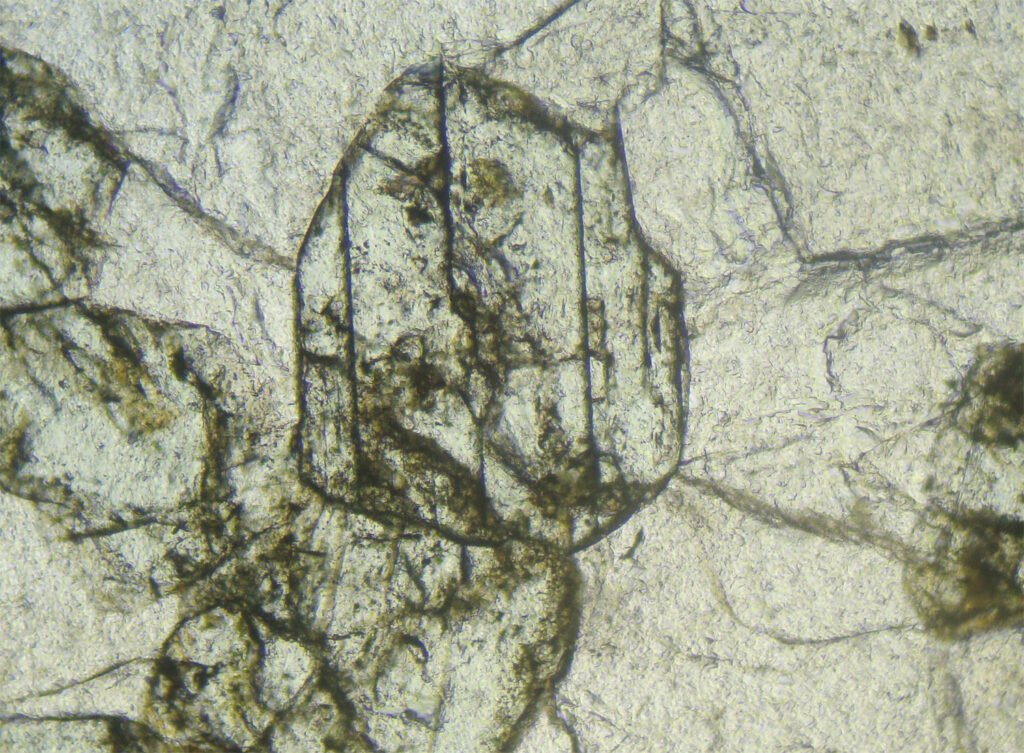
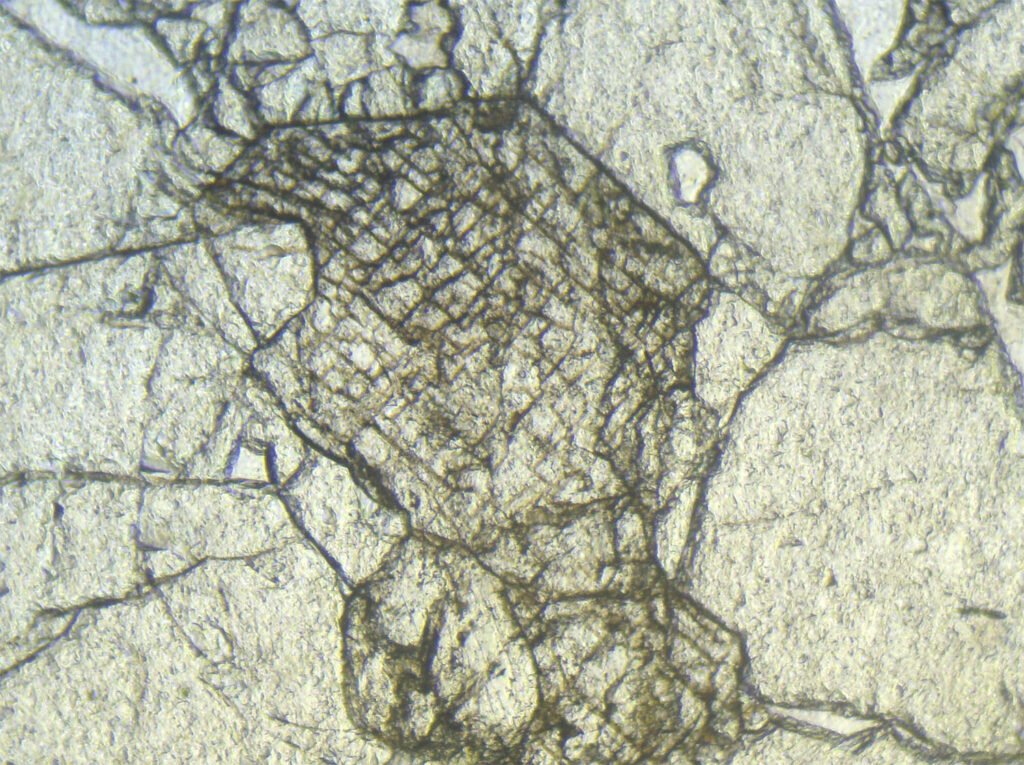
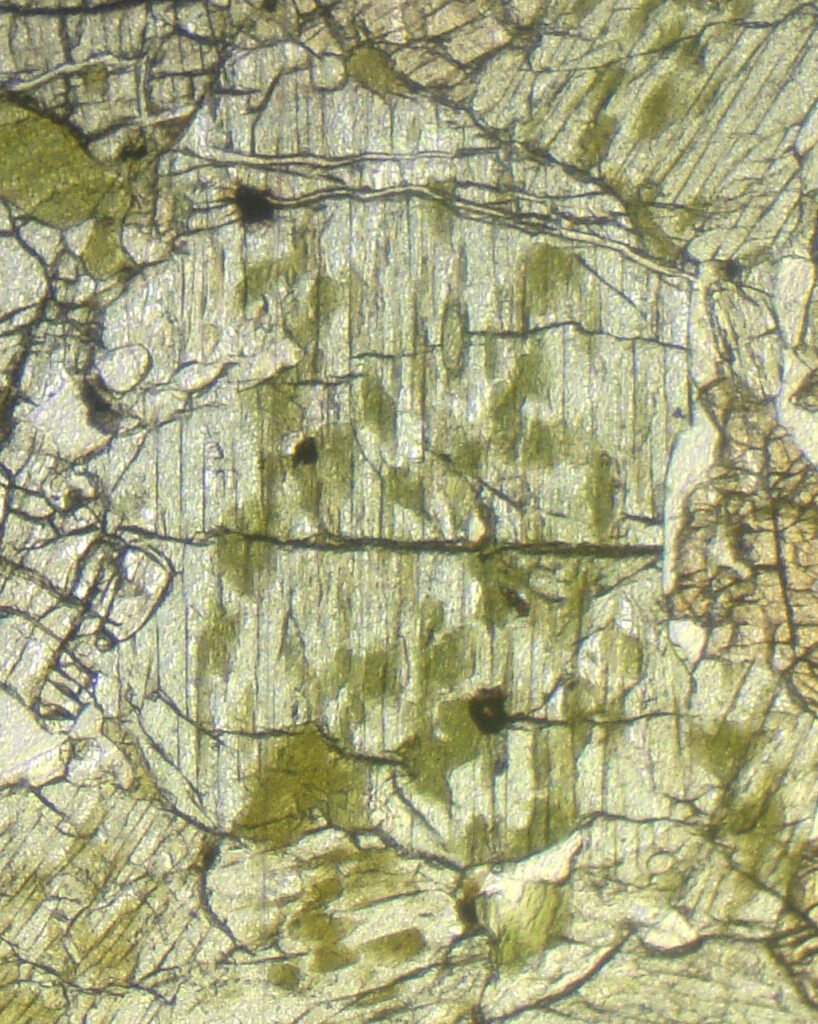
Color / Pleochroism: Colorless or pale green with very weak pleochroism in very light green tones. It can be gray or brown.
Relief: Moderate to high.
Cleavage: {110} perfect. In the longitudinal sections there is only one cleavage. In the basal sections there are two cleavages that intersect at angles of 87º and 93º, which is characteristic for pyroxenes.
Habits: Typically granular or short prismatic subhedral crystals. Rarely acicular or columnar. Octagonal basal sections (8 sides). Lamellar exsolutions of orthopyroxenes may occur.
CROSSED POLARIZED LIGHT – XPL
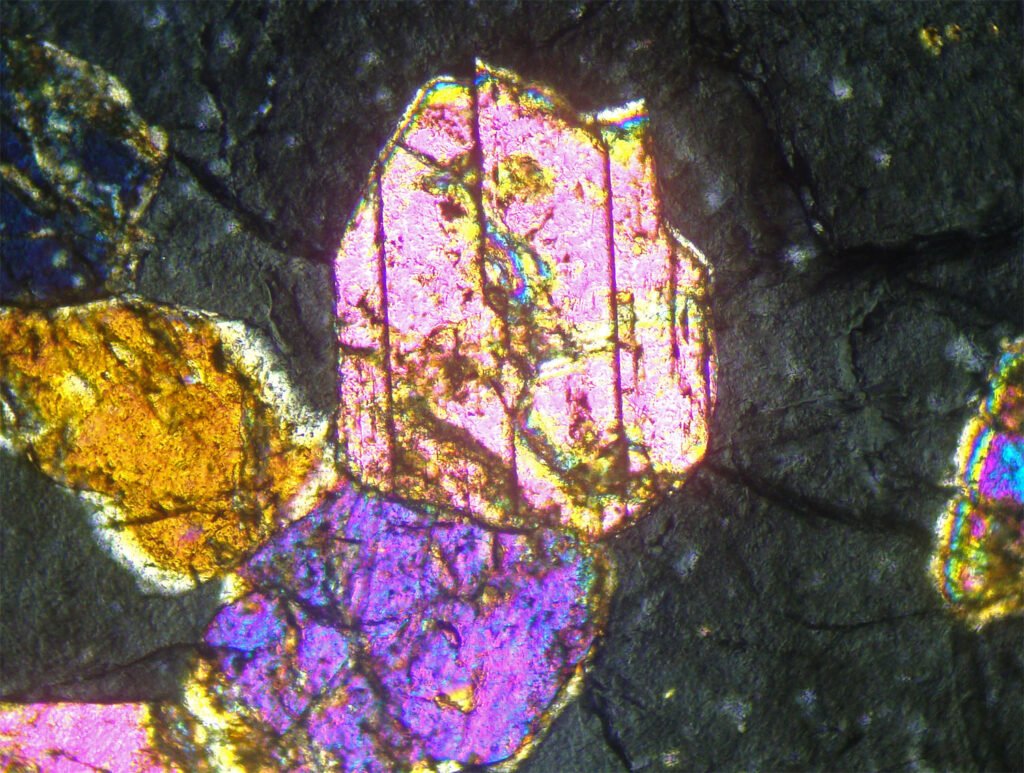
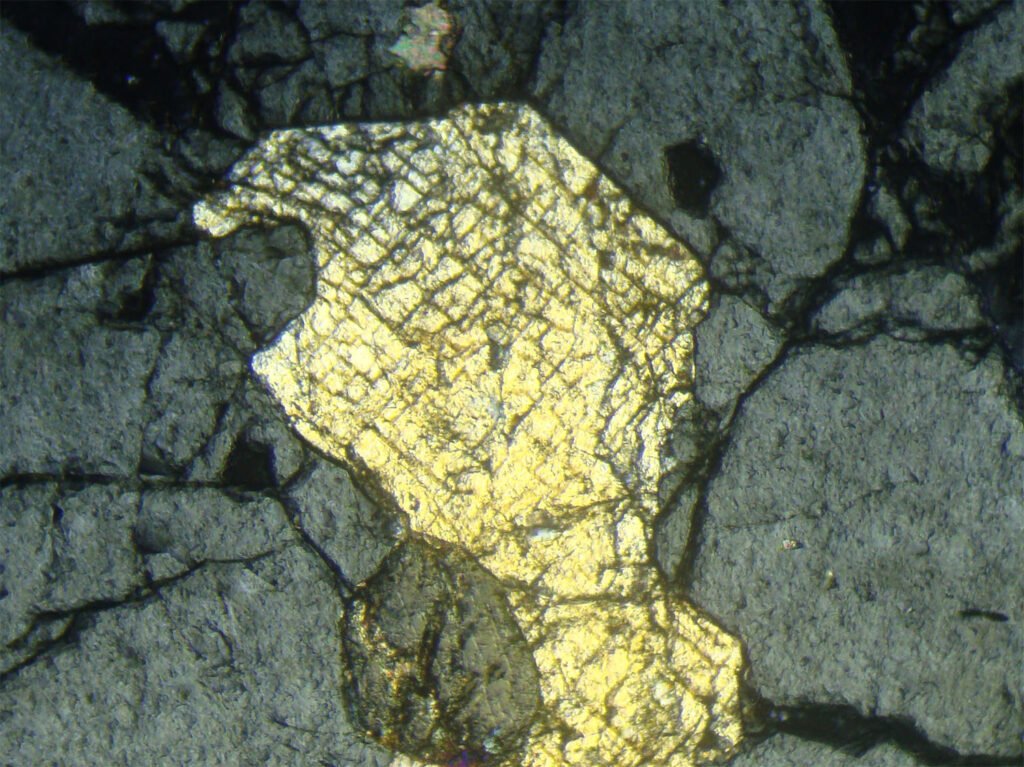
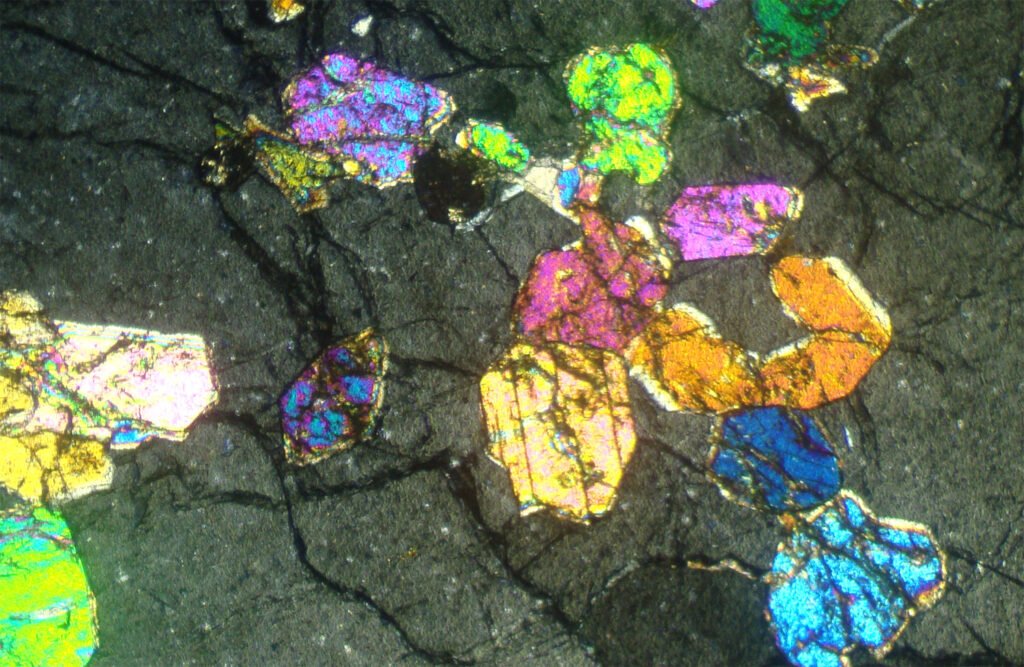
Birefringence and Interference Colors: high birefringence, 2nd higher order, ranging from 0.029 to 0.031: yellow, blue, red colors.
Extinction: tends to oblique, with increasing angle with increasing Fe2+ content. Angle between 38º and 48º.
Elongation sign: Can not be used.
Twins: In volcanic rocks, crystal aggregates are typical, interwoven in various ways. Single twins predominate according to (100), forming pyroxene lamellae oriented obliquely to the cleavage.
Zoning: Sometimes is zoned.
CONVERGENT LIGHT
Character: B(+)
2V angle: 58 – 62º, increases with increasing Fe2+ content.
Alterations: by pneumatolytic and hydrothermal alteration of high temperatures, the diopside undergoes uralitization and changes to fibrous/capillary aggregates of amphibole (tremolite or actinolite).
By hydrothermal alteration at low temperatures, it undergoes serpentinization (alters to serpentine).
Weathering changes diopside to carbonate, hematite and quartz.
May be confused with: distinguishing between the various clinopyroxenes (augite, diopside and pigeonite) can be very difficult to impossible under the petrographic microscope. Some authors report that the distinction between clinopyroxenes can only be performed with the aid of an universal stage. What facilitates identification is knowledge of paragenesis (rock type, associated minerals). In some cases the description only uses the term “clinopyroxene” for these minerals; their precise identification must be carried out with other analytical methods.
Pigeonite has an angle of 2V < 30°.
Hedenbergite has a slightly higher relief.
Augite-(Ti) shows strong pleochroism.
Orthopyroxenes (enstatite, etc.) have parallel extinction and lower birefringence.
Omphacite and jadeite occur in other paragenesis.
Olivine has higher birefringence, parallel extinction and has no cleavage.
Chondrodite may be similar.