1. Characteristics
Crystal system: Trigonal rhombohedral.
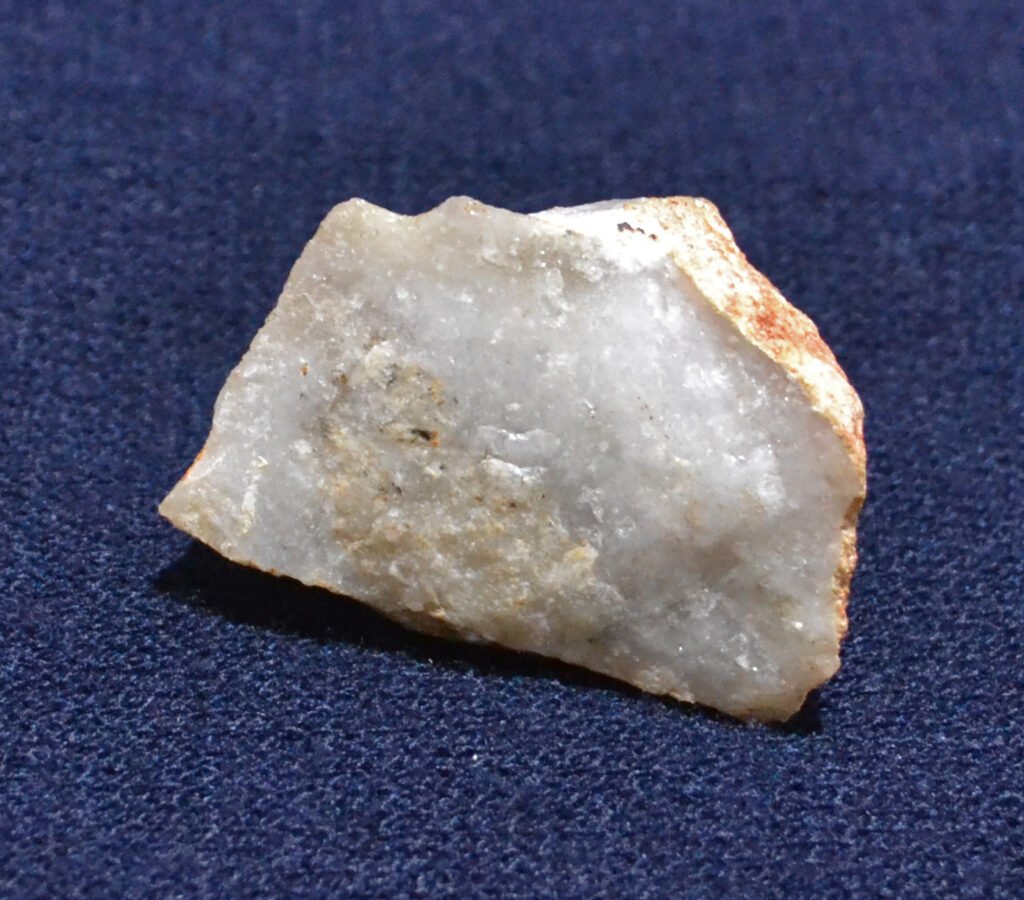
Color: Colorless, white, pale bronze, pale gray.
Habit: Generally massive or granular, rarely as equidimensional euhedral crystals.
Cleavage: {10-10} poor, {0001} poor.
Tenacity: Brittle.
Twinning: No.
Fracture: Irregular, conchoidal.
Mohs Hardness: 6.5
Parting: No.
Streak: White.
Lustre: Sub-vitreous to resinous.
Diaphaneity: Transparent.
Density (g/cm³): 2.6
2. Geology and Deposits
Eucryptite is characteristic of—and exclusive to—lithium-rich granitic pegmatites, where it occurs in graphic intergrowths with albite derived from the alteration of spodumene.
Consequently, it can form pseudomorphs after spodumene.
3. Mineral Associations
It is associated with minerals typical of granitic pegmatites: quartz, sodic-calcic feldspars (albite, cleavelandite variety), potassium feldspars (microcline, orthoclase), micas (muscovite, biotite, lepidolite), fluorite, beryl, topaz, tourmaline, and others.
Furthermore, it is associated with the lithium-bearing minerals found in these pegmatites: lepidolite, amblygonite, montebrasite, spodumene (kunzite), petalite, cookeite, and cymatolite (a mixture of muscovite and albite resulting from the replacement of spodumene).
4. Transmitted Light Microscopy
Refraction indices: nω: 1.570 – 1.573 nε: 1.583 – 1.587
PLANE POLARIZED LIGHT – PPL
Color / Pleochroism: Colorless.
Relief: Low.
Cleavage: No.
Habits: Massive, granular, rarely in rhombohedral crystals
CROSSED POLARIZED LIGHT – XPL
Birefringence and Interference Colors: maximum birefringence of 0.013: colors from gray to white to yellow, not reaching 1st order orange.
Extinction: No information available, probably paralell.
Elongation sign: No information available.
Twins: No.
Zoning: No.
CONVERGENT LIGHT
Character: U(+)
2V angle: No.
Alterations: No information available.
May be confused with: Quartz exhibits the same characteristics under the microscope.