5. Reflected Light Microscopy
Sample preparation: Franklinite has a high hardness, making it difficult to polish, as is magnetite. Its hardness upon polishing is greater than that of zincite.
PLANE POLARIZED LIGHT – PPL
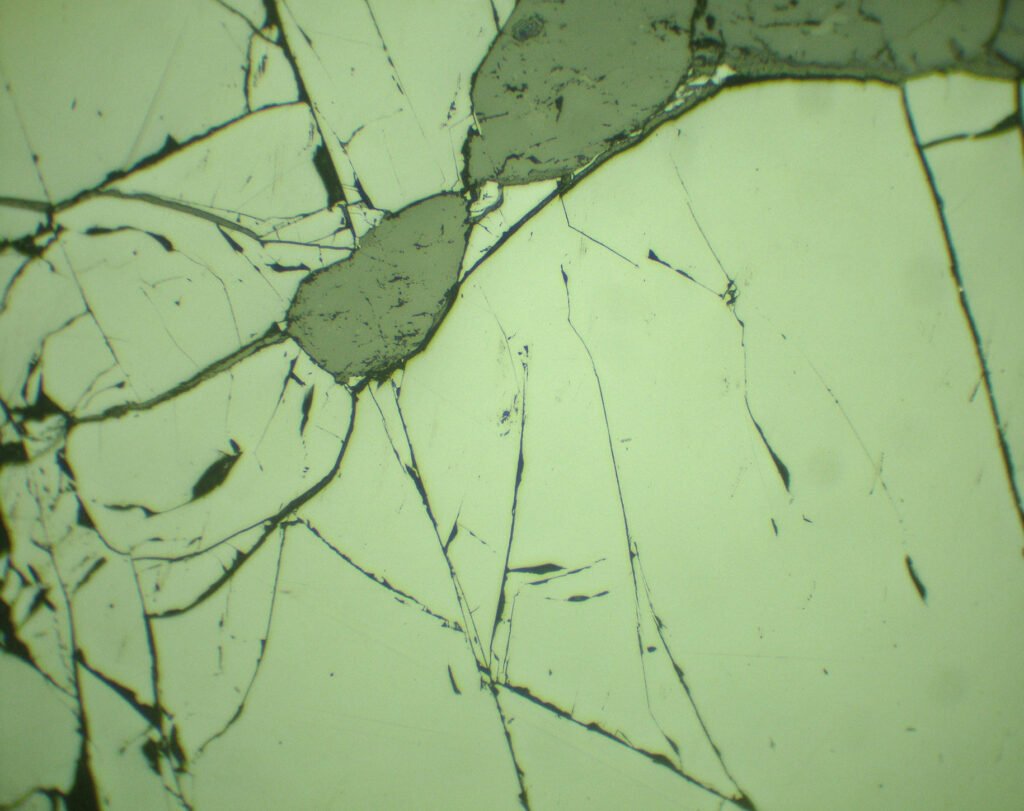
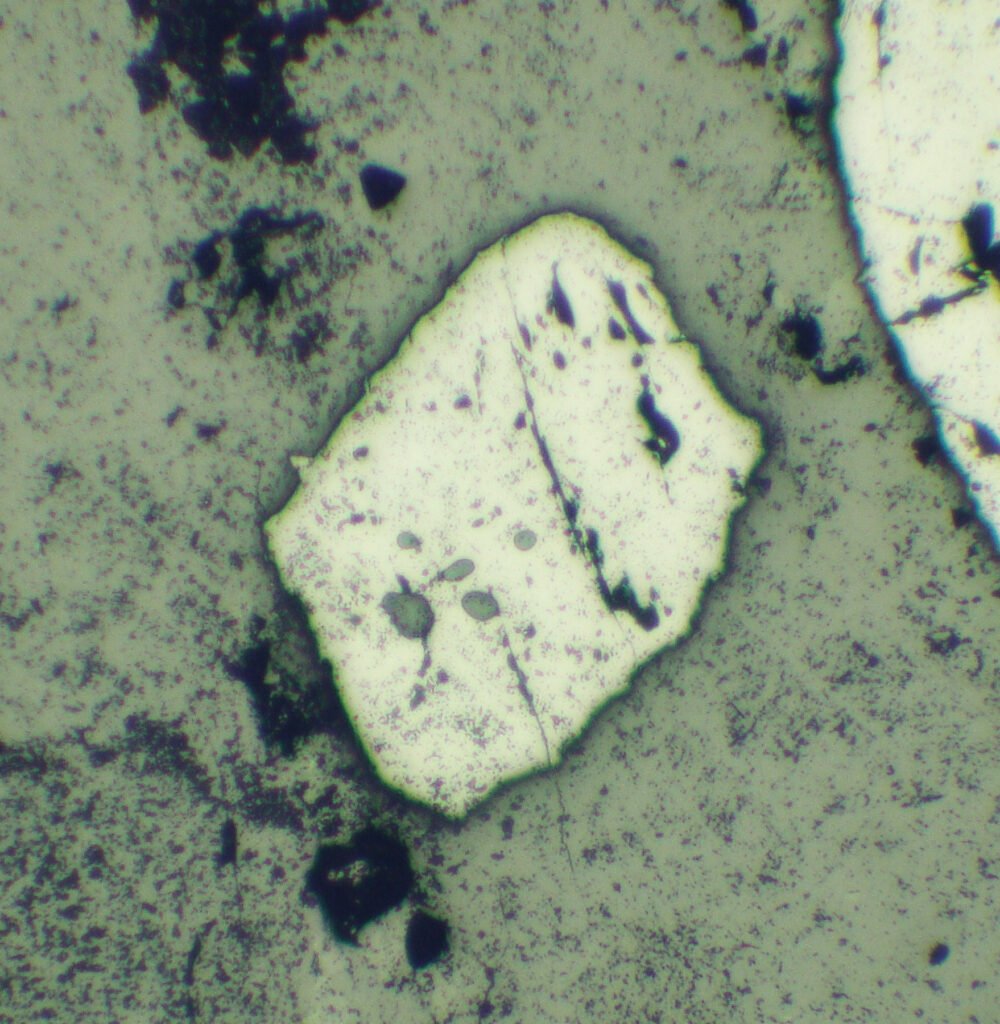
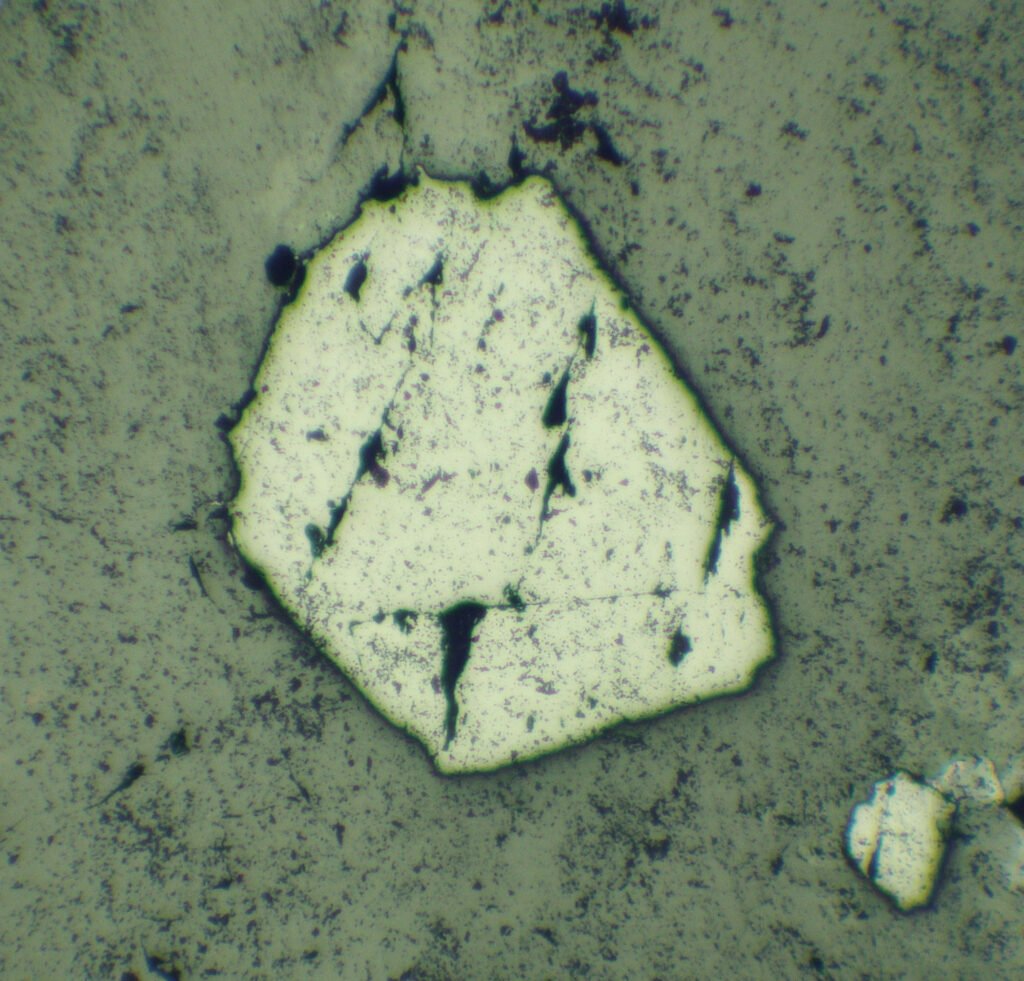
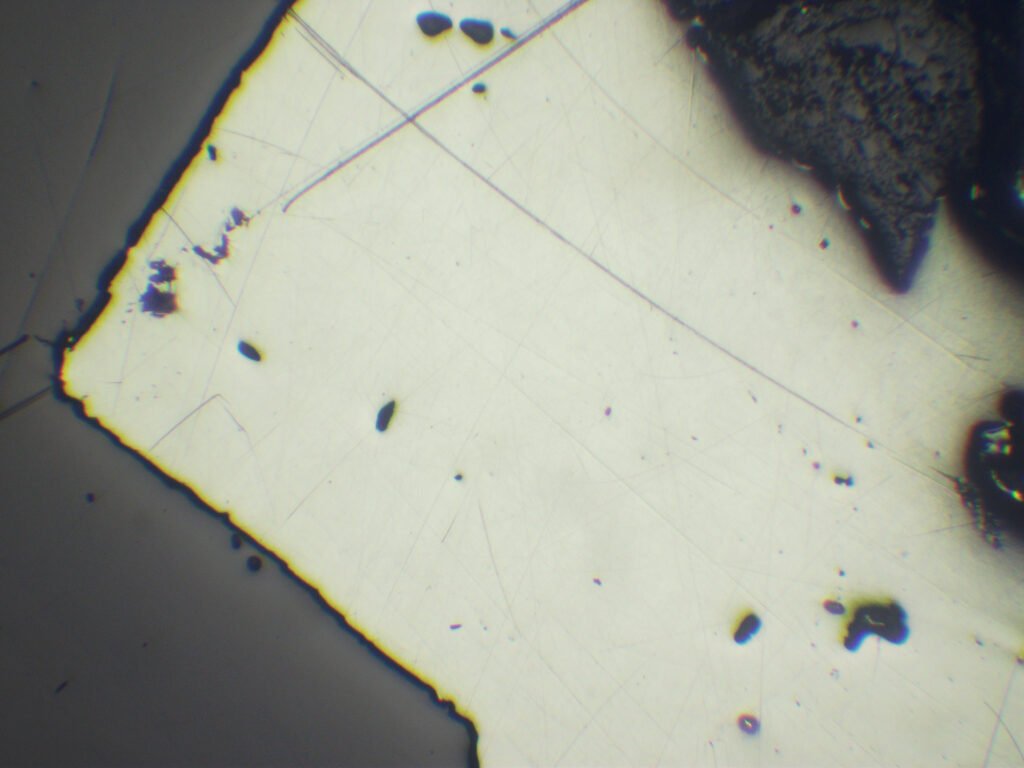
Reflection color: Light gray with very subtle greenish tones.
Compared to the color of magnetite, the color of franklinite is very similar, but less pink and more gray-green.
Compared to the color of zincite, the color of franklinite is much lighter.
Compared to the color of sphalerite, the color of franklinite is slightly lighter.
Compared to the color of hematite, the color of franklinite is much darker and grayer.
Pleochroism: No.
Reflectivity: 17.62% Reflectivity can vary considerably between different franklinites.
Bireflectance: No.
CROSSED POLARIZED LIGHT – XPL
Isotropy / Anisotropy: Isotropic, but grains that have undergone stress may show very weak anisotropy between pinkish gray and blackish gray.
Internal reflections: No. Some literature reports abundant deep red reflections, but this is not the case in air observations.
With immersion in oil(!), it is often possible to observe, through careful observation, the presence of internal deep red reflections, mainly at the intergranular boundaries.
May be confused with: Other oxides that occur in paragenesis.
Magnetite is extremely similar, it is very easy to confuse it with franklinite, but it does not have internal reflections like franklinite.
Jacobsite has a distinctly yellow reflection color.
General Characteristics:
Grain shape: Idiomorphic and hypidiomorphic crystals are common. Octahedrons are common, typically with rounded edges. Other cubic forms (dodecahedrons, cubes, combined forms) occur more rarely. It can be massive or granular, fine to coarse.
Partition parallel to (111) may be very sharp, spectacularly developed, or completely absent.
Twins parallel to (111) may be visible. Also parallel to (100).
Zoning is indicated by varying amounts of demixing bodies.
Unmixings 1: Unmixing may be absent, mainly in the younger, pegmatitic portions. In other grains, the observed unmixing is of various types.
Unmixings 2: Very small grains or discs arranged parallel to (100) may occur, formed by a transparent mineral of the Spinel Group, perhaps gahnite.
Unmixings 3: another unmixing is formed by thick plates, arranged parallel to (111), composed of a mineral similar to ilmenite, but with much more internal reflections and lower reflectivity, probably pyrophanite.
Unmixings 4: a very fine network oriented parallel to (100) may occur, composed of hausmannite or a Mg-spinel.
Unmixings 5: Unmixings with magnetite are common. At high temperatures, probably all transitions (continuous solid solution) between magnetite, franklinite, and jacobsite occur. Above a certain quantity of one of the members, unmixing occurs, such that all “magnetic franklinites” are almost always franklinite with magnetite unmixings or magnetite with franklinite unmixings. In both cases, lamellae arranged parallel to (100) of the host mineral occur. In limiting situations, unmixings does not occur: the members remain homogeneous, but are less translucent and have much higher reflectivity than normal. In them, a material similar to normal franklinite develops in fractures and cleavage or parting planes, but with many internal reflections and still magnetic.