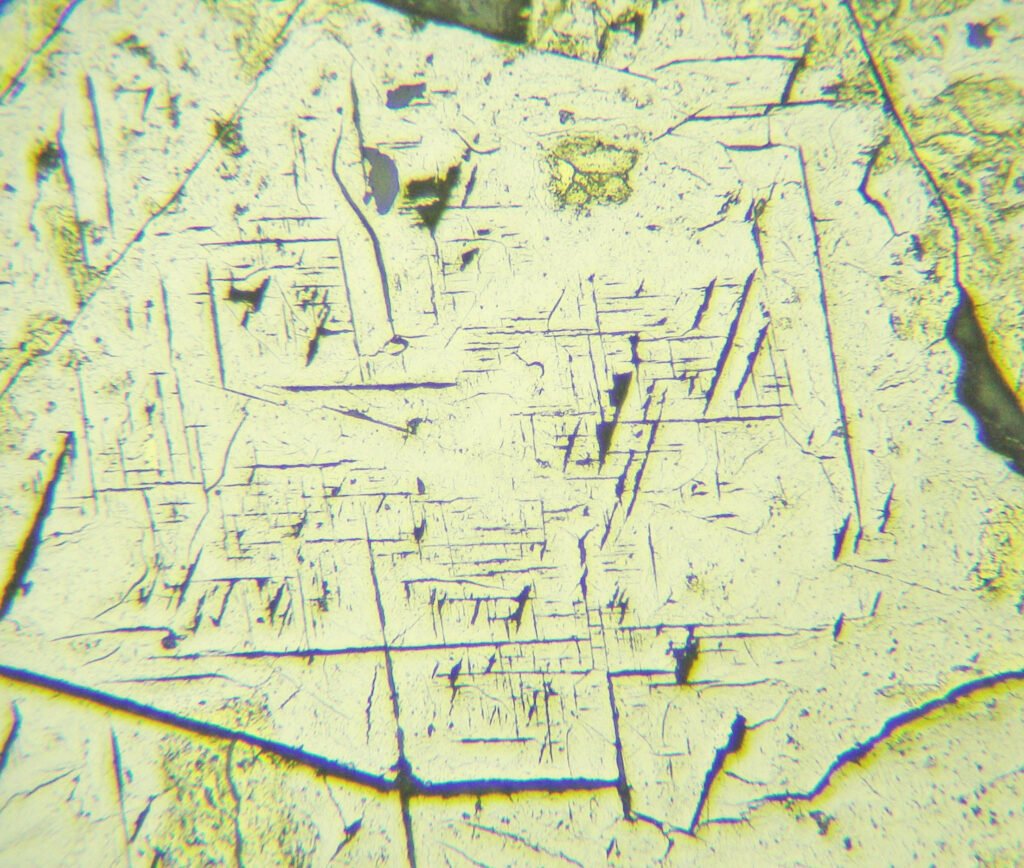
GERSDORFFITE
Gersdorffite – NiAsS – is a relatively rare sulfide. It is possible that it was not detected in many occurrences due to its similarity to galena and other ores. Integrates polymetallic ores.
It is classified in the Cobaltite Group which, except for cobaltite itself, is made up of rare and extremely rare minerals. It forms a series with cobaltite and has 3 forms of crystallization. Chemical analyzes show that it is a chemically complex mineral.
Occasionally there are high levels of Co and Fe, especially a large variation in the ratio (Ni,Co,Fe):(S,As,Sb), which is 2:3 instead of the expected 1:2. The As:S ratio also does not appear as expected; The rates are often much higher. It can show zonation and can contain Co, Sb, Cu and Fe. There is a variety with up to 15% by weight of Co that also contains Os, Ir, Ru and Rh.
Macroscopically, when massive, it is extremely similar to ullmannite, galena, arsenopyrite, cobaltite and eskutterudite. Idiomorphic crystals are indistinguishable from galena in hand sample.
CAUTION! The presence of high levels of As and the possibility of the existence of highly radioactive minerals requires special care with gersdorffite ores.
1. Characteristics
Crystal system: Cubic diploidal.
Color: White from silver to steel gray. Tarnishes to gray or grayish black.
Habit: Massive, granular or cubes, octahedrons, tetrahedrons, pentagonododecahedrons, combined forms, up to 4 cm.
Cleavage: {100} perfect, in 3 directions, forming cubes. Striations may occur.
Tenacity: Brittle.
Twinning: No.
Fracture: Irregular.
Mohs Hardness: 5 – 5.5
Parting: No.
Streak: Grayish black.
Lustre: Metallic.
Diaphaneity: Opaque.
Density (g/cm³): 5.6 – 6.2
2. Geology and Deposits
Gersdorffite occurs in larger volumes only in some hydrothermal veins of medium temperatures, associated with other Ni, Co, and Sb sulfides.
It also occurs in magmatic sulfide deposits (e.g., Sudbury).
3. Mineral Associations
It is associated with some common gangue minerals such as quartz, fluorite, and carbonates (calcite, dolomite, ankerite, and siderite (including the Mg variety, pistomomesite)).
Common associated sulfides are pyrite, marcasite, pyrrhotite, chalcopyrite, galena, sphalerite, and arsenopyrite. Magnetite is also associated.
In the specific paragenesis there are:
– Ni minerals (niqueline, Ni-eskutterudite, millerite, breithauptite, maucherite, ullmannite, rammelsbergite, pararammelsbergite, pentlandite and violarite),
– Co minerals (cobaltite, linnaeite),
– other arsenates (löllingite),
– radioactive minerals (uraninite, brannerite),
– native elements (gold, silver, bismuth),
– jamesonite, bournonite, tetrahedrite, stephanite and other Bi, Ag and Pt minerals.
Among the secondary minerals, annabergite.
Among the associated rare minerals, retgersite.
4. Transmitted Light Microscopy
This does not apply, as gersdorffite is completely opaque.
5. Reflected Light Microscopy
Sample preparation: Gersdorffite acquires a very good polish with great ease. Its hardness upon polishing is greater than that of linnaeite, approximately similar to the hardness of ullmannite and eskutterudite, and much less than the hardness of arsenopyrite and pyrite.
PLANE POLARIZED LIGHT – PPL
Reflection color: White, perhaps light gray, slightly creamy, perhaps a pinkish hue.
In some instances, gersdorffite is somewhat bluish-gray, in others harder, lighter, and somewhat yellowish. The color changes gradually with increasing Sb content, until it reaches the color of ullmannite.
Compared to the color of skutterudite, the color of gersdorffite is more yellowish.
Compared to the color of linnaeite, the color of gersdorffite is much less pink.
Compared to the color of pyrite, the color of gersdorffite is less yellow, more pinkish or creamy, darker.
Compared to the color of chalcopyrite, the color of gersdorffite is pinkish cream.
Compared to the color of galena, the color of gersdorffite is lighter, pinkish cream.
Compared to the color of arsenopyrite, the color of gersdorffite is white.
Compared to the color of ullmannite, the color of gersdorffite is very similar, perhaps a little more yellowish.
Compared to the color of nickeline, the color of gersdorffite is bluish.
Pleochroism: No.
Reflectivity: 45.39%.
Bireflectance: No.
CROSSED POLARIZED LIGHT – XPL
Isotropy / Anisotropy: Isotropic. It exhibits weak anomalous anisotropy if the structure is distorted.
Internal reflections: No.
May be confused with: Other white cubic minerals. Its excellent cleavage is very diagnostic, as is its tarnishing.
Ullmannite has an identical color.
Skutterudite and Ni-Skutterudite have very similar colors.
Linneaite, in comparison, is slightly pink and softer.
General Characteristics:
Grain shape: Gersdorffite is often idiomorphic. They are usually very small grains with irregular boundaries, but aggregates composed of crystals that individually measure several centimeters in size can occur. It can form skeletal porphyroblasts.
Cleavage perfect {100}, in 3 directions, forming cubes, is almost always visible and typical, well developed, forming straight and long lines. Due to this cleavage, characteristic triangular polishing pits often appear, as in galena, depending on the section. Cleavage is much more frequent than in ullmannite. When alteration products develop along the cleavage planes, it becomes even more conspicuous.
Zoning is very frequent and can be seen even without chemical attack due to differences in hardness and color.
Twinning occurs locally in the form of small, thin lamellae.
Deformations are not uncommon, as it is an early-forming mineral.
Deformations lead to cataclasis of the grains. The fractures are filled with other ores such as chalcopyrite and arsenopyrite; no associated replacement occurs.
Decomposition of gersdorffite produces pseudo-eutectic intergrowths between niqueline or maucherite with pyrrhotite or chalcopyrite.
Reaction rims of gersdorffite can form between pyrrhotite and nickeline.
Substitutions 1: Gersdorffite envelops pyrite in the form of crusts and replaces pyrite along fractures. It can also replace millerite, rammelsbergite, and niqueline.
Substitutions 2: Gersdorffite can be replaced by bournonite, rammelsbergite, tennantite-tetrahedrite, violarite, pyrargyrite, maucherite, and niqueline.
Inclusions: Gersdorffite may contain inclusions of native silver, native bismuth, eskutterudite, rammelsbergite, uraninite, cobaltite, pyrite, niqueline, and brannerite.