Crystal system: Monoclinic prismatic.
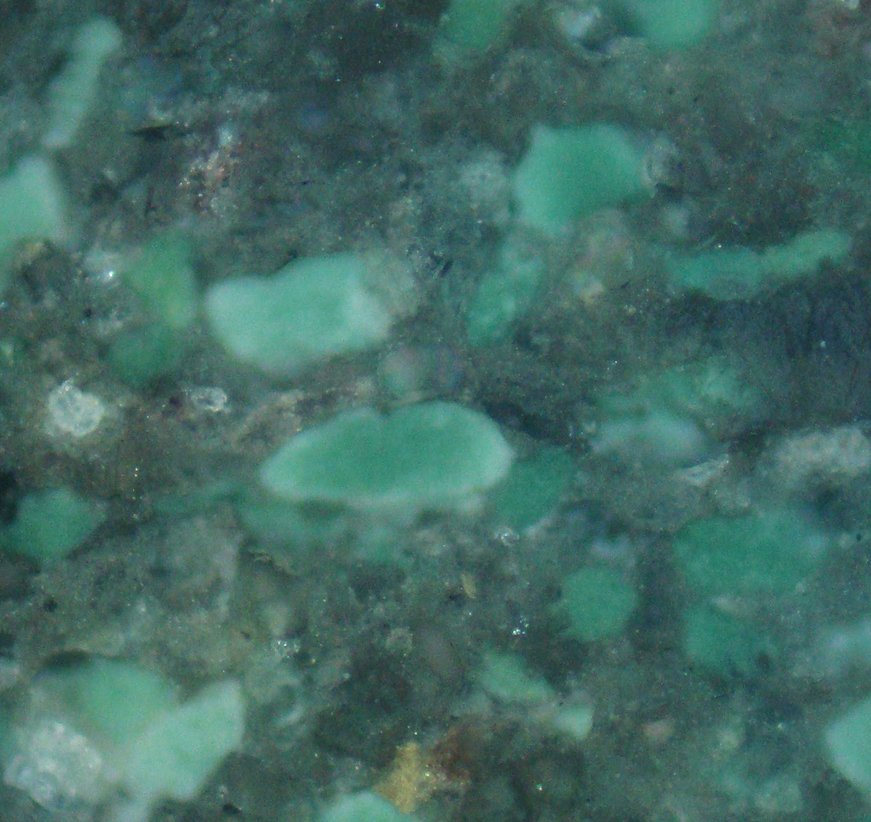
Color: Blue-green, yellow-green, green, rarely colorless.
Habit: Very small micaceous flakes, earthy aggregates.
Frillate to greasy.
Cleavage: {001} perfect.
Tenacity: Elastic.
Twinning: No.
Fracture: No information available.
Mohs Hardness: 2
Parting: No.
Streak: No information available.
Lustre: Dull, earthy.
Diaphaneity: Transparent.
Density (g/cm³): 2.4 – 2.95
2. Geology and Deposits
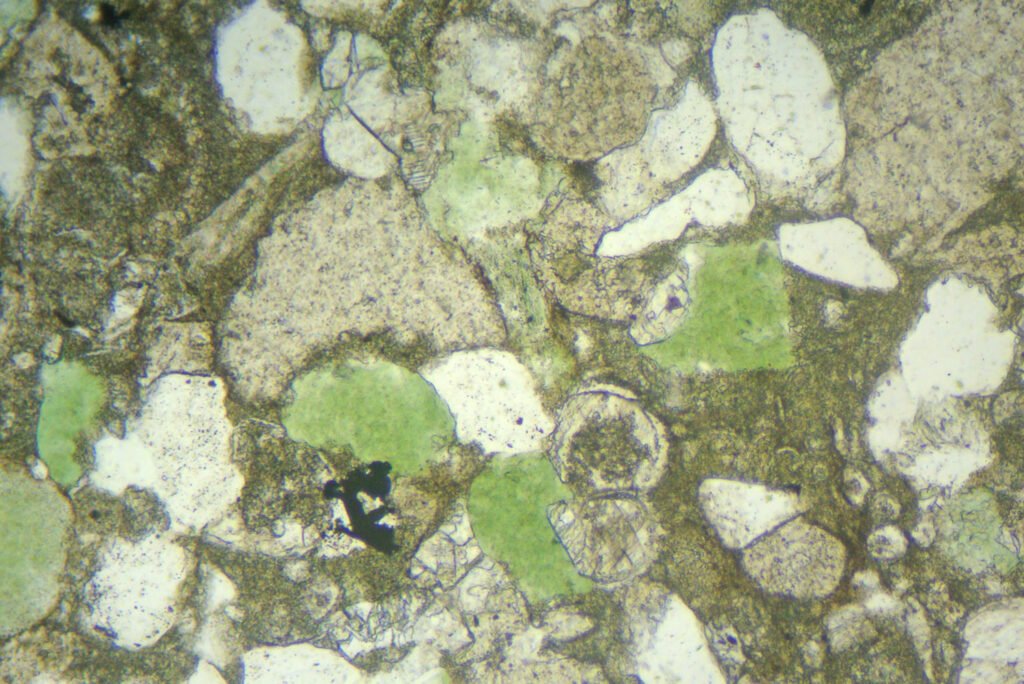
Glauconite is a synsedimentary to diagenetic mineral of marine sediments. It forms by alteration of detrital biotites and other minerals through marine diagenesis under shallow water conditions and reducing environments. It is especially common in unconsolidated sands (“green sands”), but also occurs in siltstones, shales, and impure carbonate rocks. Until the late 1990s, the term “green sand” was applied interchangeably to aggregates of glauconite and celadonite.
True glauconites may have been found in environments other than marine sediments, but were classified as celadonites until 1998.
3. Mineral Associations
It is associated with quartz, feldspar, clay minerals, carbonates (dolomite, siderite, calcite, ankerite), pyrite, zircon, aegirine and “limonite” (iron oxides and hydroxides).
4. Transmitted Light Microscopy
Refraction indices: nα: 1,592 – 1,610 nβ: 1,614 – 1,641 nγ: 1,614 – 1,641
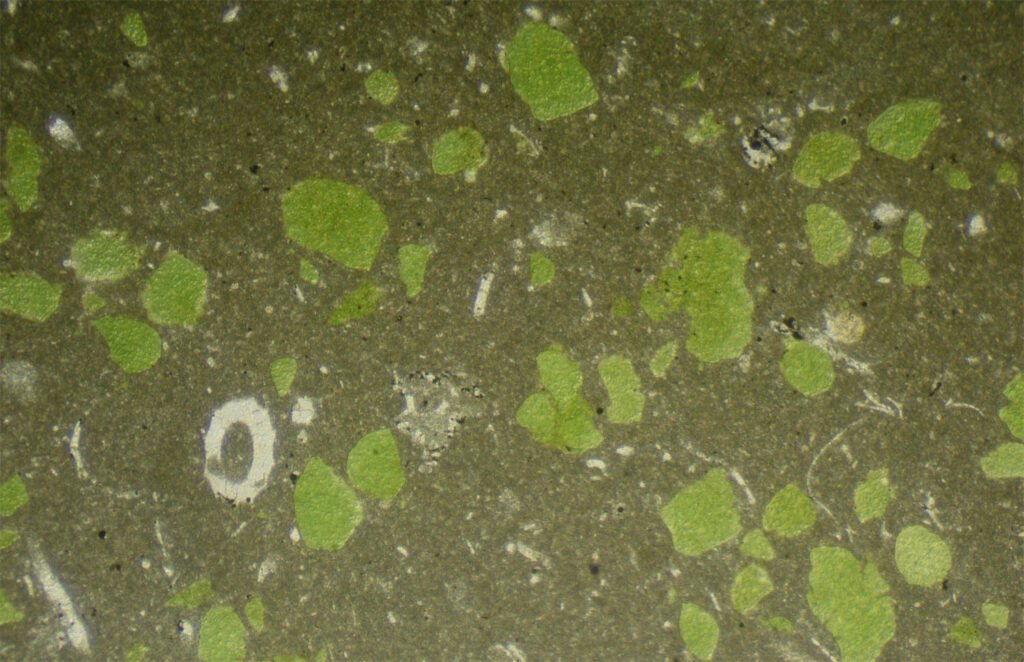
PLANE POLARIZED LIGHT – PPL
Color / Pleochroism: Green, yellow, yellow-green, olive-green to blue-green.
Distinct pleochroism between:
X = yellow-green to green, dark blue-green,
Y and Z = stronger yellow, dark olive-green, blue-green.
This pleochroism is generally not visible in very fine-grained aggregates.
Relief: Moderate.
Cleavage: {001} perfect, usually not visible in thin section due to the very small size of the grains.
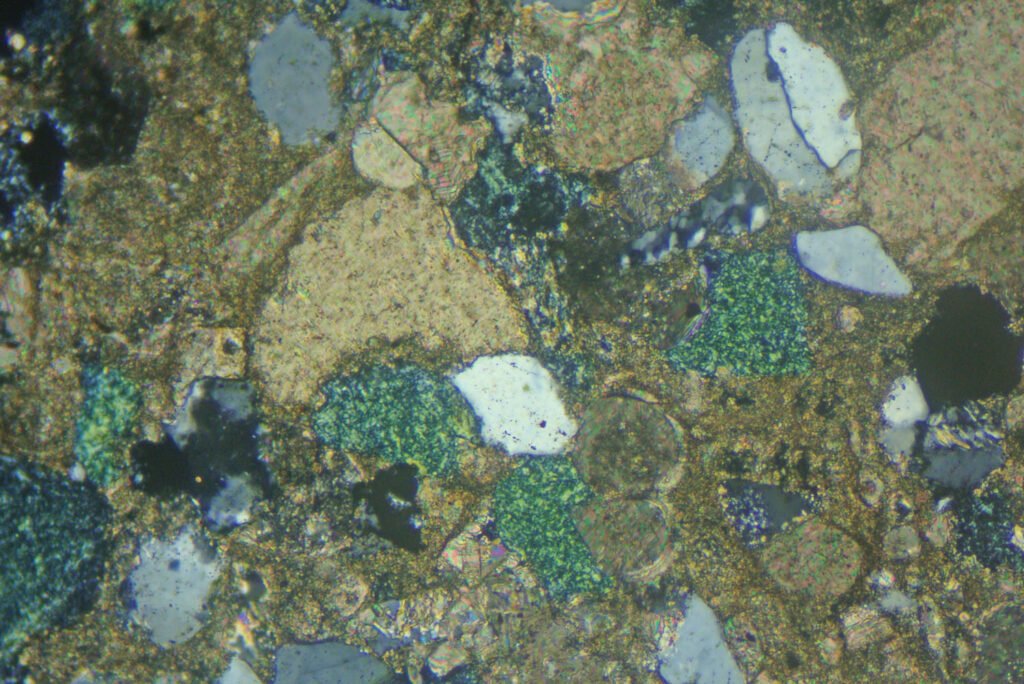
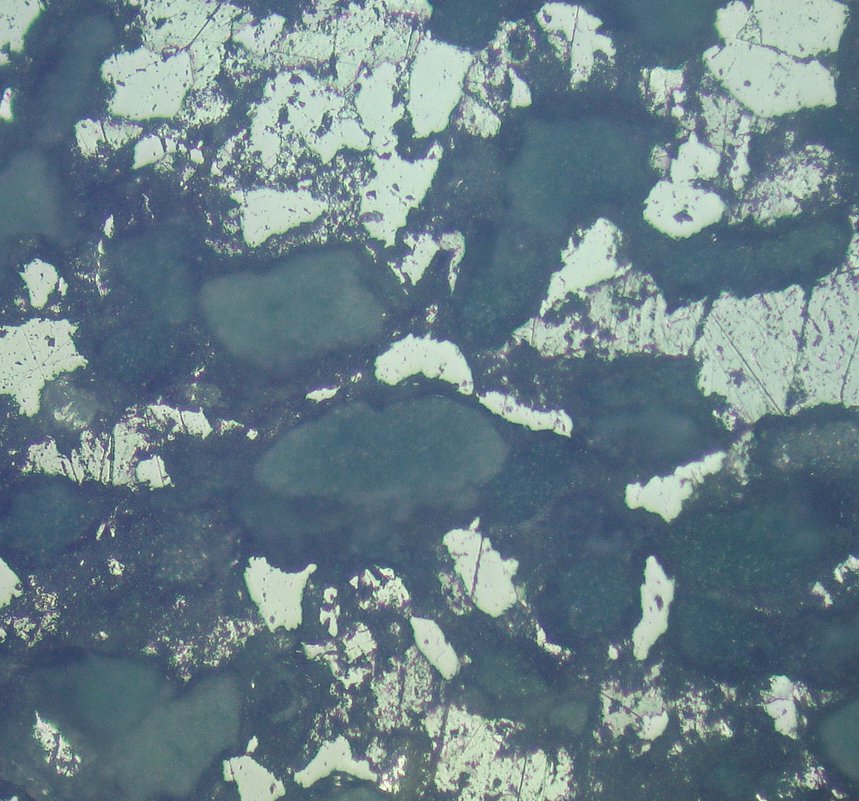
Habits: Glauconites typically occur as rounded to elliptical aggregates (“pellets”) composed of very fine-grained particles with a micaceous habit.
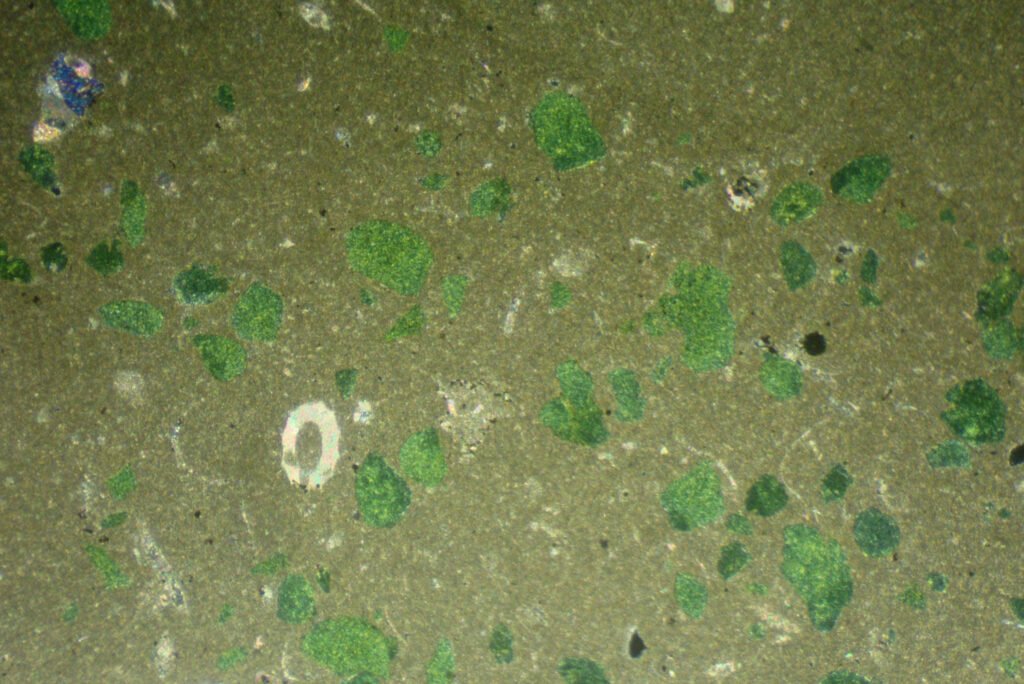
CROSSED POLARIZED LIGHT – XPL
Birefringence and Interference Colors: 0,020 a 0,032: cores fortes de 1ª ordem até início de 2ª ordem, geralmente mascaradas pela cor forte do mineral. A birrefringência aumenta com o aumento do teor em Fe.
Extinction: 2-3º oblique (simulates parallel extinction!)
Elongation sign: ES(+), but the crystals are usually so small that they do not allow this identification.
Twins: No.
Zoning: No.
CONVERGENT LIGHT
Character: B(-), generally impossible to determine due to the very small size of the particles.
2V angle: 0 – 20º (calculated)
Alterations: It alters easily, with the formation of limonite.
May be confused with: Few other minerals. The habit of glauconite—in rounded aggregates of microcrystals—is very typical.
Ortho- and leptochlorite exhibit lower birefringence.
Green biotite has much higher birefringence.
Celadonite (a clay mineral) is extremely similar, but occurs in other paragenesis.
Fragments of volcanic rocks, when chloritized and occurring in sandstones, look very much like glauconite.