5. Reflected Light Microscopy
Sample preparation: after careful grinding the hausmannite acquires a good polish, clearly different according to the orientation of the section in the mineral. Its polishing hardness is:
– greater than the hardness of manganite;
– similar to the hardness of braunite.
– lower than the hardness of pyrolusite, bixbyite and jacobsite.
– much less than the hardness of bixbyite.
When the twin lamellae are oriented slightly oblique to the plane of the polished section, the polish is not good.
PLANE POLARIZED LIGHT – PPL
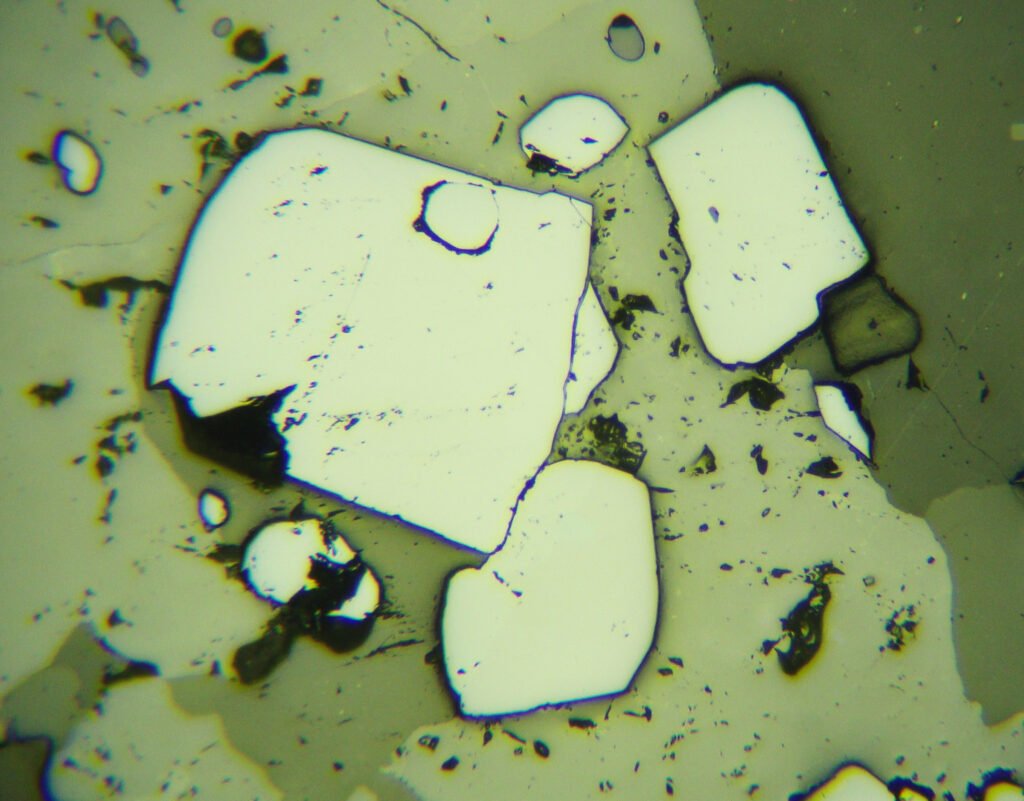
Reflection color: Medium gray to white gray, may have bluish or brownish hues.
Compared with the color of braunite, the color of hausmannite is very similar, but does not show the brownish hue.
Compared to the color of jacobsite, the color of hausmannite is somewhat more gray.
Compared to the color of bixbyite, the color of hausmannite is much darker and shows no yellow tint.
Compared to the color of magnetite, the color of hausmannite under certain circumstances is very similar.
Pleochroism: No.
Reflectivity: 20.06 – 15.81%
Bireflectance: Faint to distinct in shades of gray.
CROSSED POLARIZED LIGHT – XPL
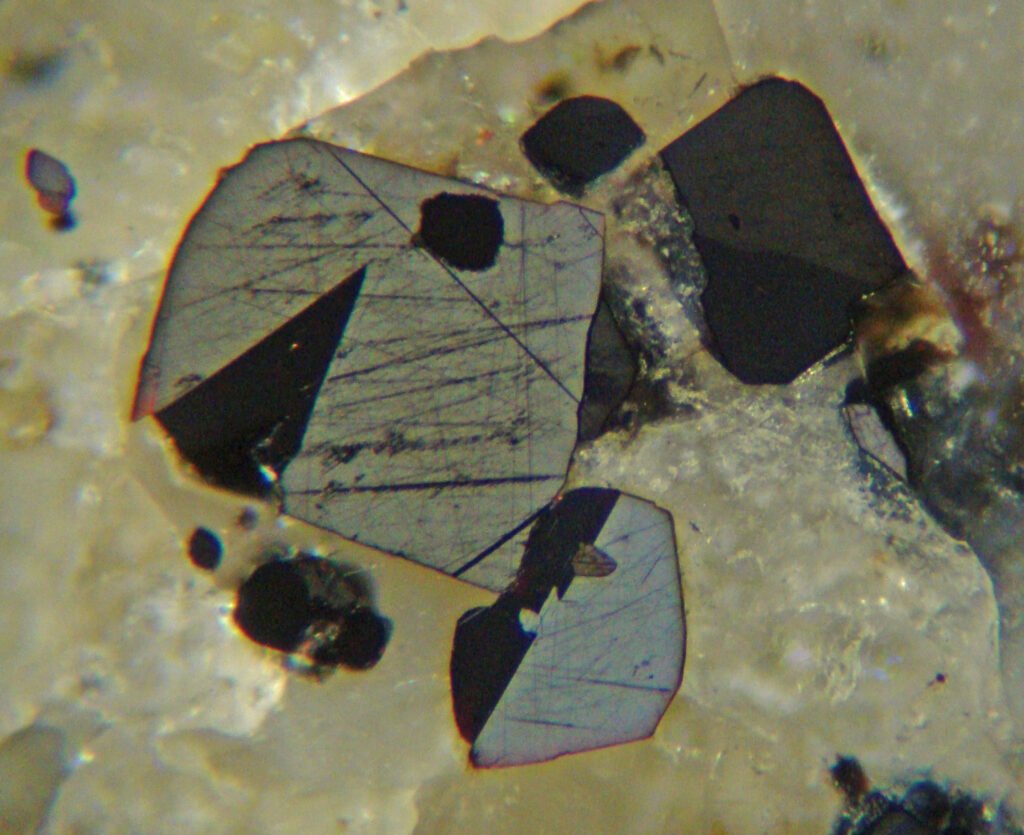
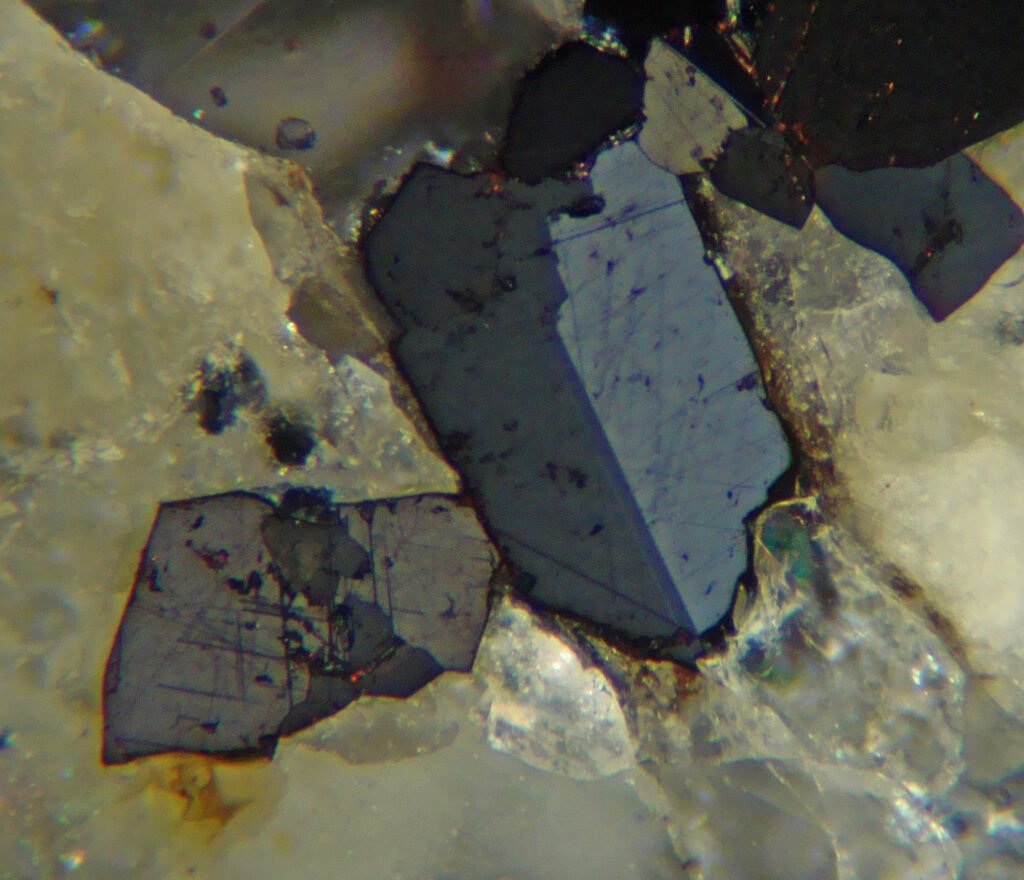
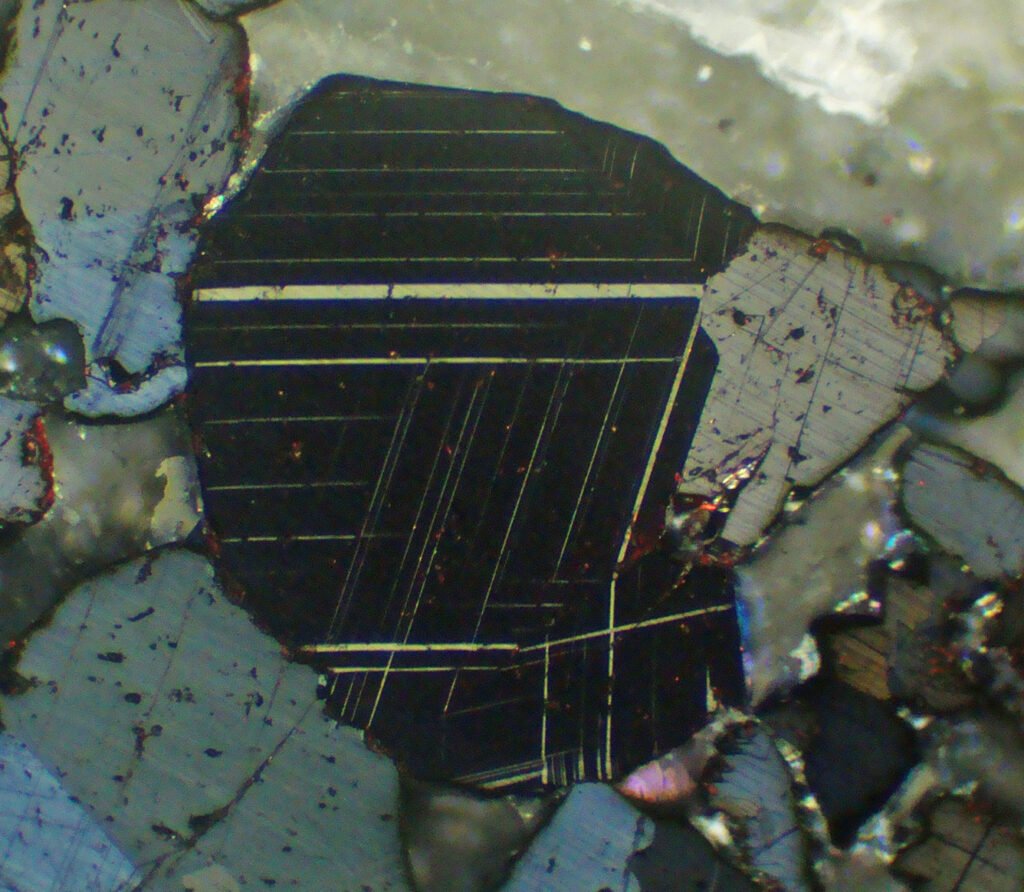
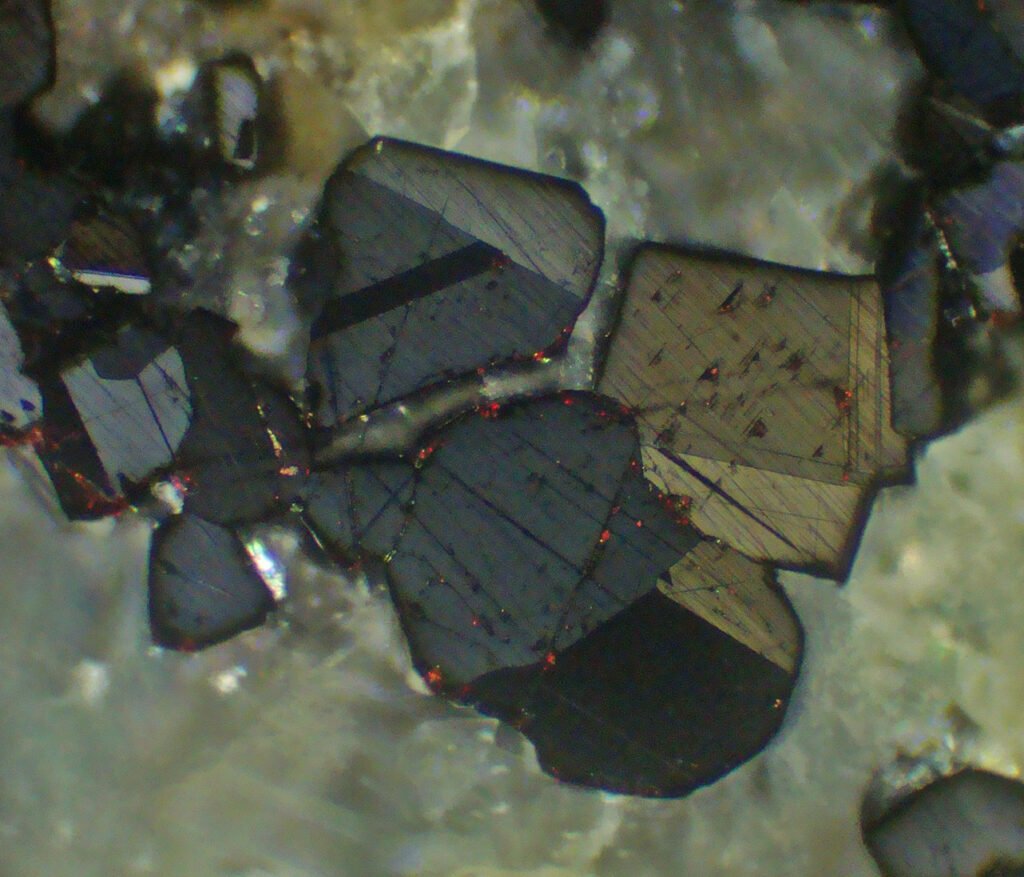
Isotropy / Anisotropy: Distinct to strong anisotropy from greenish gray to dark, with no associated vivid colors. Some literature refers to yellowish-brown or yellow-brown to light gray or bluish gray.
Extinction is not complete.
In the darkest position, many polishing grooves become visible.
Internal reflections: Internal reflections in blood red to deep blood red and reddish brown or orange may occur, but are not abundant.
May be confused with: a number of other minerals.
Magnetite and jacobsite are isotropic.
Braunite has weaker anisotropy and absent or rare twins.
Manganite can be very similar but lacks twins and shows strong anisotropy with other colors.
Wolframite acquires worse polishing, presents only single twins and other paragenesis.
Valleriite has higher reflectivity with yellow hue and is bluish in PPL.
General Characteristics:
Grain shape: the grains have a strong tendency to idiomorphy. Grains can also be anhedral, equigranular, coarse-grained, and veined. Mosaic texture may occur.
Cleavage (001) is rarely visible.
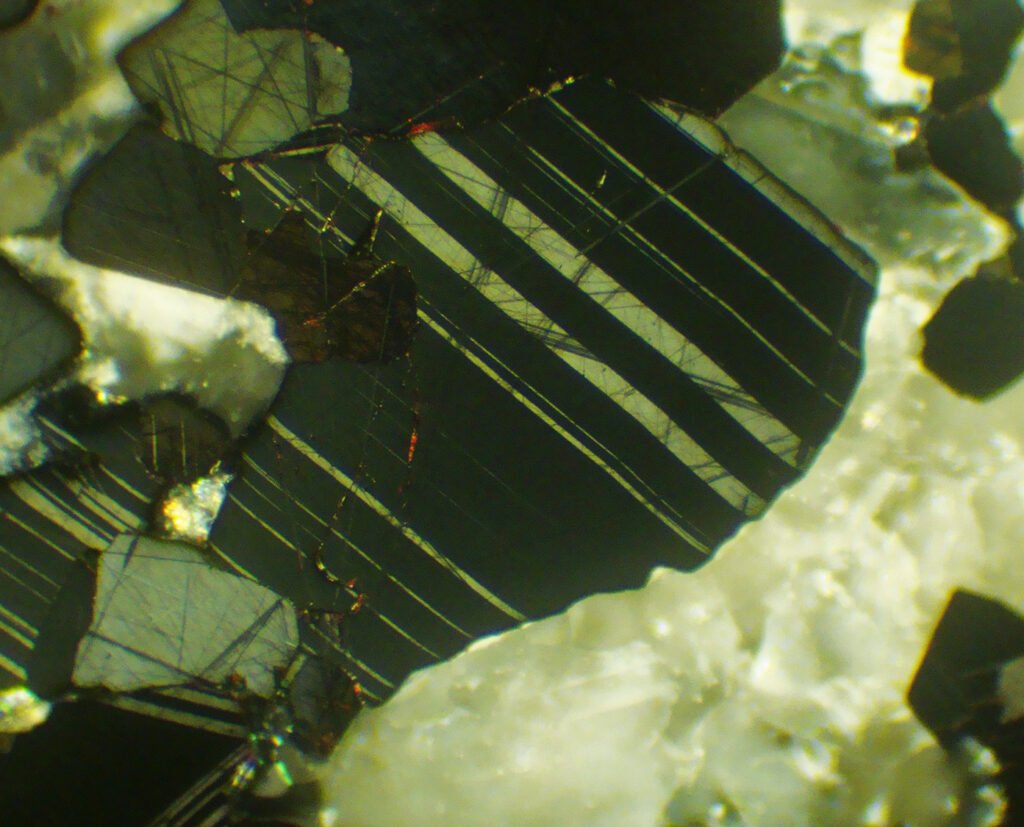
Twinning: generally lamellar twins are common, following a plane (101). The number and width of the lamellae is very variable, both in the same sample and in the same individual crystal. A series of twin lamellae is often arranged in a stairway fashion against another series of twinning lamellae. The lamellae can cross. Very often twin lamellae are similar to those of plagioclase or microcline. The gills are oblique to extinction. Non-twinned grains may occur.
Inclusions: idiomorphic inclusions of braunite, arranged without a defined orientation, can be found in some hausmannites. When braunite and hausmannite occur together, the braunite is preferentially idiomorphic. Manganosite inclusions also occur.
Substitutions 1: replacement of hausmannite by pyrolusite neoformations from fractures may occur and may lead to complete replacement of hausmannite. This can be observed in all samples, at least incipiently. Hausmannite can also be replaced by psilomelane, cryptomelane and braunite.
Substitutions 2: hausmannite can replace bixbyite (starting from fine veins), braunite, manganese carbonates and manganosite.
Alteration of hausmannite leads to the formation of pyrolusite and psilomelane.
Regular intergrowths (epitaxys) of jacobsite with hausmannite are called β-vredenburgite; in this association, jacobsite forms the matrix and hausmannite the lamellar network. The term “vredenburgite” was originally used for a material from India that consisted of lamellae of hausmannite in a jacosite matrix. Also applicable to hausmannite lamellae in galaxite or zincite. The term applies to oriented exsolution lamellae from one mineral to another, both of which are oxides rich in Mn and/or Zn.