
HEMIMORPHITE
Hemimorphite – Zn4Si2O7(OH)2·H2O – is a relatively common sorosilicate, characteristic of oxidation zones of Zn sulfide ores. It makes up, along with smithsonite and hydrozincite, the Zn ore called “calamine” by the mining industry.
The name hemimorphite derives from the fact that the mineral crystallizes in the orthorhombic pyramidal class, forming crystals with a pyramid at one end and several domes with a pedion at the other, appearing as if the form (=”morphos”) is half-developed (=”hemi”). This hemimorphy only becomes apparent in biterminate crystals. Individual crystals can reach 10 cm in length.
Hemimorphite can contain Fe and Cu and is strongly pyroelectric and piezoelectric. It sometimes exhibits strong green fluorescence under shortwave UV light and weak pink fluorescence under longwave UV light.
Macroscopically, it is not possible to differentiate hemimorphite from smithsonite when it does not occur in large, well-formed crystals. When massive, cryptocrystalline, or exhibiting other less characteristic habits and colors, hemimorphite can be confused with many other transparent and colorless minerals. For decades, smithsonite and hemimorphite were believed to be one and the same mineral, due to their striking similarity.
1. Characteristics
Crystal system: Orthorhombic piramidal.
Color: Colorless, white, pale blue, pale green, gray, brown when with impurities.
Habit: Polar crystals, fan-shaped aggregates, massive, mammillated, stalactitic, crusts, layers, granular, etc.
Cleavage: {110} perfect, {101} poor, {001} rare. Striations // to [001].
Tenacity: Brittle.
Twinning: On {001}, rare.
Fracture: Irregular to conchoidal.
Mohs Hardness: 4.5 – 5
Parting: No.
Streak: White.
Lustre: Vitreous, adamantine, rarely silky.
Diaphaneity: Transparent.
Density (g/cm³): 3.5
2. Geology and Deposits
Hemimorphite typically occurs as a secondary mineral, usually formed by oxidation in the upper portions (oxidation zones – “iron cap” or “gossan”) of Zn ores, generally from sphalerite.
It also occurs in veins and layers in stratified limestone rocks and by metasomatic origin.
3. Mineral Associations
It occurs associated with some common gangue minerals such as quartz, carbonates (calcite, dolomite) and pyrite.
Due to its genesis as a secondary mineral of sphalerite, it is associated with sphalerite itself and other secondary Zn minerals such as hydrozincite, hopeite, auricalcite, rosasite, adamite, willemite and veszelyite.
As sphalerite generally occurs associated with galena, hemimorphite occurs associated with galena remnants and secondary Pb minerals such as anglesite, cerussite, wulfenite, coronadite, plattnerite and mimetite.
It also occurs with chrysocolla, limonite (goethite), talc and chlorite.
4. Transmitted Light Microscopy
Refraction indices: nα: 1.614 nβ: 1.617 nγ: 1.636
PLANE POLARIZED LIGHT – PPL
Color / Pleochroism: Colorless.
Relief: Moderate.
Cleavage: {110} perfect and two other poor ones may be visible.
Cleavages and fractures in hemimorphite may be filled by hopeite (ZnZn2(PO4)2 · 4H2O).
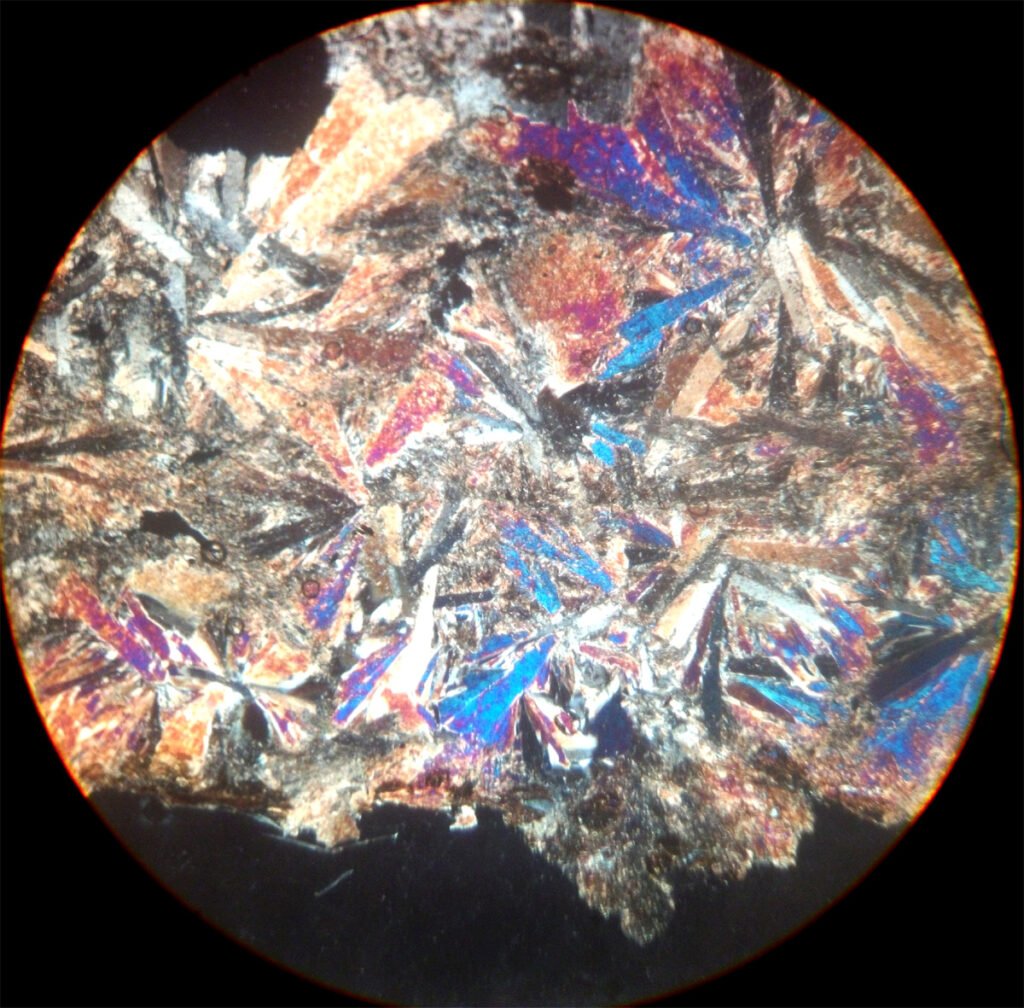
Habits: Crystals are common in cavities, can form well-developed radial aggregates, and can completely fill cavities, associated or not with a goethite rim on the cavity wall. The aggregates can form spheres that can coalesce to form botryoidal aggregates.
Generally, hemimorphite forms small anhedral grains, for example within veins containing Fe oxidation material in the vicinity of sphalerite and pyrite.
Brecciation after crystal formation can occur.
CROSSED POLARIZED LIGHT – XPL
Birefringence and Interference Colors: Maximum birefringence of 0.022, corresponding to colors from gray, white, yellow, orange, red/purple up to the final 1st order blue.
Extinction: Parallel, as expected of an orthorhombic mineral.
Elongation sign: No information available.
Twins: {001} rare.
Zoning: No.
CONVERGENT LIGHT
Character: B(+)
2V angle: 46º
Alterations: Hemimorphite alters to hydrozincite.
May be confused with: Smithsonite.
Hemimorphite can form alongside sphalerite crystals, recognized under transmitted light by its strong reddish-brown color (or yellow! Depending on the Fe content).
When hemimorphite occurs disseminated in very small grains, for example between carbonate grains, its identification requires other analytical methods.
5. Reflected Light Microscopy
Reflected light microscopy is clearly not the recommended analytical method for identifying hemimorphite. However, it is important to prepare a polished slide or section to identify the opaque minerals that occur associated with hemimorphite, such as pyrite and galena.
Sample preparation: Polishing hemimorphite is simple and results in good quality polishing.
PLANE POLARIZED LIGHT – PPL
Reflection color: Dark gray. There are some colored internal reflections even in PPL.
Pleochroism: No.
Reflectivity: Very low.
Bireflectance: No.
CROSSED POLARIZED LIGHT – XPL
Isotropy / Anisotropy: It is not possible to perceive isotropy or anisotropy as a function of internal reflections.
Internal reflections: Widespread, colorless, milky and multicolored.
May be confused with: Other colorless minerals, such as smithsonite, prehnite, and many others.
It is not possible to identify hemimorphite under reflected light.
General Characteristics:
Polishing scratches may occur.
Polishing pits, poorly defined, may occur if the crystals are large.