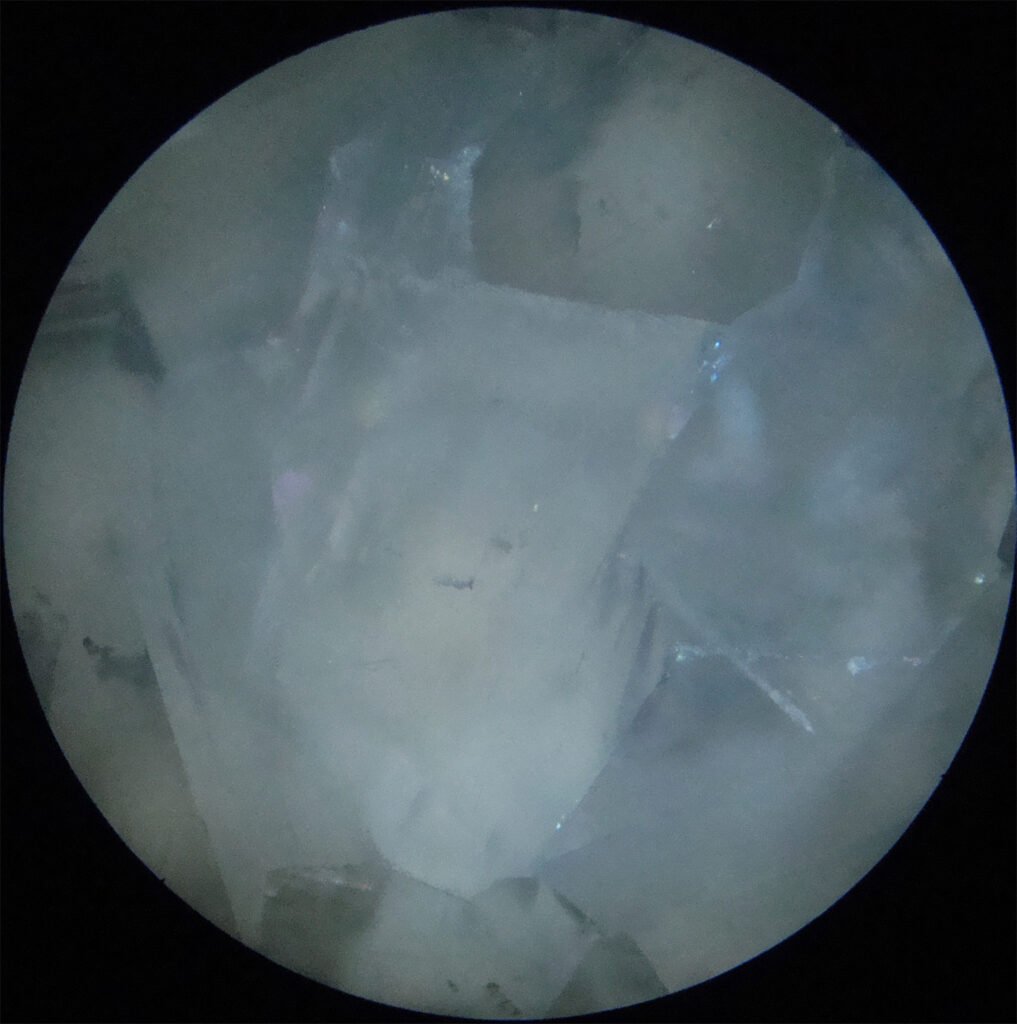
1. Characteristics
Crystal system: Monoclinic prismatic.
Color: Colorless, white, more rarely red, green, brown or yellow.
Habit: Tabular, coffin-shaped (trapezoidal). Granular, massive. Idiomorphy is common.
Cleavage: {010} perfect.
Tenacity: Brittle.
Twinning: On {100}.
Fracture: Irregular, conchoidal.
Mohs Hardness: 3.5 – 4
Parting: No.
Streak: White.
Lustre: Vitreous, pearly on cleavage planes.
Diaphaneity: Transparent.
Density (g/cm³): 2.1 – 2.2
2. Geology and Deposits
Heulandite occurs as a filling of cavities in basaltic rocks (basalts, diabases, gabbros), acidic volcanic rocks (rhyolites, rhyodacites, dacites) and andesites. It can also occur associated with serpentinites, pegmatites and active hydrothermal systems.
It is formed as a product of devitrification of volcanic glasses and tuffs, when it constitutes ore. It integrates the zeolite facies of regional metamorphic rocks and may constitute the diagenetic matrix of sandstones.
A detailed account of the occurrence, forms and other details of heulandite can be found in the book “Zeolites of the World” by Rudy Tschernich, available for download on the internet. Detailed information on the various ways in which heulandite occurs can be found on the website of the Commission on Natural Zeolites: http://www.iza-online.org/ .
3. Mineral Associations
Heulandite occurs with the minerals that form the host rocks, generally mafic and intermediate igneous rocks: olivines, clinopyroxenes (augite, pigeonite), plagioclases (labradorite), magnetite, ilmenite, chalcopyrite, pyrite, native copper and alteration minerals such as goethite, covellite, cuprite, malachite and others.
It is part of the assembly of secondary minerals common in basaltic rock cavities, such as quartz (including amethyst variety), chalcedony, calcite, powellite, prehnite, datolite, babingtonite, fluorapophyllite, clay minerals (celadonite) and others. Other zeolites such as laumontite, chabazite-(Ca), mordenite, okenite, analcima, stilbite-Ca, scolecite and gyrolite can also be found in these cavities.
4. Transmitted Light Microscopy
Refraction indices: nα: 1.496 – 1.499 nβ: 1.497 – 1.500 nγ: 1.501 – 1.505
PLANE POLARIZED LIGHT – PPL
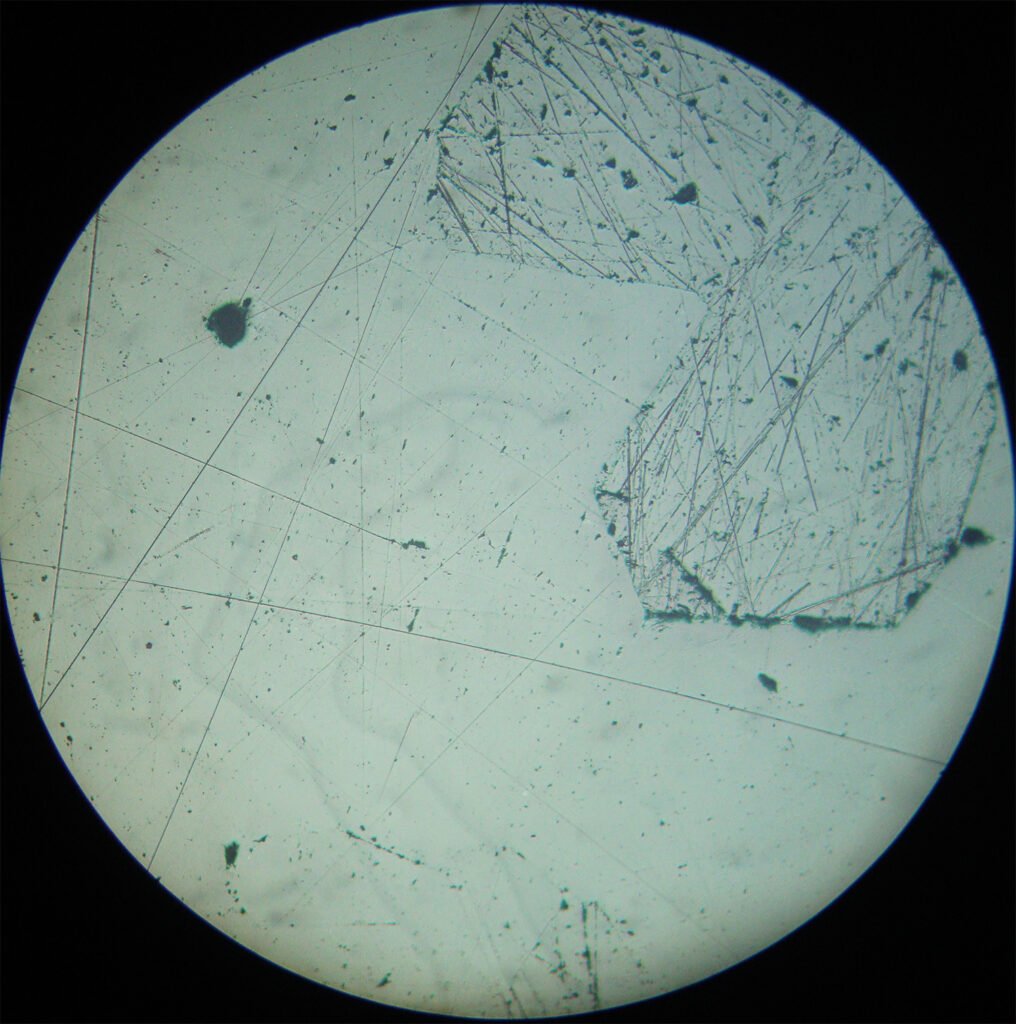
Color / Pleochroism: Colorless. It may appear reddish due to Fe oxide inclusions.
Relief: Low to moderate.
Cleavage: {010} perfect.
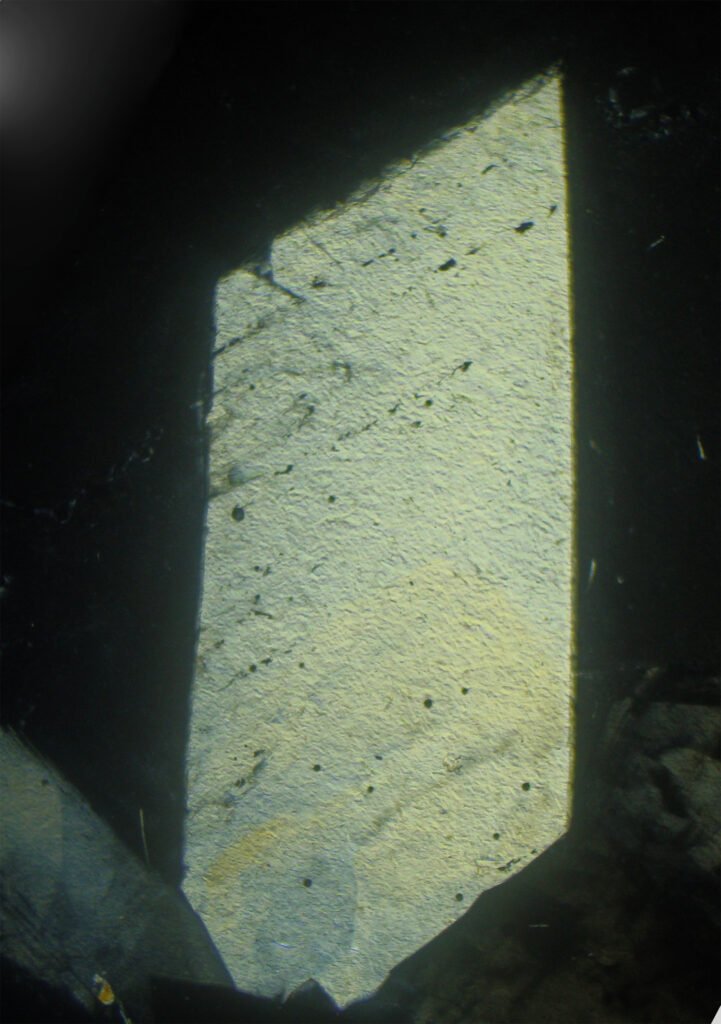
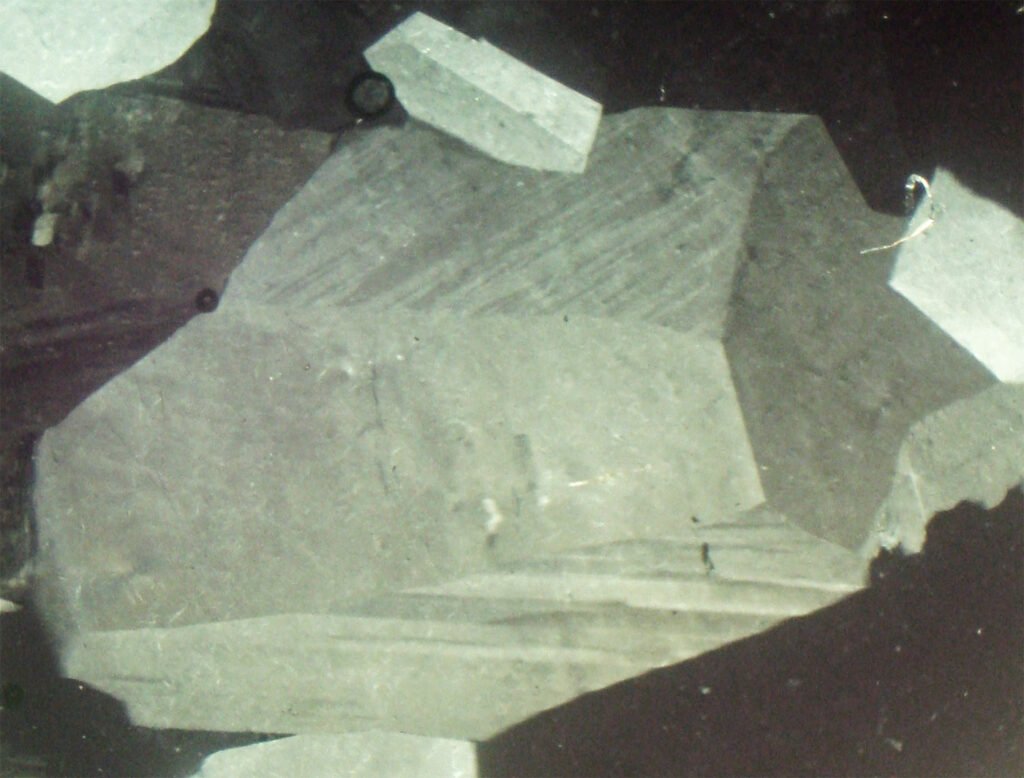
Habits: tabular to elongated crystals, wider at the center and narrower at both ends: “coffin-shaped” (trapezoidal). It forms subparallel aggregates. Perfect cleavage can result in holes in the thin sections where portions of heulandite from sections perpendicular to the cleavage were torn off during the making of the thin section.
CROSSED POLARIZED LIGHT – XPL
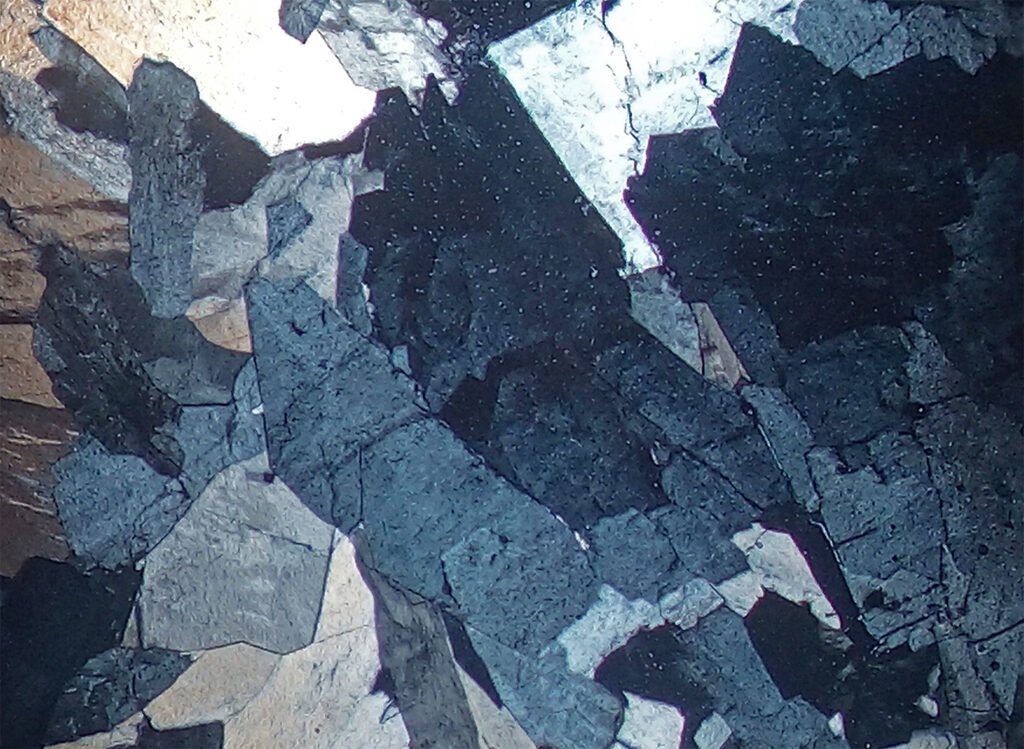
Birefringence and Interference Colors: birefringence of 0.005 to 0.009, corresponding to 1st order medium colors: gray in various shades and white, not reaching straw yellow.
Extinction: oblique, angle between 0 and 32º.
Sections with the {010} cleavage vertically show parallel extinction.
Sections parallel to {010} show no cleavage, have oblique extinction to form, and show very low birefringence (dark gray colors).
Elongation sign: ES(-)
Twins: Form twins along the {100} plane.
Zoning: No, but sectorizing is very common.
CONVERGENT LIGHT
Character: B(+). It can simulate being uniaxial.
2V angle: 0 – 55º, usually between 10º – 48º, more commonly between 30º – 34º.
Alterations: heulandite alters to clay minerals and other zeolites.
May be confused with: several other zeolites.
Scolecite and laumontite are B(-).
Stilbite has other twins and other habits (bow-tie-shaped radiated aggregates).
Natrolite exhibit parallel extinction and square basal sections.