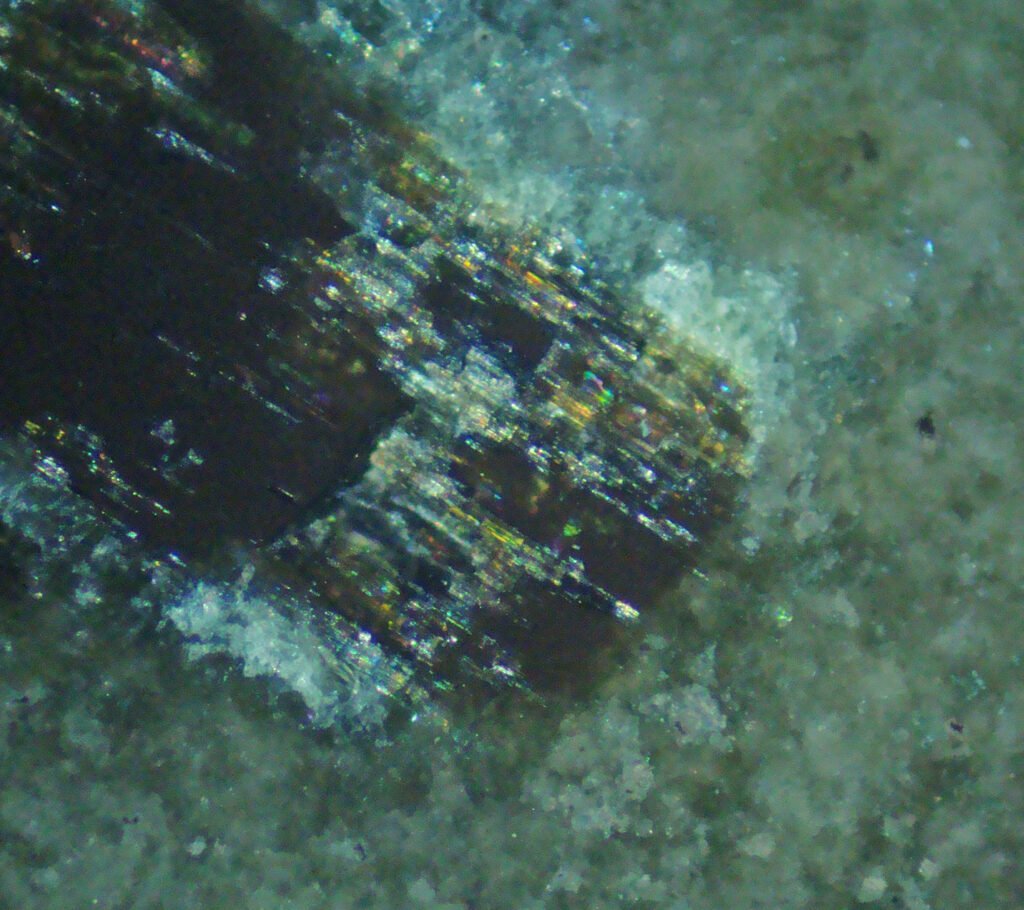
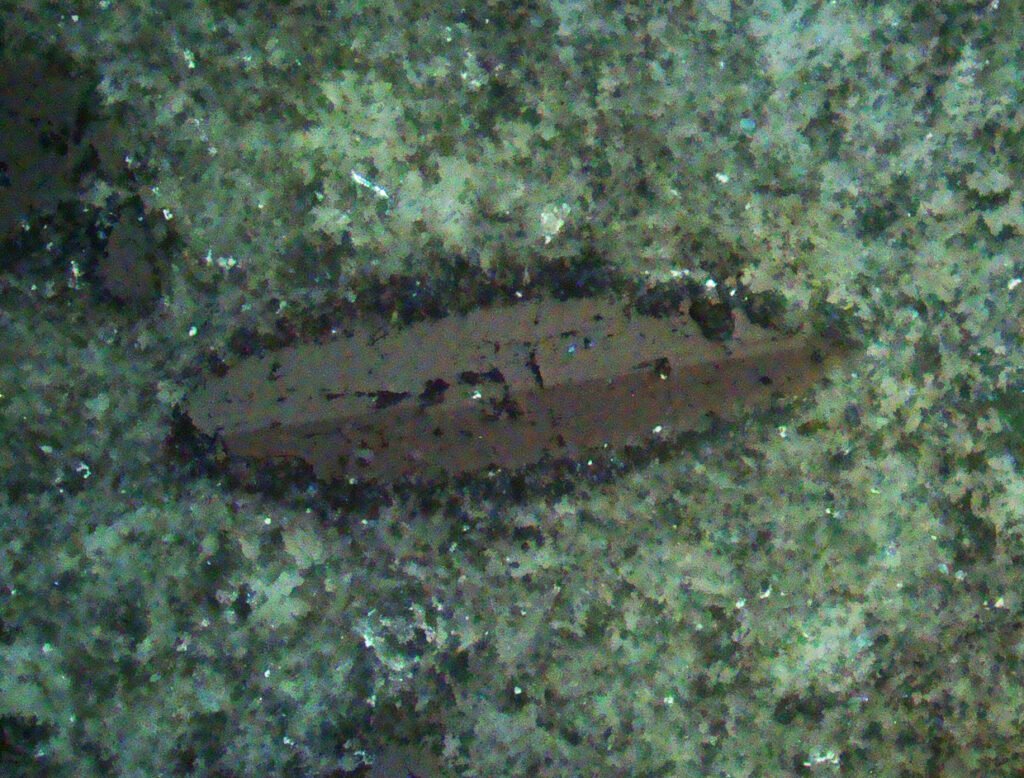
1. Characteristics
Crystal system: Monoclinic prismatic.
Color: Dark brown to black, with undertones of green, blue or yellow, depending on the mineral.
Habit: Prismatic short to long, massive, granular, fibrous, skeletal.
Cleavage: {110} perfect, typical for amphiboles.
Tenacity: Brittle.
Twinning: Common.
Fracture: No information.
Mohs Hardness: 5 – 6
Parting: No.
Streak: Pale gray-brown.
Lustre: Vitreous.
Diaphaneity: Transparent.
Density (g/cm³): ~3.2
2. Geology and Deposits
Brown hornblendes, in general, occur in intermediate to acidic igneous rocks, such as biotite-hornblende dacites, fourth-latite andesites, ignimbrites and other types of pyroclastic rocks.
Kaersutite is relatively rare and occurs in basic plutonic, volcanic and subvolcanic rocks (dykes) such as essexites, theralites, tephrites, basanites, camptonites, monchiquites, etc. It is rare in alkaline basalts where it occurs in gabbroic or peridotite nodules. Syenites, monzonites, carbonatitic tuffs and alkaline gabbros may occur.
Katophorite occurs in alkaline (volcanic and plutonic) magmatic rocks such as nepheline-syenites and in subvolcanic Na-shonquinites such as phono-nephelinites. Also in jadeitites of blueschist facies.
3. Mineral Associations
The minerals that make up the “brown hornblendes” are associated with titanoaugite, olivine, calc-sodium feldspars (albite), potassium feldspars (microclinium), feldspathoids (nepheline), fluorapatite, biotite, zircon and eudialite.
Katophorite is found with arfvedsonite, aegirine, chromite, and eckermannite, as well as a number of rare and very rare minerals such as vlasovite, gittingsite, miserite, agrellite, and mosandrite-(Ce).
Kaersutite is associated with hematite, ilmenite, spinel, Ti-pargasite, titanite and garnet (pyrope), in addition to rare minerals such as rhönite.
4. Transmitted Light Microscopy
Refraction indices: nα: 1.640 – 1.681 nβ: 1.658 – 1.688 nγ: 1.660 – 1.692 (Katophorite)
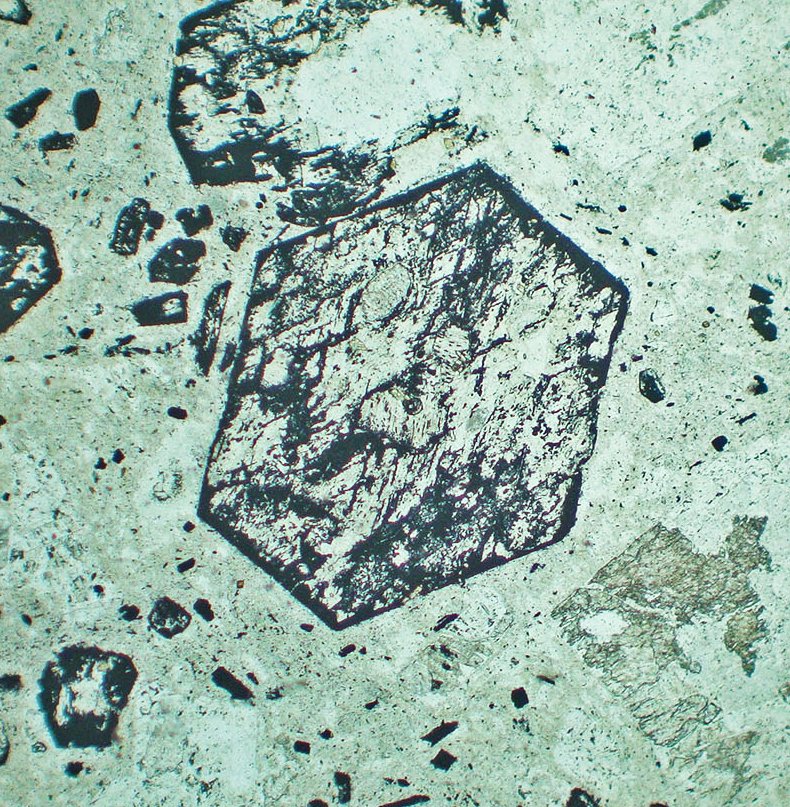
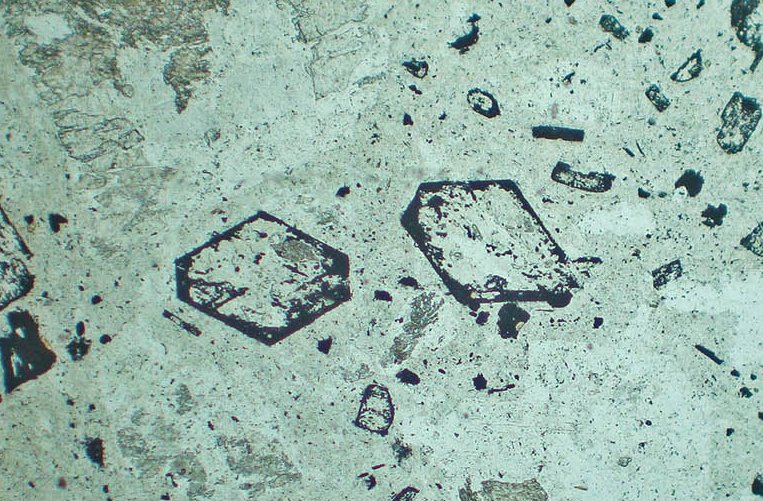
PLANE POLARIZED LIGHT – PPL
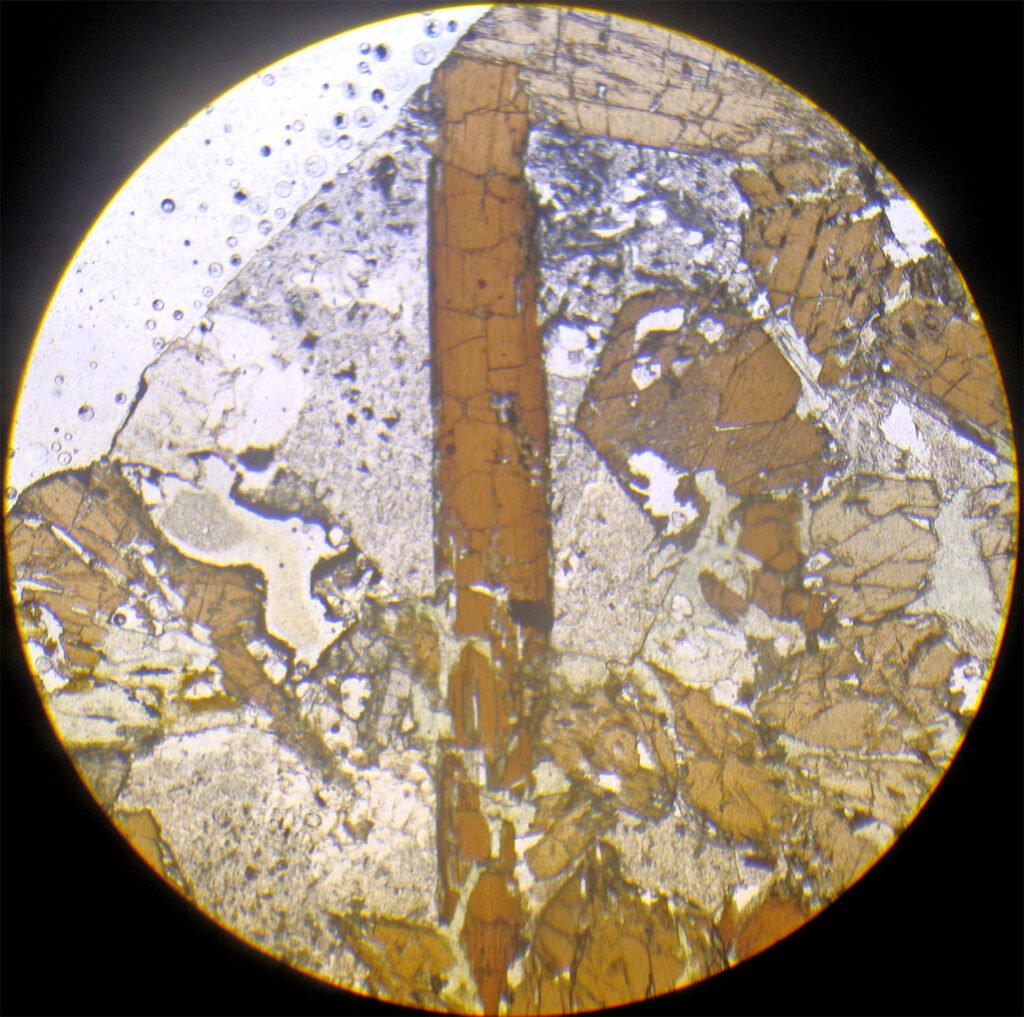
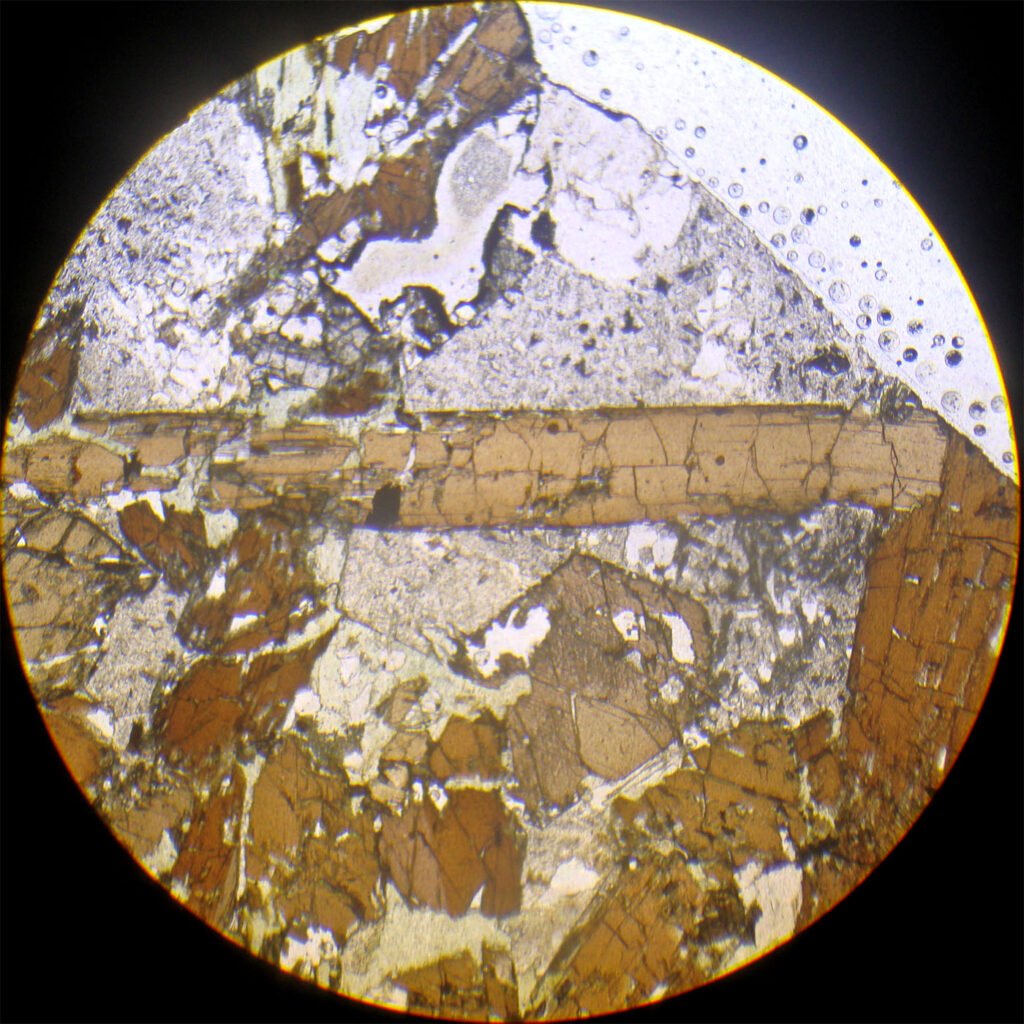
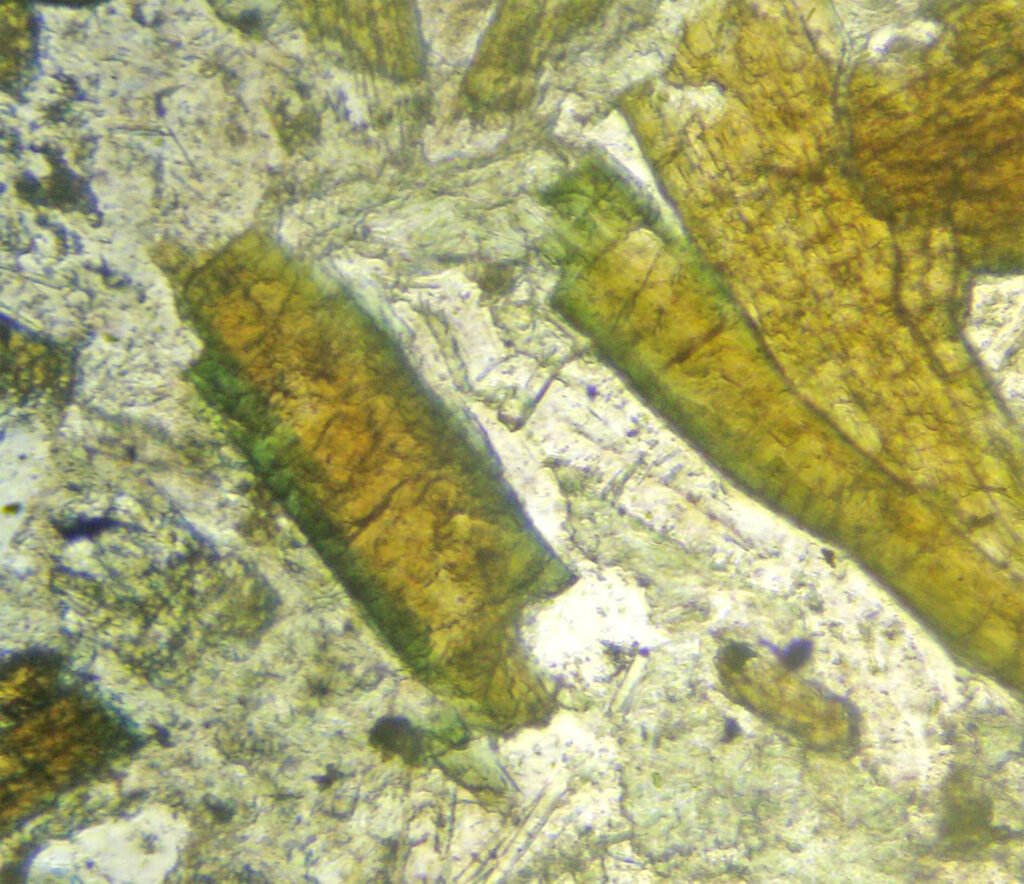
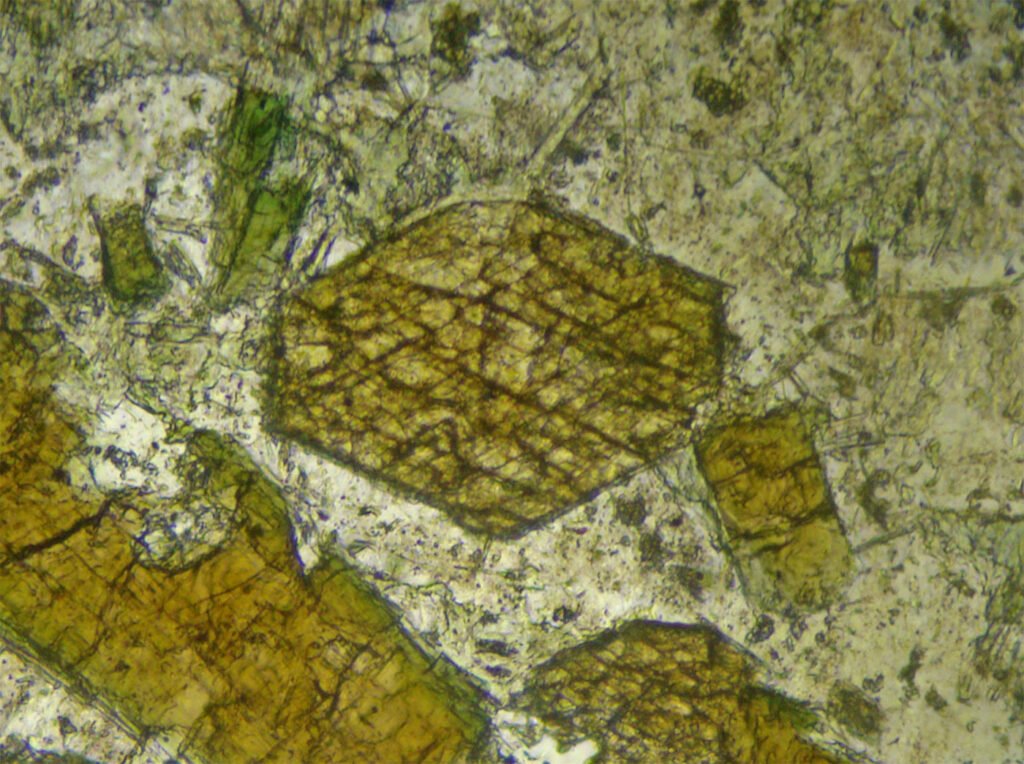
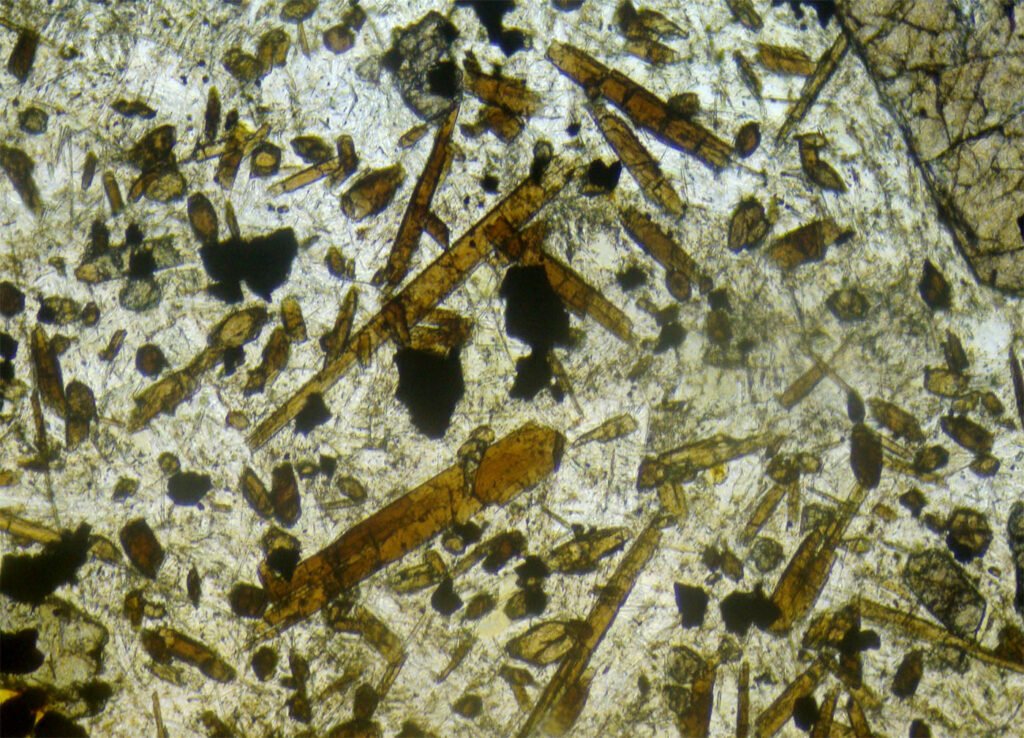
Color / Pleochroism: Deep brown and deep reddish-brown, with intense pleochroism.
Also black-brown, walnut-brown, brown-red, pale yellowish-red, yellow-orange and other colors.
The colors have an uneven distribution in spots, due to the uneven distribution of oxidation in the crystal.
Kaersutite and kathophorite have brownish colors (similar to biotite); are often sharply zoned or banded or hourglass in color.
Relief: Moderate to high.
Cleavage: {110} perfect. In the longitudinal sections there is only one cleavage. In the basal sections there are two cleavages that intersect at angles of 56 and 124º, forming the typical rhombuses of the basal sections of amphiboles.
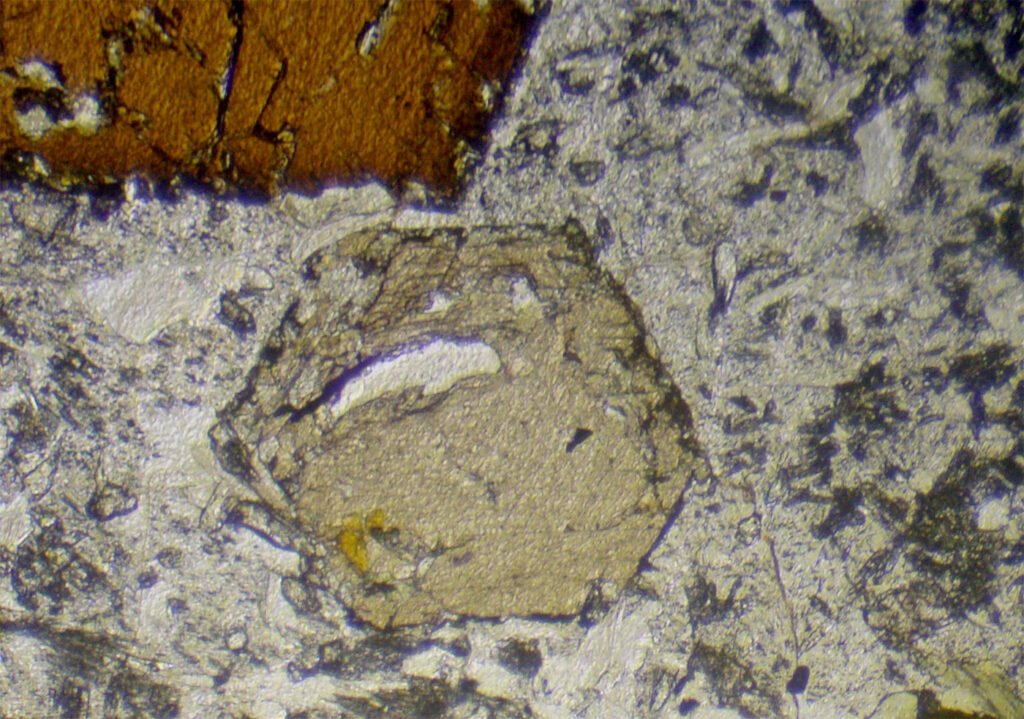
Habits: Euhedral to subhedral crystals with short to long prismatic habits, often with eroded margins.
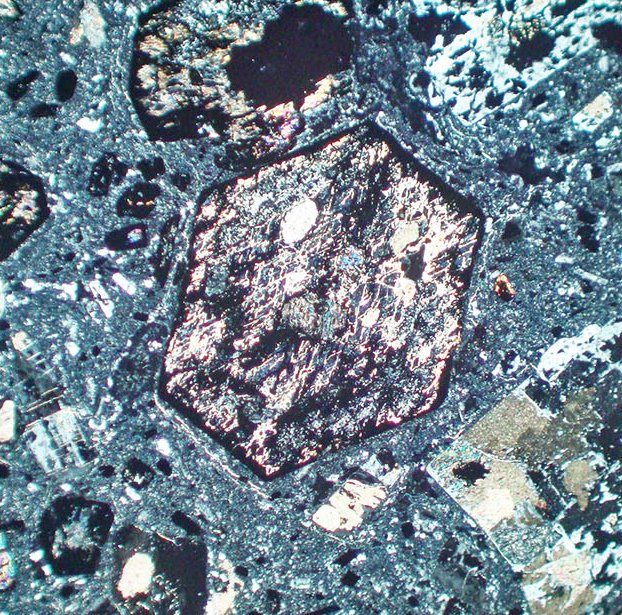
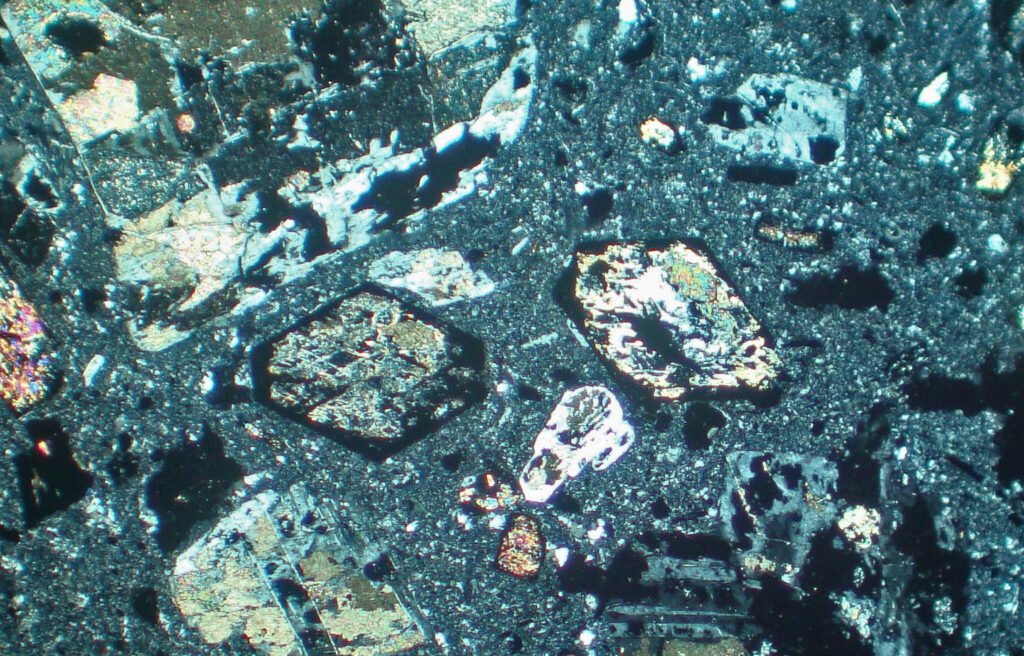
CROSSED POLARIZED LIGHT – XPL
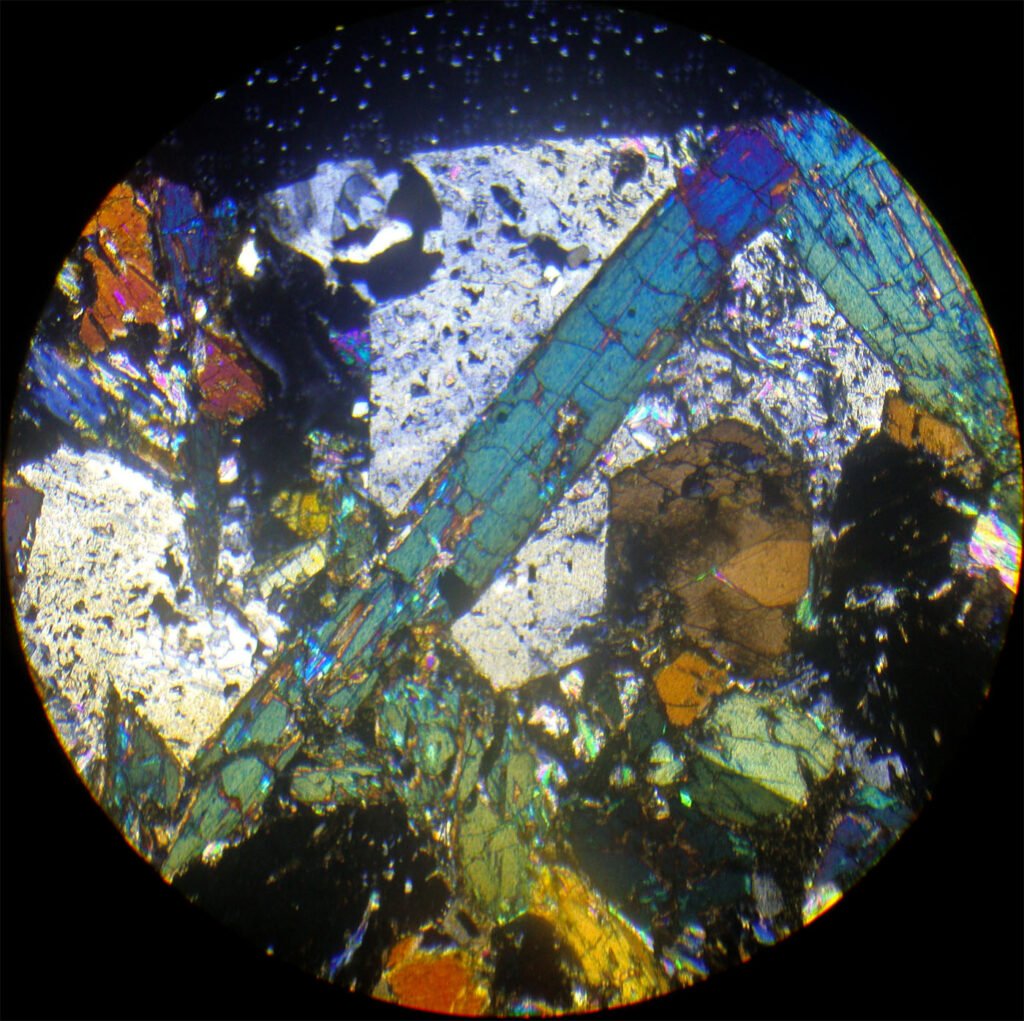
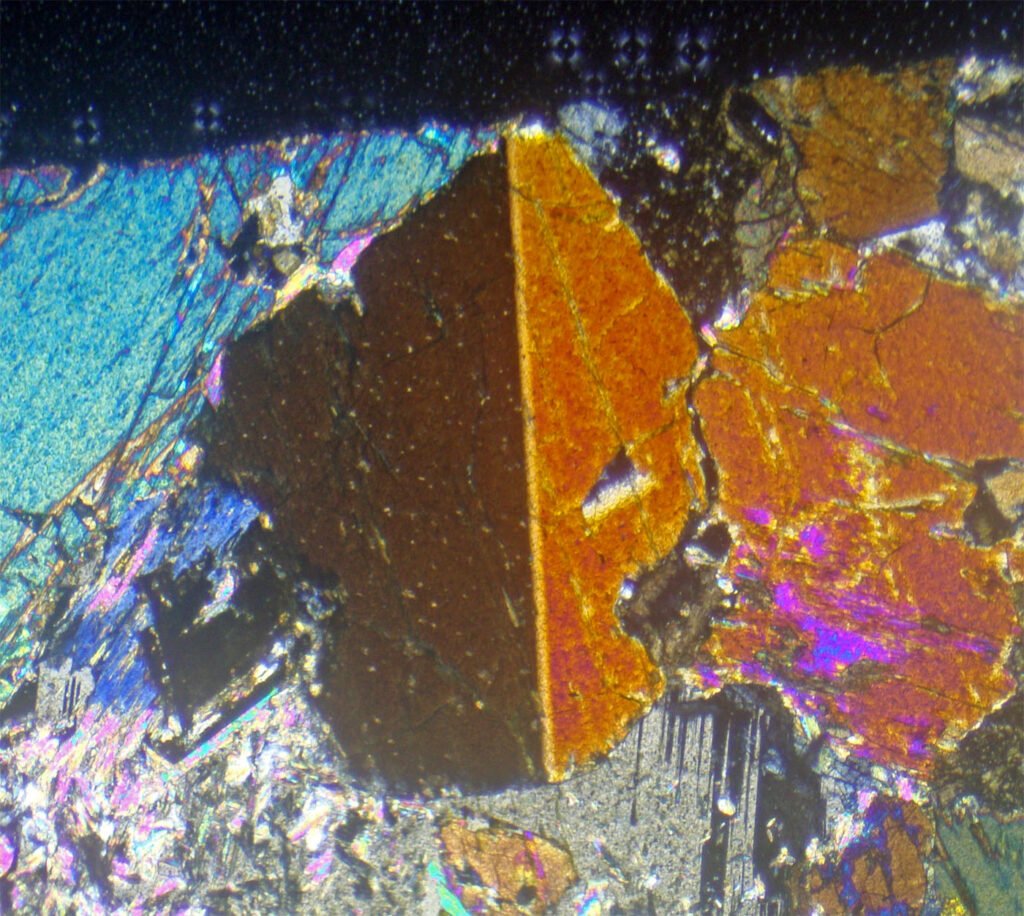
Birefringence and Interference Colors: Birefringence between 0.009 and 0.094: katophorite has low interference colors (0.009 to 0.021), kaersutite has 1st and 2nd order colors (0.026 – 0.047), similar to green hornblende. Strongly colored amphiboles usually have the interference colors masked by their own color.
Extinction: Oblique. Kaersutite 3-19º, katophorite 8-16º. Low extinction angles are very diagnostic!
Elongation sign: Kaersutite ES(+), katophorite ES(-). In strong colored minerals the elongation sign is difficult to determine.
Twins: Lamellar twins in (100) are common.
Zoning: Zonation is common, with lighter colored cores and dark edges. Color changes at multiple isomorphic levels occur.
CONVERGENT LIGHT
Character: B(-)
2V angle: 2V angle: kaersutite 74-82º (usually 80º); katophorite 0–57º (usually 35º)
Alterations: by magma imbalance, alteration to magnetite + hematite + iron-poor clinopyroxenes and others. This process is called opacitization and can affect biotite as well, initially at the margins and then throughout the entire crystal. Pressure drop also leads to corroded margins. Only in ignimbrites and in lava flows that have cooled rapidly is opacification minimal or absent.
Weathering leads to the formation of carbonate, limonite and quartz.
May be confused with: diagnostic are cleavage, strong colors and intense pleochroism.
Biotite has parallel and mottled extinction.
Stilpnomelan, in the longitudinal sections, is similar (and similar to biotite!), but the extinction is parallel. In basal sections it does not show the two amphibole cleavages. Occurs in other paragenesis.
Oxyhornblende from volcanic rocks is oxidized green hastingsite, optically very different.