5. Reflected Light Microscopy
Sample preparation: Polishing native iron requires care regarding the temperature reached during grinding and polishing; otherwise, the iron’s characteristics change. Its polishing hardness is high, though lower than that of magnetite. Polished iron tarnishes very rapidly, which is itself a diagnostic feature.
PLANE POLARIZED LIGHT – PPL
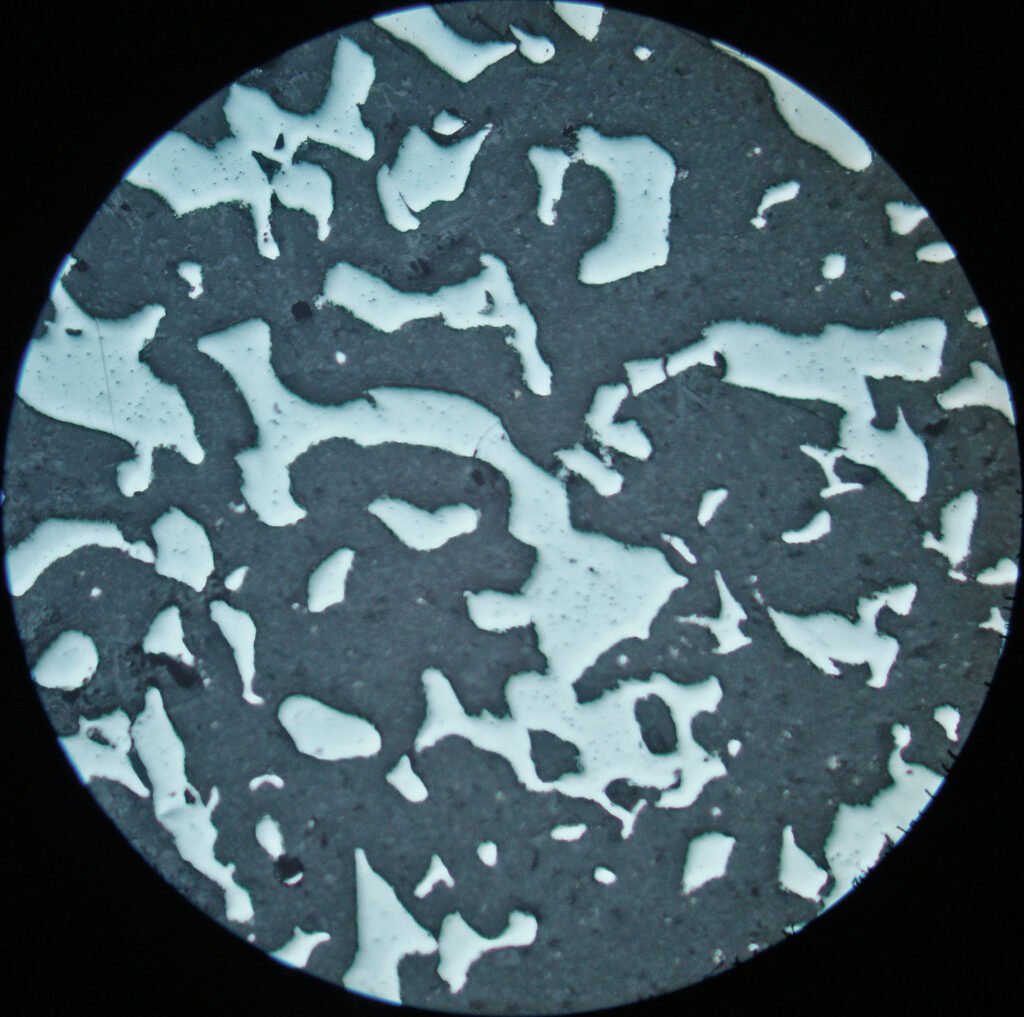
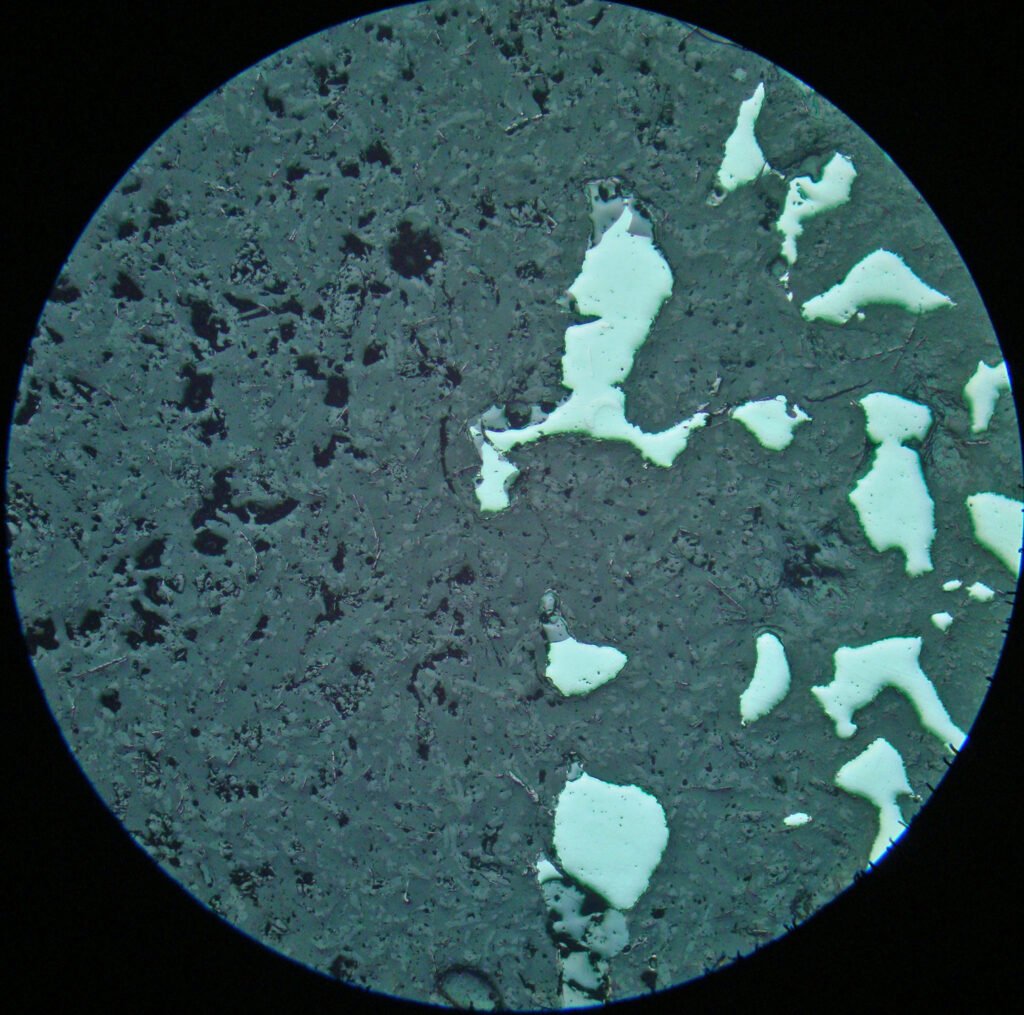
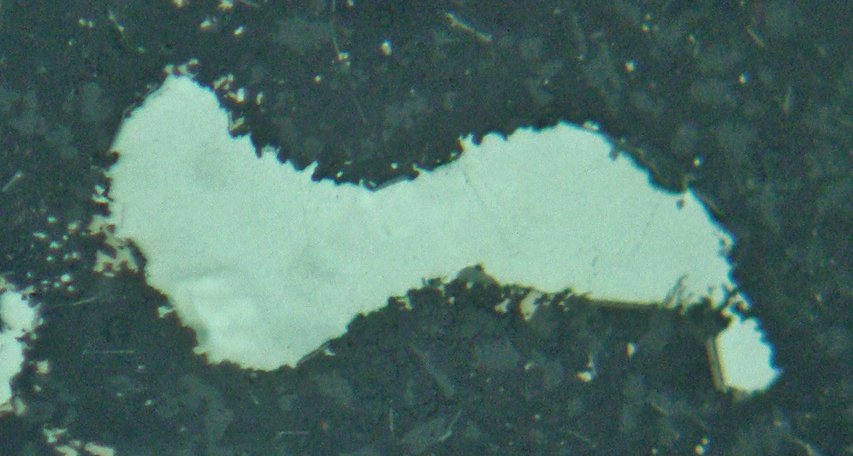
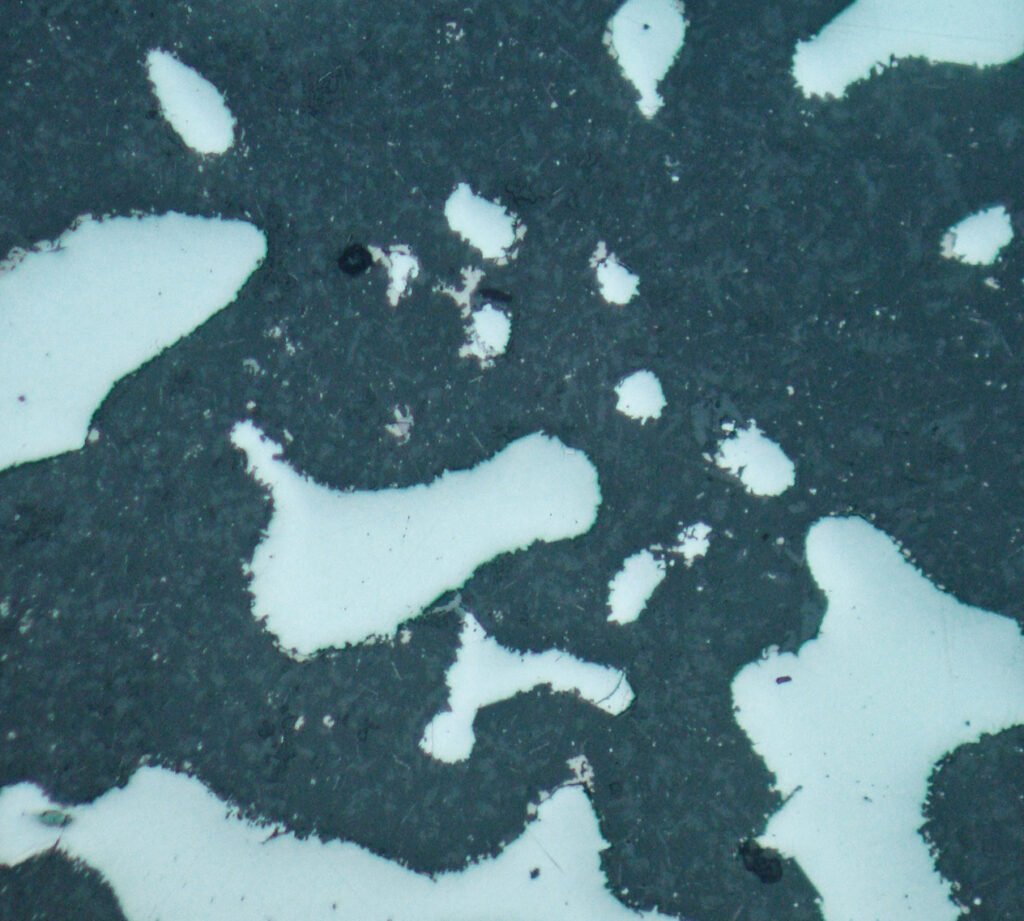
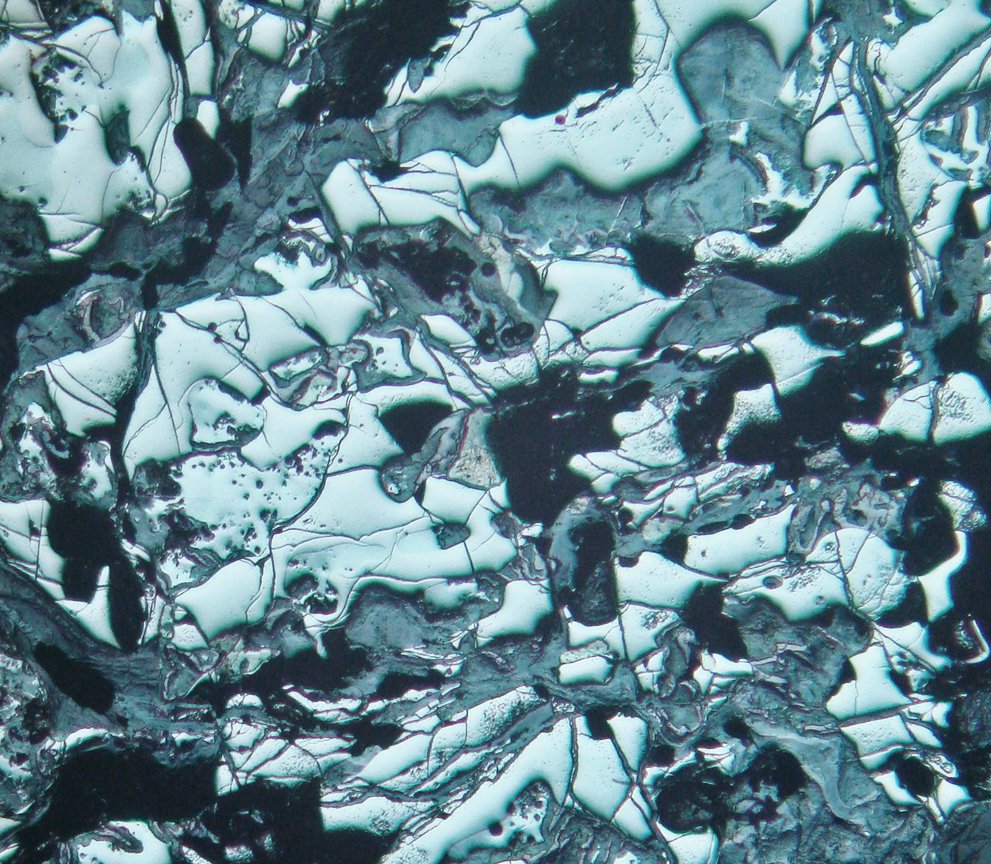
Reflection color: Pure white to light gray. Slightly bluish when compared to cohenite, which is part of the paragenesis.
Pleochroism: No.
Reflectivity: 58%
Bireflectance: No.
CROSSED POLARIZED LIGHT – XPL
Isotropy / Anisotropy: Isotropic, completely dark throughout the rotation of the stage.
Internal reflections: No.
May be confused with: various other minerals.
Platinum can look very similar, but it does not exhibit the rapid tarnishing that polished native iron undergoes, and it shows a slightly darker reflection color.
Cohenite, which is found in association, has a slightly more yellowish color and is anisotropic.
General Characteristics:
Grain shape: generally occurs as droplet-like segregations or spongy aggregates. Better-developed grains—which are quite rare—have a polygonal shape and appear strongly intergrown.
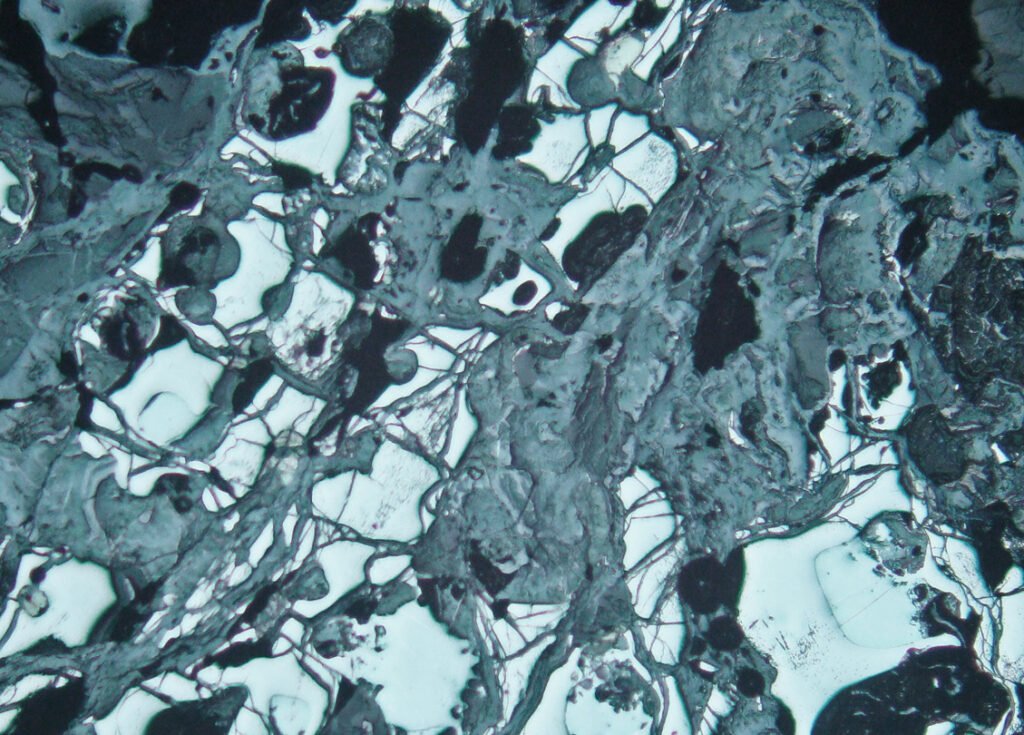
Tarnishing or atmospheric corrosion: atmospheric moisture rapidly attacks native iron associated with basalts. Oxidation processes can be prevented by coating the section with varnish.
Exsolution intergrowths of lamellar cohenite, oriented parallel to the {111} planes of the native iron, are known as pearlite. The formation of cohenite or pearlite as the groundmass depends on the carbon content (consult specific literature). Pearlite subsequently alters to oxipearlite or hydroxipearlite.
Twinning does not occur, although it is abundant in meteorites and metallurgical products.
Cleavage does not occur.
Zoning does not occur.
Wüstite inclusions may be present.
Rims surrounding the native iron may consist of ilmenite, pyrrhotite, cohenite, native copper, or magnetite.
Native iron rims occur around mackinawite.
Alteration clearly reveals tabular cohenite crystals in native iron samples with high cohenite content.
Alterations: native iron may alter to colloform hematite, goethite, or magnesioferrite. Wüstite alters to magnetite and native iron.
Oriented intergrowths of native iron and magnetite, well-developed, may occur.
Overview of the minerals of the native iron paragenesis:
None shows birreflectance nor internal reflections. Pleochroism is weak (in cohenite and troilite) or absent.
Native iron:
Reflection color: pure white with a bluish tint.
Reflectivity: 58%
Iso/Anisotropy: isotropic, completely black.
Cohenite:
Reflection color: white cream
Reflectivity: 57 – 59%
Iso/Anisotropy: weak anisotropy, compare individual grains.
Schreibersite:
Reflection color: light cream
Reflectivity: 52%
Iso/Anisotropy: anisotropic between gray and brown.
Taenite:
Reflection color: dark gray (like silicates!)
Reflectivity: 7% (extremely weak)
Iso/Anisotropy: Isotropic.
Troilite:
Reflection color: light brown, as pyrrhotite.
Reflectivity: 40%
Iso/Anisotropy: distinct anisotropy between gray and bluish.
Wüstite:
Reflection color: medium gray.
Reflectivity: 18.65%
Iso/Anisotropy: isotropic.