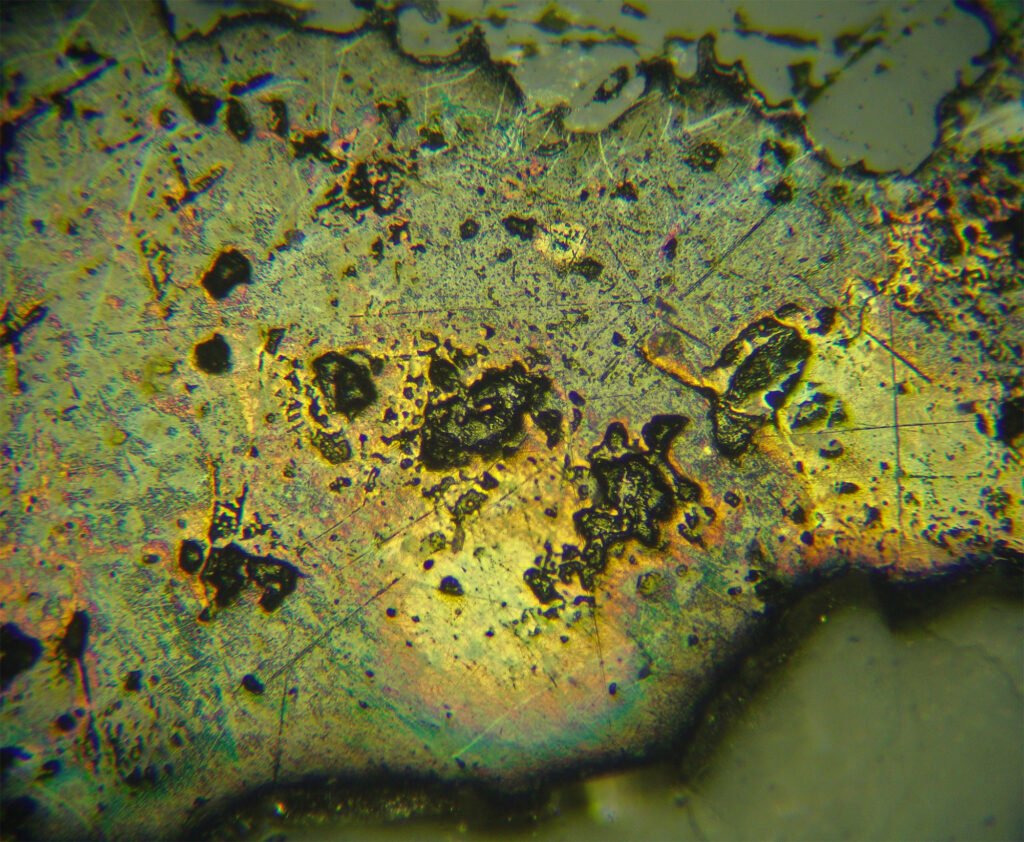
KLOCKMANNITE
Klockmannite – CuSe – is a very rare selenide, characteristic of hydrothermal veins with paragenesis of Se minerals. It may constitute ore, but Se is generally obtained as a by-product in the refining of Pb, Zn and Cu ores.
It is the Se analogue of covellite, with which it is isomorphic. It is the Cu analogue of achávalite, phreboldite and sederholmite. It is unstable under compression, decomposing to umangite and krut’aita. May contain Ag.
Klockmannite, after exposure to air, tarnishes fairly quickly, developing a chalcocite-like appearance after long storage.
1. Characteristics
Crystal system: Hexagonal bipiramidal dihexagonal.
Color: Gray-black to black. It can tarnish to blue-black.
Habit: Tabular thin to thick, can be hexagonal, can be rounded. Granular.
Cleavage: {0001} perfect.
Tenacity: No information available.
Twinning: No.
Fracture: No information available.
Mohs Hardness: 2 – 2.5
Parting: No.
Streak: No information available.
Lustre: Metallic to submetallic, becomes dull soon.
Diaphaneity: Opaque.
Density (g/cm³): 5.99
2. Geology and Deposits
Klockmannite is typical of hydrothermal veins with Se paragenesis, rich in Cu and Te. It forms from late low-temperature hydrothermal solutions.
3. Mineral Associations
In the type locality (Mina Las Asperezas, General Lamadrid, Rioja, Argentina) it is associated with other Se minerals such as umangite, eukairite, crookesite, clausthalite, chalcomenite and berzelianite.
In addition to these, it occurs with other Se minerals such as cobaltomenite, bukovite, tiemannite, bohdanowiczite and penroseite.
Occurs with common gangue minerals such as quartz and calcite.
With Cu minerals such as chalcopyrite, malachite, azurite and covellite.
Also with hematite, goethite, biotite, pyrite, tellurite, paratellurite and native gold.
It can be associated with radioactive ores such as uraninite (variety pitchblende).
4. Transmitted Light Microscopy
Not applicable, as klockmannite is completely opaque.

5. Reflected Light Microscopy
Sample preparation: klockmannite easily acquires an excellent polish. Its polishing hardness is low, similar to the hardness of umangite and lower than the hardness of eucaryrite.
PLANE POLARIZED LIGHT – PPL
Reflection color: Creamy bluish to bluish-greenish gray, strongly dependent on cut orientation.
Pleochroism: Extreme, very strong, between (i) dark olive grey, slate gray to greyish brown and (ii) lighter white gray with blue hues, very similar to covellite pleochroism.
Reflectivity: 14,13 – 35,44%
Bireflectance: Distinct.
CROSSED POLARIZED LIGHT – XPL
Isotropy / Anisotropy: Extreme anisotropy between (i) intense pink (“fiery”) orange, very light and (ii) white or greyish, very similar to the anisotropy of covellite.
Internal reflections: No.
May be confused with: the recognition of klockmannite, once paragenesis is known, is quite simple, using its pleochroism and anisotropy as diagnostic features, very typical and very similar to those of covellite.
General Characteristics:
Grain shape: klockmannite can be presented in thin to thick tabular crystals, which can develop a perfect hexagonal shape like covellite. Also granular.
Cleavage (0001) (basal) is often very clearly visible.
Twins do not occur.
Alteration of klockmannite can lead to the formation of clausthalite or eukaryrite.
Substitutions: klockmannite replaces umangite and eukaryrite.
Oriented intergrowths of klockmannite and berzelianite can occur, with the klockmannite crystals oriented parallel to (111) berzelianite. Thin klockmannite lamellae may also occur parallel to the umangite base. Klockmannite lamellae also occur in chalcopyrite.