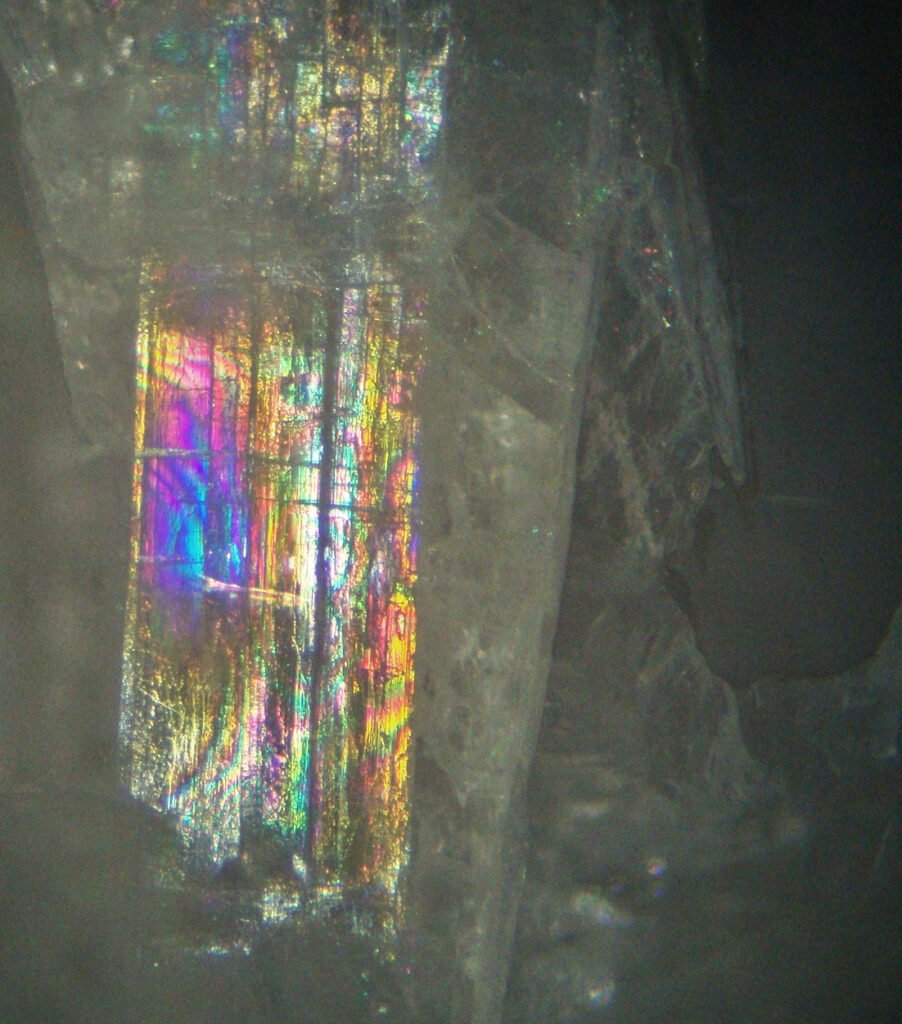
1. Characteristics
Crystal system: Triclinic pinacoidal.
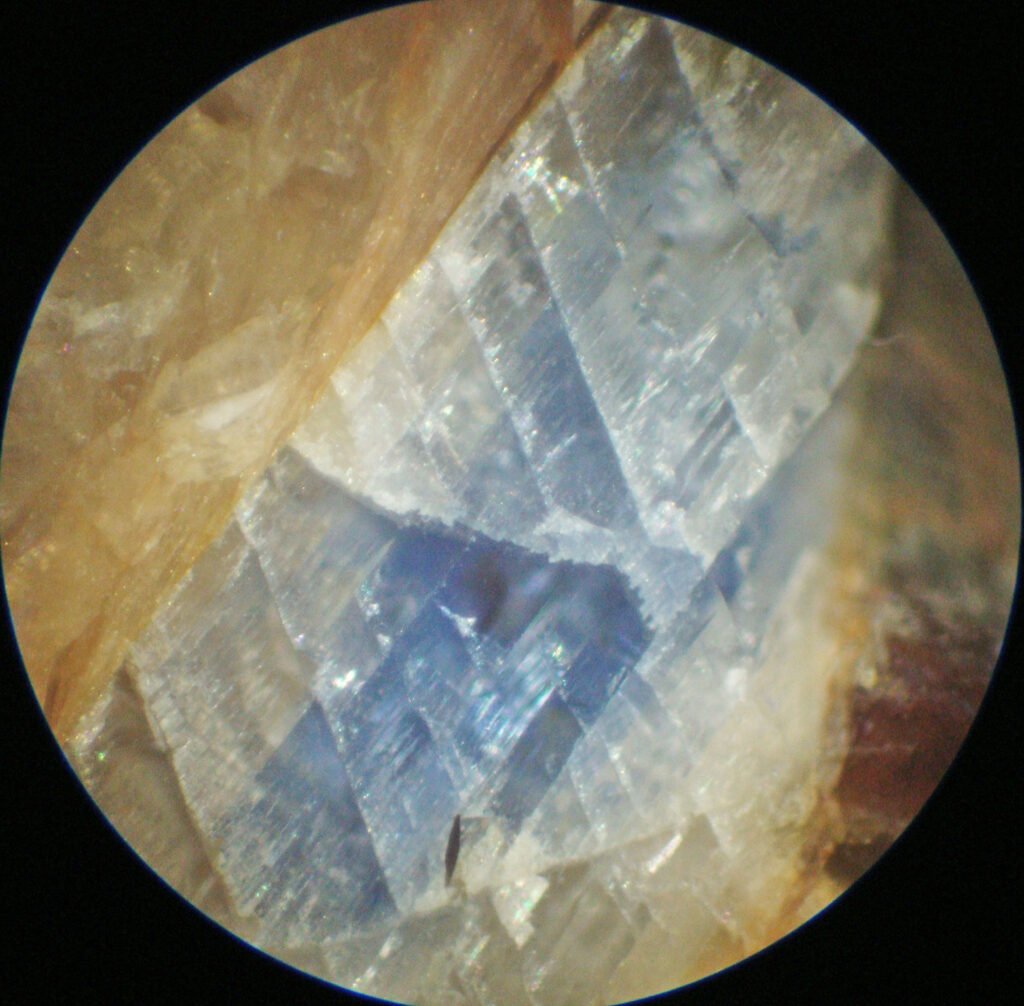
Color: Light gray, white, blue, green, rarely pink, yellow, orange, red to black. Zonation is possible.
Habit: Tabular or laminar crystals, often deformed. Rarely fibrous or porphyroblastic with “sieve texture”
Cleavage: {100} perfect, {010} good.
Tenacity: Brittle.
Twinning: Lamellar on {100}, common.
Fracture: Splintery.
Mohs Hardness: 5,5 parallel to [001], 7 parallel to [100].
Parting: On {001}.
Streak: Colorless.
Lustre: Vitreous, silky, resinous.
Diaphaneity: Transparent.
Density (g/cm³): 3.53 – 3.67
2. Geology and Deposits
Kyanite is a common medium to high pressure metamorphic mineral that occurs mainly in Al-rich metasedimentary rocks of pelitic composition, such as schists and gneisses.
It can occur in granitic pegmatites, granulites, eclogites and kimberlites.
Detrital it occurs in sediments and sedimentary rocks, being frequently mined from placers.
It does not occur in igneous rocks.
3. Mineral Associations
It occurs with common minerals like quartz, feldspars (anorthite), micas (muscovite, biotite, phengite, paragonite), amphiboles (“hornblendes” and “omfacites”), and clinopyroxenes.
With other typical metamorphic minerals like staurolite, sillimanite, andalusite, chloritoid, garnet and corundum.
Also with gedrite, mullite, rutile, pyrite, talc and hematite.
4. Transmitted Light Microscopy
Refraction indices: nα: 1.712 – 1.718 nβ: 1.720 – 1.725 nγ: 1.727 – 1.734
PLANE POLARIZED LIGHT – PPL
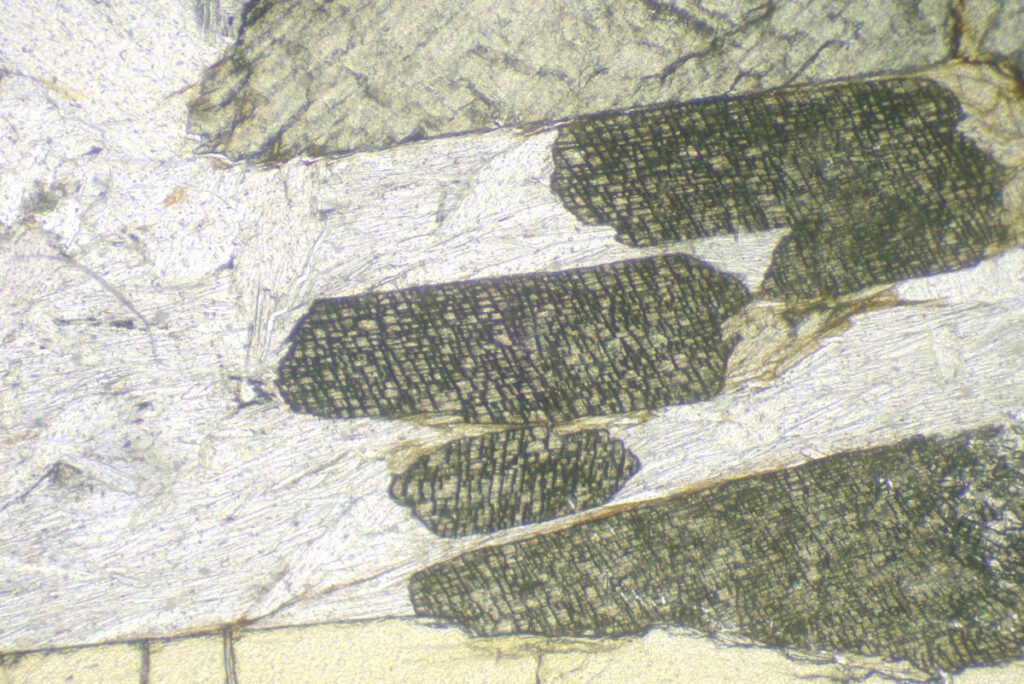
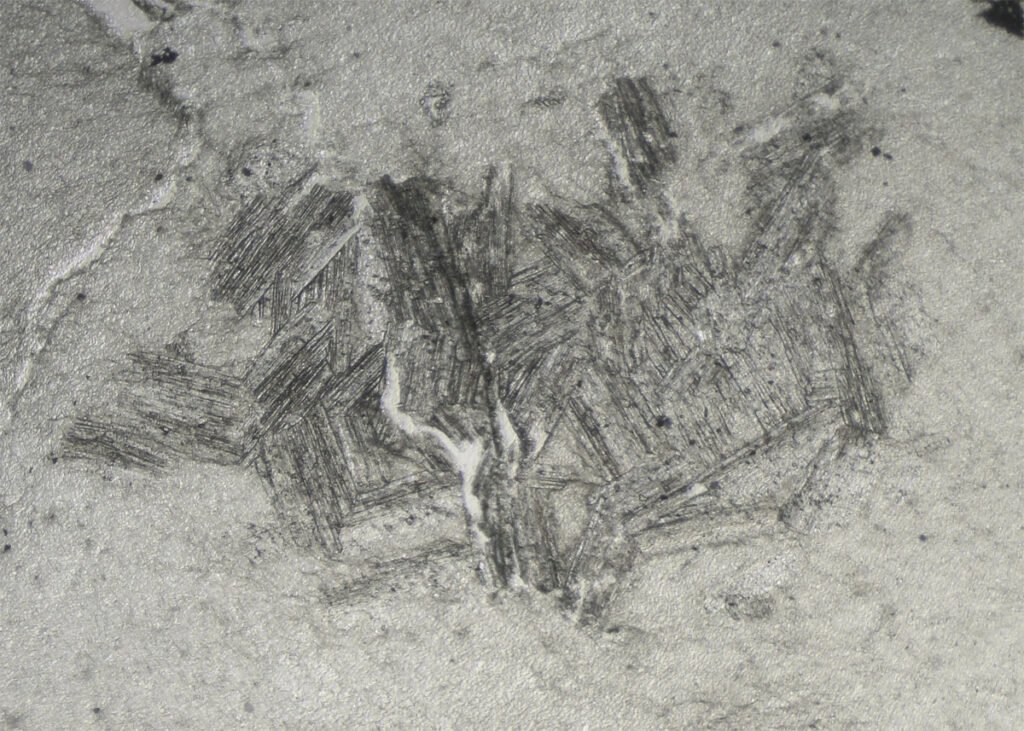
Color / Pleochroism: Normally colorless. May have bluish spots. Rarely pale blue with weak pleochroism: X = colorless, Y = pale violet blue, Z = pale cobalt blue.
Relief: High.
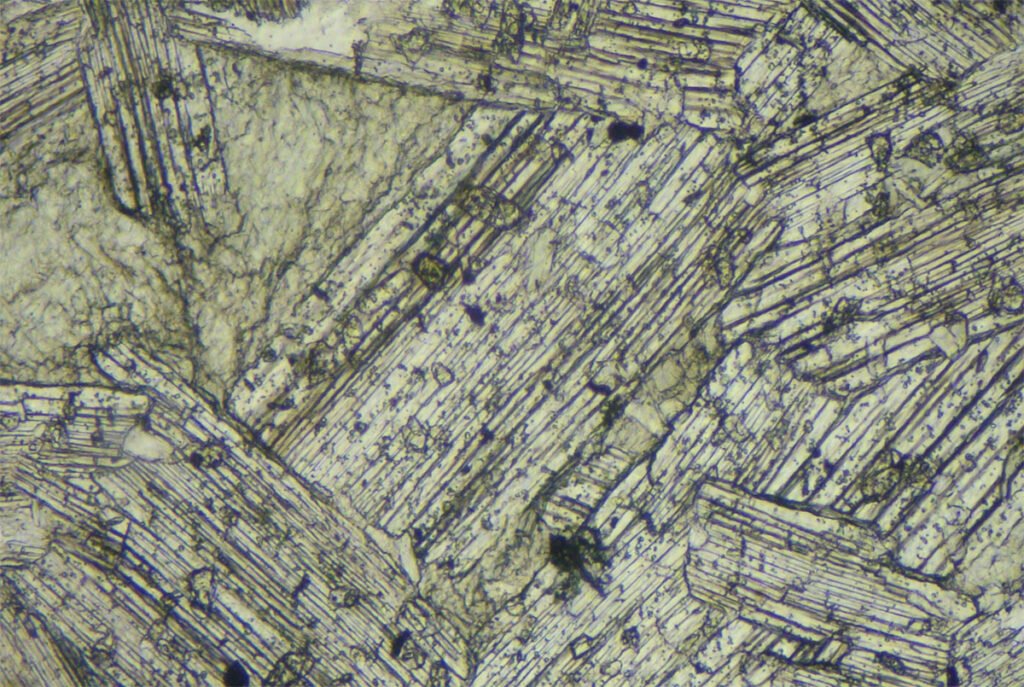
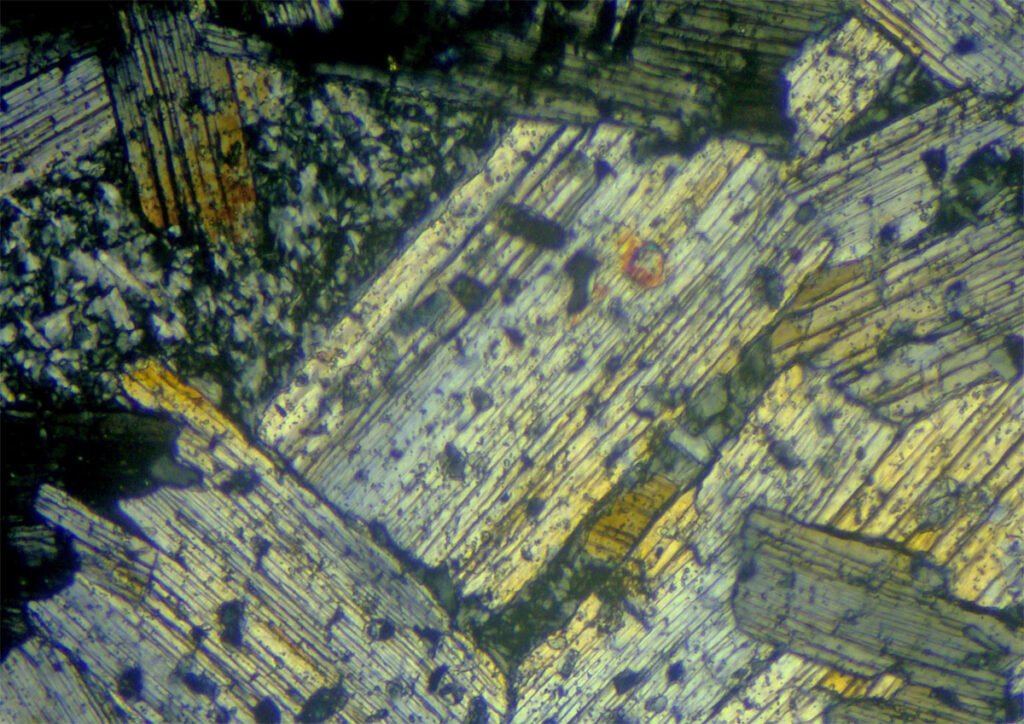
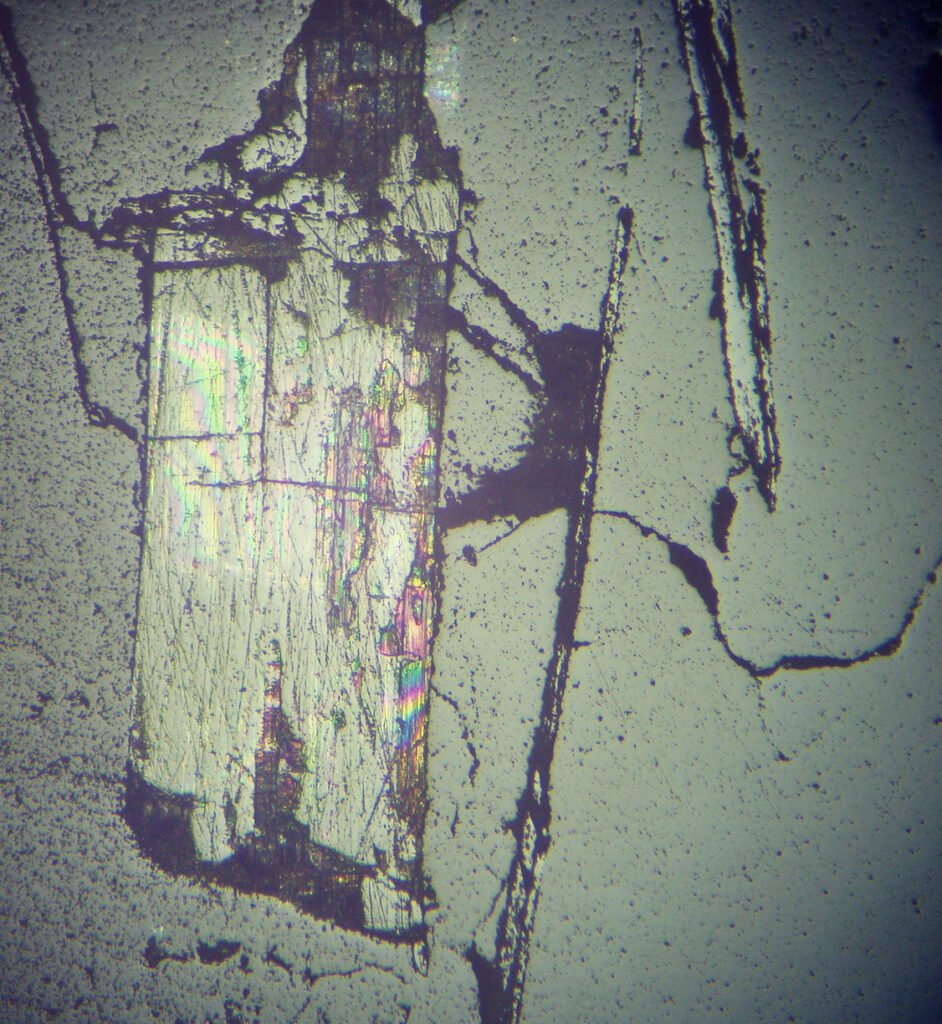
Cleavage: {100} perfect and {010} good. In the longitudinal sections, only one perfect cleavage is observed. In the basal sections, the two cleavages are observed, which intersect at 79º (diagnostic!).
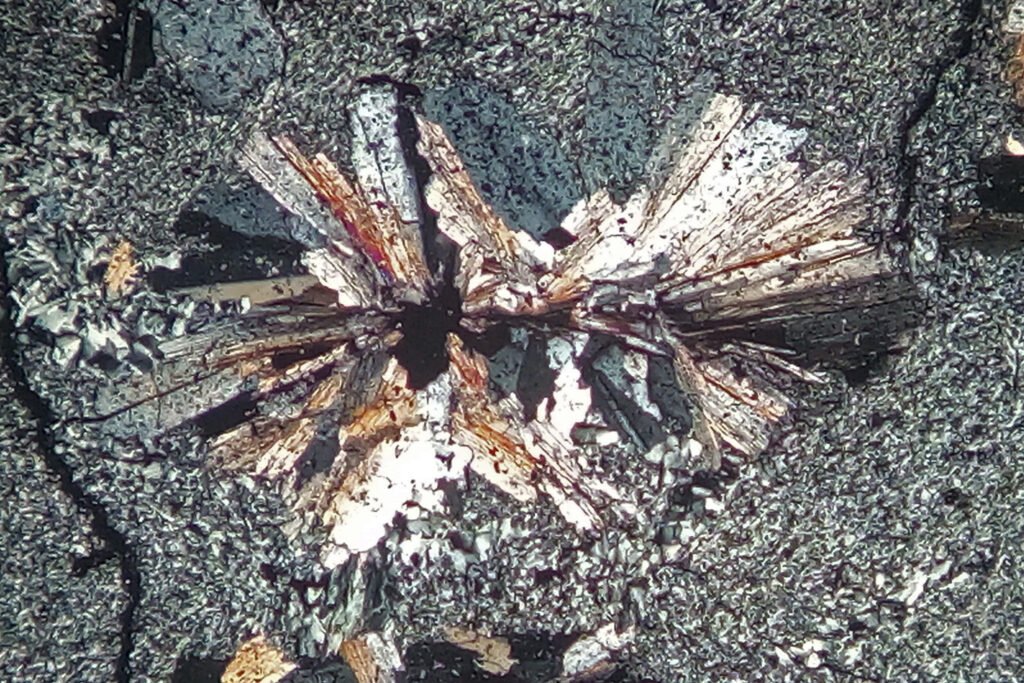
Habits: Columnar to elongated crystals, tabular parallel to {100}.
The tabular habit, with a cleavage direction parallel to the elongation, is a very diagnostic feature.
Due to the excellent cleavage and type of tenacity of kyanite, which shatters very easily during the process of making the thin blade, holes often occur in the blade associated with kyanite crystals.
CROSSED POLARIZED LIGHT – XPL
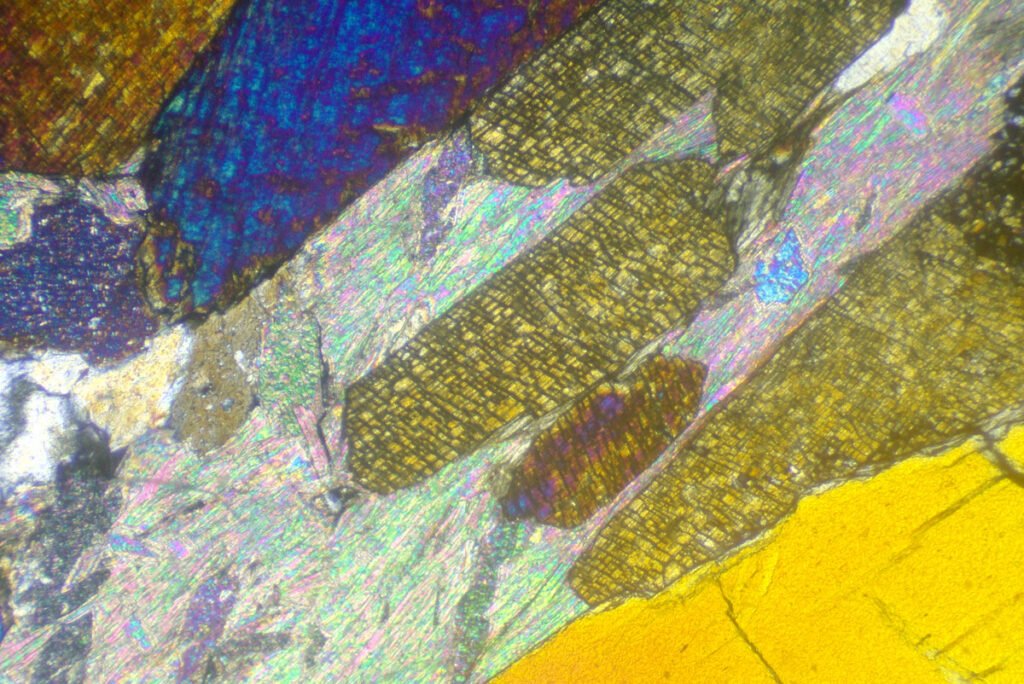
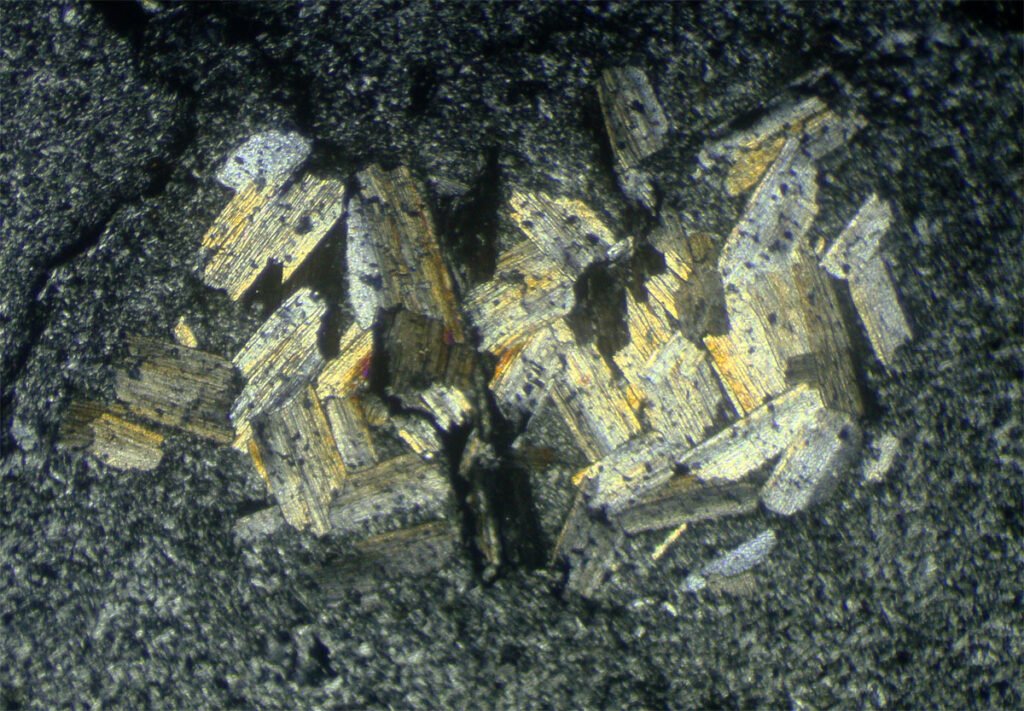
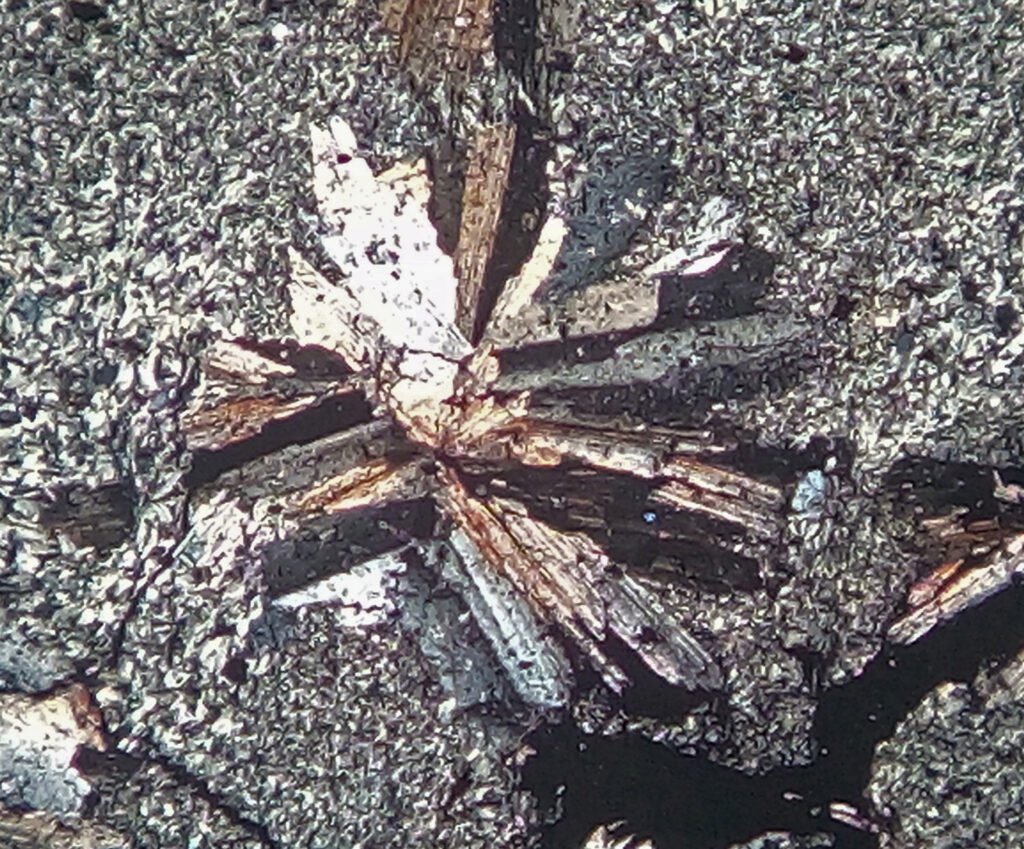
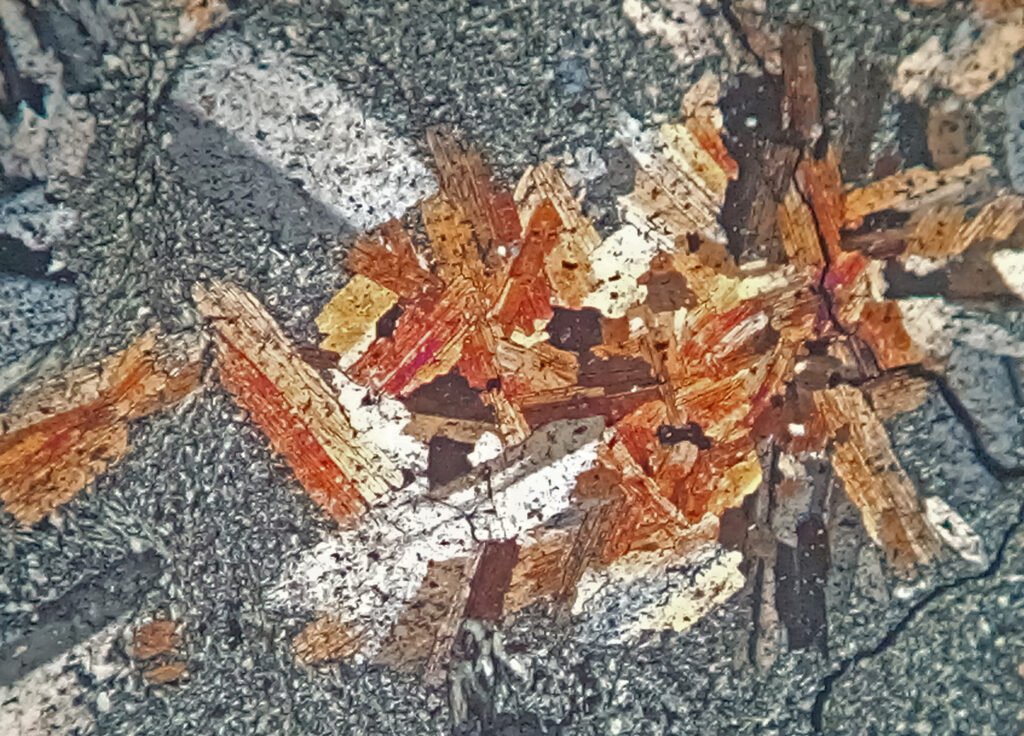
Birefringence and Interference Colors: Birefringence from 0.012 to 0.016 (low to medium), resulting in 1st order interference colors: gray to faint yellow (straw yellow) and orange. These low interference colors are very typical and diagnostic.
Due to the difficulty of making the thin sheet with kyanite, it is possible that some crystals are thicker than 30 microns and present orange to red and blue colors.
Extinction: Oblique from 0 to 32º in tabular crystals. It can simulate being parallel!
Elongation sign: ES(+).
Twins: Simple and lamellar, very frequent.
Zoning: No.
CONVERGENT LIGHT
Character: B(-).
2V angle: 78 – 82º
Alterations: alters to sericite or other phyllosilicates. With more intense metamorphism, it is replaced by sillimanite.
May be confused with: some other minerals, including some from the same paragenesis.
Pyroxenes may be similar, but in the basal section their cleavages intersect at an angle of 87º and 93º and their interference colors are higher than those of kyanite.
Andalusite and sillimanite, its polymorphs, have smaller extinction angles and different interference colors.
Clinozoisite has typically lower birefringence, often shows anomalous interference colors, does not form tabular crystals with a cleavage parallel to the elongation, and has a smaller 2V angle.
Orthopyroxenes have parallel extinction and pleochroism.
As kyanite shatters easily, it makes thin section making very problematic, losing fragments during the grinding process and creating holes in the thin section. These holes, often associated with kyanite remains, are nonetheless diagnostic.