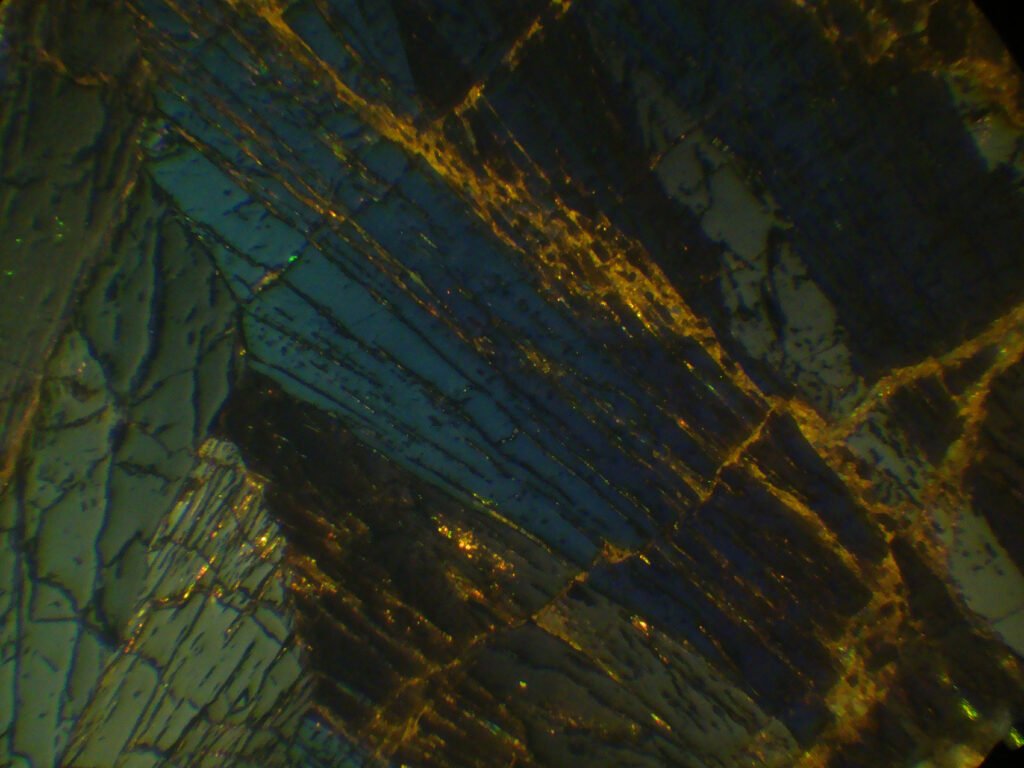
Lepidocrocite – γ-FeO(OH) – is a very common hydroxide that can occur in association with various types of ores, especially oxidized iron ores and those containing iron sulfides.
Lepidocrocite is a polymorph of goethite and feroxyhyte. It is a component of “limonite” and may contain Mn and Co, as well as various other impurities, which can be present in significant quantities. There is also a variety containing adsorbed water, known as hydrolepidocrocite.
Crystal system: Orthorhombic pyramidal.
Color: Ruby red, deep red to reddish-brown.
Habit: Its crystals are typically lamellar, flattened along the {010} plane, and reach a maximum length of 2 mm.
Cleavage: {010} perfect, {100} less perfect, {001} good.
Tenacity: Brittle.
Twinning: No.
Fracture: No information available.
Mohs Hardness: 5
Parting: No.
Streak: Orange.
Lustre: Submetallic, dull.
Diaphaneity: Transparent.
Density (g/cm³): 4.05 – 4.13
Lepidocrocite forms through the alteration or oxidation of primary iron-bearing minerals in iron ore deposits – such as hematite, magnetite, pyrite, and arsenopyrite- and may form crusts over goethite.
It can occur in the supergene zone of hydrothermal deposits containing sulfides.
It also forms in lateritic soils, in association with goethite and hematite.
It may occur as a precipitate from groundwater.
It is found in submarine manganese nodules.
It also forms when iron-containing substances rust underwater; for instance, it can be found on the walls of water tanks or within iron water pipes.
In general, lepidocrocite is far less abundant than goethite—it is, in fact, relatively rare.
It occurs with quartz (including the amethyst variety), carbonates (dolomite, malachite, azurite), other oxides (goethite, hematite, magnetite, limonite, murdochite), and pyrite.
In general, considering its mode of occurrence, lepidocrocite can be expected to be associated with many other minerals in the oxidized zones of ore deposits, particularly in iron (Fe) deposits.
Refraction indices: nα: 1.940 nβ: 2.200 nγ: 2.510
PLANE POLARIZED LIGHT – PPL
Color / Pleochroism: Light red to orange-red, strongly pleochroic:
X = colorless to yellow, Y = orange, yellow, dark orange-red, Z = orange, yellow, darker orange-red.
Fragments may appear nearly opaque; it is advisable to use the condenser to distinguish lepidocrocite from opaque minerals.
Relief: Very high.
Cleavage: The {010} cleavage may be visible in larger and/or wider crystals.
Habits: Tabular, fibrous, scaly, micaceous, in nodules and spherulites.
CROSSED POLARIZED LIGHT – XPL
Birefringence and Interference Colors: Birefringence of 0.57: extreme, very high-order colors, ranging between gray and black.
Extinction: Parallel to the cleavage.
Elongation sign: ES(+), but the extremely high interference colors make determination practically impossible.
Twins: No.
Zoning: No.
CONVERGENT LIGHT
Character: B(-)
2V angle: 83º
Alterations: It rarely alters, but it can transform into goethite and maghemite.
May be confused with: In very fine grains, lepidocrocite is difficult to distinguish from other iron oxides and hydroxides with which it is associated.
Hematite is redder and generally nearly opaque.
Goethite has a smaller 2V angle and is more yellowish.
Brookite is very similar.
Sample preparation: Lepidocrocite takes a very good polish, which varies depending on the grain size and the porosity of the sample. Its polishing hardness is lower than that of goethite.
PLANE POLARIZED LIGHT – PPL
Reflection color: Whitish medium gray.
Compared to the color of goethite, lepidocrocite is lighter and whiter.
Compared to the color of hematite, the color of lepidocrocite has a dull greenish tint.
Compared to the color of rutile, the color of lepidocrocite is less bluish and pinkish.
Pleochroism: Distinct, though not always detectable in fine crystals. Colors range from gray to brownish-gray.
Reflectivity: 10.66 – 15.87%
Bireflectance: Strong, but difficult to see in thin sheets.
CROSSED POLARIZED LIGHT – XPL
Isotropy / Anisotropy: Moderate to strong anisotropy, appearing in shades of darker and lighter bluish-gray, as well as various tones of gray and white. This strong anisotropy – lacking any distinct, saturated colors – is a diagnostic feature.
Internal reflections: Reddish-brown internal reflections are frequently visible, and are generally quite apparent in thin sections. These internal reflections do not mask the anisotropy, as is the case with goethite. They are never the deep, intense red colors seen in hematite. They are far less abundant than in goethite.
May be confused with: Goethite, but goethite exhibits anisotropy and different reflections. However, goethite and lepidocrocite can occur together.
Rutile displays different colors and internal reflections of different colors.
General Characteristics:
Grain shape: generally thin plates or tabular crystals, found within goethite. Grain size and shape, however, vary within a wide range; relict rhythmic structures may be preserved. Within goethite, they can form fine alignments, likely filling former desiccation cracks in the limonite. Thin plates growing upon mammillary-stalactitic aggregates of goethite are very common. Euhedral lepidocrocite plates may also be present, growing inward from the outer boundary of the goethite. Since lepidocrocite forms from pyrite, it often occurs as crusts with complex, curved morphologies. The presence of lepidocrocite is frequently restricted to the interior of pseudomorphs. Intergrowths of lepidocrocite and goethite are collectively referred to as “limonite.”
Cleavage is sometimes visible, but typically not apparent in high-quality polished sections.
Twinning is absent.
Alteration of lepidocrocite produces goethite, which initially forms as fine spherulites. Upon losing water, it transforms into maghemite.
Substitutions: lepidocrocite can be replaced by magnetite.
Pseudomorphs of lepidocrocite after pyrite may occur, as well as pseudomorphs of goethite after lepidocrocite – the latter being quite common.