1. Characteristics
Crystal system: Monoclinic prismatic.
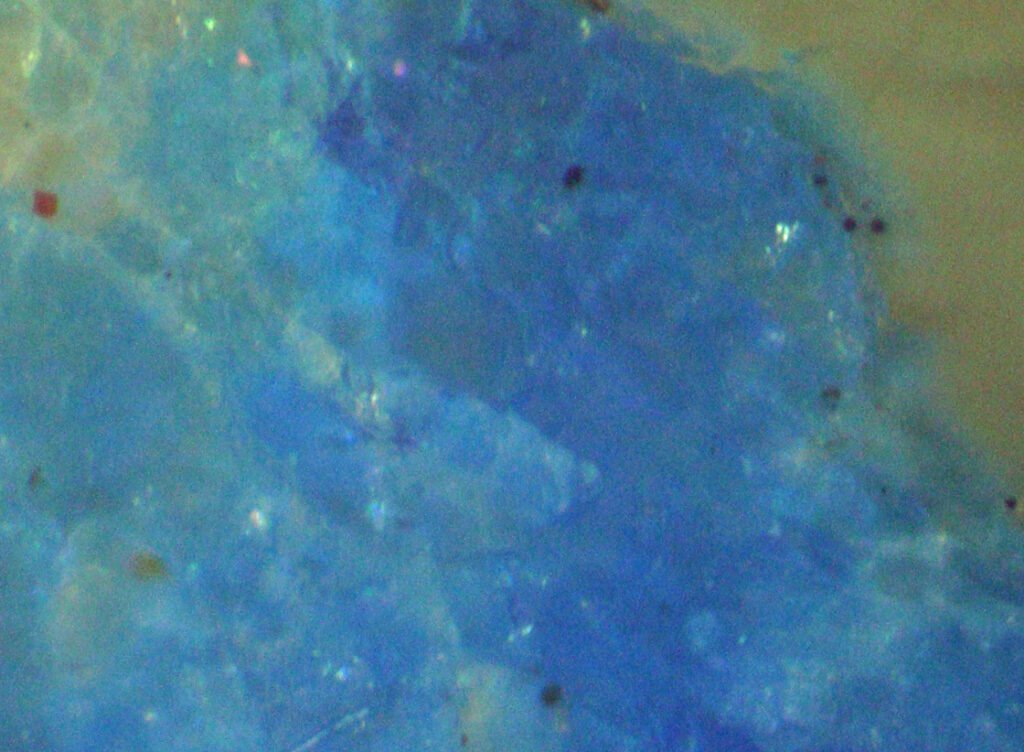
Color: Deep, intense blue, very similar to the color of azurite, but a less intense blue.
Habit: Small, tabular to elongated crystals, in 40 different shapes. Crusts or aggregates.
Cleavage: {100} perfect, {001} imperfect
Tenacity: Brittle.
Twinning: Common on {100}, also on {001}.
Fracture: Conchoidal.
Mohs Hardness: 2.5
Parting: No.
Streak: Pale blue.
Lustre: Vitreous to sub-adamantine.
Diaphaneity: Transparent.
Density (g/cm³): 5.35
2. Geology and Deposits
Linarite is one of several secondary minerals that develops in the oxidized zones (“gossan”) of copper and lead ores. Zn ore minerals may be present. It occurs in small quantities in many localities, usually forming crusts or in cavities.
It is associated with other blue secondary copper minerals such as azurite, chrysocolla, cyanotrichite, plancheite, sampleite, caledonite, chalcanthite, and kröhnkite. Distinguishing between these blue minerals—and other associated blue minerals (allophane, hemimorphite)—requires care and in many cases is not possible under a microscope; other analytical techniques are necessary.
3. Mineral Associations
It occurs associated with primary ore minerals and gangue minerals in different deposits.
The gangue can be composed of quartz, fluorite, and carbonates (calcite, dolomite, ankerite).
The primary ore minerals of Cu-Pb-Zn mineralizations are sulfides such as galena, chalcopyrite, chalcocite, sphalerite, and wurtzite, accompanied by other sulfides such as pyrite.
From the sulfides, a secondary mineralization develops with:
– secondary copper minerals such as covellite, chalcanthite, chrysocolla, brochantite, and malachite,
– secondary lead minerals such as cerussite, anglesite, and leadhillite,
– secondary zinc minerals such as hemimorphite and
– polymetallic secondary minerals such as kaleidonite (Pb5Cu2(SO4)3(CO3)(OH)6), and serpierite (Ca(Cu,Zn)4(SO4)2(OH)6 · 3H2O).
Goethite, allophane, and native sulfur may be present.
4. Transmitted Light Microscopy
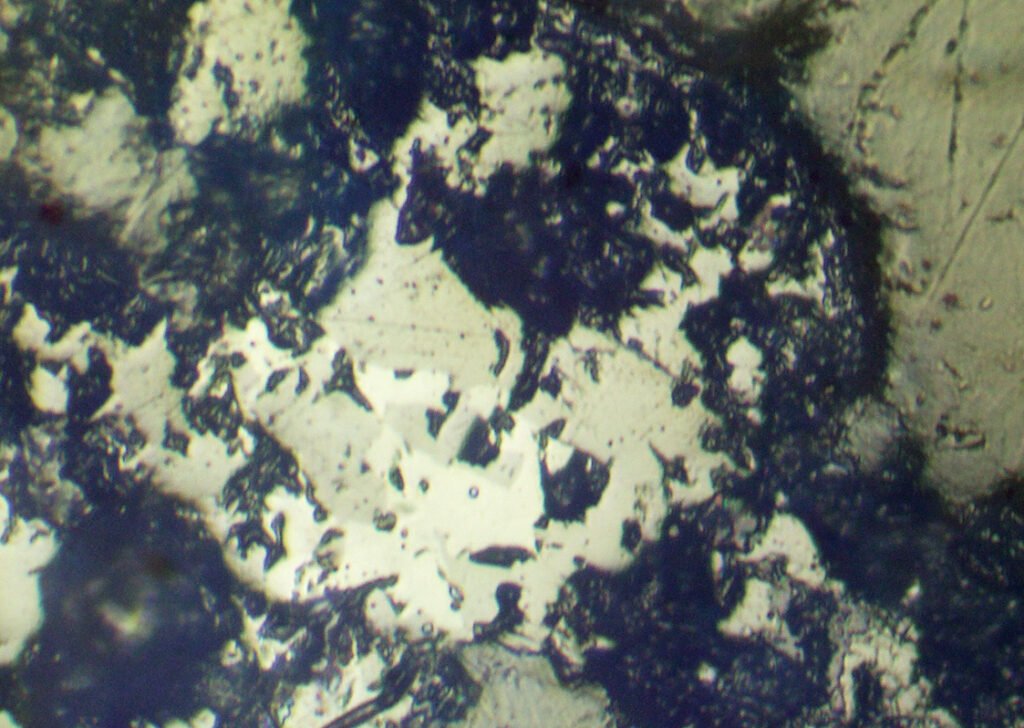
Refraction indices: nα: 1,809 nβ: 1,838 nγ: 1,859
PLANE POLARIZED LIGHT – PPL
Color / Pleochroism: Deep blue, with distinct pleochroism between X = pale blue, Y = light blue, and Z = Prussian blue (deep).
Relief: Very high.
Cleavage: Without information, probably visible in well-developed crystals.
Habits: Tabular, elongated, crusts and radial aggregates.
CROSSED POLARIZED LIGHT – XPL
Birefringence and Interference Colors: Maximum birefringence of 0.05, very high, resulting in colors of up to the 3rd order, usually masked by the mineral’s own blue color.
Extinction: No information available, probably oblique.
Elongation sign: No information available.
Twins: Can occur, since twins by {100} are common.
Zoning: No information available.
CONVERGENT LIGHT
Character: B(-)
2V angle: 80º
Alterations: Alters to antlerite or cerussite+malachite.
May be confused with: azurite, chrysocolla, and other secondary copper minerals that are blue in color.