1. Characteristics
Crystal system: Monoclinic prismatic.
Color: Light green, dark green, green-black.
Habit: Massive, mamelonate to botryoidal, stalagtitic, fibrous, acicular, long prismatic, etc.
Cleavage: {-201} perfect, {010} good.
Tenacity: Brittle.
Twinning: On {100} and {201}, common. Polysynthetic.
Fracture: Subconchoidal, irregular.
Mohs Hardness: 3.5 – 4
Parting: No.
Streak: Light green.
Lustre: Adamantine, vitreous, silky, dull.
Diaphaneity: Transparent.
Density (g/cm³): 3.6 – 4
2. Geology and Deposits
Malachite occurs in Cu ores and the alteration deposits arising therefrom, even when there are only traces of Cu present.
It is also found in altered volcanic rocks (basalts, diabases, gabbros), formed from the native copper present there, even when there are only very small amounts.
Some care is needed to avoid confusing malachite with celadonite. Celadonite is a green clay mineral whose color is somewhat similar to that of malachite. Glauconite is also green and could, in theory, be confused with malachite. An easy test to identify malachite is with 10% hydrochloric acid, as malachite effervesces with the acid, unlike celadonite and glauconite, which do not effervesce.
3. Mineral Associations
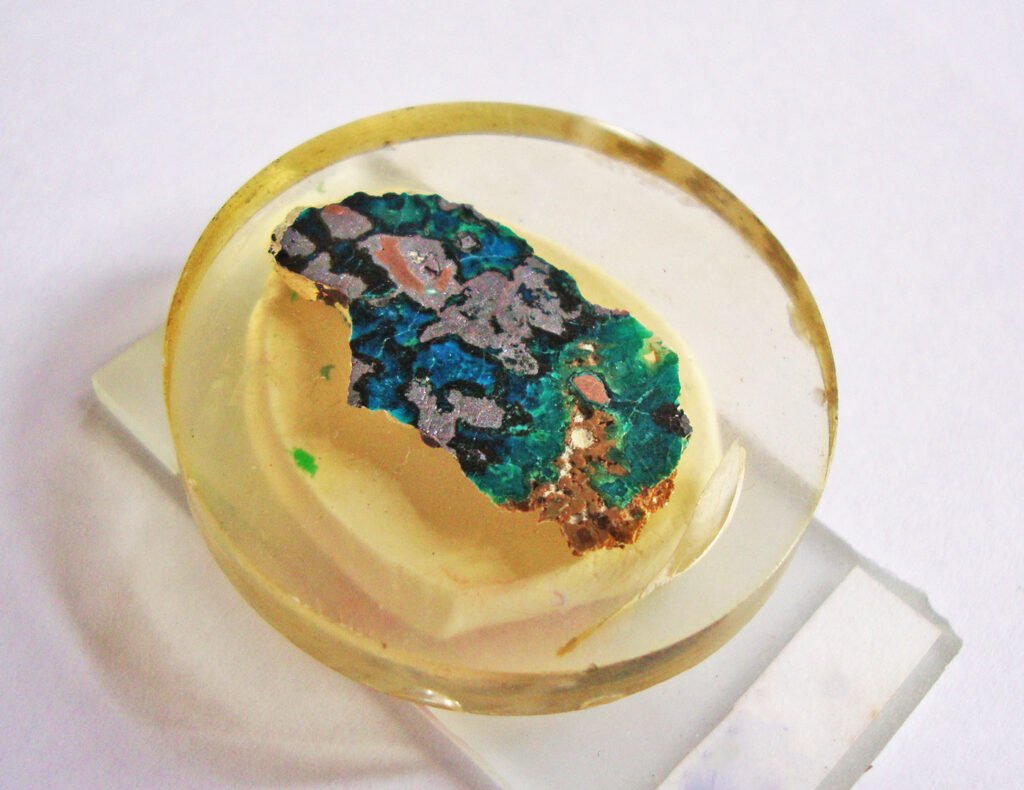
Malachite occurs with many other primary (chalcocite, bornite, chalcopyrite, etc.) and secondary Cu minerals. Among the secondary minerals, one is black (tenorite), another is red (cuprite), others are blue (azurite, linarite, chrysocolla, chalcanthite, plancheite, etc.), and many are green (libethenite, chalcantite, brochantite, chrysocolla, etc.).
Several of them can present great color variations, from green to light blue, for example. Furthermore, malachite is associated with quartz, native copper, cerussite, calcite, “limonite”, chalcedony and many rare minerals such as duftite, auricalcite, sphaerocobaltite, kolwezite, shattuckite, chalcophyllite, conicalcite, rosasite, chalcosiderite, clinoclase, graemite, liroconite, mixite and cornetite, among many others.
4. Transmitted Light Microscopy
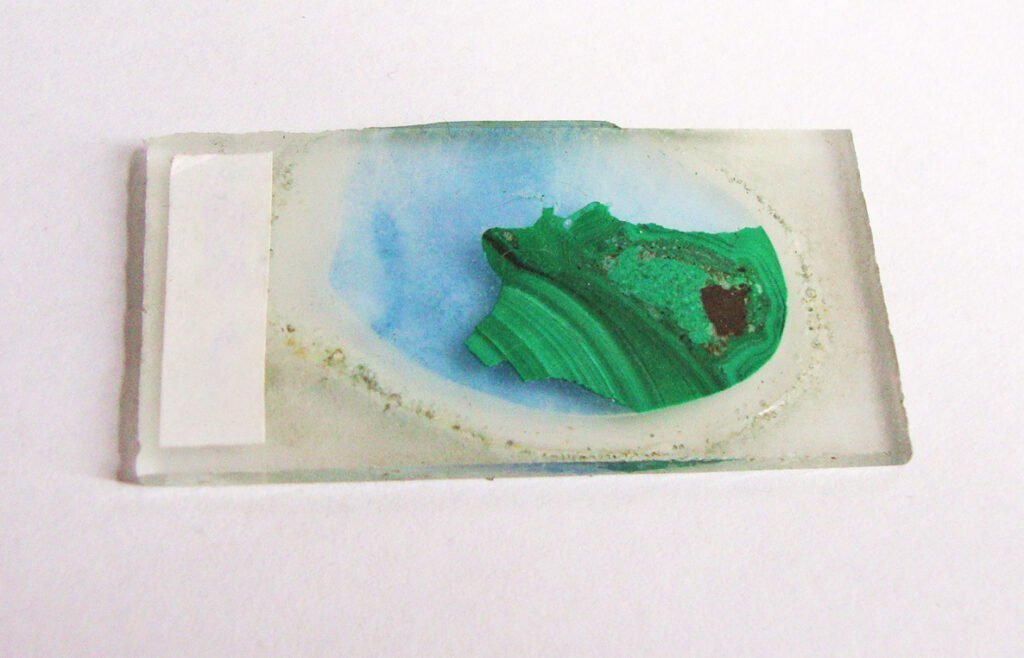
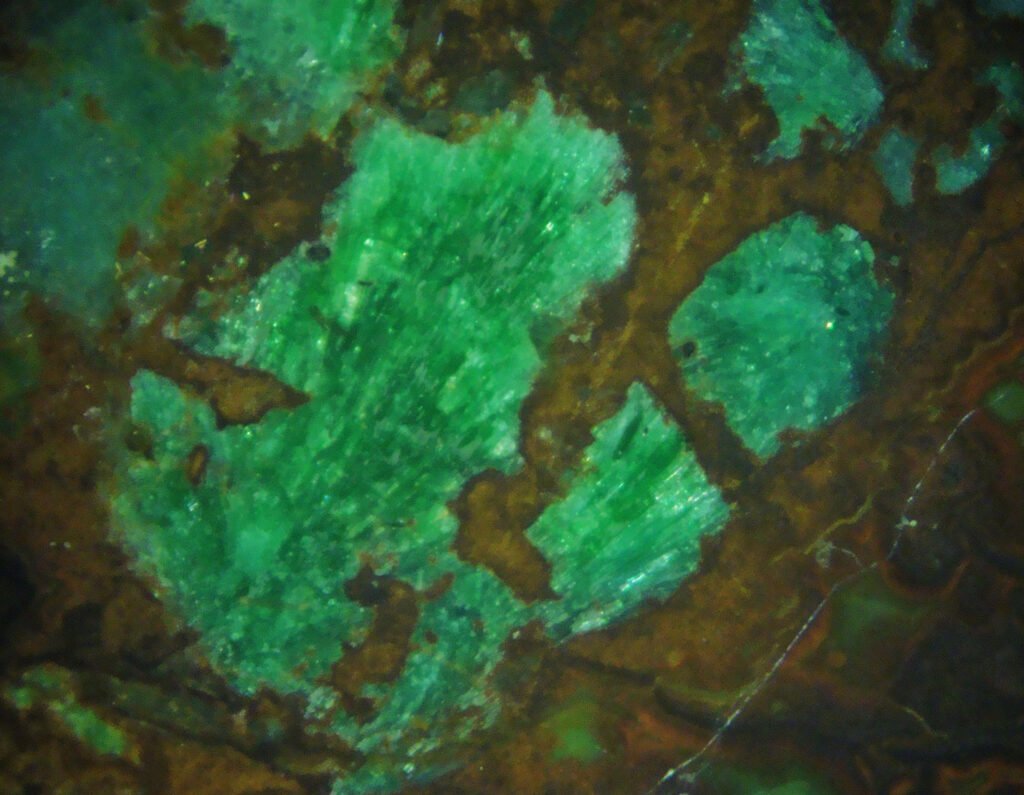
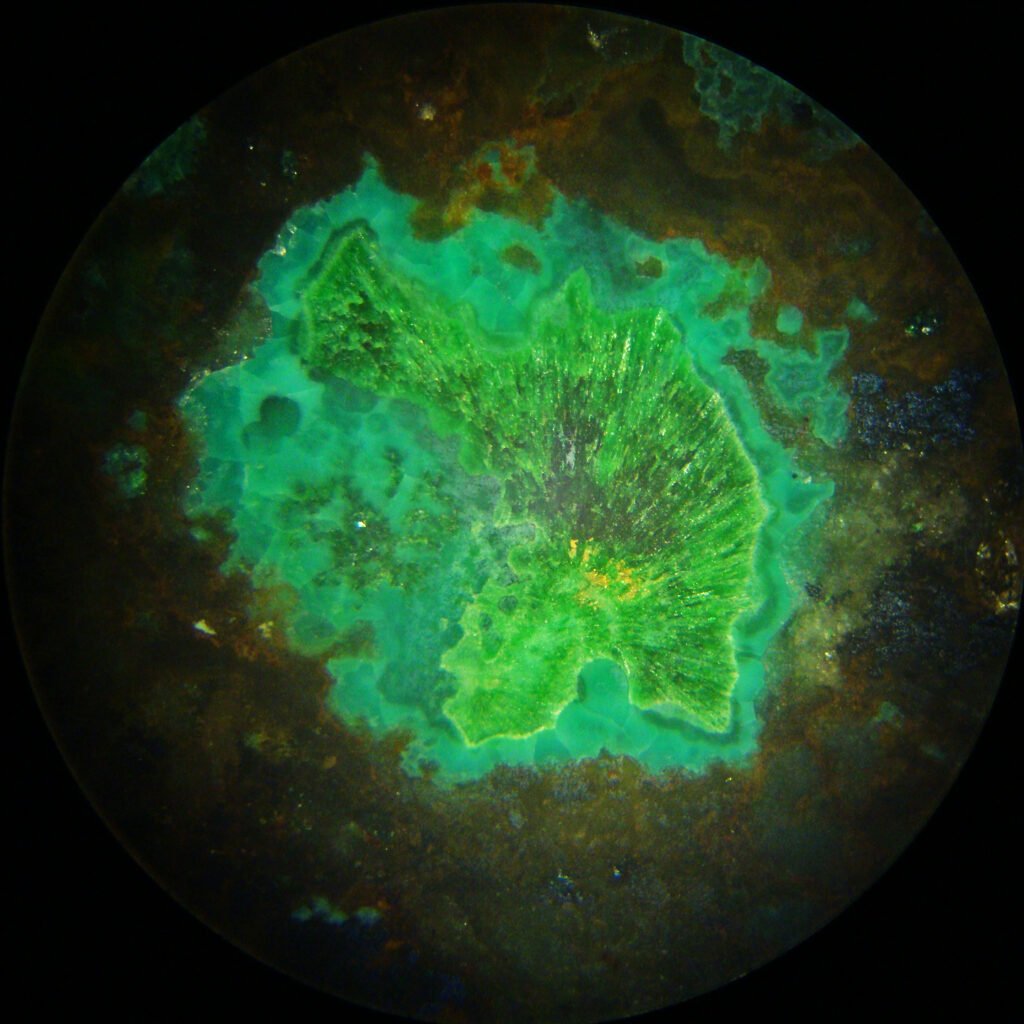
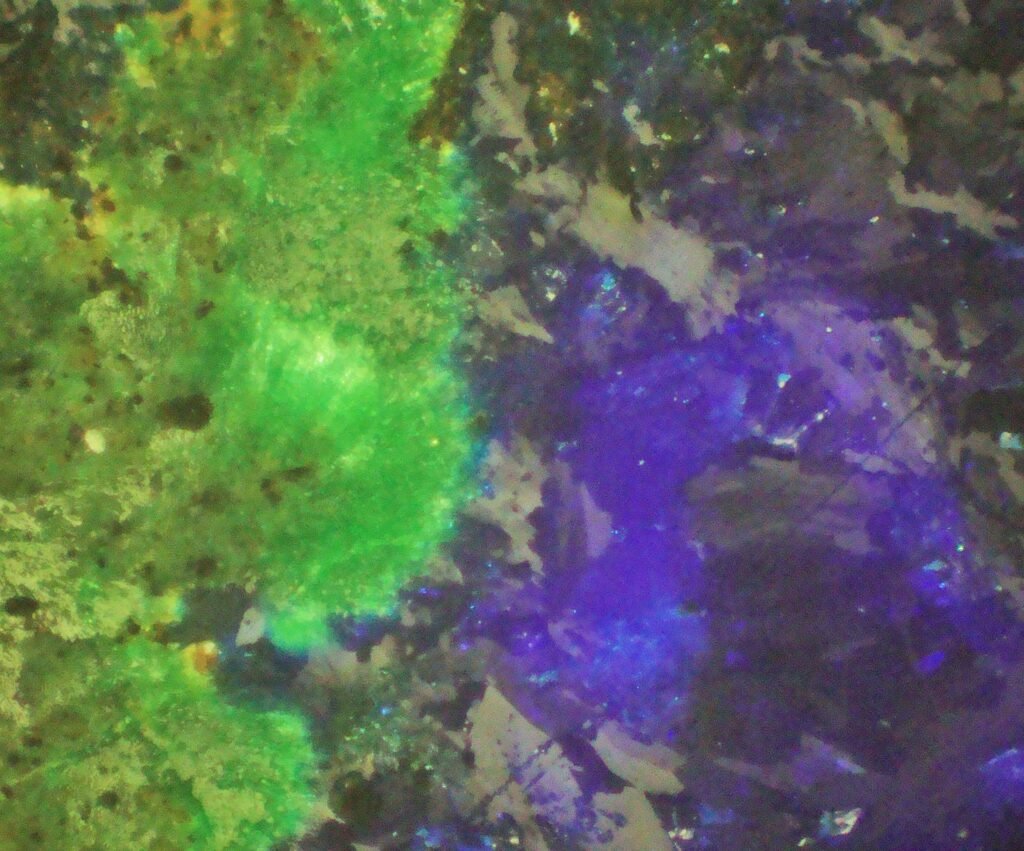
The preparation of a thin section of malachite requires only a rough grinding of the mineral, otherwise the malachite becomes so smooth that it peels off the glass slide. The glue simply does not adhere to the malachite and the thin section is rendered useless during the grinding step.
Refraction indices: nα: 1.655 nβ: 1.875 nγ: 1.909
PLANE POLARIZED LIGHT – PPL
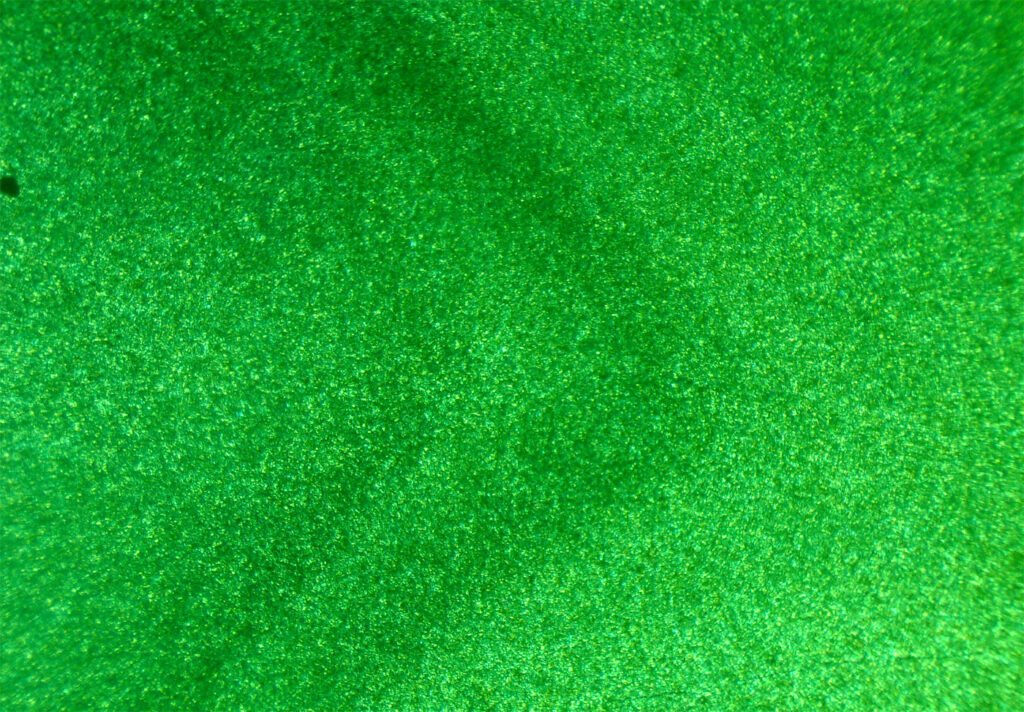
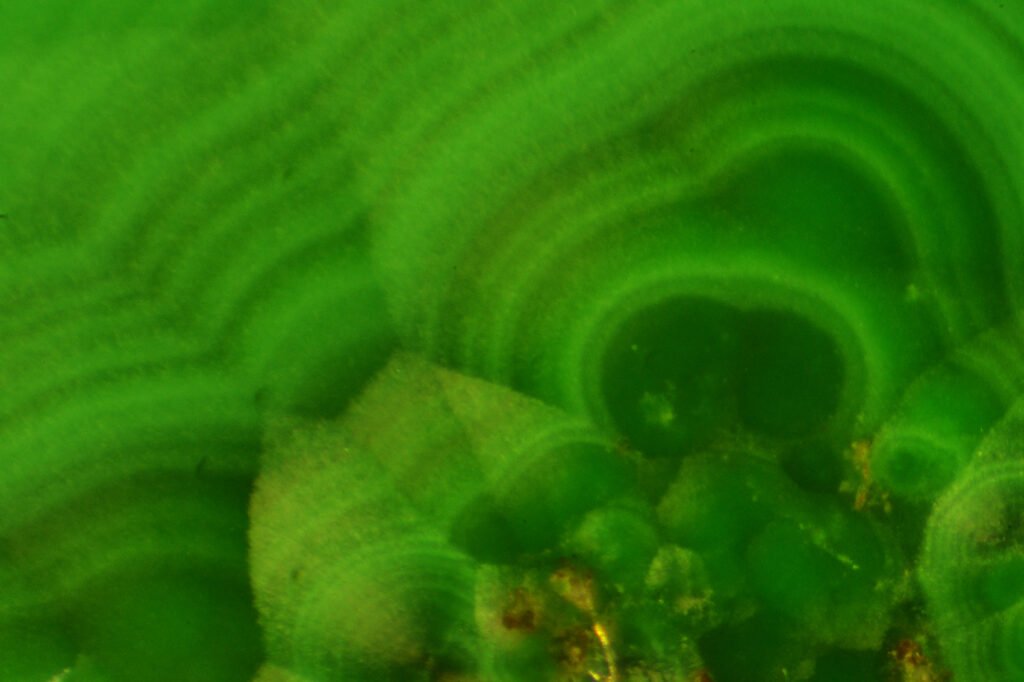
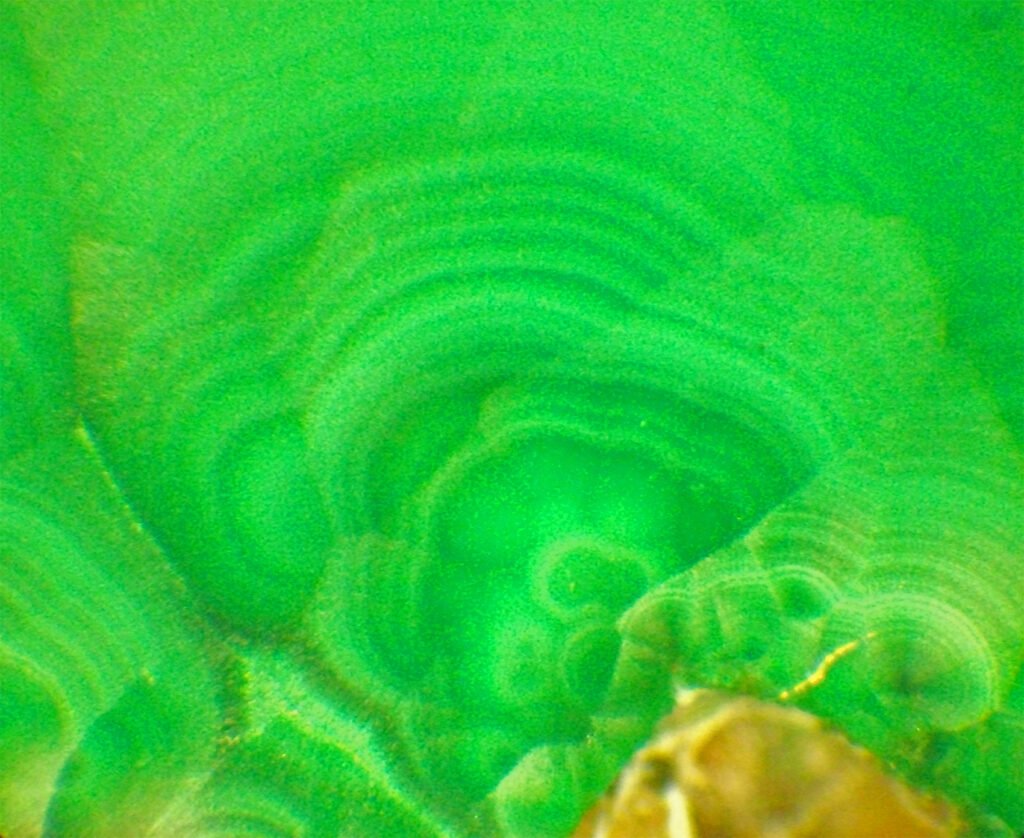
Color / Pleochroism: Green to yellowish green with visible pleochroism:
X = almost colorless;
Y = yellowish green;
Z = deep green.
Difficult to see in very small crystals.
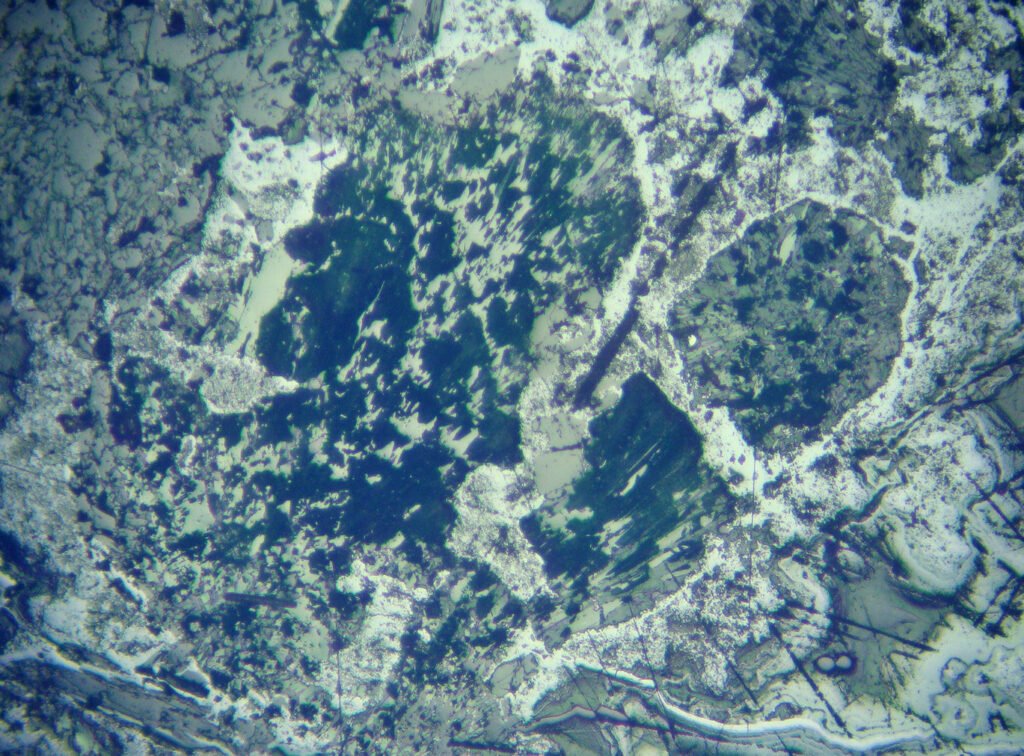
Relief: Very high.
Cleavage: Generally not noticeable
Habits: Concentric bands, fibrous, acicular, long prismatic. Never in large crystals.
CROSSED POLARIZED LIGHT – XPL
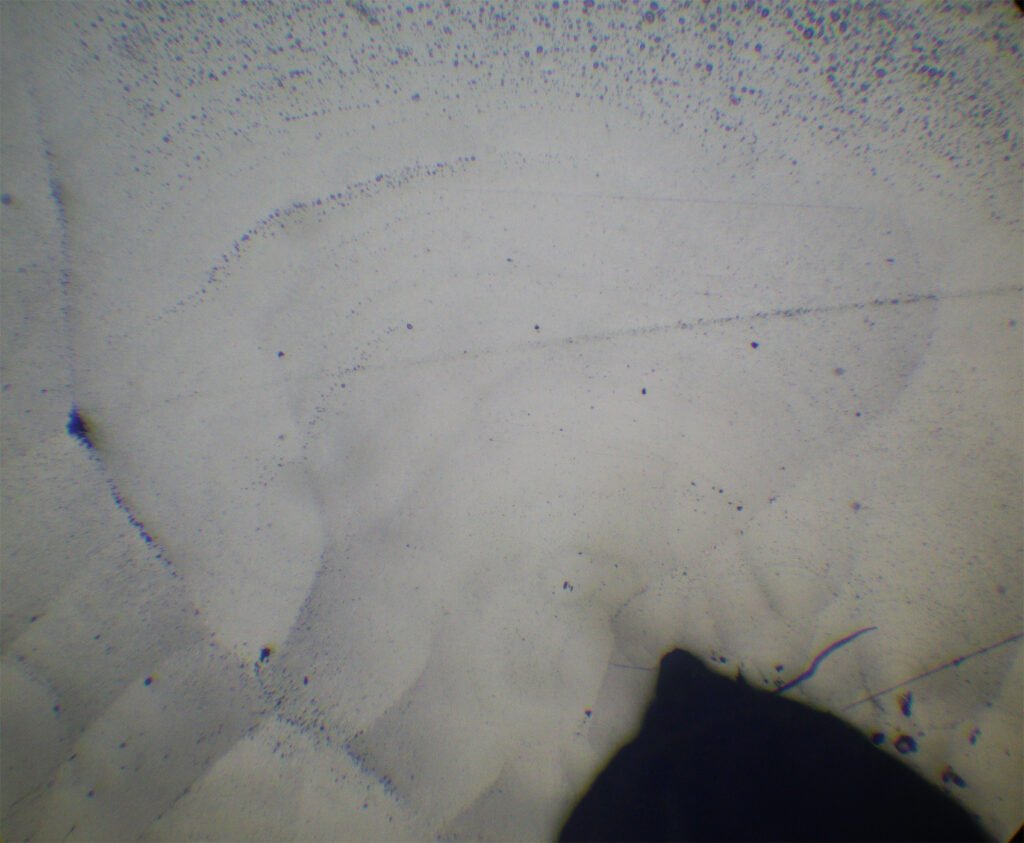
Birefringence and Interference Colors: Maximum birefringence of 0.254, corresponding to higher-order colors, but the intense own green color masks any other color.
Extinction: No information available, probably oblique.
Elongation sign: No information available.
Twins: No information available.
Zoning: No information available.
CONVERGENT LIGHT
Character: B(-), usually impossible to determine because the crystals are too small.
2V angle: 43o
Alterations: Under certain conditions (low H2O, slightly different pH), malachite can transform into azurite. Malachite can break down and form cuprite and tenorite in more oxidizing environments where carbonate is lost. And malachite can alter into chrysocolla (if silica-rich fluids are present) and in brochantite (in sulfate-rich conditions).
May be confused with: other green secondary copper minerals.