Crystal system: Triclinic pinacoidal.
Color: Gray to white, grayish yellow, yellowish, bronze, salmon pink, bluish green to green.
Habit: Massive, granular or as prismatic crystals. Perthites are very common.
Cleavage: {001} perfect, {010} good.
Tenacity: Brittle.
Twinning: See above.
Fracture: Irregular.
Mohs Hardness: 6 – 6.5
Parting: On {100}, {110}, {-110} and {-201}.
Streak: White.
Lustre: Vitreous, pearly on cleavages.
Diaphaneity: Transparent.
Density (g/cm³): 2.54 – 2.57.
2. Geology and Deposits
Microcline is the lowest temperature potassic feldspar (sanidine = high temperature, only volcanic rocks; orthoclase = intermediate term, higher temperatures than microcline) and is abundant in acidic plutonic igneous rocks such as granites, granodiorites, diorites, syenites and pegmatites that are associated with these rocks. May occur in lamprophyres.
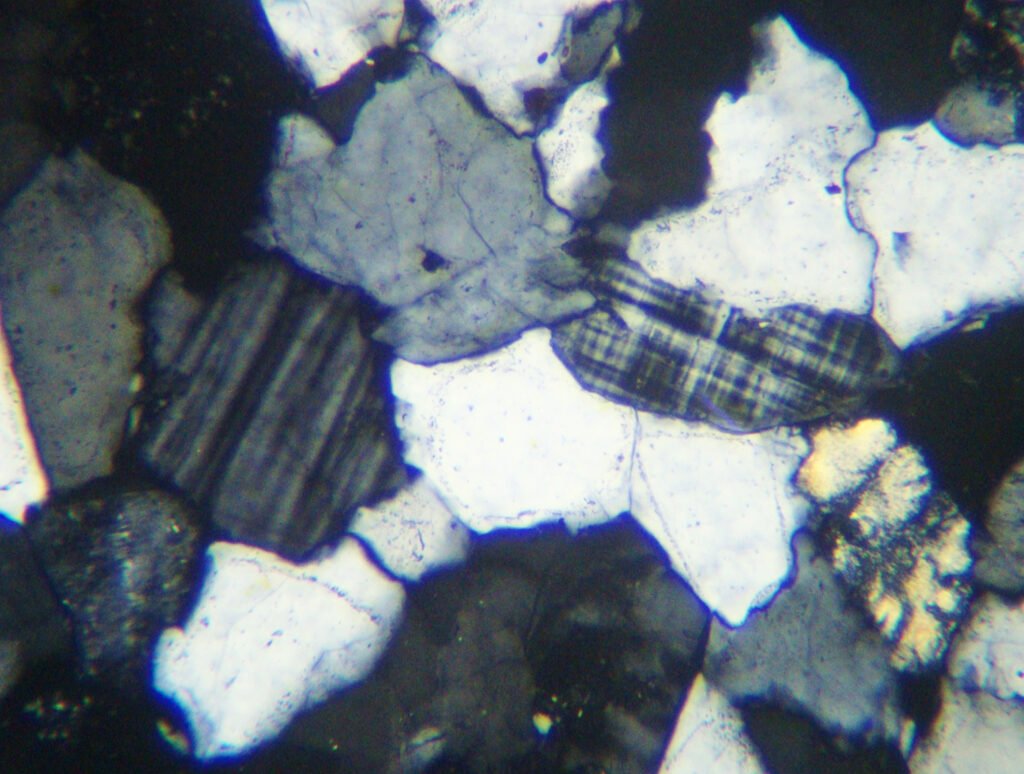
In metamorphic rocks it is restricted to high-grade metamorphic rocks such as gneisses and granulites. Can occur in greisen. Microcline is relatively resistant to weathering and is therefore a common detrital mineral, forming grains in sands and occuring in immature sandstones.
3. Mineral Associations
Being a common mineral, microcline is associated with many other minerals: quartz (including the smoky quartz variety), micas (biotite, muscovite, chlorite), plagioclases (albite, clevelandite), amphiboles (hornblende), titanite, zircon, beryl (aquamarine), fluorite, tourmalines (schorlite), garnets (spessartine) and aegirine, among many others.
4. Transmitted Light Microscopy
Refraction indices: nα: 1.514 – 1.529 nβ: 1.518 – 1.533 nγ: 1.521 – 1.539
PLANE POLARIZED LIGHT – PPL
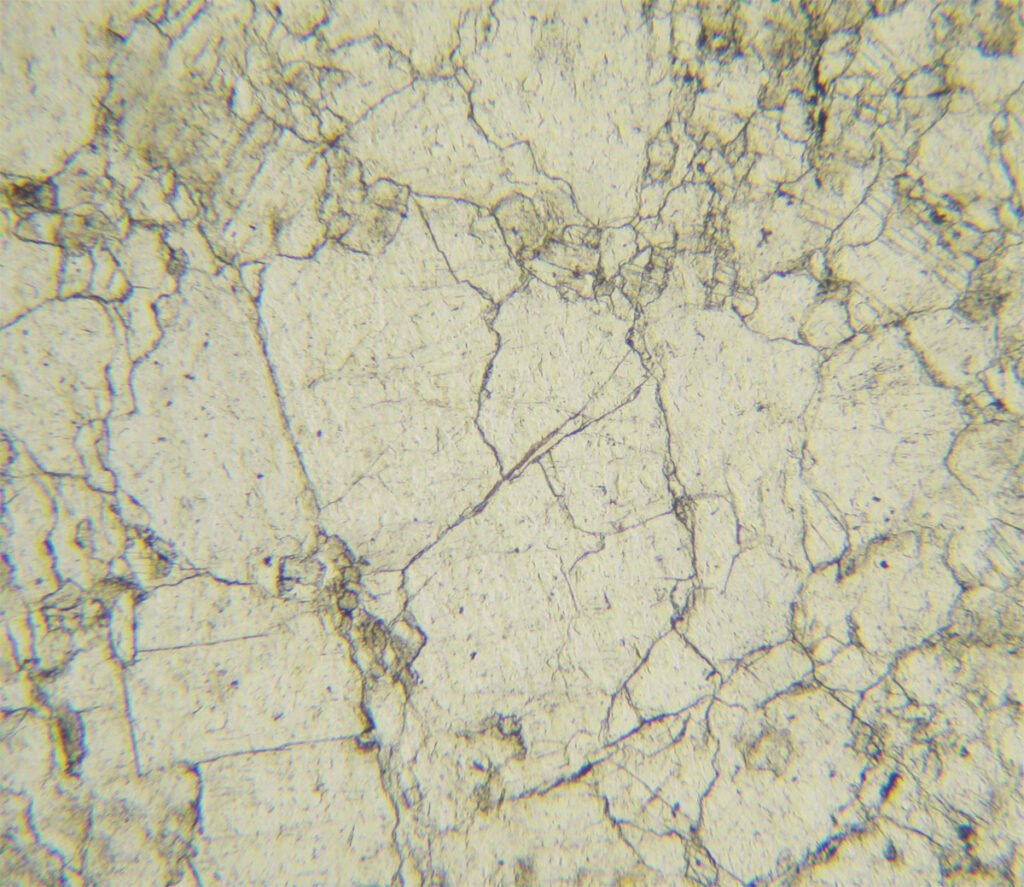
Color / Pleochroism: Colorless; it never has color much less pleochroism. Due to the alteration to clay minerals, it can be cloudy, with yellowish or brownish tones.
Relief: Low, like other feldspars and quartz.
Cleavage: {001} perfect and {010} good, with an angle of 90.6º between them.
Due to the low relief of the microcline, these cleavages are usually not visible under a microscope.
Habits: Massive, tabular or in short prismatic crystals. Anhedral to subhedral grains, may present perthites and/or alteration with “clouds” of clay minerals (kaolinite).
CROSSED POLARIZED LIGHT – XPL
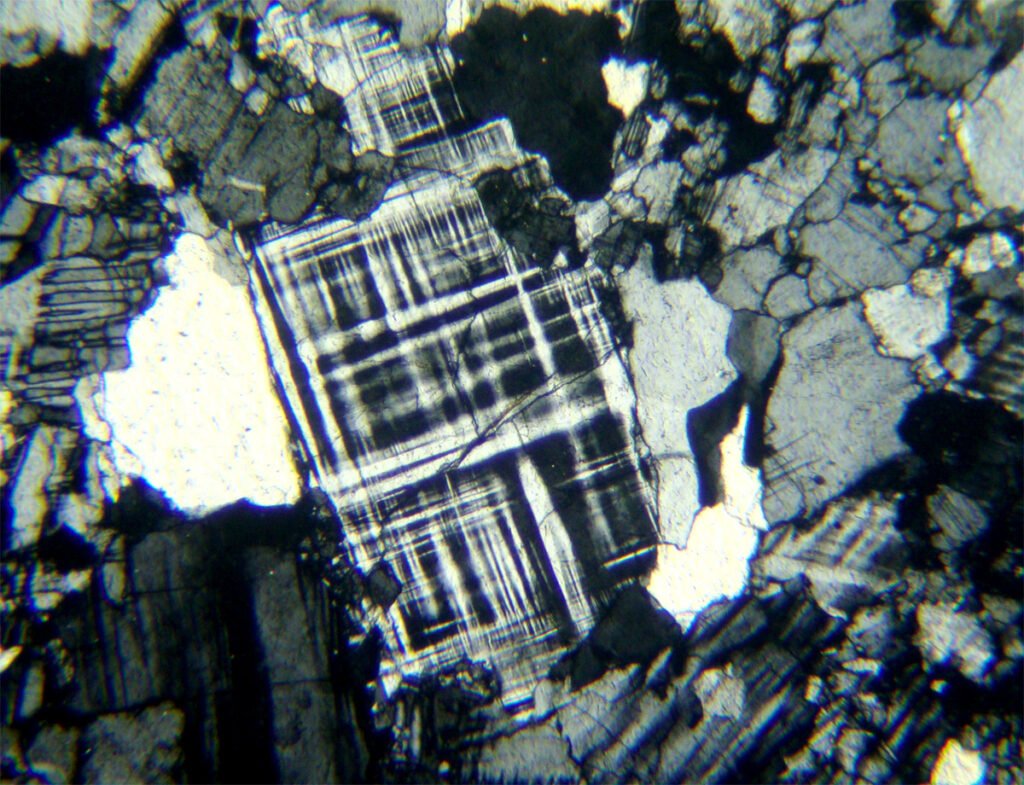
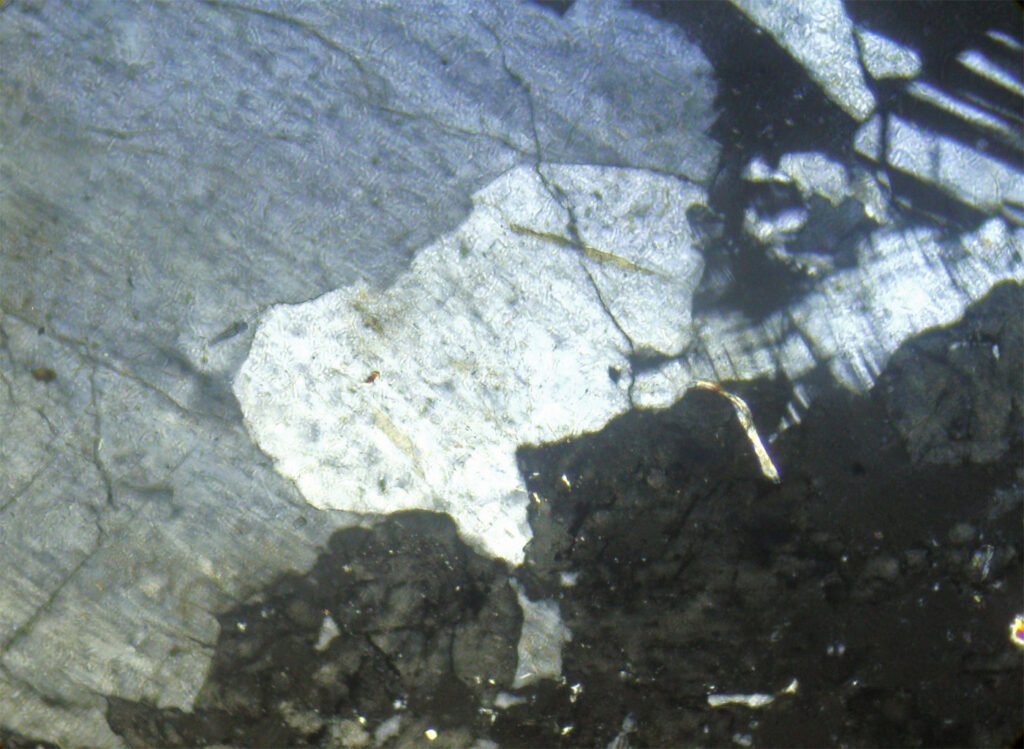
Birefringence and Interference Colors: Birefringence of 0.005 to 0.008: first order medium colors, with grays in various shades (dark to light) to white.
Extinction: Oblique with angles of 15-20o oblique in (001), but this is difficult to measure due to the twinning.
Elongation sign: ES(-) in relation to cleavage, generally impossible to determine.
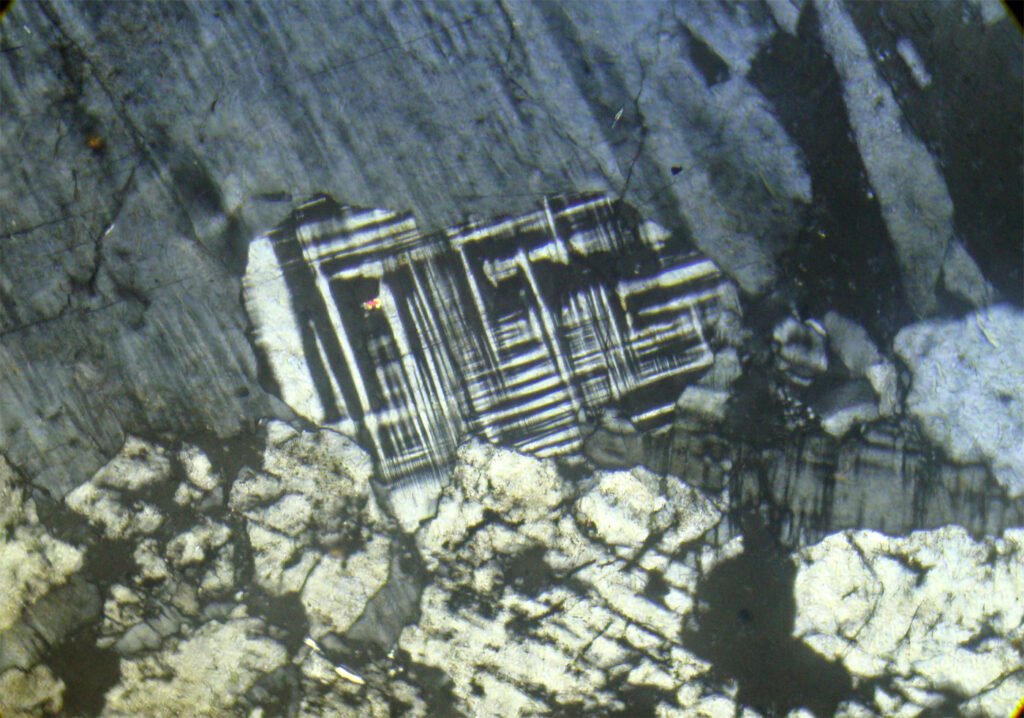
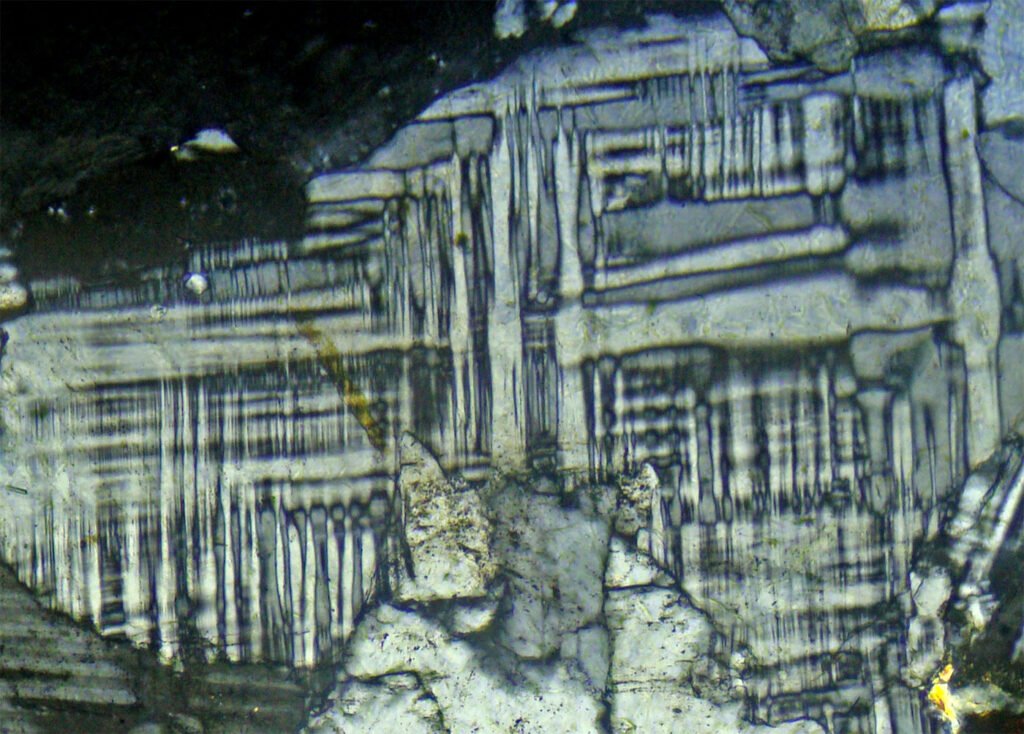
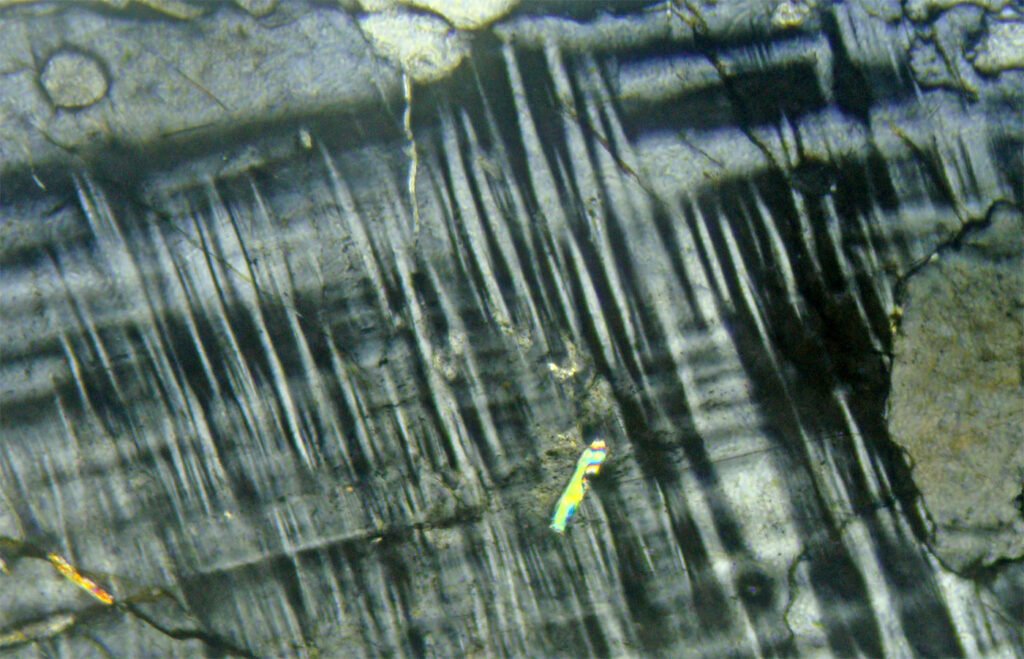
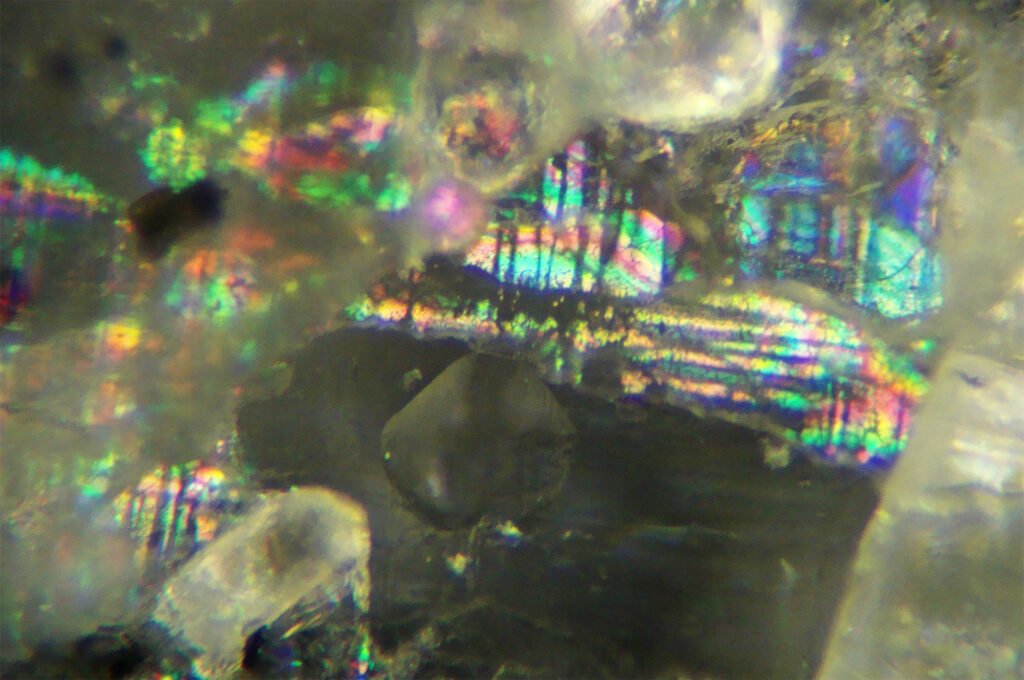
Twins: Twins in two perpendicular directions, forming a twinning in a pattern of “parquet” or “chess”, which are intersections of albite and pericline twins.
Typically they do not form bands with constant thickness, but bands that end in spikes; they individually narrow and widen rotating the stage and, in four positions during the complete turn of the stage, disappear completely.
There may be single twins: Carlsbad, Baveno and Manebach. It may also have perthites: dissolved albite (plagioclase) form lamellae, irregular bands and drops. Low-temperature autogenic microcline may be without twins and is easily confused with other minerals.
Zoning: Sometimes zonation occurs.
CONVERGENT LIGHT
Character: B(-)
2V angle: 66 – 103o
Alterations: microcline is more resistant to weathering than other feldspars such as orthoclase, sanidine and plagioclase. As a result, it is still unaltered while the other feldspars in the rock have already developed alteration minerals (clay minerals, sericite). Due to this greater resistance to weathering, microcline occurs as grains in sandstones. Alteration forms clay minerals (kaolinite) and sericite (alteration mica, usually muscovite).
May be confused with: other colorless twinned minerals with low-relief.
Anorthoclase may have similar twins, but it only occurs in volcanic rocks (microcline never occurs in volcanic rocks).
Plagioclases with an albite-pericline twin may be similar, but the twin planes are well defined, do not narrow and widen rotating the stage, and do not all disappear in certain positions rotating the stage.
Leucite may have a similar twin pattern, but its relief is lower, the crystal are generally rounded and the birefringence is lower (the interference colors in CPL are much darker).