5. Reflected Light Microscopy
Sample preparation: Polishing molybdenite is difficult due to its low hardness (lower than graphite). The mineral tends to smudge, resulting in many polishing grooves at best. Polishing is especially difficult in aggregates of large grains and in the presence of quartz.
Polishing is easier when it occurs as aggregates of fine fibers associated with calcite and other soft minerals. The hardness upon polishing is greater than expected; similar to that of galena and chalcopyrite, but lower than the hardness of calcite and graphite.
PLANE POLARIZED LIGHT – PPL
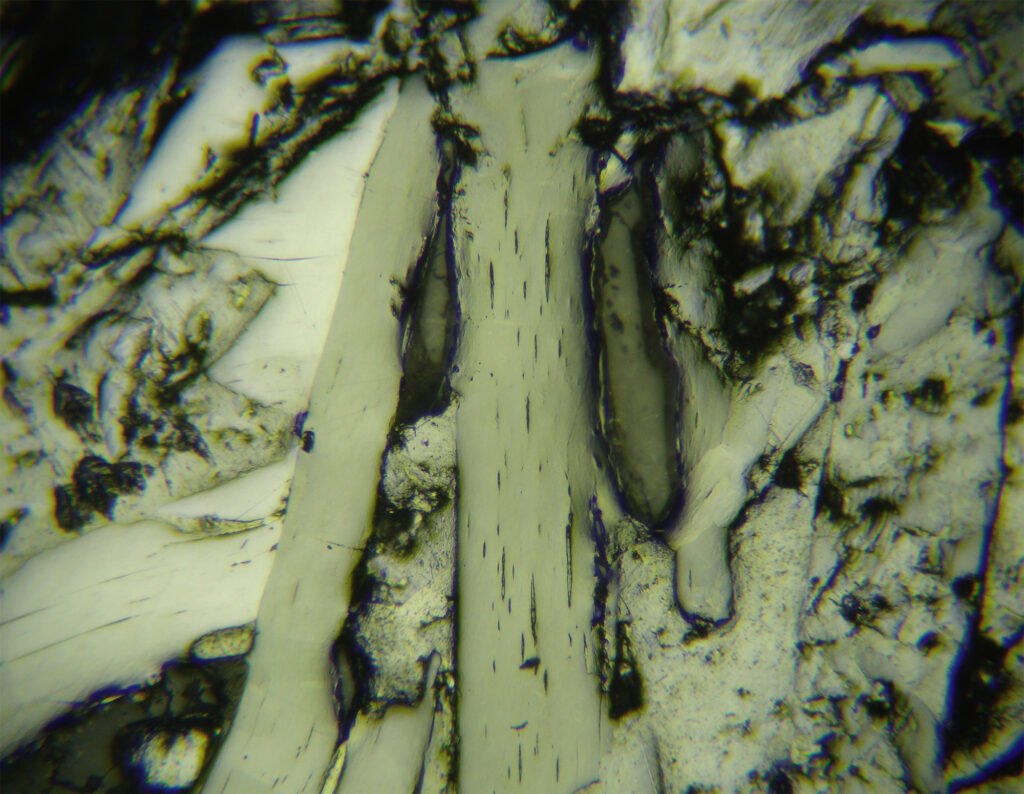
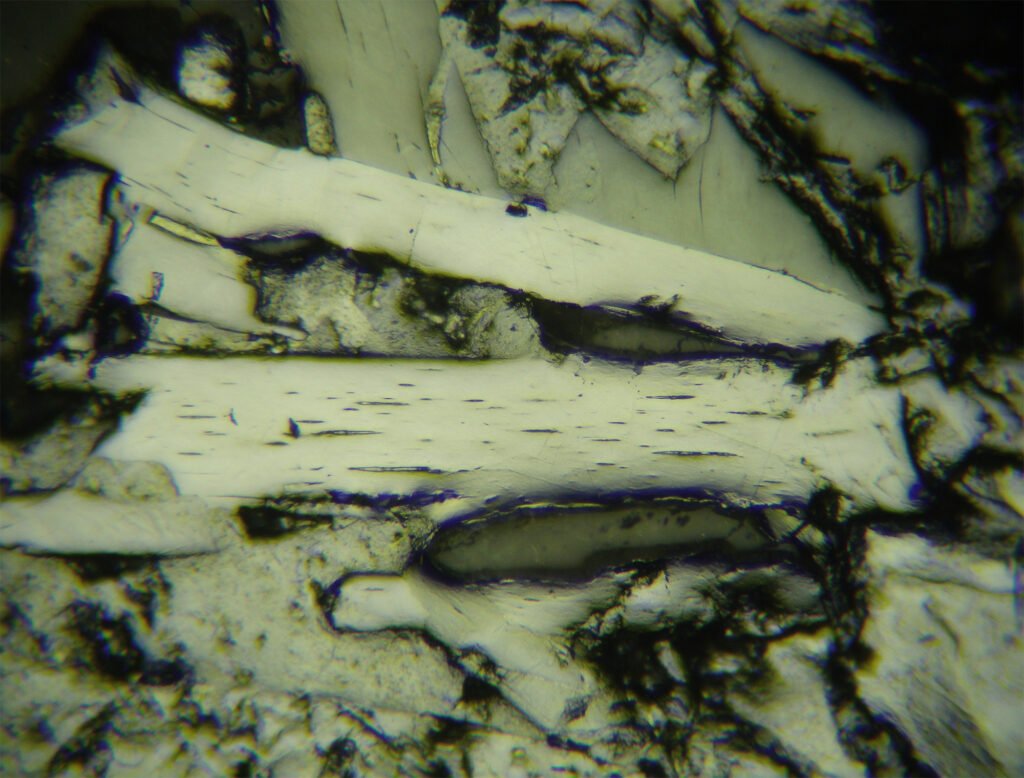
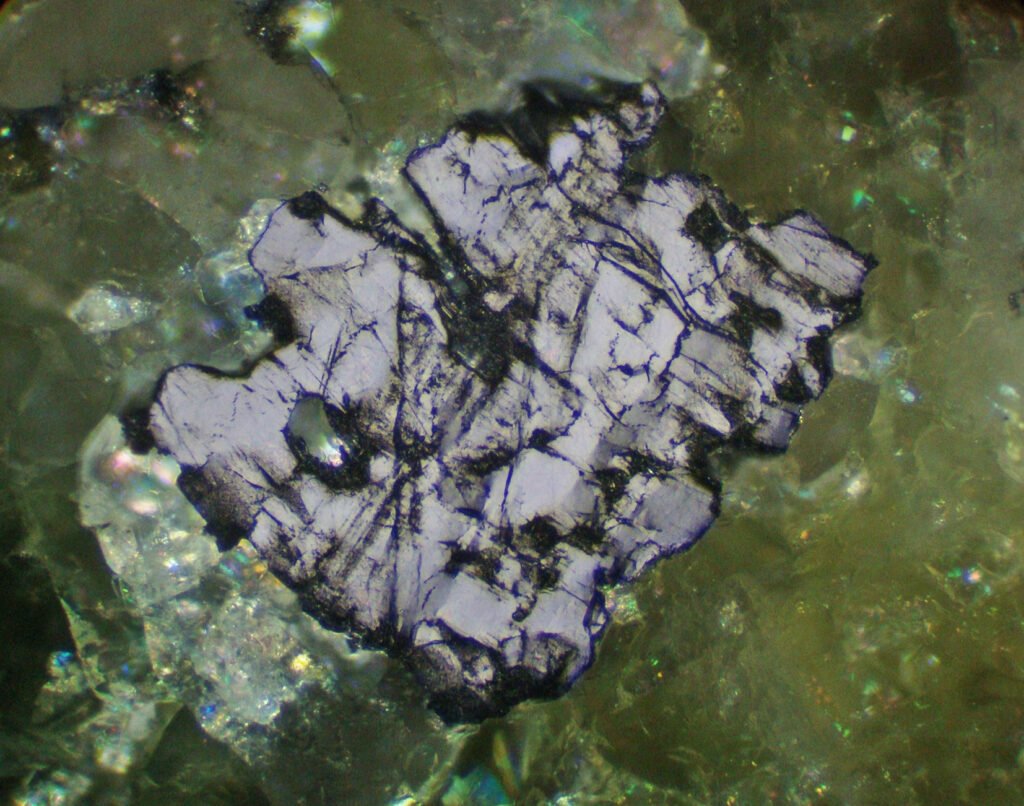
Reflection color: Light gray to bluish-gray, also creamy-yellowish gray. The color depends on the section of the mineral; it can even be pure white.
Pleochroism: Very strong, ranging between bluish-white and cream. This pleochroism, which is one of the strongest known, can appear as distinct shades of gray and may have a defined blue tone.
Reflectivity: 20,51 – 44,27%
Bireflectance: Strong.
CROSSED POLARIZED LIGHT – XPL
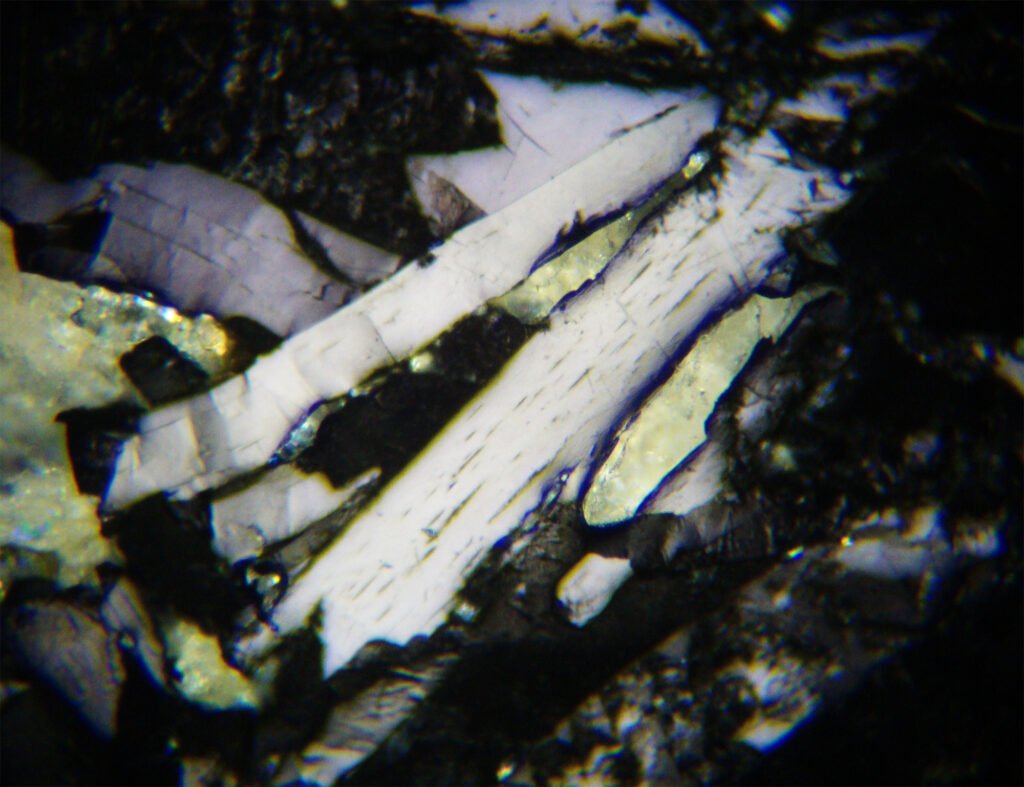
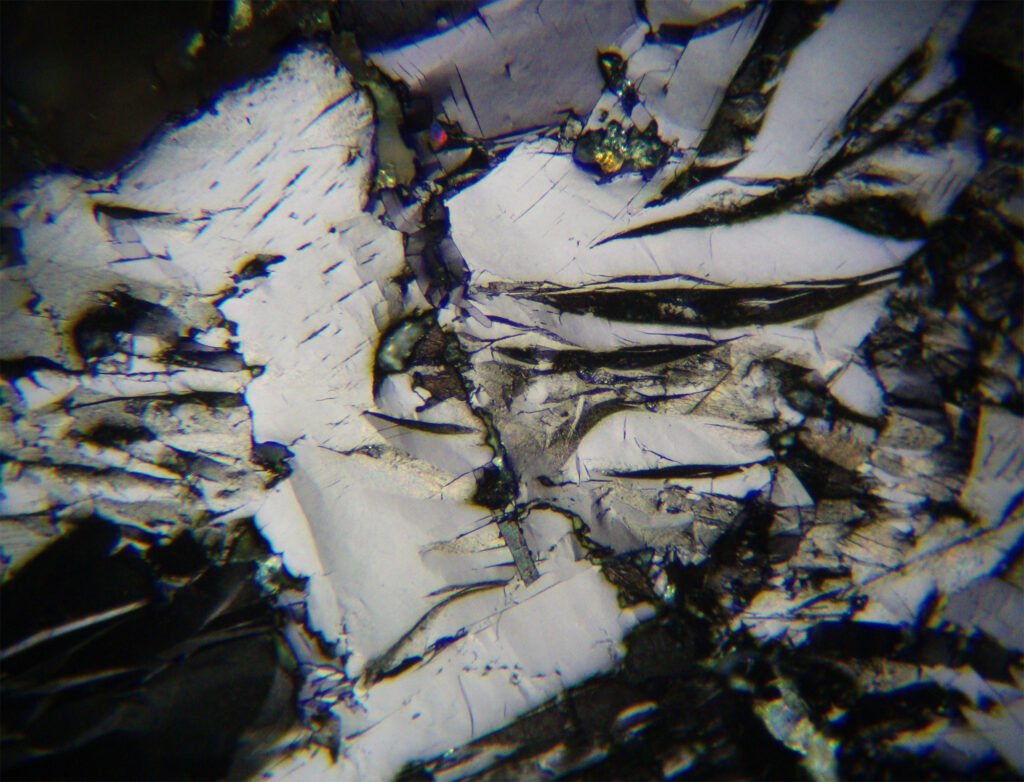
Isotropy / Anisotropy: Extremely strong anisotropy in shades of brown, blue, and turquoise. The bluish tone is very characteristic and diagnostic. But with the nicols exactly crossed, the colors are not expressive – a white with a pinkish tone. It is necessary to rotate one of the nicols minimally (1-2º) to observe the deep blue and other colors.
Internal reflections: No.
May be confused with: Graphite exhibits similar behavior and habits, but in XPL it is darker and displays yellowish colors instead of the bluish hues of molybdenite. Valeriite and makinawite have higher reflectivity and more yellowish tones. Theoretically, it is possible to confuse it with tetradymite, nagyagite, and some rare minerals.
General Characteristics:
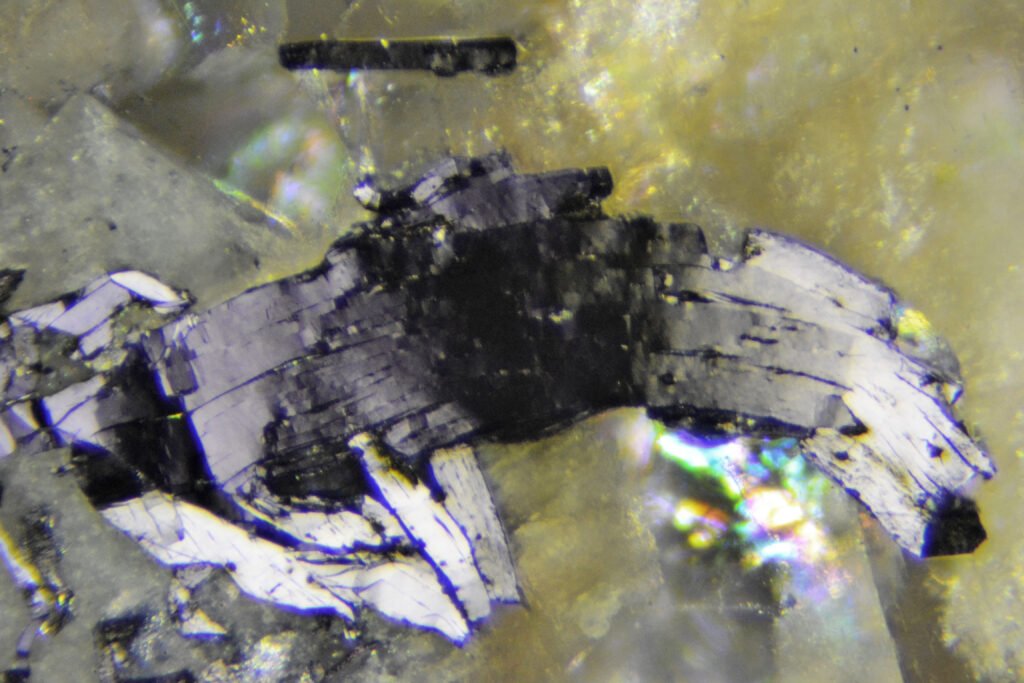
Grain shape: its occurrence in lamellae, often deformed, folded and stacked, is very characteristic. In the deformed lamellae, extinction is incomplete and wavy. The grains may have a barrel shape.
Colloform textures are possible.
Cleavage parallel to {0001} is almost always visible if polishing was done well.
Grain size is highly variable. Pegmatites are known to have plates with a diameter of 15 cm; in masses formed from gels, the grains are at the limit of observability under a microscope. In most occurrences, the granulation is relatively coarse. In masses consisting only of molybdenite, the intergranular contacts are straight, with very little toothing. Tuff or feathery aggregates are rare.
Mammillary to botryoidal masses (as in goethite), formed by globules of varying sizes with a few millimeters in diameter, develop a very distinct concentric texture that is highlighted by polishing due to the greater hardness of the larger diameter globules.
Parallel dislocations (crumpling) may be very well developed, producing a texture that resembles twinning.
Cataclasis is not expected in such an easily deformable mineral, but compressions very often result in delaminations (an “open book” structure).
Deformations are extremely common and always present in coarse-grained masses. Frequently, widespread deformations are easily observable even in uncrossed nicoles. In some cases, extremely deformed molybdenite lamellae are situated amidst grains of other minerals that apparently have not undergone any type of deformation, which can be explained by the recrystallization of these other minerals after tectonic events; molybdenite preserved the features generated by tectonism while other minerals, such as chalcopyrite, recrystallized.
Polysynthetic twins of primary origin are indicated by variations in polarization effects in sections parallel to “c”.
Substitutions 1: molybdenite can be replaced by powellite, arsenopyrite, and chalcopyrite.
Substitutions 2: molybdenite replaces pyrite, chalcopyrite, arsenopyrite, and magnetite.
Alteration to molybdite (MoO3) is common and accompanied by partial pseudomorphization. This oxidation readily follows the planes opened by delaminations.
Inclusions in molybdenite can be native bismuth, bismuthinite, ikunolite, joseite, galena, and gold.
Inclusions of molybdenite occur in pyrite, chalcopyrite, arsenopyrite, bismuthini, and tetrahedrite; they can be interstitial in cassiterite and wolframite; and small spots occur in scheelite.