
MONAZITE
Monazite – (Ce,La,Th,Sm)PO4 – is a common phosphate. It was an important ore of Th, La and Ce, before the world market for Rare Earth Elements was dominated by the Mongolian occurrences exploited by China. It still remains as REE ore, but on a very small scale.
“Monazite” nowadays no longer designates a mineral species, but is just a generic term used for the members of the Monazite Group: monazite-(Ce), monazite-(La), monazite-(Nd) and monazite-(Sm ). There is a term with Gd. All are very similar to each other. The most common is monazite-(Ce), the others are very rare.
The presence of Th, sometimes of U, makes them radioactive. May be fluorescent yellow.
Monazite-(Ce) always contains varying amounts of Nd, La, Sm and other REEs replacing Ce. There are 4 varieties (with Eu, with silica, with S and golden).
1. Characteristics
Crystal system: Monoclinic prismatic.
Color: Reddish brown to brown. It can be greenish, yellow, green, gray, white.
Habit: Usually in prismatic, flat or wedge-shaped crystals.
Cleavage: {100} distinct, {010} poor, {110} {101} {011} indistinct. Striations may occur.
Tenacity: Brittle.
Twinning: Contact twins are common, on {100}.
Fracture: Conchoidal, irregular.
Mohs Hardness: 5 – 5.5
Parting: On {001} or {-111}.
Streak: White, faint colored tones.
Lustre: Resinous, vitreous, sub-vitreous to adamantine.
Diaphaneity: Transparent.
Density (g/cm³): 5 – 5.5 (increases with increasing Th content).
2. Geology and Deposits
Monazite is a relatively common accessory mineral in acidic igneous rocks (granites, syenites) and their pegmatites. Occurs in carbonatites. It is occasionally found in hydrothermal vents.
In metamorphic rocks it occurs in magnesian marbles, schists, gneisses and granulites.
In sedimentary rocks it can be found as detrital grains. It is rarely autigenic in shales and heavily altered zones. It is typically concentrated in placers, where mining is possible.
3. Mineral Associations
Monazite occurs with common minerals of granitic rocks such as quartz (smoky quartz), feldspars (plagioclase (albite), orthoclase (adularia), microcline), micas (biotite, muscovite), amphiboles, pyroxenes, epidote, apatite, allanite, zircon , magnetite, hematite, ilmenite, pyrite, pyrrhotite and goethite.
In granitic pegmatites it is associated with columbite-(Fe), tantalite, wolframite, cassiterite, tourmaline, fergusonite, gadolinite, samarskite-(Y), xenotime-(Y), xenotime-(Yb), zircon-(Hf) and polymorphs of TiO2 (rutile, anatase, brookite).
Also with astrophyllite, conichalcite, clinochlor, aegirine, uraninite, uranophane, elpidite, ferroceladonite, carminite, segnitite and betaphyte.
4. Transmitted Light Microscopy
Refraction indices: nα: 1.770 – 1.793 nβ: 1.778 – 1.800 nγ: 1.823 – 1.860
PLANE POLARIZED LIGHT – PPL
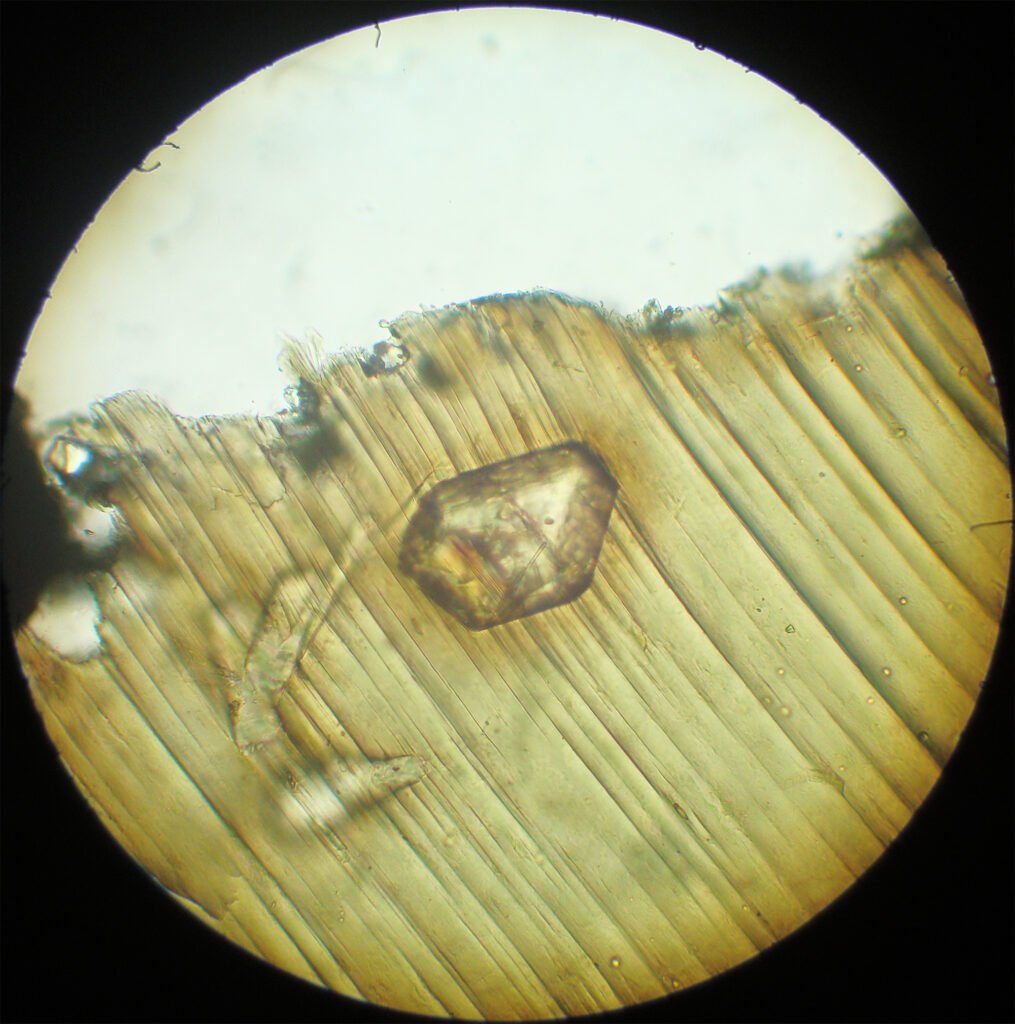
Color / Pleochroism: Colorless, gray, pale yellow to yellow, pale green.
It does not have pleochroism or has very weak pleochroism between light yellow and very light yellow. It can also be between shades of greenish yellow.
May not show any pleochroism.
If rich in Th it may be metamictic. Due to its radioactivity, it can have black halos around it when it occurs as an inclusion in biotite or other mafic minerals (amphiboles).
Relief: High to very high.
Cleavage: {100} distinct, often visible, is an important diagnostic feature. Also cleavage {010} distinct to bad. Partition on {001} or {-111}.
Altered grains show cleavage and partitioning much better.
Habits: Idiomorphic tabular crystals flattened parallel to {100} or elongated along the “b” axis. Also as small equidimensional grains; can be prismatic or wedge-shaped. Longitudinal sections can show the shape of a parallelogram (rhombs) with 4, 6 or 8 sides.
CROSSED POLARIZED LIGHT – XPL
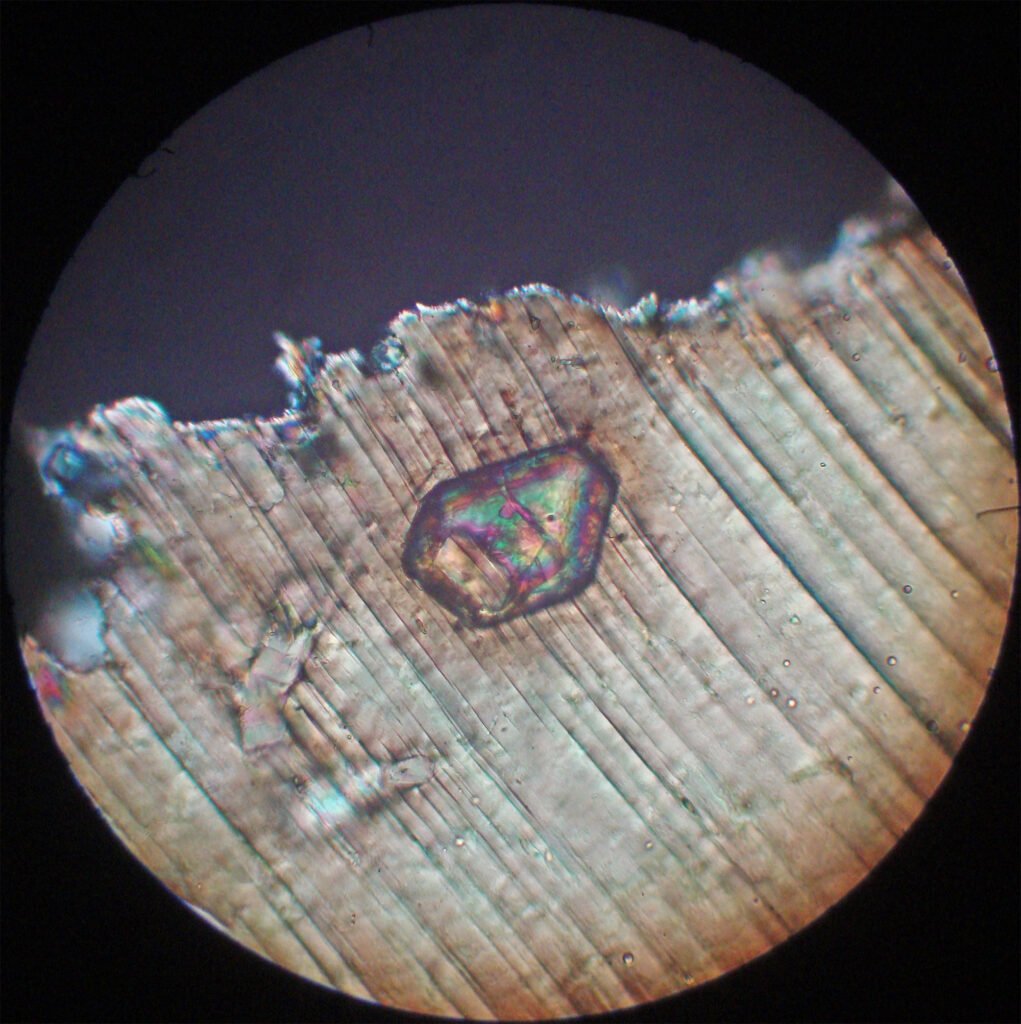
Birefringence and Interference Colors: Birefringence up to 0.053 – 0.067, corresponding to intense colors, very colorful, up to the end of 3rd order, such as zircon and epidote.
Extinction: Oblique, from 0 – 10º , can simulate being parallel!
Elongation sign: No information available.
Twins: Single contact twins by {100} are common. Lamellar twins are rare.
Zoning: No.
CONVERGENT LIGHT
Character: B(+)
2V angle: 6 – 19º or 10 – 26º (literature diverges).
Alterations: hardly alteres, it is a common detrital mineral. May change to a brown material, such as limonite, along cleavages and at grain boundaries. Sometimes it gets cloudy due to very small opaque particles, which are probably limonite.
May be confused with: diagnostic are high relief, high birefringence, and pale yellow color. If it occurs in small grains, it is easily confused with zircon, epidote, xenotime and titanite.
Zircon is normally colorless and uniaxial.
Titanite usually has a stronger color.
Xenotime is very rare, uniaxial and has even higher birefringence.
Epidote is rarely euhedral.
Staurolite has stronger yellow pleochroism and much lower birefringence.
Olivine and epidote have a greater 2V angle.
5. Reflected Light Microscopy
Reflected light microscopy is not the recommended analytical method for the identification of monazite. However, it is important to make a polished thin section or a polished section to identify the opaque minerals that occur associated with monazite, like magnetite, hematite and ilmenite.
Sample preparation:
PLANE POLARIZED LIGHT – PPL
Reflection color:
Pleochroism:
Reflectivity:
Bireflectance:
CROSSED POLARIZED LIGHT – XPL
Isotropy / Anisotropy:
Internal reflections:
May be confused with:
General Characteristics: