1. Characteristics
Crystal system: Monoclinic prismatic.
Color: White, gray, silvery, brown, green, pink, yellow.
Habit: Massive, micaceous, tabular, columnar, scaly, granular, pseudohexagonal or diamond-shaped.
Cleavage: {001} perfect, as other micas.
Tenacity: Flexible and elastic.
Twinning: Plane at {001}, axis at [310], in 6-pointed stars.
Fracture: Micaceous.
Mohs Hardness: 2 – 2.5 // a {001}; 4 perpendicular to {001}.
Parting: on {110} and {010}.
Streak: White.
Lustre: Vitreous, silky, pearly.
Diaphaneity: Transparent.
Density (g/cm³): 2.76 – 3.
2. Geology and Deposits
Muscovite is an abundant mica, the most common of the white micas. It occurs in many types of igneous rocks (aluminous granites, granodiorites, aplites, pegmatites and other felsic rocks) and metamorphic rocks with a pelitic composition and low to medium metamorphic grade (slate, phyllite, shale, gneiss, cornubianite and quartzite).
Sericite occurs in very low-grade metamorphic rocks. Muscovite also is found in some immature sedimentary rocks (sandstones, siltstones, etc.) as detrital mineral. May be autogenic in sedimentary rocks.
Never occurs in volcanic rocks!
3. Mineral Associations
In magmatic and metamorphic rocks, muscovite is associated with quartz, plagioclase, microcline, biotite, zircon, fluorapatite and many others. In pegmatites, it occurs with quartz, K-feldspars (orthoclase, microcline), albite, beryl (aquamarine), fluorite, garnet (spessartite), tourmaline and scheelite, among others.
In low-grade metamorphic rocks it is associated with albite; with the advancement of the metamorphic grade it is associated with biotite, chloritoid and potassic feldspar.
4. Transmitted Light Microscopy
Refraction indices: nα: 1.552 – 1.576 nβ: 1.582 – 1.615 nγ: 1.587 – 1.618
PLANE POLARIZED LIGHT – PPL
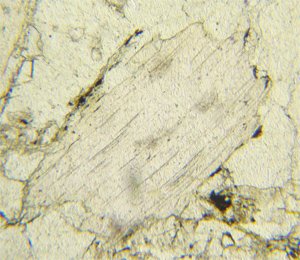
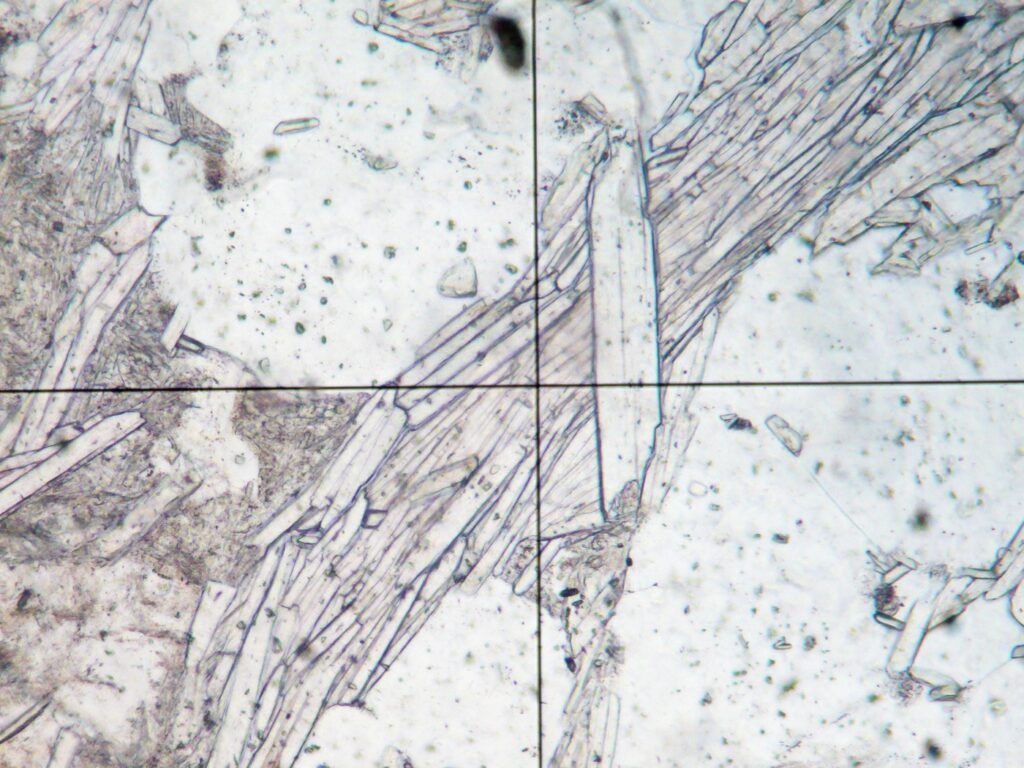
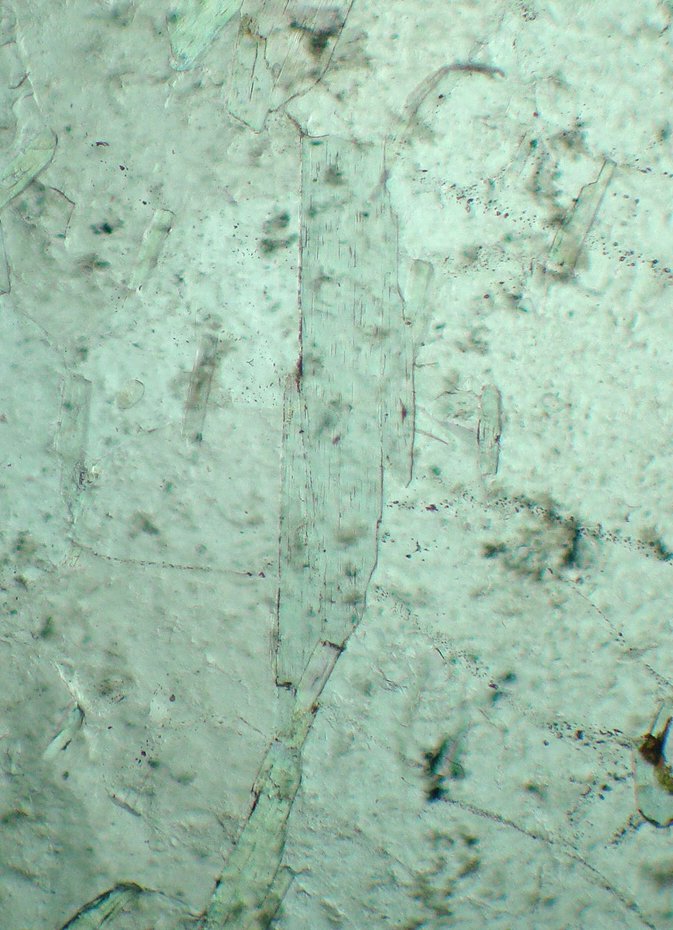
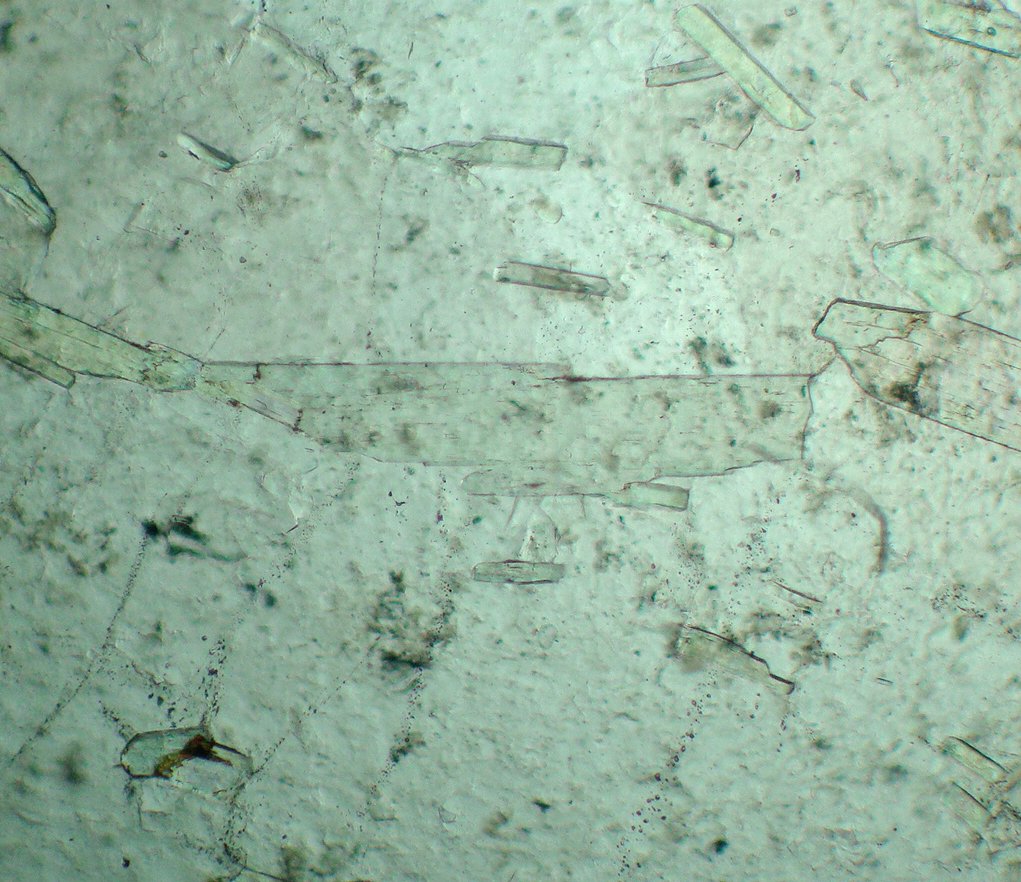
Color / Pleochroism: Colorless. It rarely presents shades of pale green, pale yellow or pink, with slight pleochroism. The variety fuchsite shows a discrete pleochroism between colorless and bluish-green, better observed in portions of the thin section with a thickness a little above 30 microns.
Relief: Moderate. It is a well-defined relief, far superior to the relief of quartz and feldspars. It is easier to notice closing the diaphragm by more than 50%.
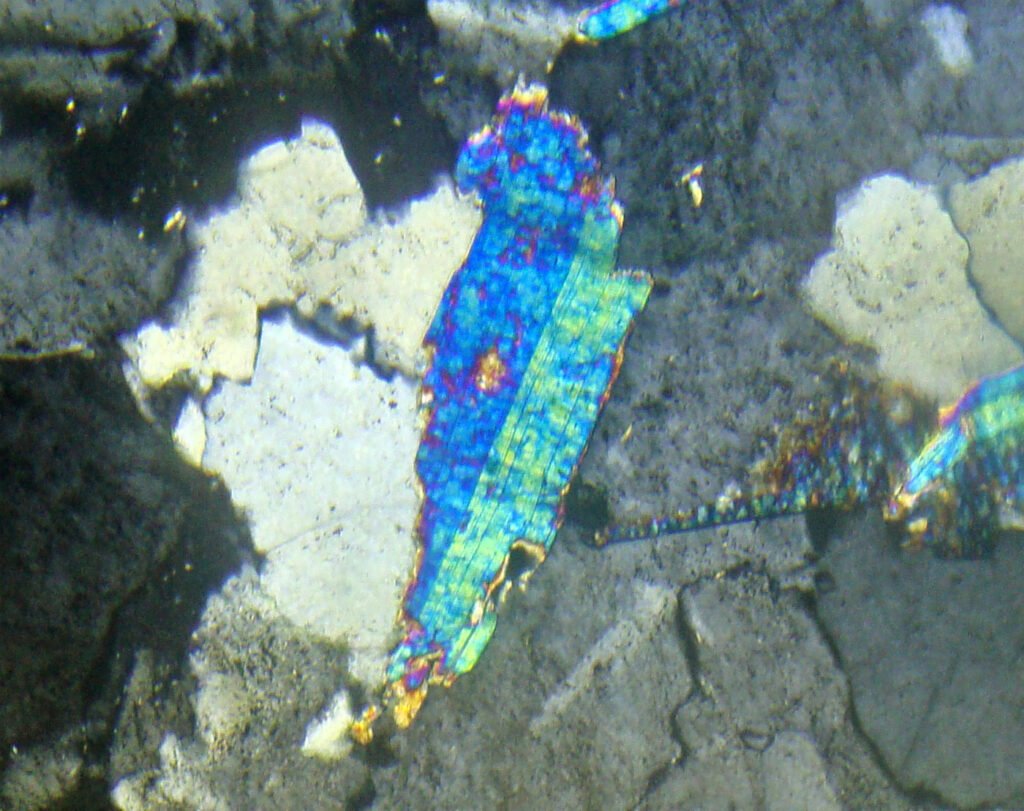
Cleavage: (001) perfect, can be partial or just indicated. Controls the orientation of the fragments: the cleavage is parallel to the elongation of the lamellae.
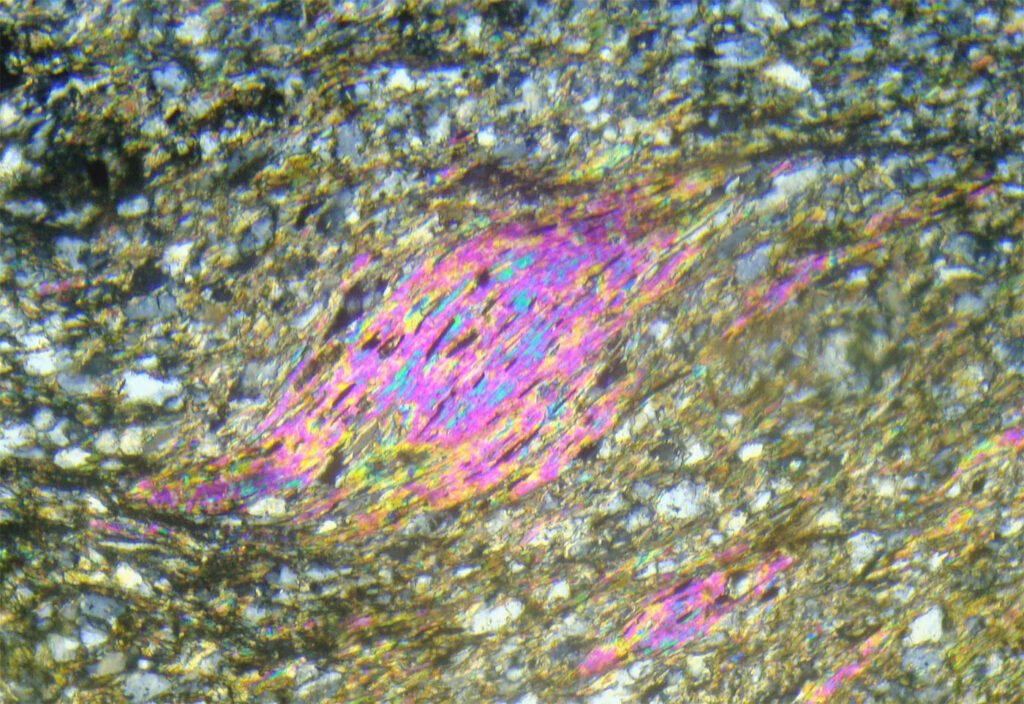
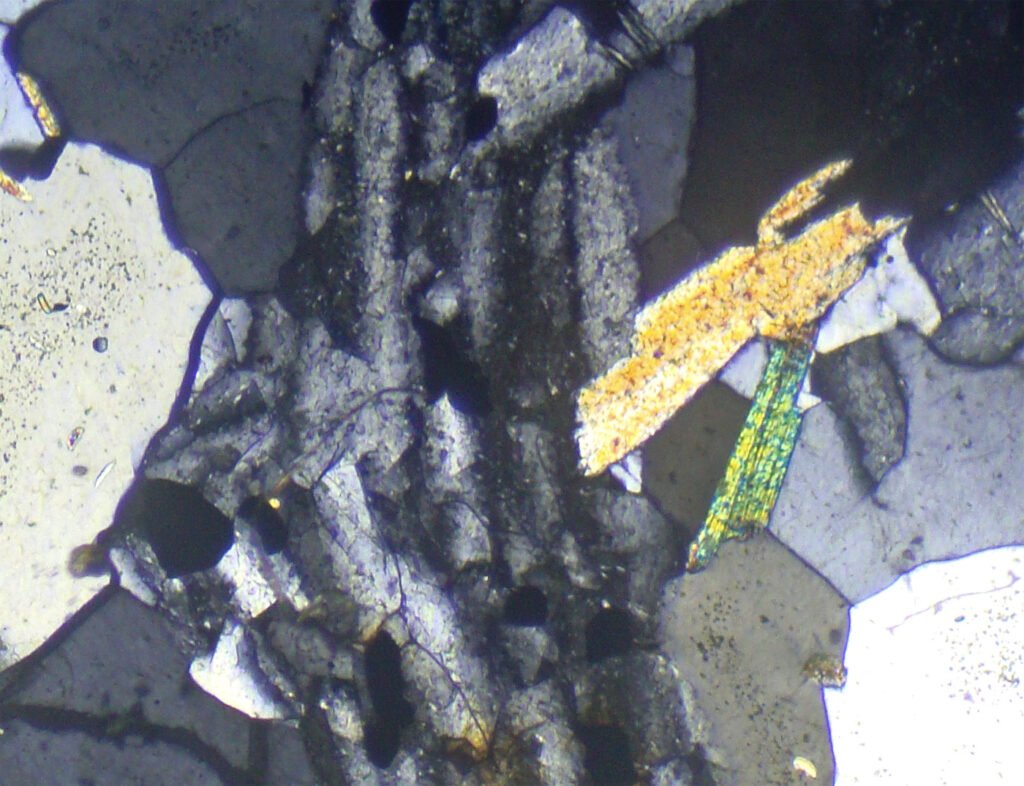
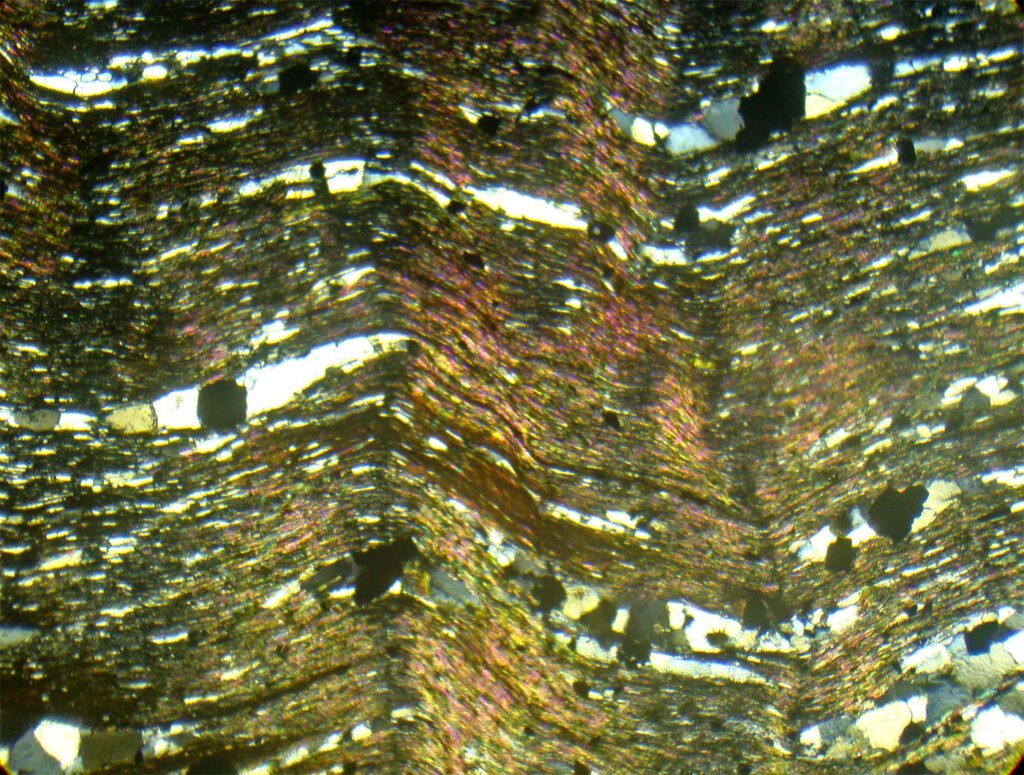
Habits: Lamellar, reeds, plates, flakes, columnar, tabular. They may be deformed, curved or bent in a zigzag pattern. May be intergrown with biotite.
CROSSED POLARIZED LIGHT – XPL
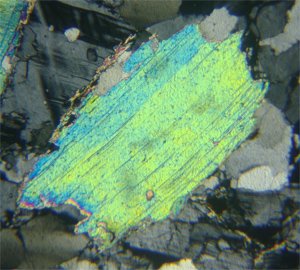
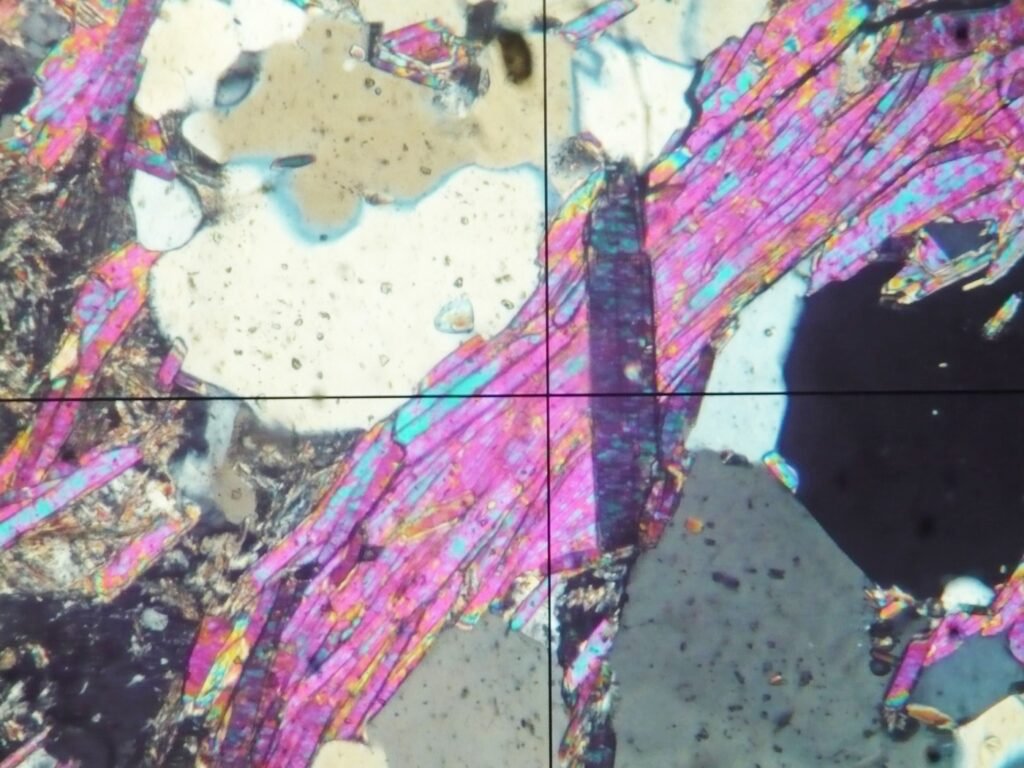
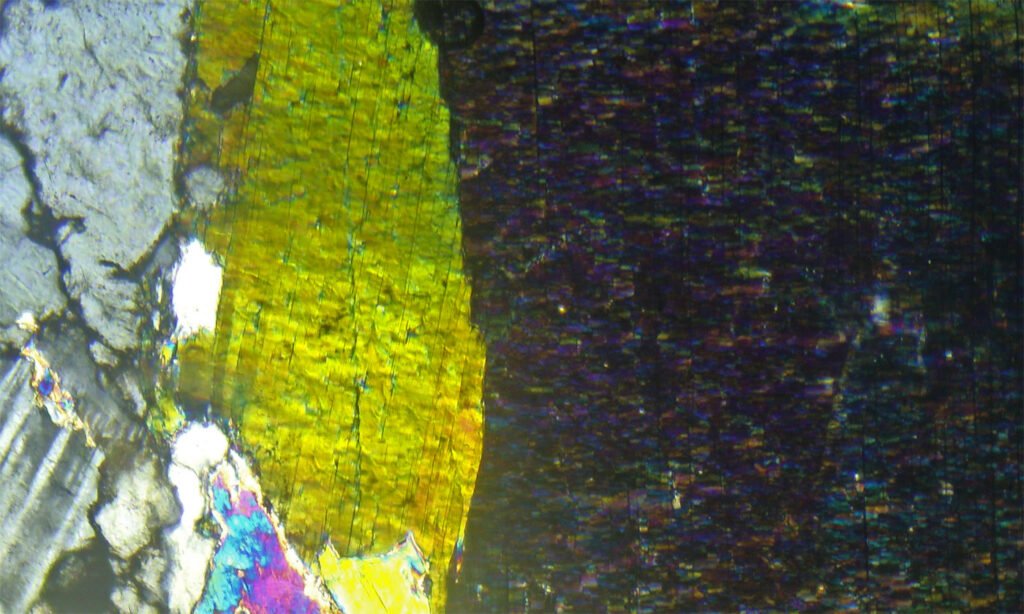
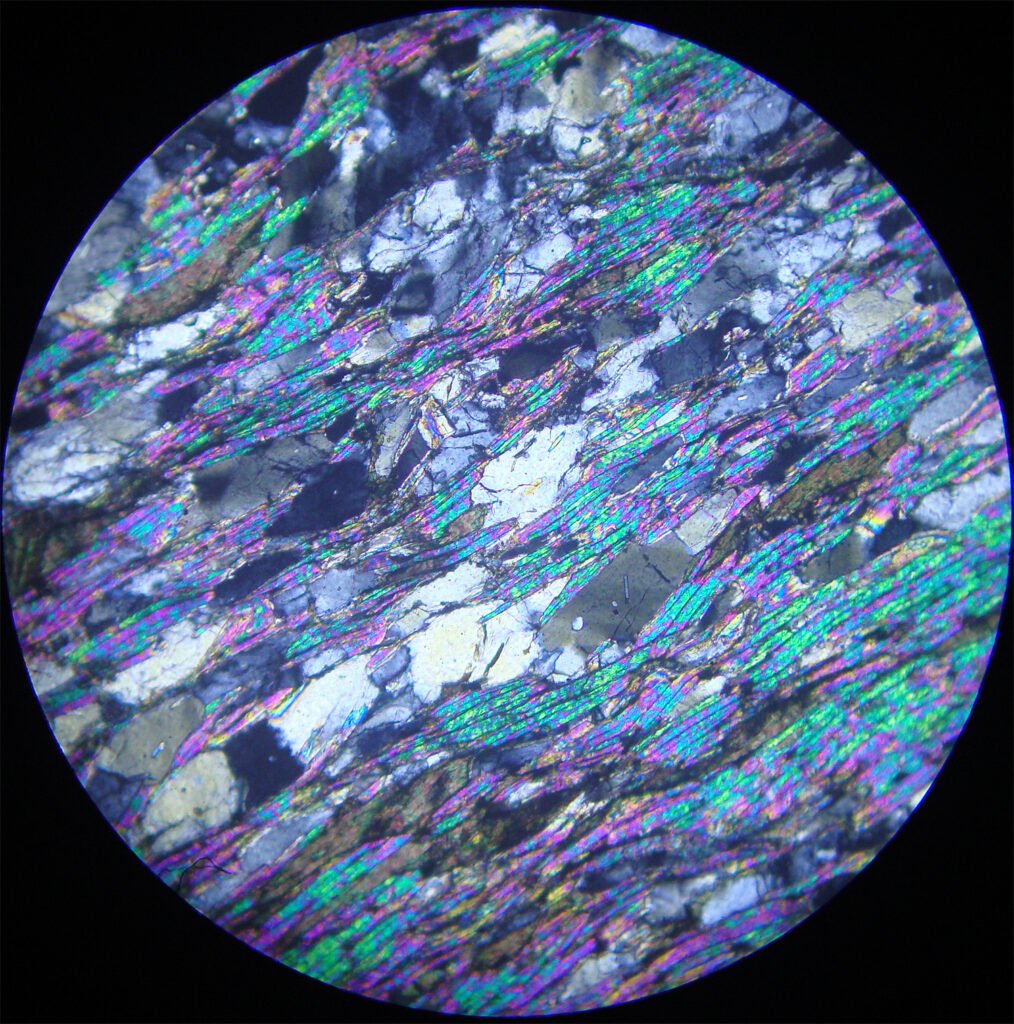
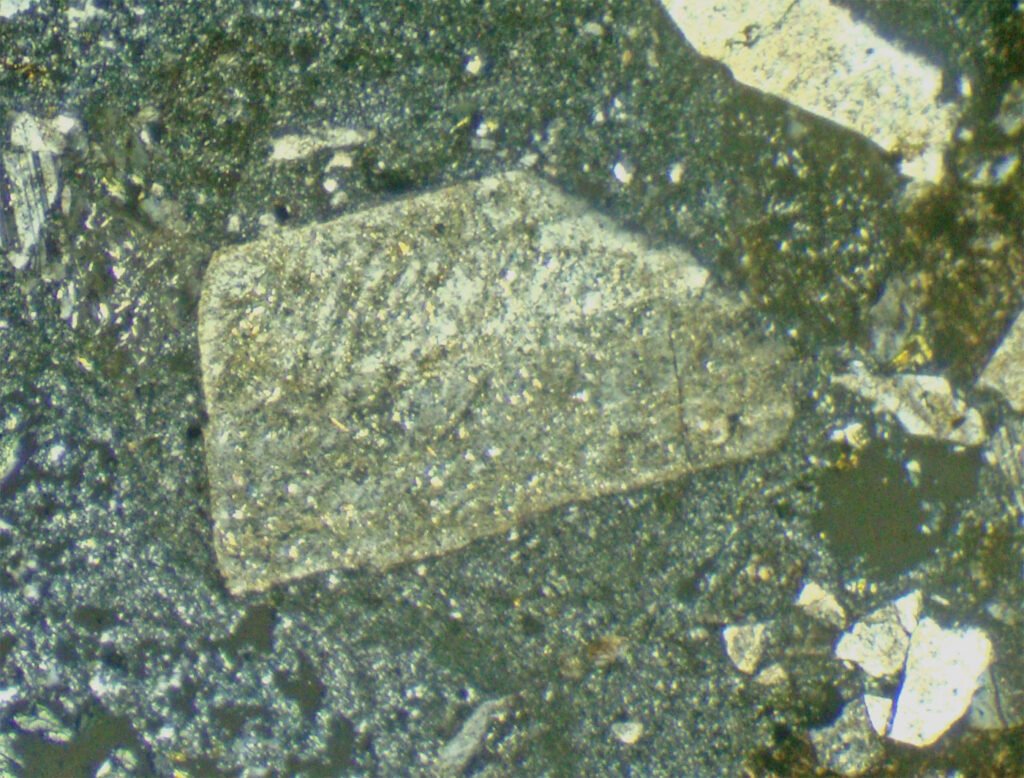
Birefringence and Interference Colors: Birefringence of 0.037 – 0.041, with 2nd and 3rd order interference colors: strong, intense, colorful colors. Sections parallel to the cleavage show very low 1st order interference colors.
Extinction: Parallel and mottled in the sections perpendicular to the cleavage; it may be oblique from 1-3º.
Mottled (“birds-eye”) extinction is a type of extinction that is not complete, generating a texture with a backlight. This mottled extinction is diagnostic for biotite, muscovite, talc, pyrophyllite and brucite!
Elongation sign: ES(+) by cleavage, like all micas.
Twins: May show simple twins, but they are very rare.
Zoning: No.
CONVERGENT LIGHT
Character: B(-), difficult to see due to the strong interference colors.
2V angle: 30–47o or 35–50o; the literature indicates different angles.
Alterations: muscovite is a mineral that is quite resistant to weathering and is generally unaltered. Very fine-grained aggregates can alter to hydromuscovite and illite.
There are two special (very rare!) situations of alteration:
(1) Occasionally, muscovite changes to kaolinite, this alteration may generate perfect pseudomorphosis.
(2) Under conditions of more intense metamorphism, muscovite becomes unstable and is replaced by an aggregate of small grains of potassic feldspar.
May be confused with: other micas.
Lepidolite, talc, pyrophyllite, margarite and paragonite are very difficult or impossible to distinguish from muscovite under the petrographic microscope.
Chlorite, when faintly colored, may be similar, but it has lesser birefringence and often shows anomalous interference colors.
Kaolinite has less birefringence.
Sericite can only be identified by X-Ray Diffractometry.
Any colorless mica can be considered a muscovite; many petrologists use the term “white mica” instead of naming species. Distinguishing muscovite from other white micas and brittle micas may be impossible.