NICKELINE
Nickeline – NiAs – is a relatively common arsenide, important as an ore of Ni, as it contains 43.9% Ni. The use of nickeline is problematic, as As is harmful to the vast majority of milling and casting techniques. It is necessary to blend Ni ores with nickeline with Ni ores free of As.
Also called “nicolite” (Dana, 1868), nickeline was formerly called “Kupfernickel” or “Rotnickelkies” by German miners because its color seemed to indicate the presence of copper. However, in addition to not being able to extract any copper from the mineral, they became ill, attributing this to an evil spirit, a “nickel”. It was only in 1751 that Baron Axel Fredrik Cronsted managed to obtain a metal from this mineral, which he called nickel, in allusion to such a spirit. In 1832 it was called nickeline by F.S. Beudant.
It is the most common member of the Nickeline Group. May contain Sb, Fe, S and Co.
Watch out! Heated it develops a garlic smell due to the toxic arsenic fumes it releases. In addition, it may be associated with pitchblende (uraninite), which are highly radioactive.
1. Characteristics
Crystal system: Hexagonal, dihexagonal bipiramidal.
Color: Pale copper red, tarnishes to lead gray, gray or black colors.
Habit: Massive in granular aggregates, radial reniform, dendritic, reticulate, crystals up to 1.5 cm very rare.
Cleavage: {1010} imperfect, {0001} imperfect. Striations: Crystals tend to be striated.
Tenacity: Brittle.
Twinning: On {10-11}, gives “fourlings”(4 xls).
Fracture: Conchoidal.
Mohs Hardness: 5 – 5.5
Parting: No.
Streak: Brownish black.
Lustre: Strong metallic.
Diaphaneity: Opaque.
Density (g/cm³): 7.8
2. Geology and Deposits
Nickeline is typically a high temperature hydrothermal mineral of veins with Ag, Cu and Ni arsenides and sulfides. It can form large concentrations of Co-Ni ores, characterized from classical occurrences such as Schneeberg and Cobalt City. It is formed by hydrothermal alteration of ultramafic rocks (peridotites, gabbros and norites) and associated ores.
It can be formed by the substitution of Ni and Cu sulfides (replacing pentlandite, in association with Cu and As sulfides). It also originates from metasomatism of sulphide-free ultramafic rocks, when metasomatic fluids introduce S, As and carbonate. Sometimes, As is replaced in large proportions by Sb, this process forms an isomorphic series with breithauptite (NiSb).
3. Mineral Associations
It occurs with typical gangue minerals (calcite, dolomite, barite) and common sulphides (arsenopyrite, pyrrhotite, pyrite and chalcopyrite). When exposed to humid air, it alters to annabergite.
It occurs with the typical minerals of the Cu-Ni-Co-As paragenesis: breithauptite, millerite, gersdorffite, maucherite, rammelsbergite, safflorite, skutterudita, Ni-skutterudite, cobaltite, glaucodot, linnaeite, arsenopyrite, heazlewoodite, molybdenite, ullmannite, michenerite, pentlandite, bishinite, allargentum, dyscrasite polybasite, pyrargirite and native elements (gold, silver and bismuth).
4. Transmitted Light Microscopy
Does not apply, as nickeline is completely opaque.
5. Reflected Light Microscopy
Sample preparation: Nickeline easily obtains an excellent polish, without expressively showing polishing scratches. Its polishing hardness is
smaller than those of rammelsbergite, safflorite, loellingite and eskutterudita, practically
the same as breithauptite, pyrrhotite and maucherite and
greater than those of native silver, dyscrasite and chalcopyrite.
PLANE POLARIZED LIGHT – PPL
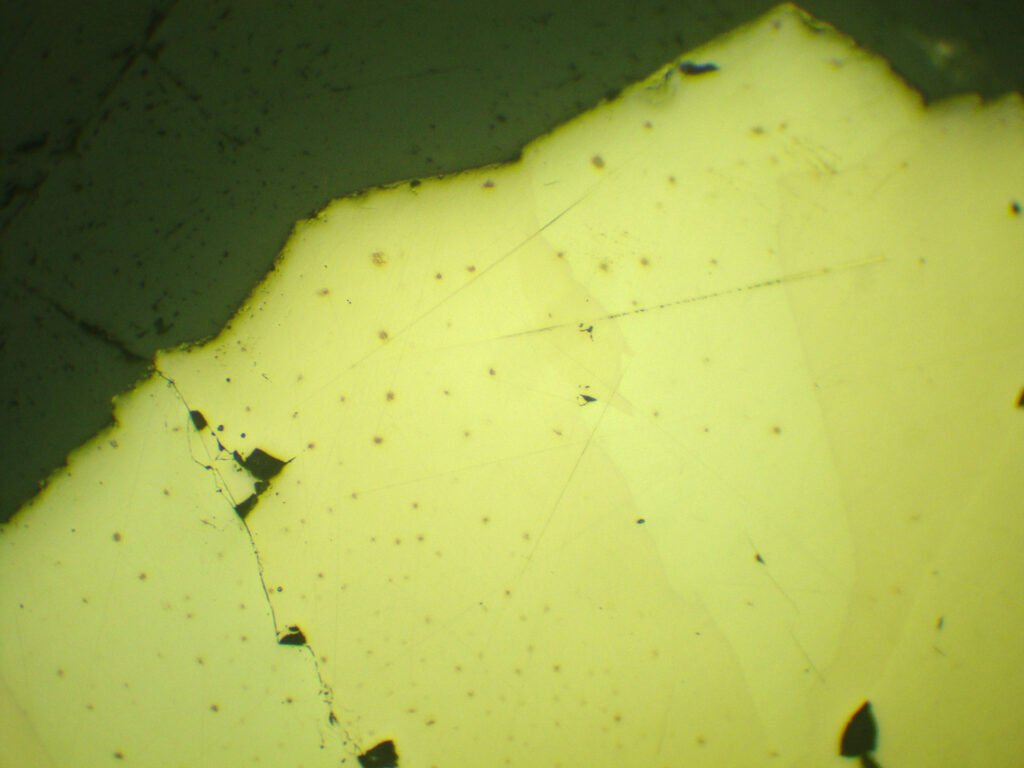
Reflection color: White with a strong yellow-pink tone, it resembles light orange, very similar to the reflection color of native copper. The color has a brownish pink-orange hue. Next to white ores (Bi and native As) the color is decidedly pink.
Compared with the color of maucherite, the color of nickeline is pinker, lighter and more intense. The color of maucherite is violet-blue-gray.
Compared with the color of breithauptite, the color of nickeline is less colorful.
Compared with the color of cobaltite, the color of nickeline is much more colorful.
Compared with the color of magnetite, the color of nickeline is more pink.
Compared to the color of skutterudite, the color of nickeline is distinctly pink.
Compared to the color of pyrrhotite, the color of nickeline is lighter and more rosy, without the brown tones.
Compared with the color of bornite, the color of nickeline is much lighter and less colorful.
Pleochroism: Strong to moderate orange to yellowish, pinkish-white, and light slate gray (white-yellow-pink to light brown-pink).
Pleochroism is best observable in intergranular contacts and makes it easy to recognize them.
Reflectivity: 59,01 – 60,24%
Bireflectance: Distinct.
CROSSED POLARIZED LIGHT – XPL
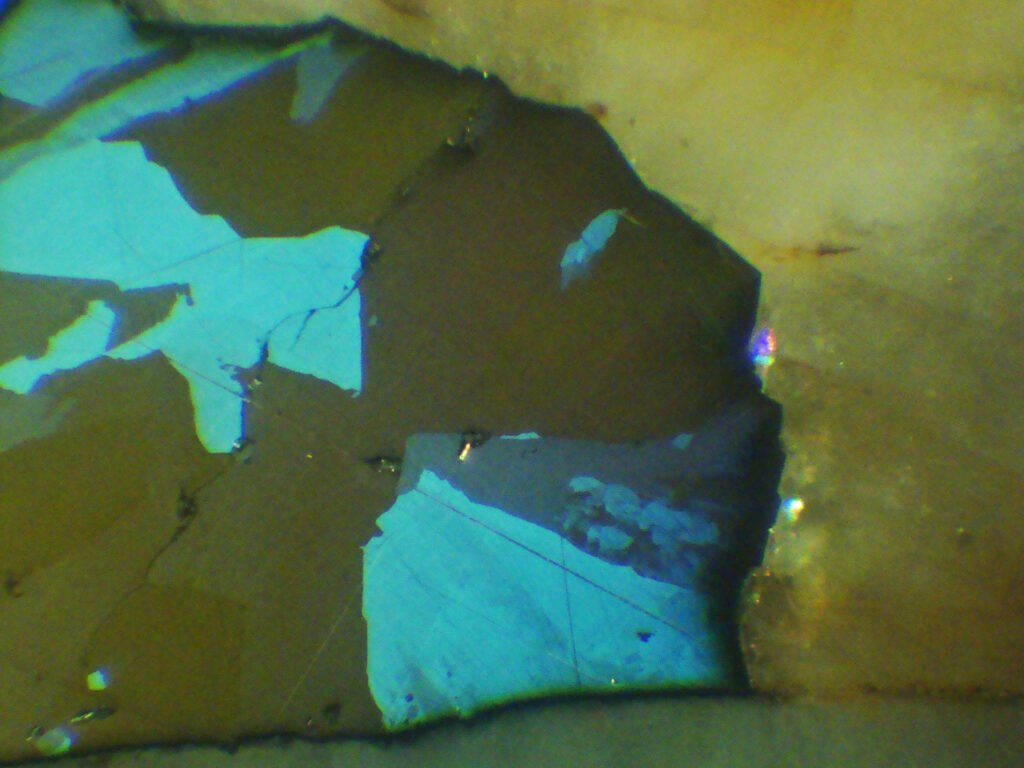
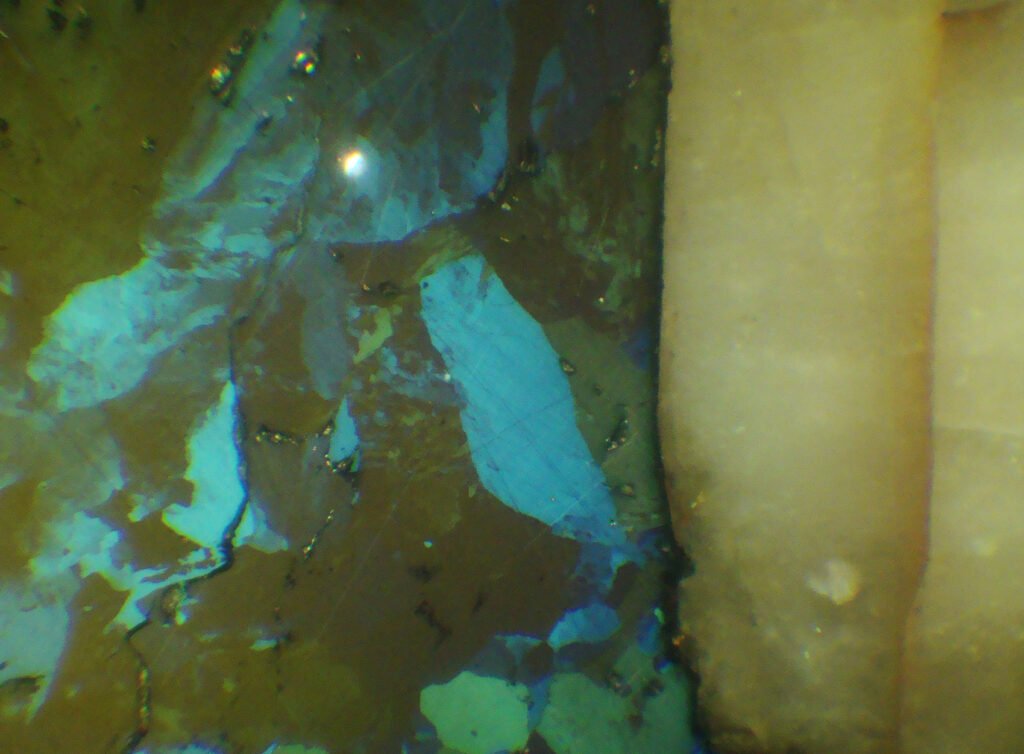
Isotropy / Anisotropy: Very strong anisotropy in colors from brown to blue, blue-violet, green to slate gray and gray-green. Colors are somewhat variable.
Extinction is straight. Basal sections are apparently isotropic.
Internal reflections: No.
May be confused with: breithauptite and maucherite, which are similar and can occur with nickeline. Breithauptite has a darker color, in PPL is pinker and in XPL is greener.
Maucherite does not have pleochroism, the color is more gray, its anisotropy is weaker, it is sometimes fibrous or has polishing pits; it can replace nickeline.
Pyrrhotite has much lower reflectivity, less perfect polishing and more yellow-brown color.
General Characteristics:
Grain shape varies greatly. Idiomorphic single crystals are rare in carbonates, but can occur, including cross-shaped twins. Frequent are granular aggregates, which in section have a radial structure, formed by subparallel, subhedral to euhedral coarse grains. They transition into mamelonate and botryoidal formations. In these botryoidal aggregates the crystals often form very fine needles, generally radially arranged, closely intergrown with safflorite with the same acicular habit. A more detailed analysis shows that these needles are often composed of an irregular aggregate of extremely fine grains, probably representing a pseudomorphosis on an earlier mineral. Completely irregular allotriomorphic (anhedral) aggregates, composed of grains of the most varied sizes, are also common. The contact between the grains, due to these very different habits, is quite variable, but as a rule it is quite straight, with little toothing.
Cleavage is generally not visible in a polished section. With incipient alteration sometimes a very sharp cleavage appears parallel to (0001), apparently only in very pure crystals that are not arranged in subparallel aggregates. Very rarely shows a second cleavage (1120). These cleavages exposed by incipient changes can form a checkerboard pattern, vaguely resembling microcline twins. Alteration along twin planes in crystals with parallel lamellar twins can produce very similar patterns, simulating cleavage.
Twins are rare, parallel to (10-11), but often form subparallel aggregates (like a Chevron texture) of alternating isotropic and anisotropic lamellae, simulating twins. Only in some deposits are twins very frequent. Paramorphoses on maucherite may show lamellar twins parallel or oblique to the length of the crystals.
Zonations due to growth are common.
Deformations are only rarely observed.
Cataclasis is very common. In cataclastic fractures, solutions with other elements often penetrate. Cataclastic nickeles can show very well developed twin lamellae.
Subparallel aggregates, which on microscopic observation give the impression of undulating extinction, are very frequent. Often the core of a grain extinguishes uniformly, while the edges have several zones with extinction in different positions with each other and in relation to the core.
Intergrowths 1: Intergrowths with other minerals (sulfides!), sometimes very finely, are relatively frequent in some deposits. They show the formation of nickel from gels or from the decomposition of a previous mineral. Common are intergrowths with eskutterudita (in ancient literature: smaltite) or safflorite. Intergrowths also occur with galena, pyrrhotite, chalcopyrite, breithauptite, maucherite, loellingite, pitchblende and others. Nickeline can form crusts on native silver.
Intergrowths 2: Parallel intergrowths of nickel grains are very common, which under the microscope simulate undulating extinction. The kernels of the grains quench uniformly and the edges quench in other positions or show variations in quenching.
Myrmekites with chalcocite may occur, as nickel replaces and can replace chalcocite.
Decomposition of nickeline forms vaesite and a compound similar to rammelsbergite.
Unmixings are rare. Very rarely, discoid unmixing bodies arranged parallel to (0001) occur, perhaps formed by arita, a mixture of NiAs and NiSb, formed at high temperatures, but which is sometimes stable. Arita can decompose into an extremely fine myrmekite of nickeline and breithauptite. This myrmekite, however, can be destroyed by recrystallization.
Substitutions 1: Substitutions are frequent. Nickeline is one of the main representatives of the Ni-Co-As system and the minerals that contain them easily pass from one to another with variations in the concentrations of the forming solutions. The removal of arsenic leads to a switch from nickel to maucherite. In the deposits where this process took place, nickelin was replaced by maucherite from the intergranular limits. The addition of arsenic can be seen, at least in small proportions, in almost all nickel samples: in fractures and from the edges of the crystals, (1) thick crusts of rammelsbergite or (2) idioblastic crystals of pararammelsbergite or , from a higher concentration of arsenic, (3) directly chloantite (NiAs2 with As excess up to As2.5. The name chloantite has been discredited: today it is considered an As-deficient variety of Ni-eskutterudite). However, the mentioned minerals can be deposited rhythmically in a primary way, occurring side by side and constituting “cockade” textures. When maucherite is replaced by nickeline, often the shape of the tabular maucherite crystals is preserved, but the crystallographic orientation is completely irregular.
Substitutions 2: very often nickeline is completely replaced by other ores. This group of substitutions is economically very important, as nickel is replaced by silver minerals (native silver, acanthite, proustite, pyrargyrite, sternbergite, dyscrasite and many others). This process is documented in many deposits of the “Co-Ni-Ag Formation”. On a smaller scale, nickeline is replaced by galena, sphalerite, tetrahedrite-tennantite, cobaltite, gersdorffite, rammelsbergite, maucherite, pararammelsbergite, eskutterudita, native gold, pentlandite, safflorite, chalcocite and chalcopyrite.
Substitutions 3: nickeline replaces pyrrhotite, eskuterrudite, chalcopyrite, pentlandite, native silver, native bismuth, sphalerite, galena, chalcocite and maucherite.
Inclusions 1: inclusions of nickeline occur in skutterudite (with nickel showing a rammelsbergite reaction border), pentlandite, chalcopyrite, galena, and safflorite.
Inclusions 2: inclusions in nickeline can be gold, pitchblende and coffinite.