Crystal system: Monoclinic prismatic.
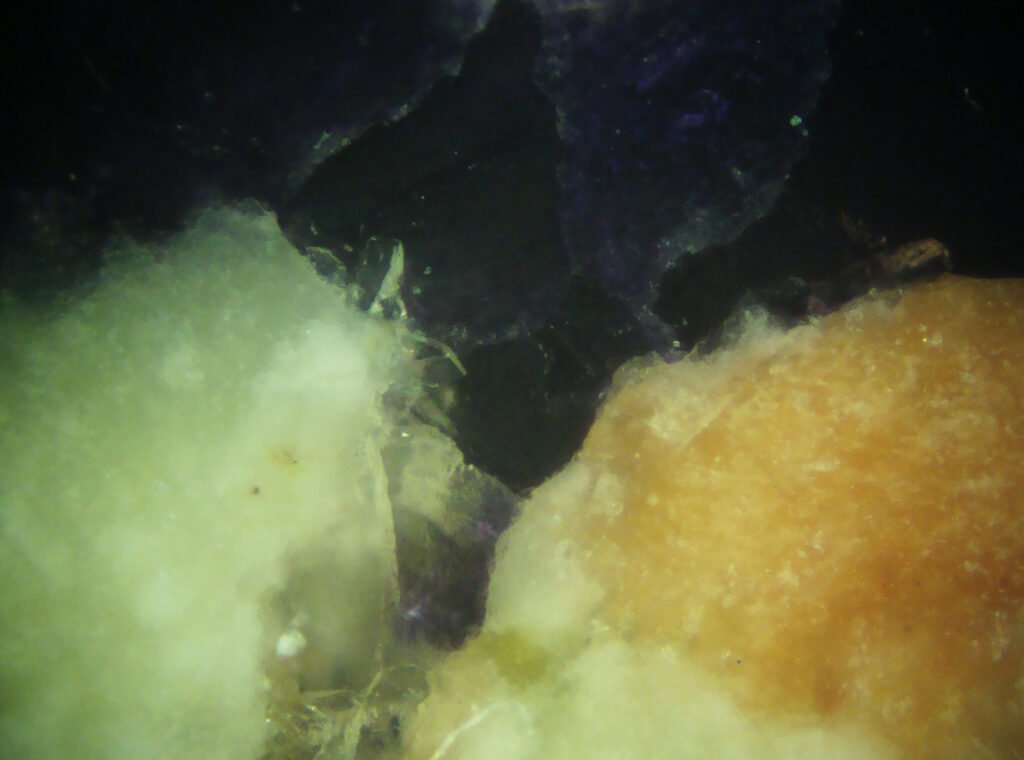
Color: Colorless to white. May have green, gray, yellow and pink tones.
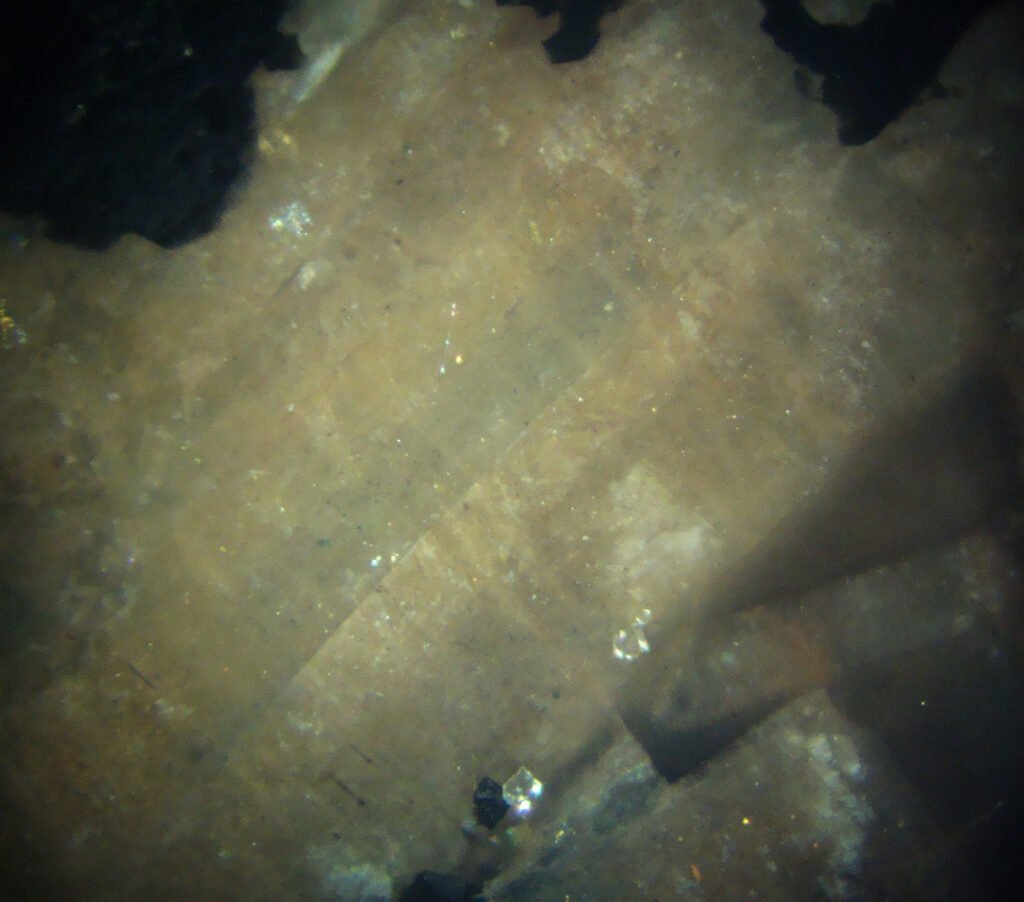
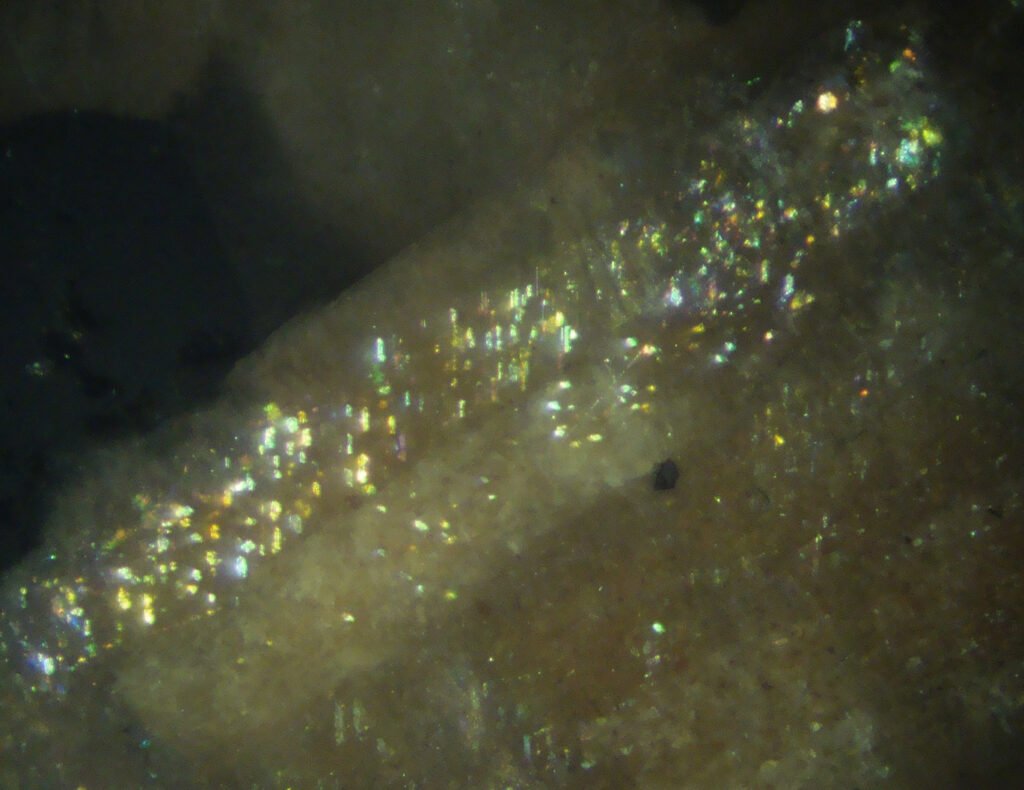
Habit: Short tabular to prismatic crystals. Granular, massive, cleavable masses.
Cleavage: {001} perfect, {010} good.
Tenacity: Brittle.
Twinning: Common: Carlsbad, Baveno and Manebach laws.
Fracture: Irregular to conchoidal.
Mohs Hardness: 6
Parting: {100}, {110}, {-110} and {-201}
Streak: White.
Lustre: Vitreous, greasy.
Diaphaneity: Transparent.
Density (g/cm³): 2.55 – 2.63
2. Geology and Deposits
Orthoclase is a very common, medium-temperature alkaline feldspar that predominates in igneous rocks. It is frequent in silicic igneous rocks such as granites in general, granodiorites, diorites and syenites, particularly from shallow intrusions. It is also found in greisen, lamprophyres and ultra-potassic rocks. The high-temperature alkali feldspar – sanidine – is most common in volcanic rocks. The lowest temperature alkali feldspar – microcline – is more abundant in deep plutonic rocks.
Orthoclase can also be found in sedimentary rocks such as immature sandstones (arkoses, graywackes), as detrital grains. In other sedimentary rocks it can occur as an autogenic mineral.
In metamorphic rocks orthoclase occurr in some rocks of high-grade regional metamorphism and in rocks of contact metamorphism.
Potassic hydrothermal alteration can generate orthoclase.
3. Mineral Associations
Orthoclase is associated with minerals that commonly constitute granitoid rocks, such as quartz, plagioclase, micas (biotite, muscovite, chlorite), amphiboles (hornblendes) and pyroxenes (clinopyroxenes and orthopyroxenes), as well as accessory minerals such as epidote, zircon, apatite and titanite.
In granitic pegmatites it is associated with the typical minerals of this paragenesis, such as fluorite, beryl (aquamarine), garnet (spessartite), tourmaline and many others. It also occurs with aegirine.
4. Transmitted Light Microscopy
Refraction indices: nα: 1.518 – 1.520 nβ: 1.522 – 1.524 nγ: 1.522 – 1.525
PLANE POLARIZED LIGHT – PPL
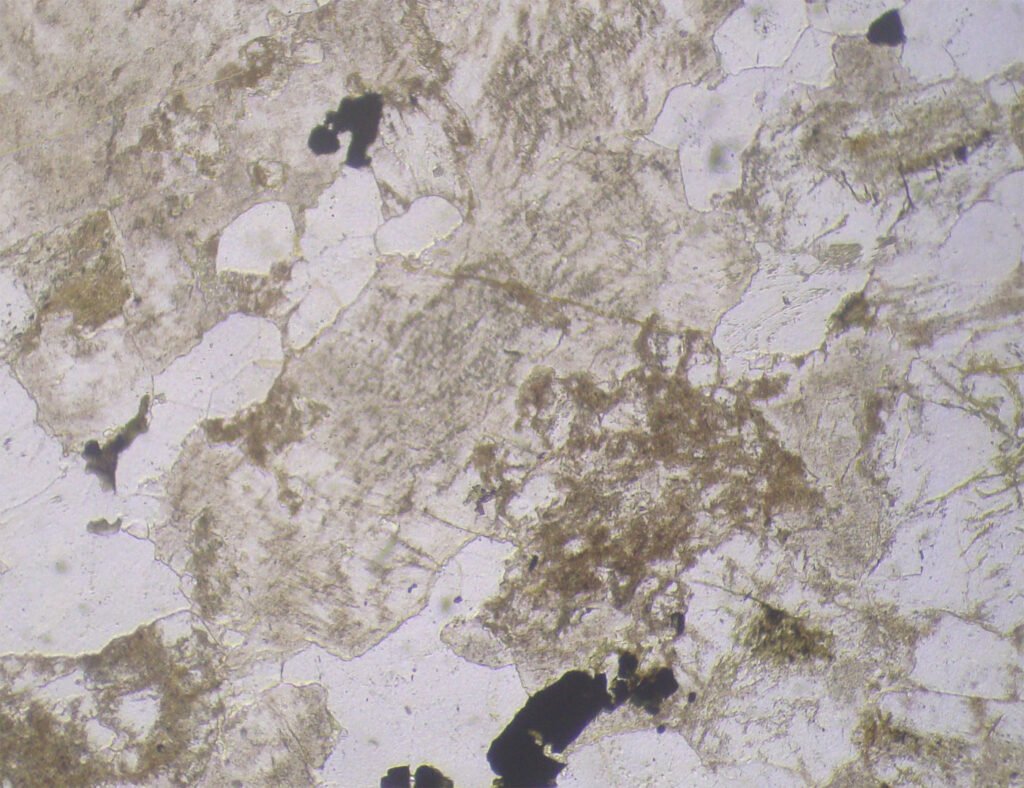
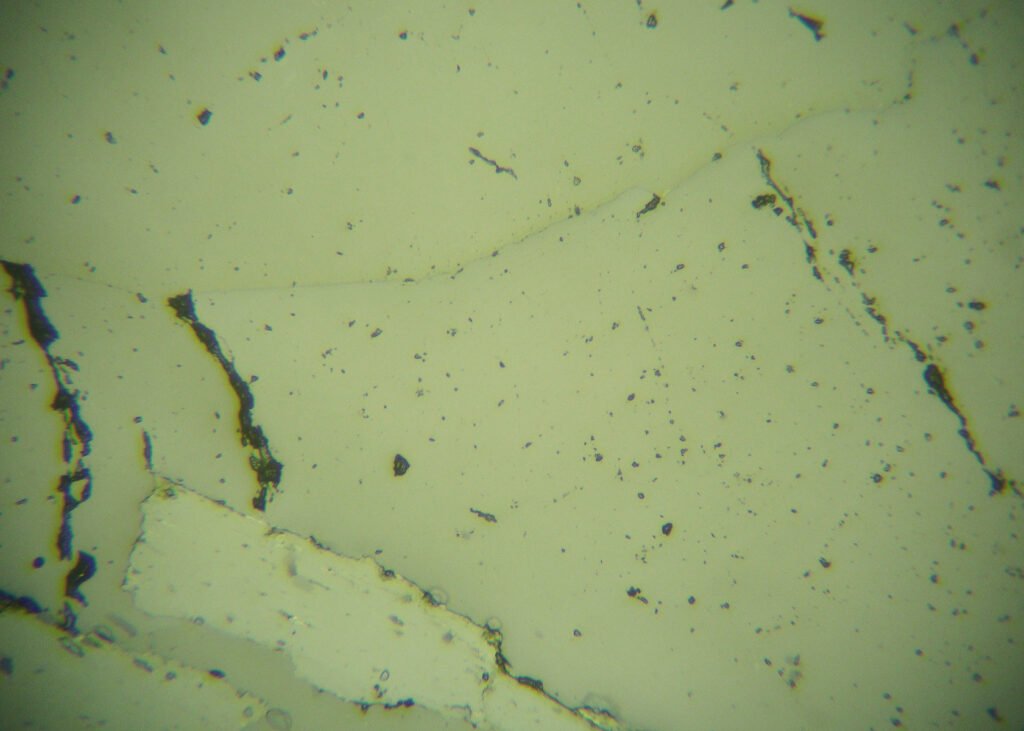
Color / Pleochroism: If unaltered it is completely colorless.
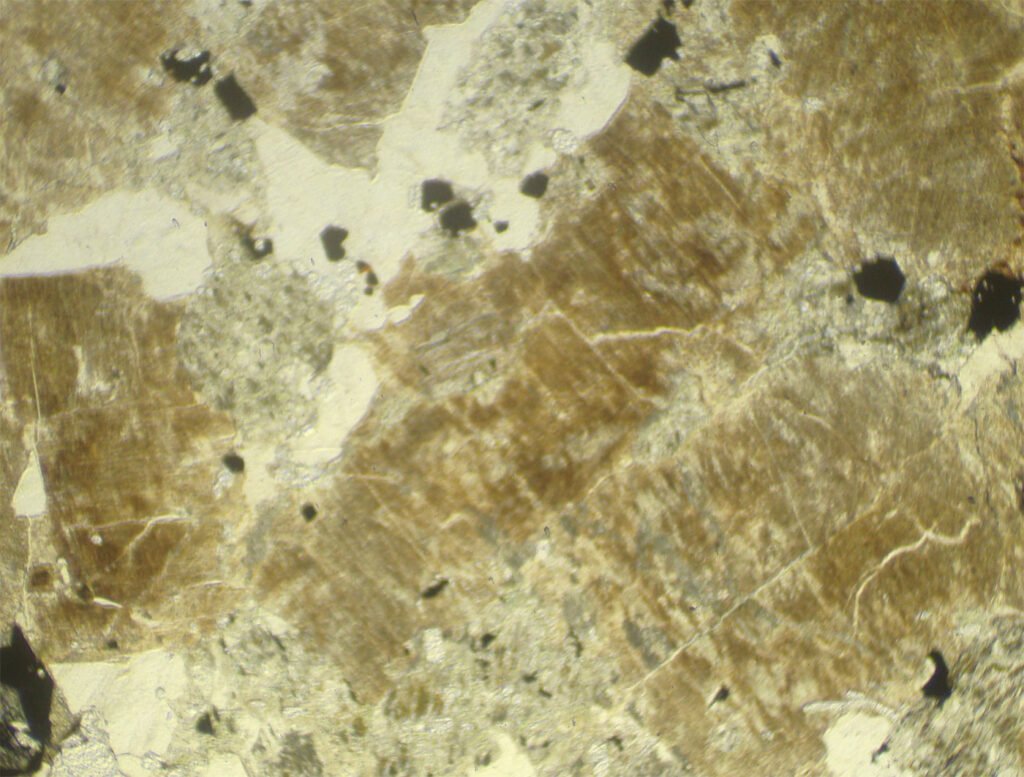
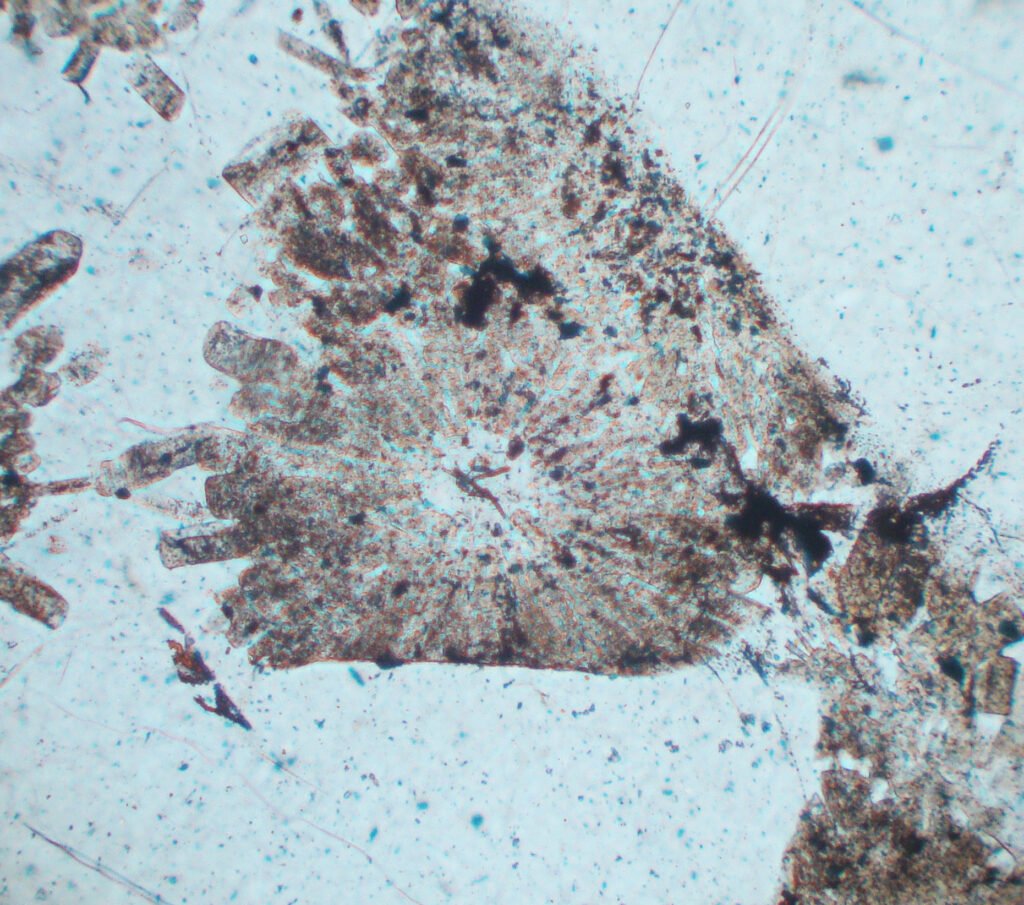
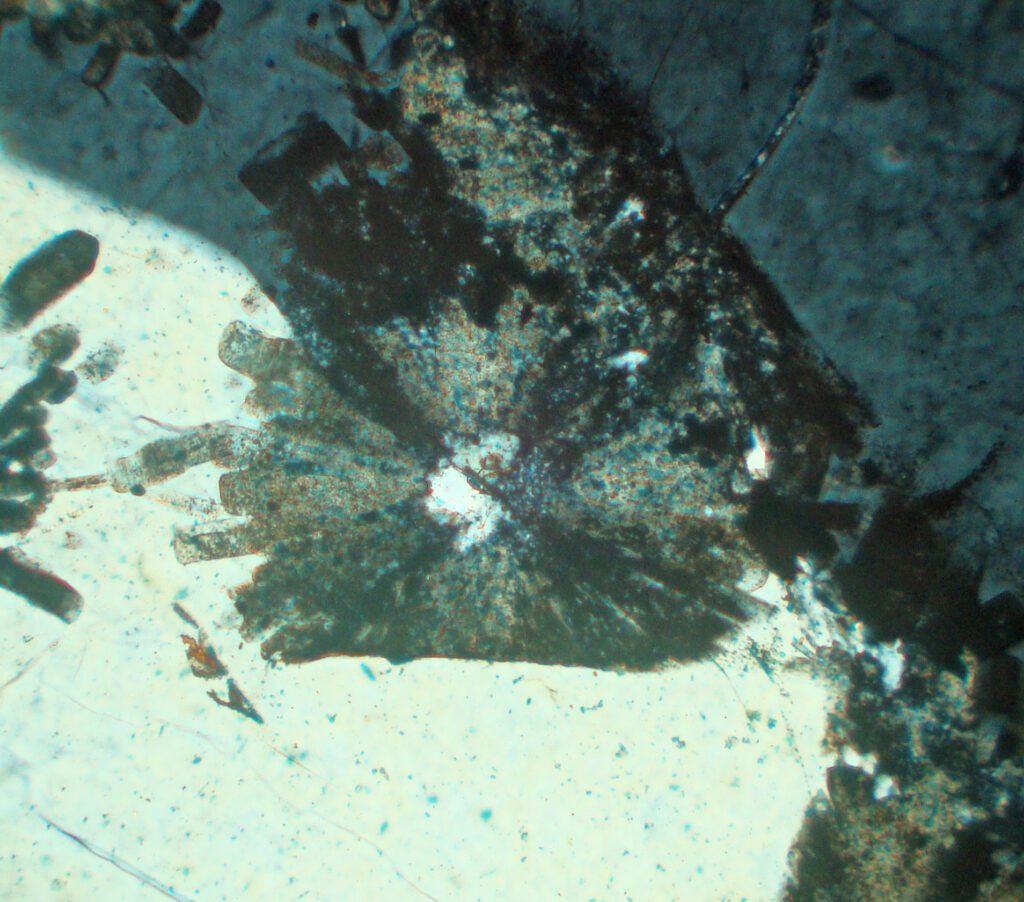
Very commonly it is altered, appearing “misty”, grayish, pale brown or brown due to alteration to clay minerals (kaolinite) and/or sericite (very fine-grained alteration muscovite).
May contain very fine inclusions of Fe oxides (goethite, hematite) that make it reddish in color.
Relief: Low, as quartz and plagioclase.
Cleavage:
{001} perfect and {010} good that cross at 90°, who are generally not visible on a thin section due to the very low relief. In the most central portion of the grain, the cleavage may be somewhat more visible.
Problems with the glue (epoxi, UV-glue) used in making thin sections can turn the cleavages visible, especially at the edges of the thin sections.
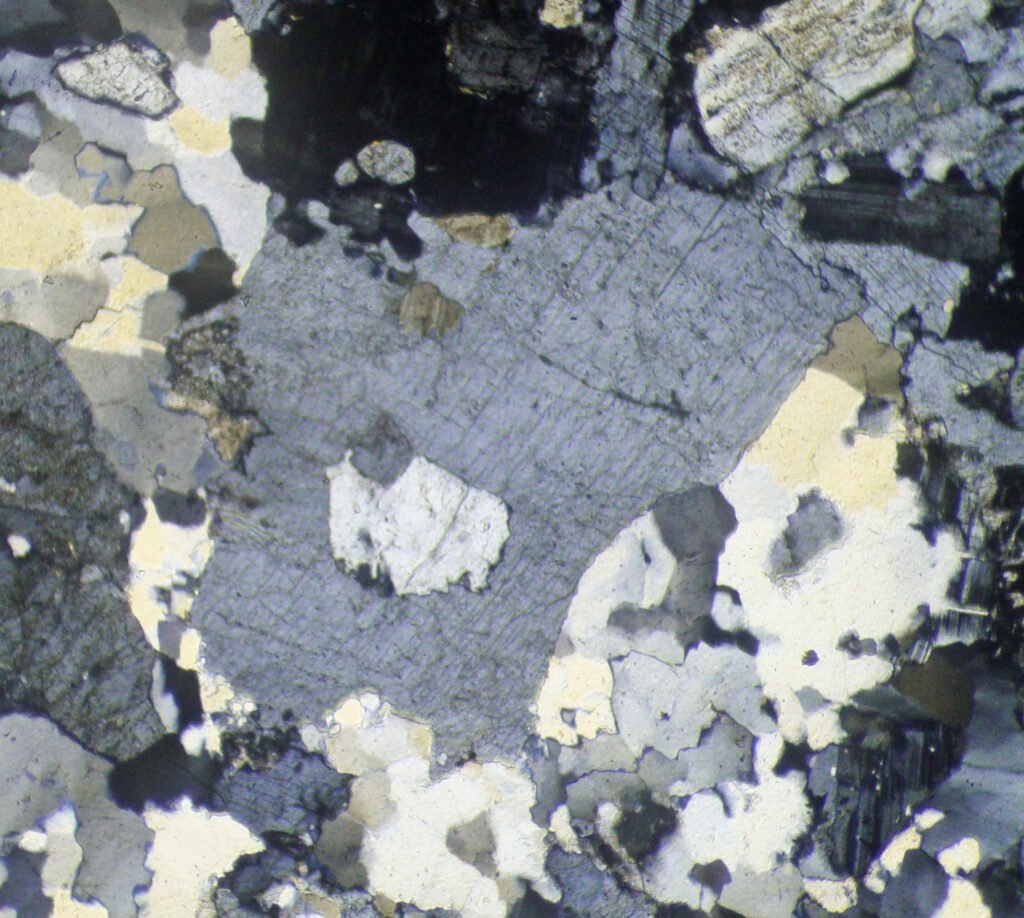
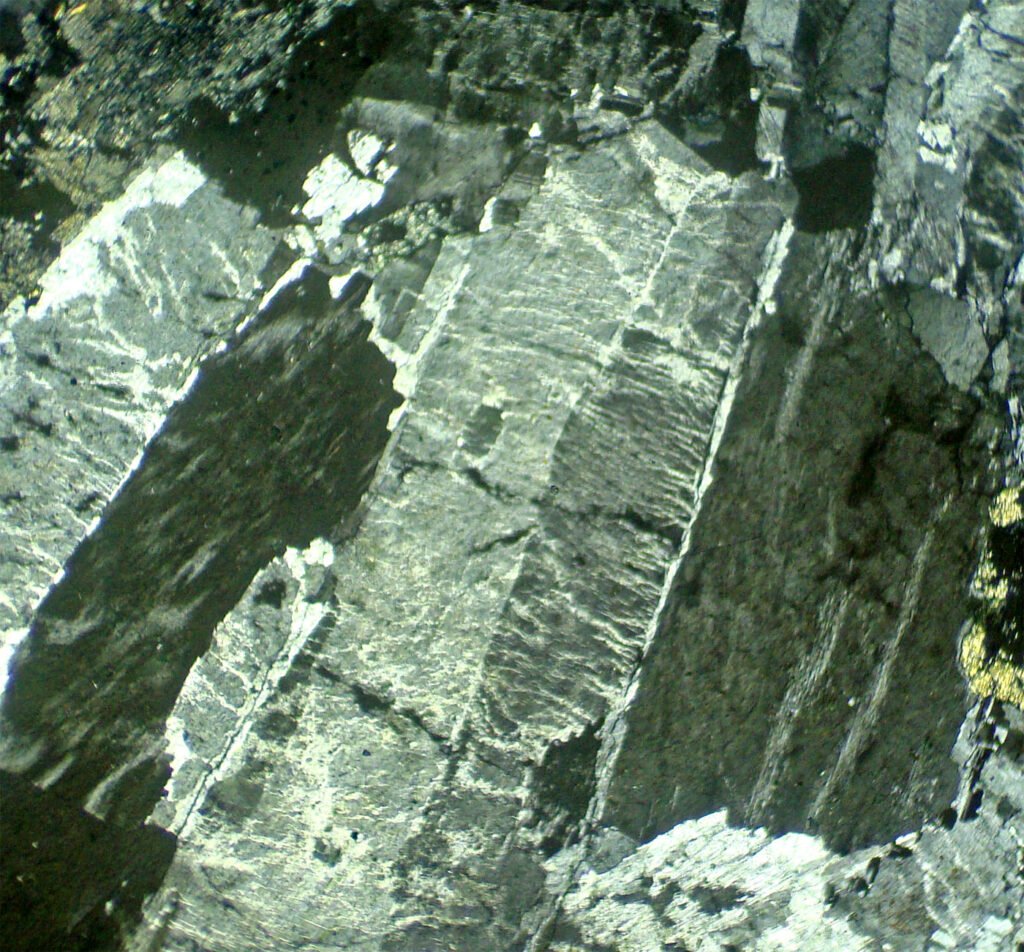
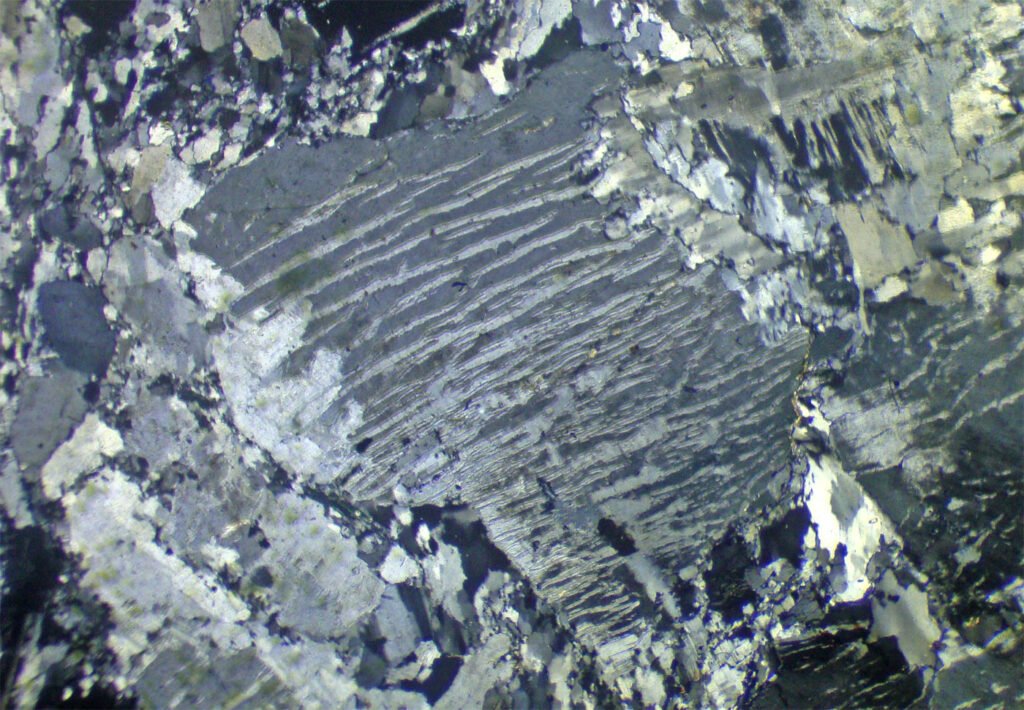
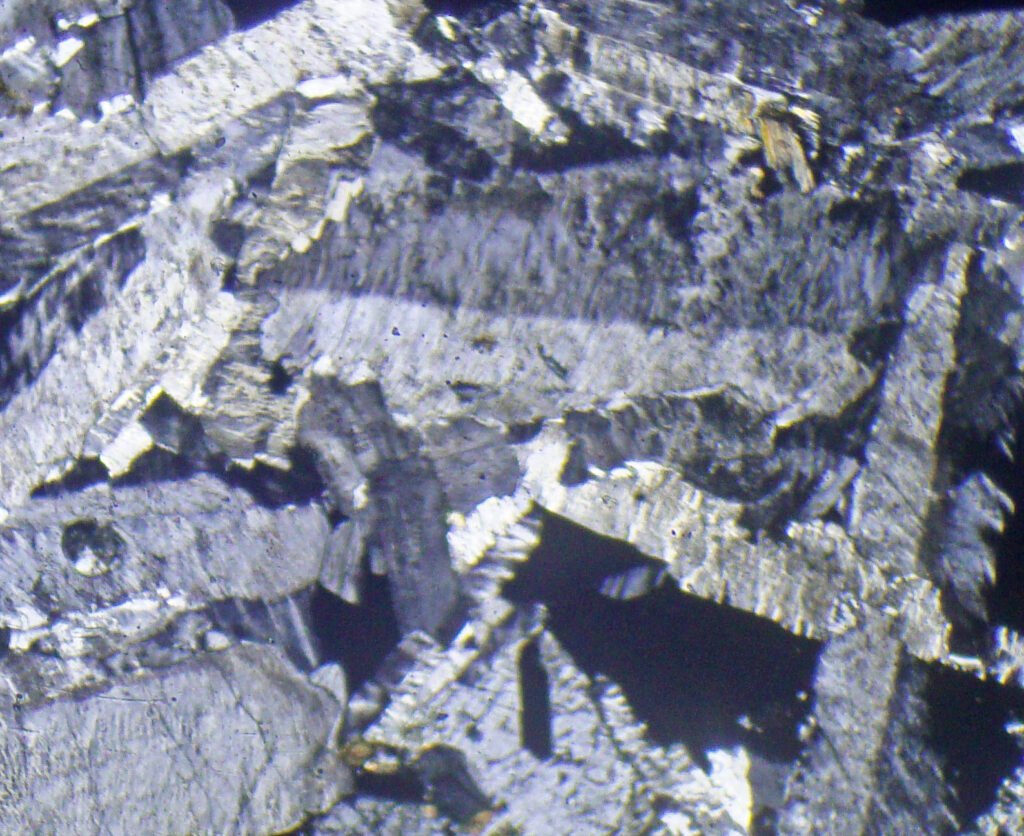
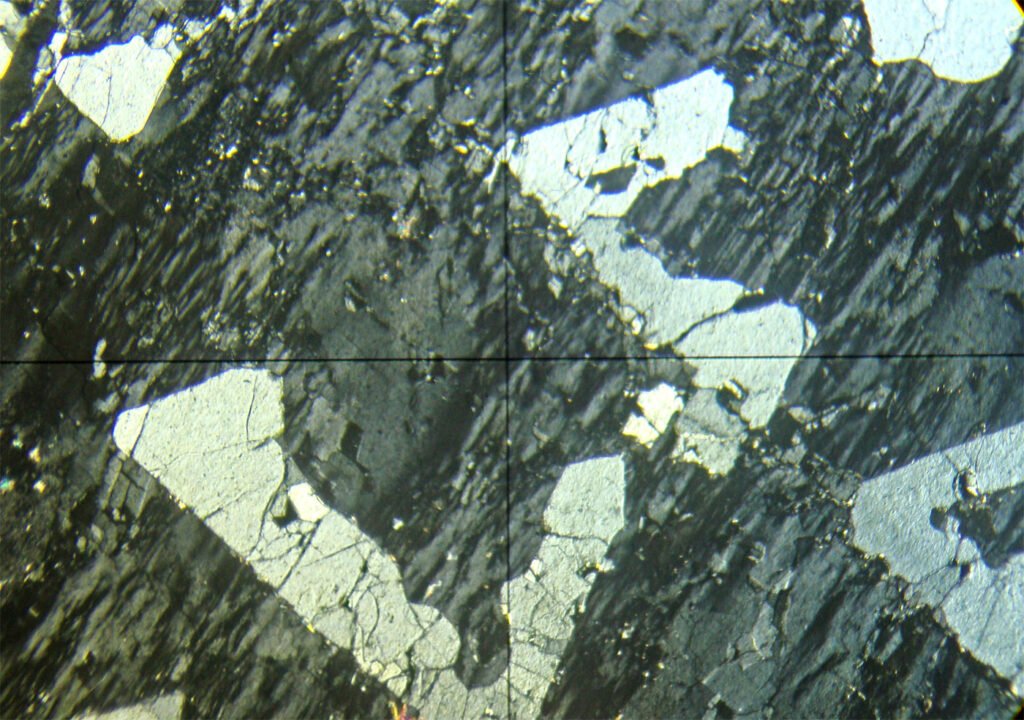
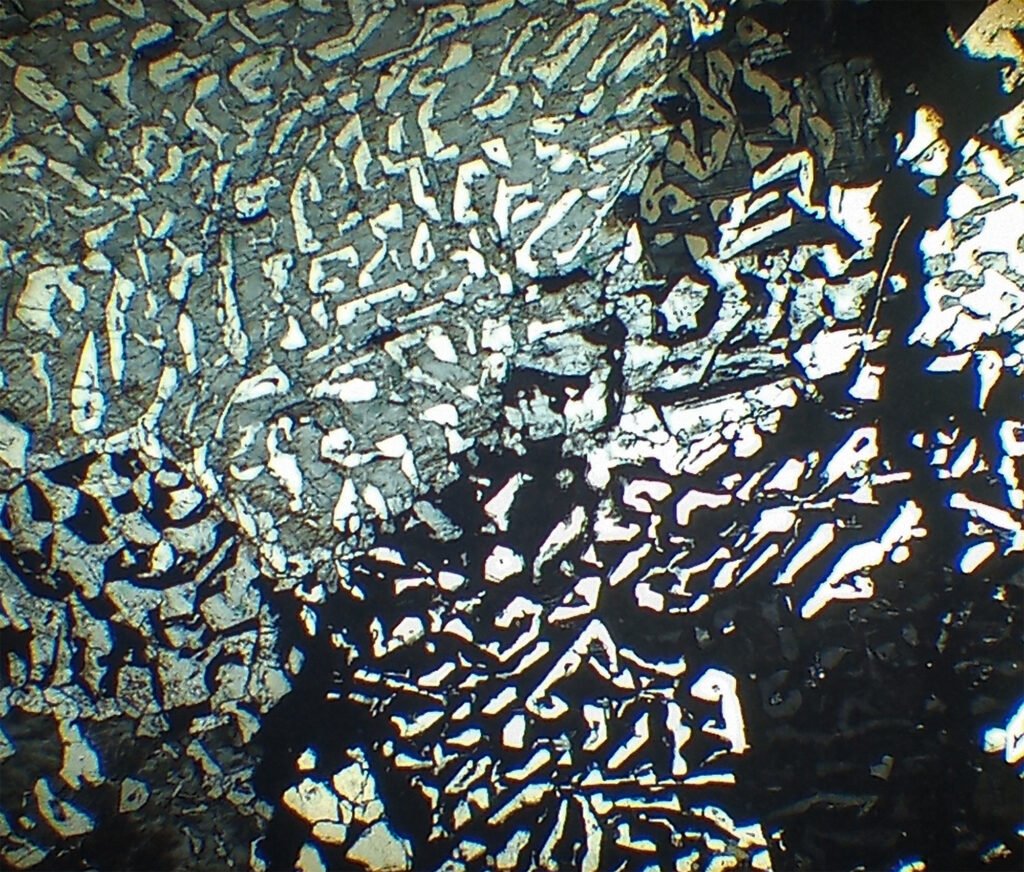
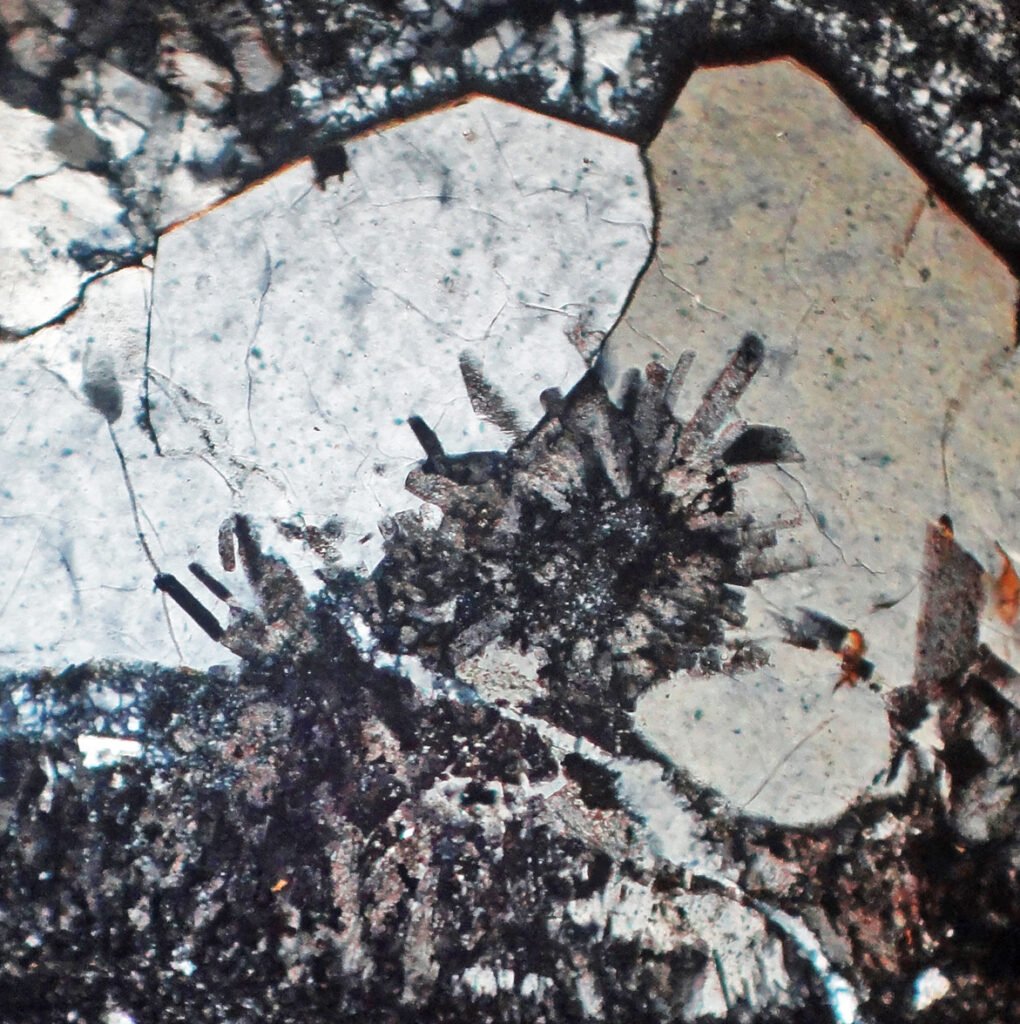
Habits: Xenomorphic (anhedral) or, less frequent, idiomorphic (euhedral) tabular (rectangular) grains. Very often perthites (plagioclase exsolutions) are present. Inclusions also are very common. Therefore, a grain of orthoclase can present, at the same time, a Carlsbad twin, perthites, inclusions and alteration to clay minerals and sericite.
CROSSED POLARIZED LIGHT – XPL
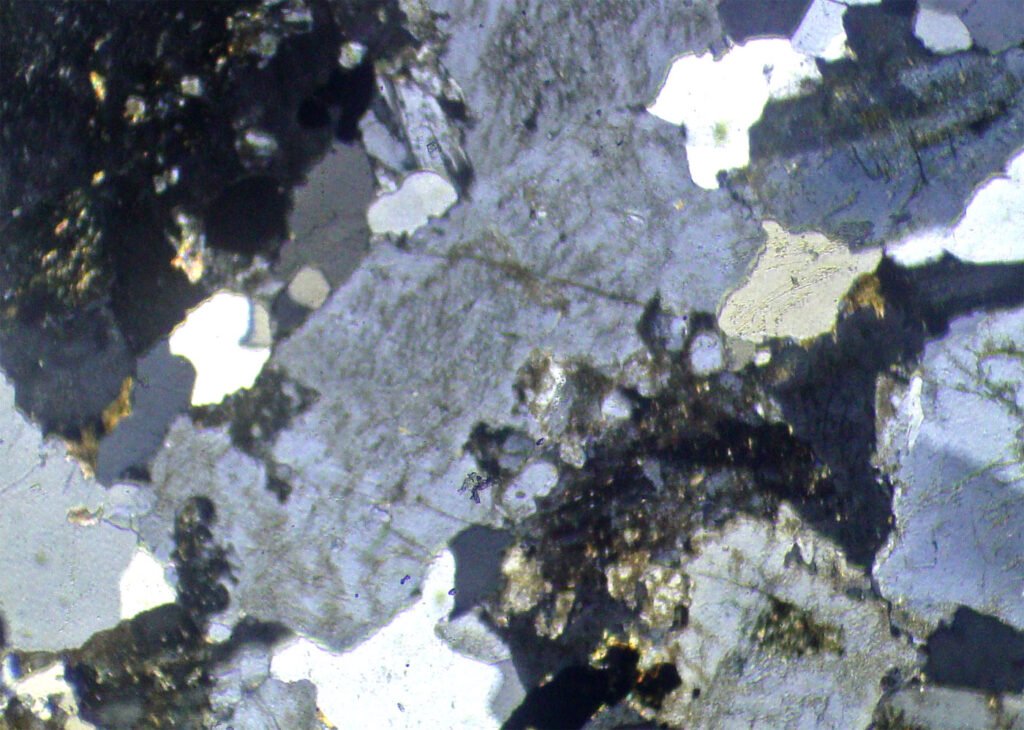
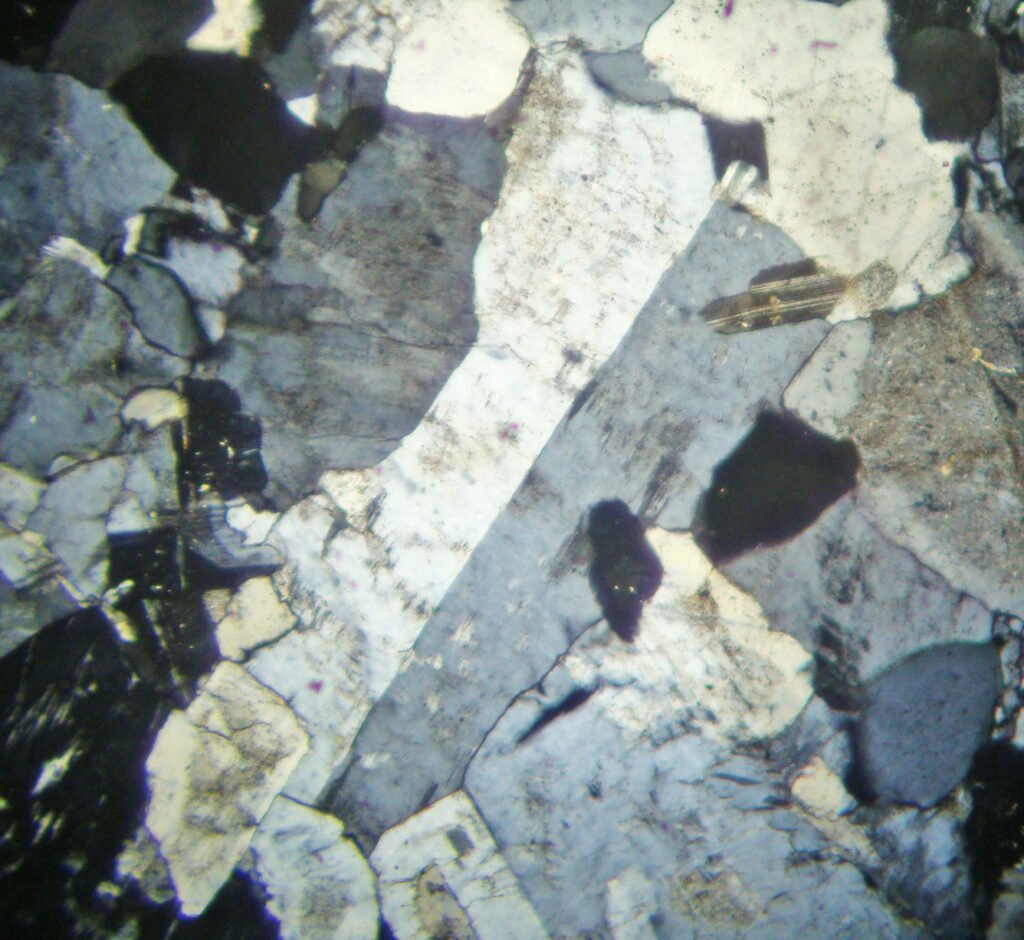
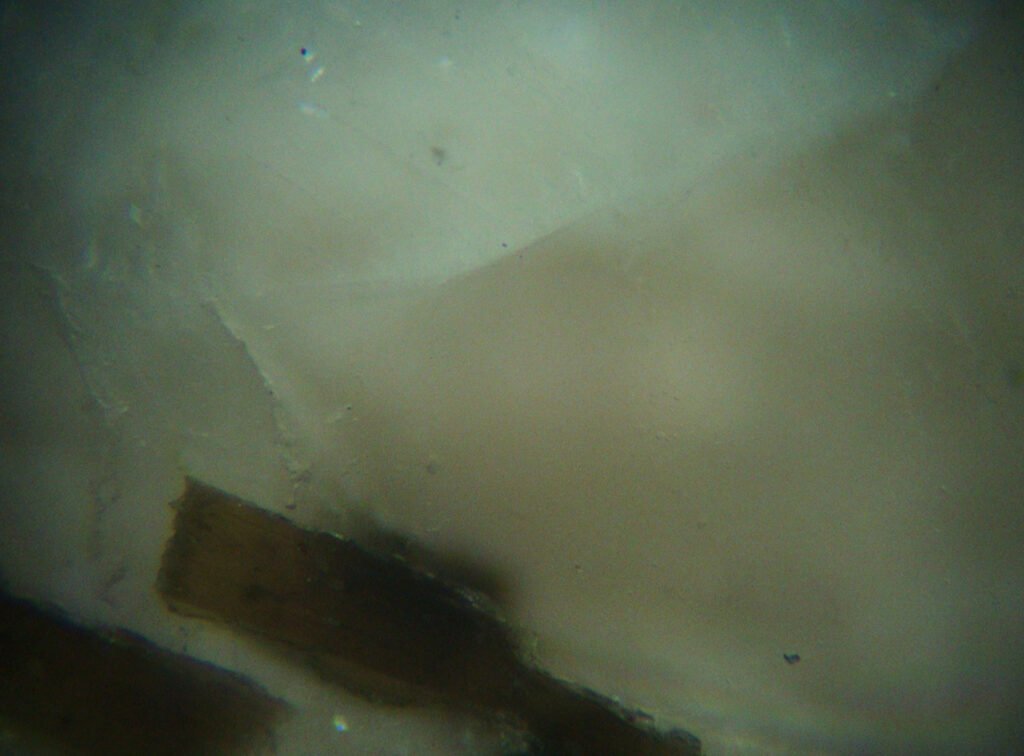
Birefringence and Interference Colors: Birefringence from 0.005 to 0.007 – 1st order medium interference colors: gray in various shades and white.
Extinction: Parallel in (010) sections, oblique (5 – 19o) in (001) sections.
Elongation sign: Does not apply as orthoclase may be elongated in several directions.
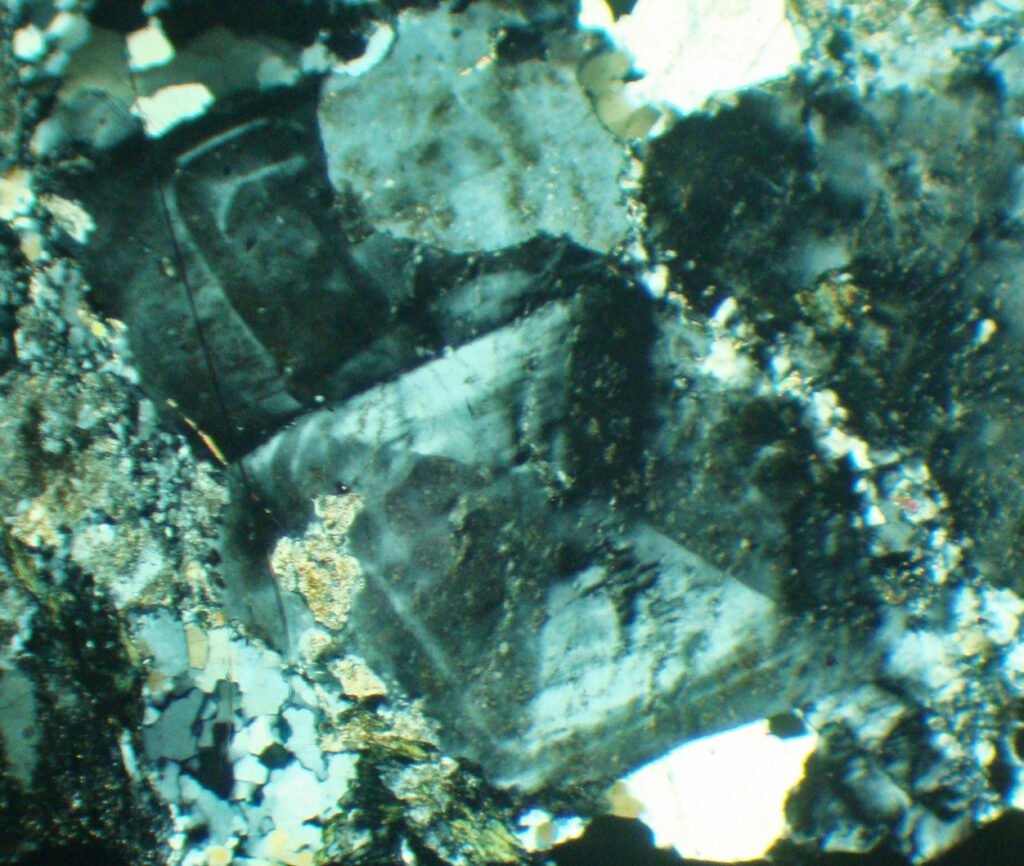
Twins: Very frequent. It is usually the Carlsbad twin: a line (the twin plane) divides the grain into two portions, each one with its own interference color. Baveno, Manebach and Albite-Pericline twins may occur.
It never shows polysynthetic twins like plagioclase!
Zoning: Sometimes zoned, specially in volcanic rocks.
CONVERGENT LIGHT
Character: B(-)
2V angle: >80o
Alterations: very common, it is almost always altered. The fact that it is altered is important to easily differentiate it from quartz, which is never altered!
Argilization (or kaolinization): when it is changed to clay minerals (beige to brown colors to ND)
Sericitization: when it is altered to sericite (alteration muscovite mica = small luminous dots in CPL).
The alteration can be generalized or ocurr only in the center of the crystal or only along the edges.
May be confused with: other colorless minerals with low relief, without cleavage and low birrefringence.
Diagnostic are the facts of being colorless, the absence of cleavage, the low relief in PPL, the gray interference colors, some alteration, frequently perthites and Carlsbad twins.
Sanidine is very similar, but has a smaller 2V angle and usually occurs in volcanic rocks.
Quartz can be very similar, but it is never altered and is U(+).
Nepheline is similar, but occurs in other paragenesis and is U(-).