5. Reflected Light Microscopy
Sample preparation: Pentlandite polishes easily when unaltered; it is more difficult if it is highly altered to bravoite ((Fe,Ni)S2) or violarite (FeNi2S4) and when it contains marcasite grains (FeS2). Its hardness upon polishing is medium; greater than the hardness of chalcopyrite, slightly less than the hardness of pyrrhotite, and much less than the hardness of magnetite. Cobalt content increases hardness, while Ag content decreases hardness.
PLANE POLARIZED LIGHT – PPL
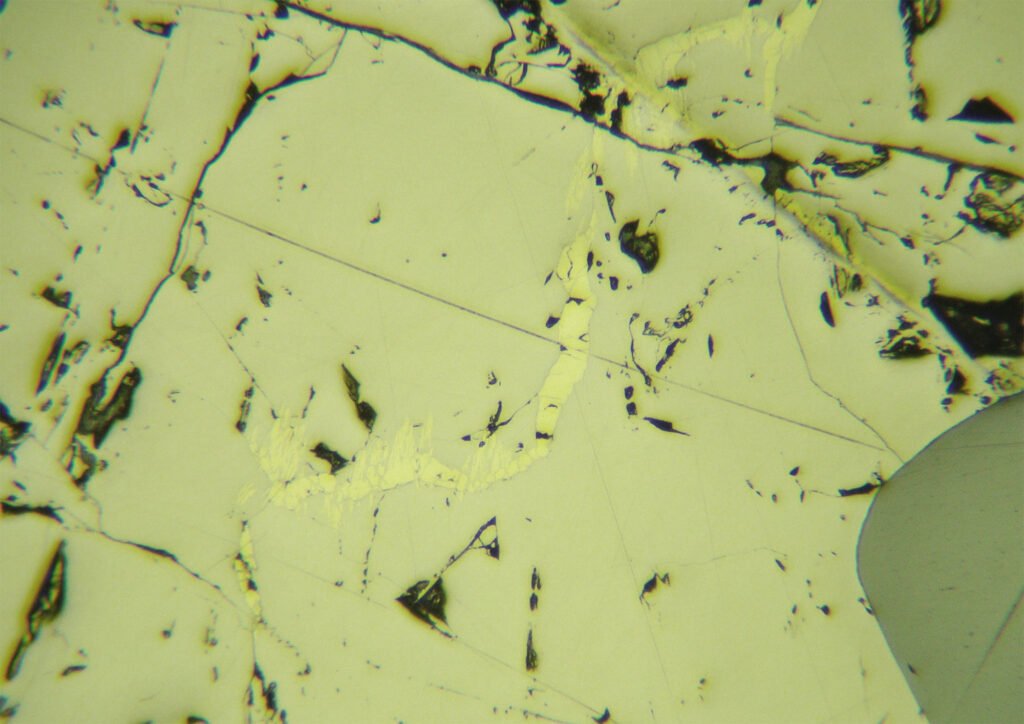
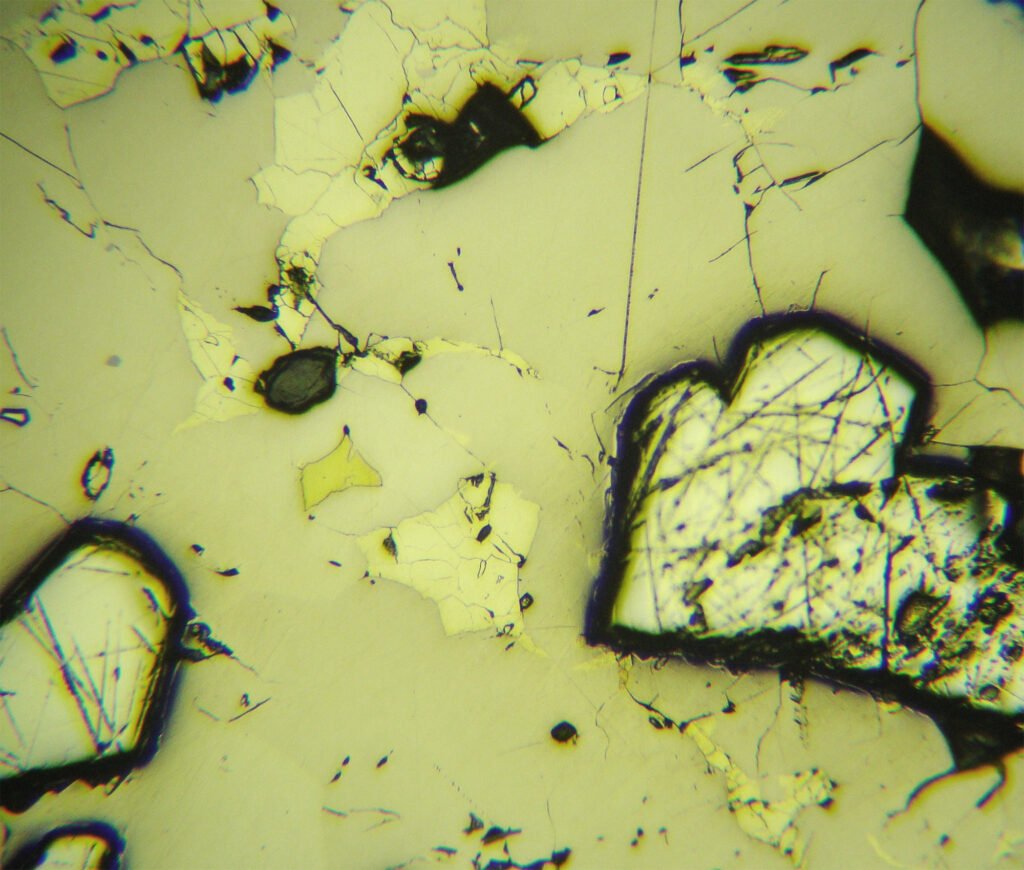
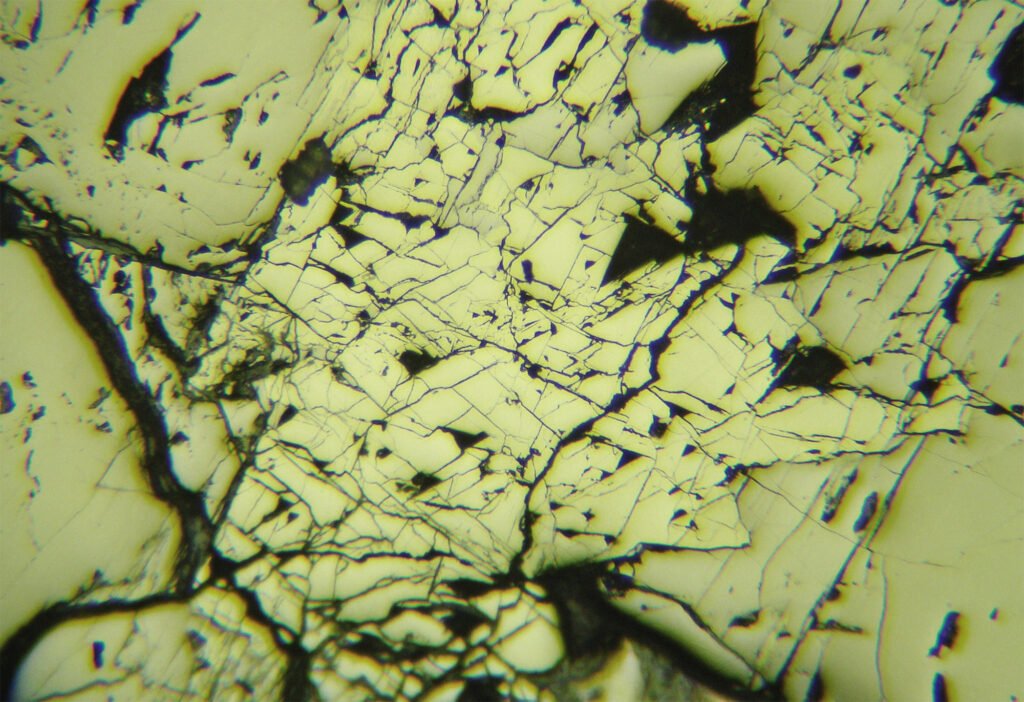
Reflection color: Cream to creamy-yellow with a brownish tint, but without pink tones.
Some pentlandites exhibit distinctly darker colors and, with high magnification, are found to be completely transformed into bravoite or violarite.
Compared to the color of pyrrhotite, the color of pentlandite is much lighter and much less brown.
Compared to the color of magnetite, the color of pentlandite is less brownish-pink.
Compared to the color of linnaeite, the color of pentlandite is darker and without the pinkish hue.
Cobaltopentlandite shows a slightly darker color than pentlandite.
Argentopentlandite is fox-red.
Pleochroism: No.
Reflectivity: 51,64%. With Rh: 48,55%
Bireflectance: No.
CROSSED POLARIZED LIGHT – XPL
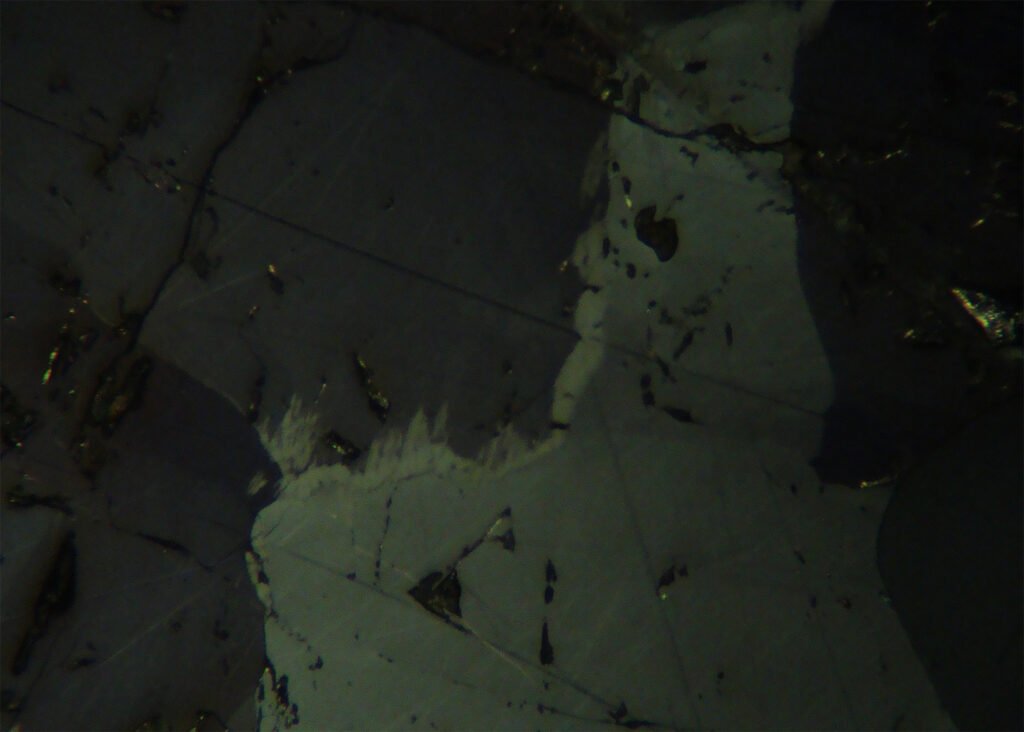
Isotropy / Anisotropy: Isotropic, but under Crossed Nicols, complete isotropy is never achieved.
Internal reflections: No.
May be confused with: the extremely characteristic association with chalcopyrite, pyrrhotite, and magnetite practically excludes confusion.
Pyrrhotite is similar, but pentlandite is isotropic.
Pyrite and magnetite are also part of this paragenesis.
General Characteristics:
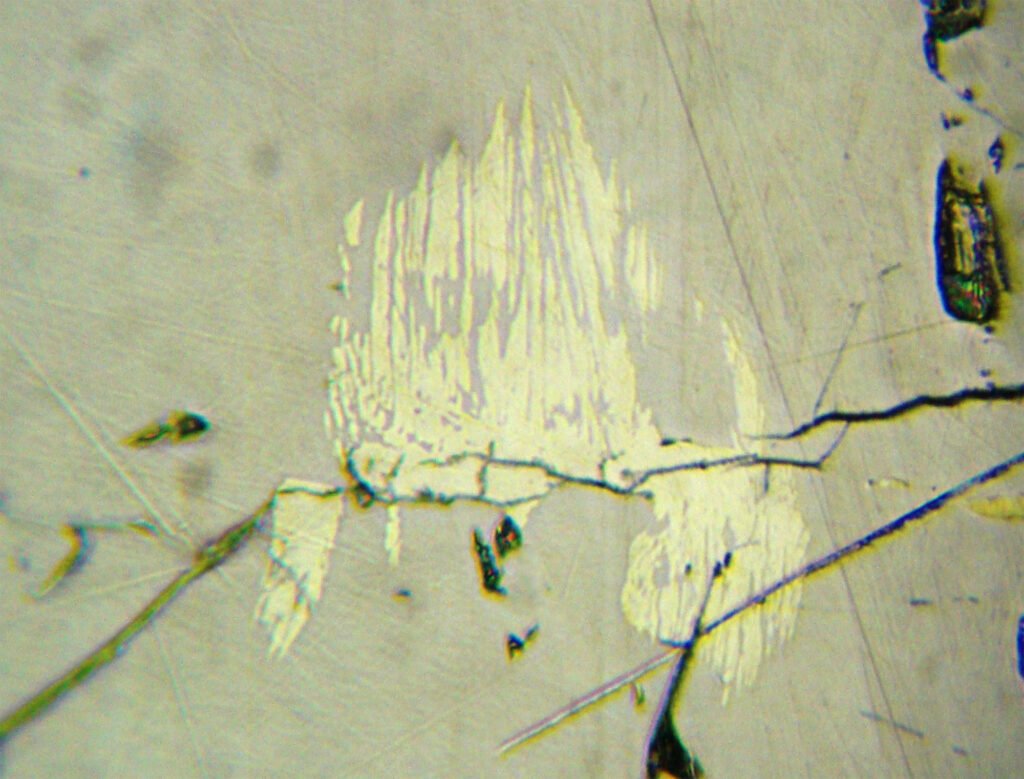
Grain shape: In the vast majority of cases, pentlandite occurs xenomorphically, associated with pyrrhotite, forming cords, “flames,” bands, and fillings of intergranular spaces between rounded subhedral pyrrhotite grains, which is very characteristic. In isolated cases, pentlandite forms rounded grains with indications of octahedral shapes, often of appreciable sizes, even the size of a fist. Normally, the pentlandite grain or aggregate is much smaller, only 2 mm or less. The pyrrhotite grains that occur in association are even smaller, but are never extremely fine. In aggregates, the grains are rounded and have no serrated boundaries.
Exsolutions in the form of “flames” in pyrrhotite are an important characteristic.
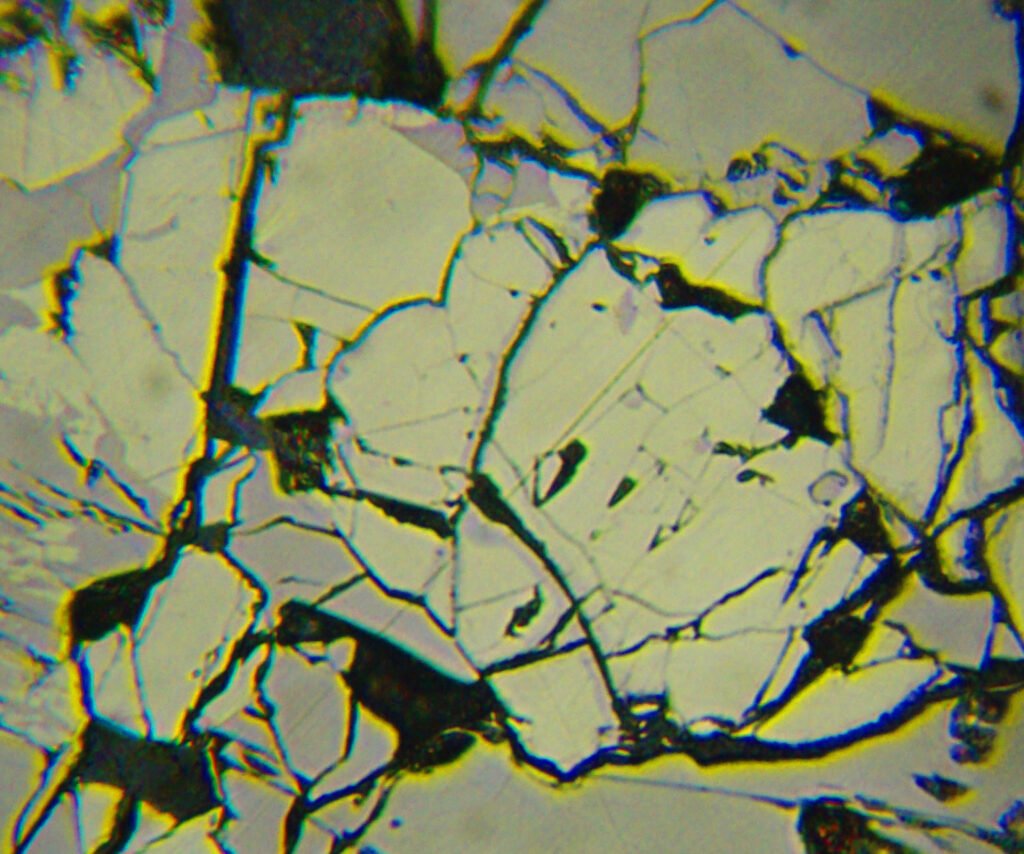
Octahedral (111) parting is usually visible in the polished section (3 directions forming equilateral triangles), often in excellent form, including the formation of triangular polishing pits, mainly in larger grains. The parting can become more pronounced, more prominent, due to the formation of violarite (ND: creamy violet, NC: isotropic) or bravoite (ND: creamy-brown violet, NC: isotropic) along its edges. Violarite can also appear along fractures and polishing pits.
Twins according to (111) are seen macroscopically, but are not observable in the polished section.
Zoning is not observed.
Deformations due to cataclasis may occur, with chalcopyrite infiltrating through the fractures.
Unmixings are normally absent. In some high-temperature pentlandites, a large quantity of pyrrhotite unmixing bodies occurs. These bodies are small, have the negative octahedral shape, and consist of an aggregate of small plates parallel to (0001), in four orientations parallel to the (111) partition of the pentlandite. These bodies alter more rapidly than pentlandite and frequently form pyrite or marcasite, implying a low-quality polish. Mackinawite occurs as a well-developed and regular unmixing, and it is possible that there is more mackinawite than pentlandite in the sample. Pentlandite occurs as a unmixing very frequently in pyrrhotite: these are flame- or brush-shaped demixtures, inserted parallel to (0001) of the pyrrhotite and penetrating the pyrrhotite from fractures and intergranular boundaries. Pentlandites from these unmixings in pyrrhotite have somewhat different colors from the colors of isolated pentlandites. Linnaeite can present the same unmixing form.
Exsolutions of pentlandite in chalcopyrite and cubanite can occur.
Substitutions are quite rare; sometimes pentlandite apparently replaces pyrrhotite, or chalcopyrite replaces pentlandite. When chalcopyrite replaces pyrrhotite with flames of pentlandite, the flames are preserved longer than pyrrhotite.
Alteration is common, with bravoite or violarite being the first stage of alteration, progressing from intergranular boundaries, fractures, and parting planes. Initially, thin strands of uniform thickness of bravoite form parallel to the parting planes; slowly the entire grain is transformed into bravoite. The parting of pentlandite remains clearly visible, although the bravoite probably forms a very fine-grained aggregate. The “flames” of pentlandite in pyrrhotite are also transformed into bravoite and become very difficult to recognize, since the color of pyrrhotite and bravoite are very similar. Pentlandite flames can alter before isolated grains, sometimes the reverse occurs. As bravoite formation involves shrinkage, very small pyrite or marcasite grains are generated. Rarely, there is a network of very fine linnaeite platelets as an alteration within the pentlandite. Pentlandite can also alter to goethite.
Oriented intergrowths of pentlandite with chalcopyrite and pyrrhotite were observed in some cases. The intergrowths with pyrrhotite are such that (0001) and (10-10) of pyrrhotite coincide with (111) or (110) of pentlandite. The pentlandite flames show, in sections parallel to (0001), symmetrical star shapes with 3 or 6 rays. The chalcopyrite intergrowths in pentlandite form a network. Oriented intergrowths and isolated grains of argentopentlandite occur in normal pentlandite.
Inclusions IN pentlandite occur from pyrrhotite, mackinawite, pyrite and marcasite, always very small.
Inclusions OF pentlandite occur in magnetite.
Substitutions 1: pentlandite replaces pyrrhotite and niqueline.
Substitutions 2: pentlandite can be replaced by chalcopyrite, cubanite, pyrrhotite, magnetite, millerite, violarite, heazlewoodite, and mackinawite.
Intergrowths can occur with pyrrhotite (pentlandite forming a lamellar network), awaruite, heazlewoodite, cubanite, chalcopyrite, and mackinawite.