1. Characteristics
Crystal system: Monoclinic prismatic.
Color: Purple to reddish-violet, dark blue, pink, brownish-yellow, moss green, colorless.
Habit: Short prismatic, tabular. Botryoidal, reniform; crusts with a radial fibrous structure.
Cleavage: {010} good, {001} poor.
Tenacity: Brittle.
Twinning: interpenetration twins, on {101}.
Fracture: Irregular.
Mohs Hardness: 3.5 – 4
Parting: No.
Streak: No information available.
Lustre: Vitreous, resinous.
Diaphaneity: Transparent.
Density (g/cm³): 2.74 – 2.76
2. Geology and Deposits
Phosphosiderite is a phosphate formed by the alteration of triphylite (LiFe2+PO4), a mineral characteristic of complex, zoned granitic pegmatites.
It can be a component of soils. It replaces bones and shells.
3. Mineral Associations
It occurs with other rare and very rare phosphates: triplite, barbosalite, strunzite, strengite, rockbridgeite, laueite, bermanite, stewartite, hureaulite, leucophosphite, turquoise, and benyacarite.
4. Transmitted Light Microscopy
Refraction indices: nα: 1.692 nβ: 1.725 nγ: 1.738
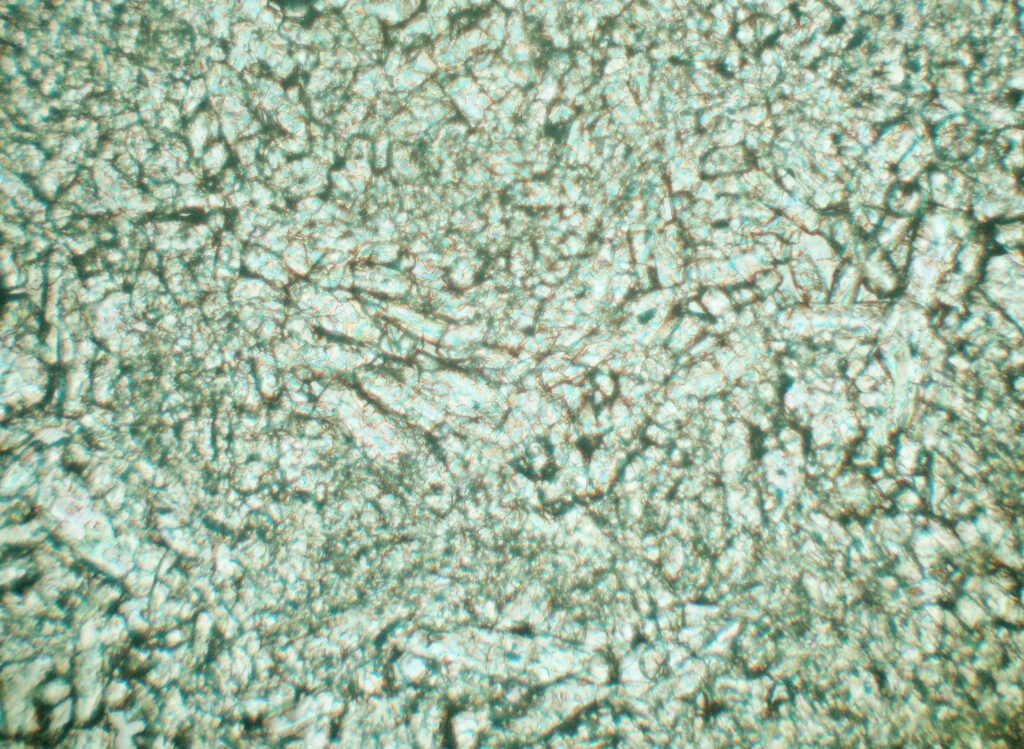
PLANE POLARIZED LIGHT – PPL
Color / Pleochroism: Colorless; may exhibit pleochroism ranging from light pink and red to colorless.
Relief: High.
Cleavage: {010} good, {001} poor. In small crystals, it is not visible.
Habits: Short prismatic.
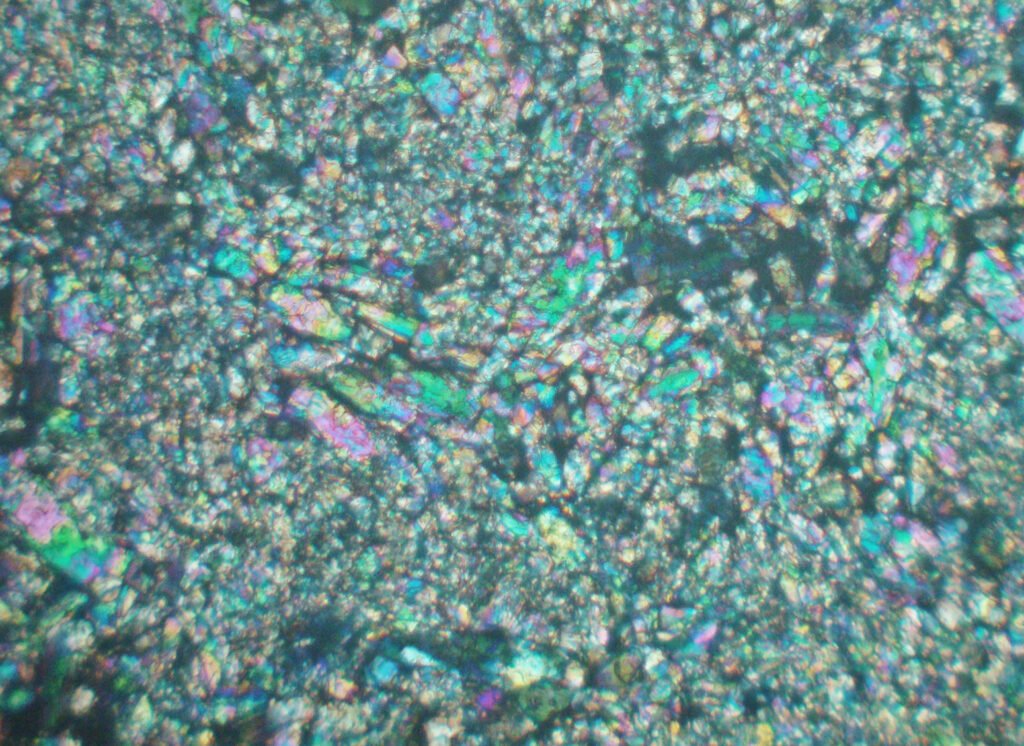
CROSSED POLARIZED LIGHT – XPL
Birefringence and Interference Colors: Maximum birefringence of 0.046 – very high – corresponding to strong colors up to the middle of the 3rd order.
Extinction: Low-angle oblique.
Elongation sign: No information available.
Twins: No information available.
Zoning: No information available.
CONVERGENT LIGHT
Character: B(-)
2V angle: 62º
Alterations: Phosphosiderite is a product of the alteration of triphylite.
May be confused with: Given its paragenesis and highly conspicuous macro-scale colors, it could easily be mistaken for some of the other rare phosphates with which it is associated.