
PIGEONITE
Pigeonite – (Mg,Fe2+,Ca)(Mg, Fe2+)[Si2O6] – is a relatively rare inosilicate that is difficult to identify. It is not an ore mineral.
It is classified within the Pyroxene Supergroup, specifically the Clinopyroxene Subgroup. It may contain Na, Mn, K, H₂O, Ti, and Al. An Fe-rich variety exists. The terms “intermediate pigeonite” (at least 35% Mg and 35% Fe) and “magnesian pigeonite” (<35% Fe) are now considered obsolete.
Pigeonite cannot be identified macroscopically, and even microscopic identification is challenging. Some authors even state that distinguishing between augite, pigeonite, and diopside under the microscope is only possible through the use of a universal stage.
1. Characteristics
Crystal system: Monoclinic prismatic.
Color: Black, brown, greenish-brown.
Habit: Prismatic up to 1 cm; may be granular or massive.
Cleavage: {110} good, like all pyroxenes.
Tenacity: Brittle.
Twinning: Twinning is common – whether simple or multiple – occurring on {100} or {001}.
Fracture: Irregular.
Mohs Hardness: 6
Parting: On {100}, {010} and {001}.
Streak: Light gray to dark gray.
Lustre: Vitreous, dull.
Diaphaneity: Transparent.
Density (g/cm³): 3.17 – 3.46
2. Geology and Deposits
Pigeonite is a Ca-poor clinopyroxene formed at high temperatures (>900°C) that is preserved only in rapidly cooled silicic volcanic rocks. Upon slow cooling, pigeonite inverts to a mixture of augite lamellae parallel to {001}, which subsequently invert to orthopyroxene accompanied by further augite exsolution; it is found in this form in layered mafic intrusive bodies.
It is common in tholeiitic mafic to intermediate volcanic and subvolcanic rocks, such as basalts and diabases. It also occurs in dolerites, andesites, dacites, tephrites, basanites, and nephelinites.
It may be found as exsolution lamellae within augite. It occurs as an interstitial mineral between plagioclase laths. It does not occur alongside titanaugite in alkaline basalts.
Pigeonite is also found in metamorphic iron formations, though it generally inverts to orthopyroxene. In granulite-facies metamorphic rocks, it occurs as exsolution lamellae within augite.
It occurs in some meteorites.
3. Mineral Associations
It occurs associated with common rock-forming minerals of basic rocks, such as plagioclase (albite-anorthite), augite, aegirine-augite, olivine, ilmenite, magnetite, hematite, nepheline, sodalite-group minerals, and leucite.
In magnesian marbles, it occurs with calcite, periclase, and brucite.
In meteorites, it occurs with “maskelynite” – a type of volcanic glass with a plagioclase composition – formed by the vitrification of plagioclase through melting within the meteorite or due to meteorite impact.
4. Transmitted Light Microscopy
Refraction indices: nα: 1.683 – 1.732 nβ: 1.684 – 1.732 nγ: 1.704 – 1.757
PLANE POLARIZED LIGHT – PPL
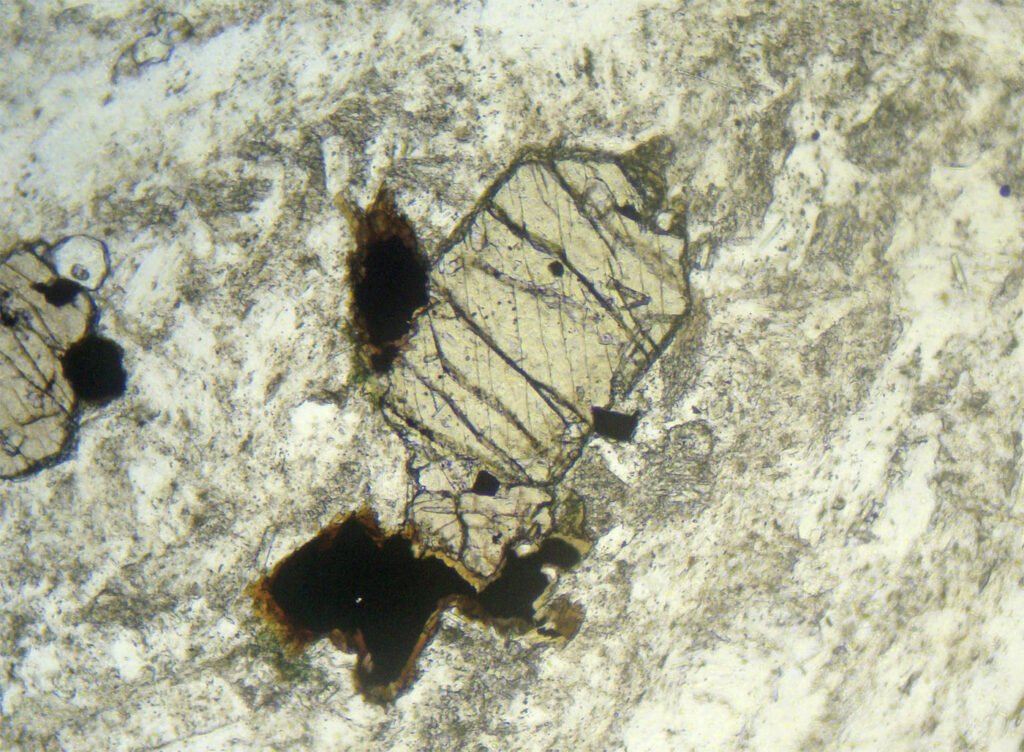
Color / Pleochroism: Colorless, pale yellow green to brownish green. It normally does not present pleochroism, but may be weakly pleochroic in these colors.
Relief: High.
Cleavage: {110} good. In longitudinal sections, there is only one cleavage. In basal sections, two cleavage directions are observed, intersecting at angles of 87º and 93º, as in all pyroxenes.
Habits: Typically anhedral granular, rarely euhedral columnar, with columns longer than the accompanying augites. May form reaction edges around augite or around orthopyroxenes; typically it is a matrix mineral.
Longitudinal sections are usually approximately rectangular.
Basal sections have 4 or 8 sides and show two cleavages that form angles of 87 and 93º with each other.
CROSSED POLARIZED LIGHT – XPL
Birefringence and Interference Colors: Maximum birefringence of 0.021 to 0.029: intense, colorful interference colors up to the middle of the second order, very similar to the colors of other clinopyroxenes.
Extinction: Generally oblique, with angles of 32º to 44º. It may be parallel. Basal sections exhibit symmetrical extinction.
Elongation sign: ES(+).
Twins: Common, simple, and multiple, according to {100} and {001}. Exsolved augite lamellae formed during the cooling of pigeonite can easily be mistaken for twins. A combination of {100} twinning and augite lamellae can produce a “herringbone” pattern.
Zoning: Relatively common, based on colors, extinction angle, birefringence, or refractive indices.
CONVERGENT LIGHT
Character: B(+), can simulate being uniaxial.
2V angle: 0–32°, tending to fall between 10° and 20° (varies with chemical composition).
Alterations: It may undergo uralitization (transformation into a very fine-grained, pale green amphibole). It may alter to serpentine or chlorite.
May be confused with: Other clinopyroxenes, primarily.
Pigeonite is easily overlooked, often being mistaken for augite. It is a typical groundmass mineral (it rarely occurs as a phenocryst). The only easily measurable difference distinguishing pigeonite from other similar clinopyroxenes is its small 2V angle! Therefore, its low 2V angle and frequently pseudo-uniaxial character are highly diagnostic. Compared to augite, pigeonite is paler.
Augite and diopside have larger 2V angles.
Aegirine has a much stronger color, intense pleochroism, and extinction angles of less than 20°.
Aegirine-augite has an extinction angle of less than 20°.
Titanaugite also has a small extinction angle but exhibits a brownish color.
Orthopyroxenes exhibit parallel extinction.
Olivine shows no cleavage under the microscope and has a larger 2V angle.
5. Reflected Light Microscopy
Reflected-light microscopy is evidently not the recommended analytical method for identifying pigeonite. However, preparing a polished section is important for identifying the opaque minerals associated with pigeonite, such as magnetite, ilmenite, hematite, chalcopyrite, and pyrite.
Sample preparation: Pyroxenes, generally speaking, are easy to polish.
PLANE POLARIZED LIGHT – PPL
Reflection color: Dark gray, but a lighter color than the gray of feldspars and much lighter than the gray color of micas.
Pleochroism: No.
Reflectivity: Very low (<<10%).
Bireflectance: No.
CROSSED POLARIZED LIGHT – XPL
Isotropy / Anisotropy: Distinct and strong anisotropy between light gray and dark gray. In some cases, this anisotropy is very evident; in others, internal reflections make it difficult to observe.
Internal reflections: Widespread, in dark colors.
May be confused with: Other dark-colored silicates. When the paragenesis is taken into account, the likelihood of error is significantly reduced.
General Characteristics:
