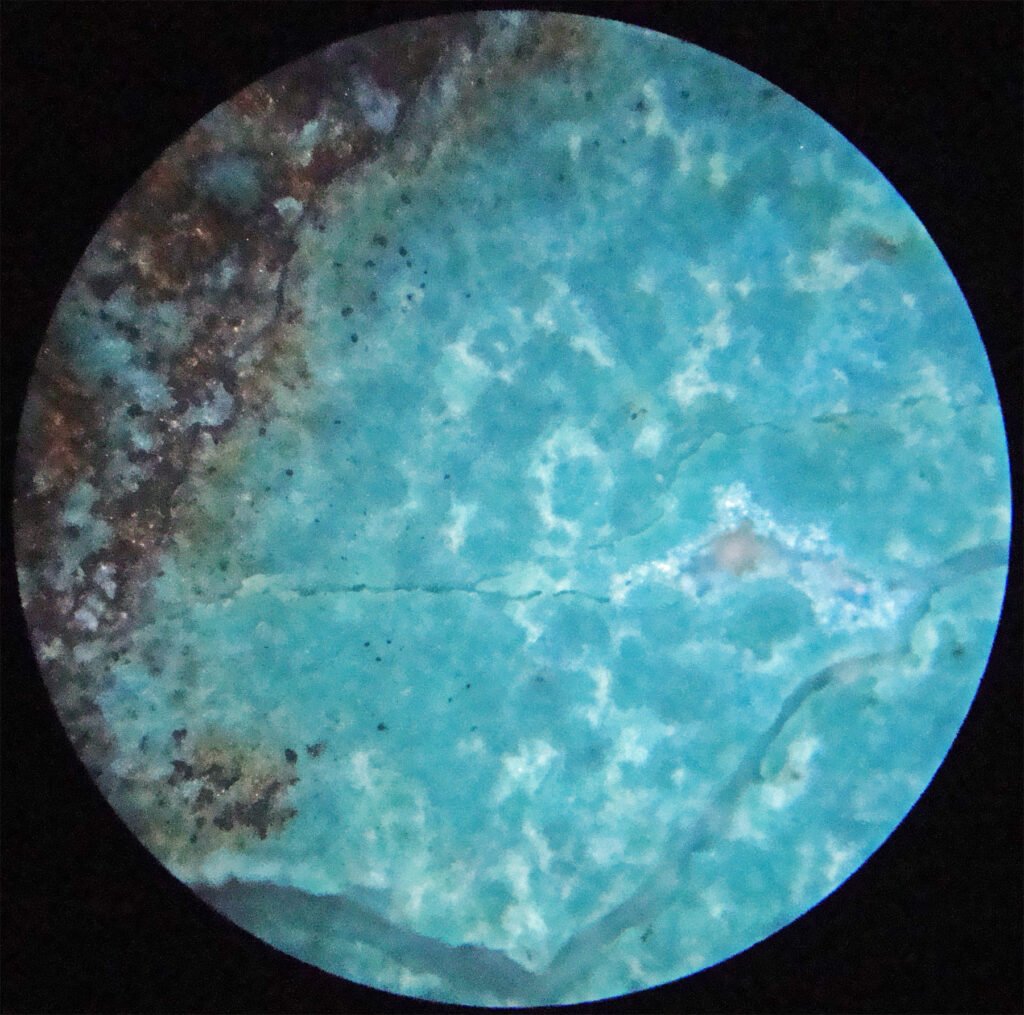
1. Characteristics
Crystal system: Orthorhombic dipyramidal.
Color: Blue to greenish-blue.
Habit: Fibrous, occurring as delicate crystals; forms radial aggregates, as well as separate or compact crystals.
Cleavage: No. Lengthwise striations.
Tenacity: No information available.
Twinning: No.
Fracture: No information available.
Mohs Hardness: 6
Parting: No.
Streak: Pale blue.
Lustre: Silky to adamantine.
Diaphaneity: Transparent.
Density (g/cm³): 3.65 – 3.8
2. Geology and Deposits
Plancheite is a very rare secondary Cu mineral that occurs in oxidized zones of Cu deposits.
3. Mineral Associations
It occurs with common gangue minerals such as quartz, barite, and carbonates (calcite).
It occurs alongside many other secondary Cu minerals, such as malachite, azurite, cuprite, tenorite, dioptase, chrysocolla, shattuckite, conichalcite, bisbeeite, and spangolite.
It also occurs with secondary Zn minerals (willemite) and secondary Pb minerals (wulfenite and mimetite).
It is associated with other very rare minerals, such as heterogenite and surite.
4. Transmitted Light Microscopy
Data on the characteristics of the plancheite under transmitted light are scarce.
Refraction indices: nα = 1.645, nβ = 1.660 e nγ = 1.715
PLANE POLARIZED LIGHT – PPL
Color / Pleochroism: Blue, pleochroism between blue and pale blue.
Relief: Very high.
Cleavage: No.
Habits: Fibrous, may form radial aggregates.
CROSSED POLARIZED LIGHT – XPL
Birefringence and Interference Colors: The maximum birefringence is 0.044, corresponding to intense interference colors of up to the fourth order, but its strong own color masks these colors.
Extinction: Probably paralell.
Elongation sign: No information available.
Twins: No.
Zoning: No information available.
CONVERGENT LIGHT
Character: B(+)
2V angle: 88.5°
Alterations: No information available.
May be confused with: No information available.