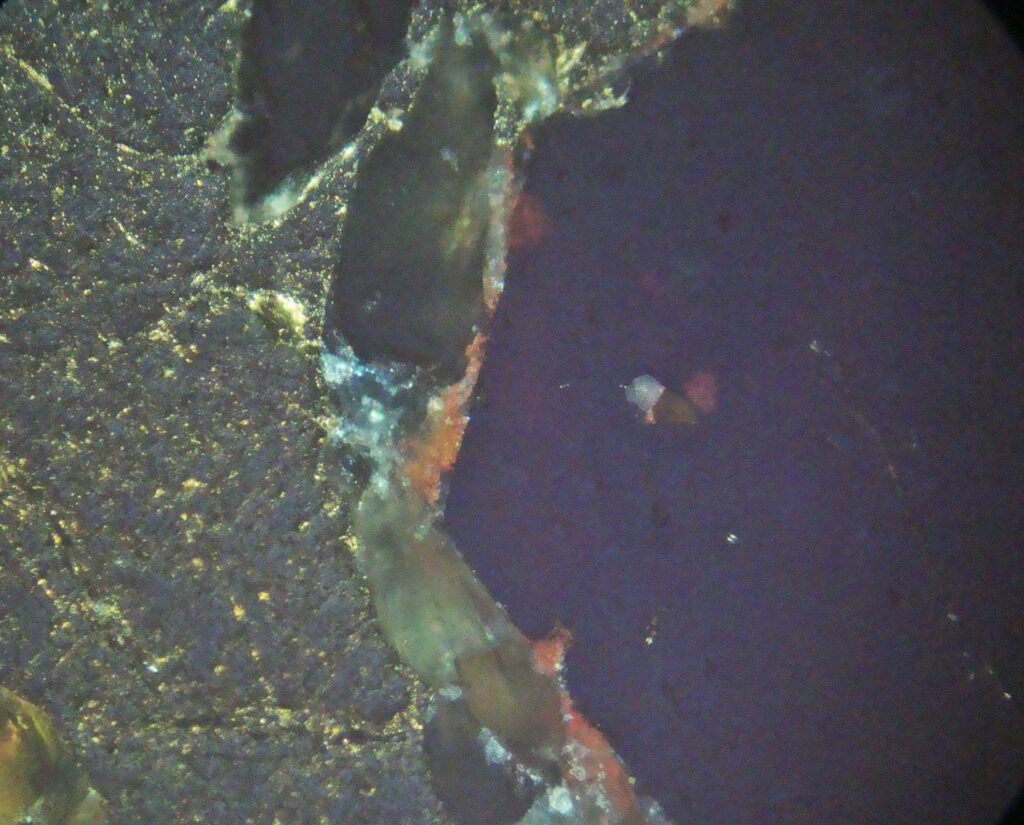
Pyrochlore – A2Nb2(O,OH)6Z (A = Na, Ca, Sn2+, Sr, Pb2+, Sb3+, Y, U4+, H2O or a vancancy; Z = OH, F, O, H2O or a vacancy) – is a fairly rare oxide, occurring in very specific parageneses.
It is the main ore of niobium. The world’s largest Nb producers mine pyrochlore. The CBMM deposit in Araxá (Minas Gerais state, Brazil) is the largest in the world. The second largest is the Catalão deposit (Goiás state, Brazil), followed by a deposit in Canada. Brazilian production accounts for 75% of world production.
Pyrochlores are radioactive minerals and are informally called “Rare Earth Oxides” due to their Rare Earth content.
Pyrochlore is no longer the name of a mineral, but the name of a Supergroup of chemically complex cubic oxides with Nb, Ta and Ti. The Supergroup is divided into 6 Groups, one of which is the Pyrochlore Group, with the general formula indicated above. The Pyrochlore Group consists of 20 different minerals and there are 10 varieties of “pyrochlore”. The classification of pyrochlores was revised by Atencio et al. (2010) and Christy and Atencio (2013).
Correct identification of individual group members is only possible through a combination of several analytical methods; microscopic identification is impossible.
They are difficult minerals to recognize. An important diagnostic feature is the fact that pyrochlore forms perfect octahedral crystals, up to 7 cm; sometimes the color or streak helps in identification. Pyrochlore (from Nb) forms a solid solution with microlite (from Ta), which is classified in its own Group with 8 members, very similar to the Pyrochlore Group.
Crystal system: Cubic hexaoctahedral.
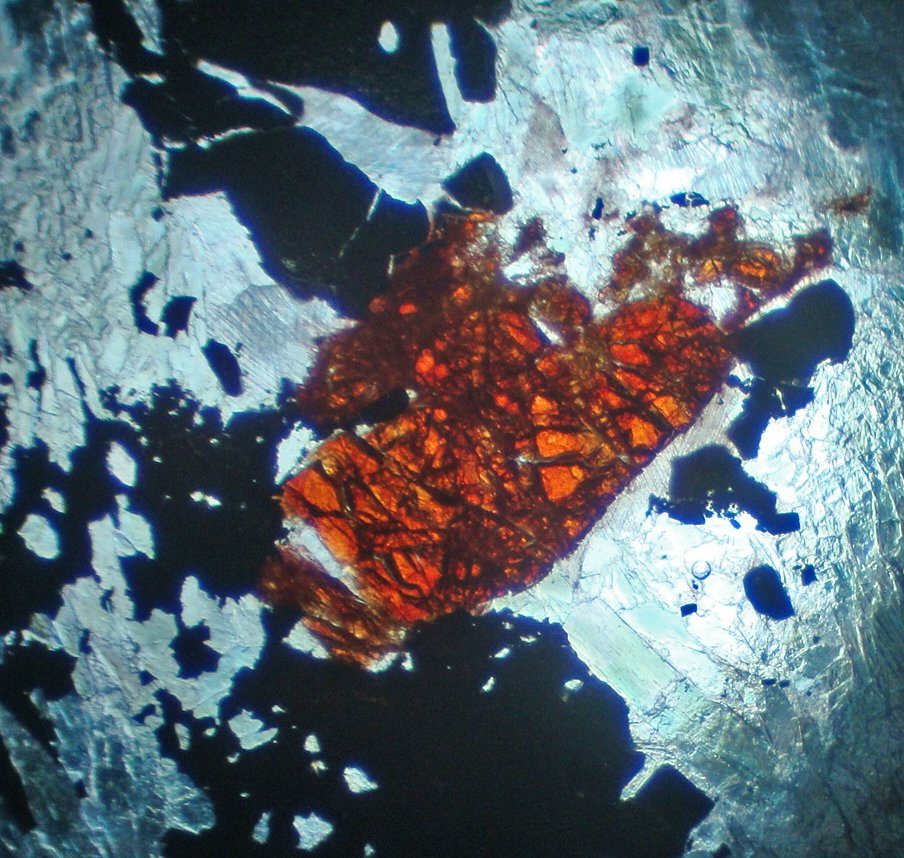
Color: Black to brown, chocolate brown, reddish-brown, amber orange, red orange.
Habit: Typically octahedrons, granular, disseminated, massive.
Cleavage: {111} poor, it could be a partition.
Tenacity: Brittle.
Twinning: On {111}, rare.
Fracture: Subconchoidal to irregular, fibrous.
Mohs Hardness: 5 – 5.5
Parting: May be present.
Streak: White.
Lustre: Vitreous to resinous.
Diaphaneity: Transparent.
Density (g/cm³): 4.45 – 4.9
Pyrochlore is associated with the final metasomatic stages of magmatic intrusions. The crystals may be metamict due to the included radioactive elements.
Pyrochlore typically occurs in carbonatites, also in nepheline syenites. It also occurs in granitic pegmatites and greisens. It can be detrital.
Microlite, which is much more common, occurs in granitic pegmatitic dikes and sometimes in carbonatites.
In carbonatites with carbonates (calcite, dolomite), oxides (magnetite, ilmenite), sulfides (pyrite, chalcopyrite), amphiboles (tremolite, actinolite), phlogopite, apatite, allanite and many others. Carbonatites, in general, can be composed of up to 80 different minerals.
Also with zircon, aegirine, perovskite and columbite.
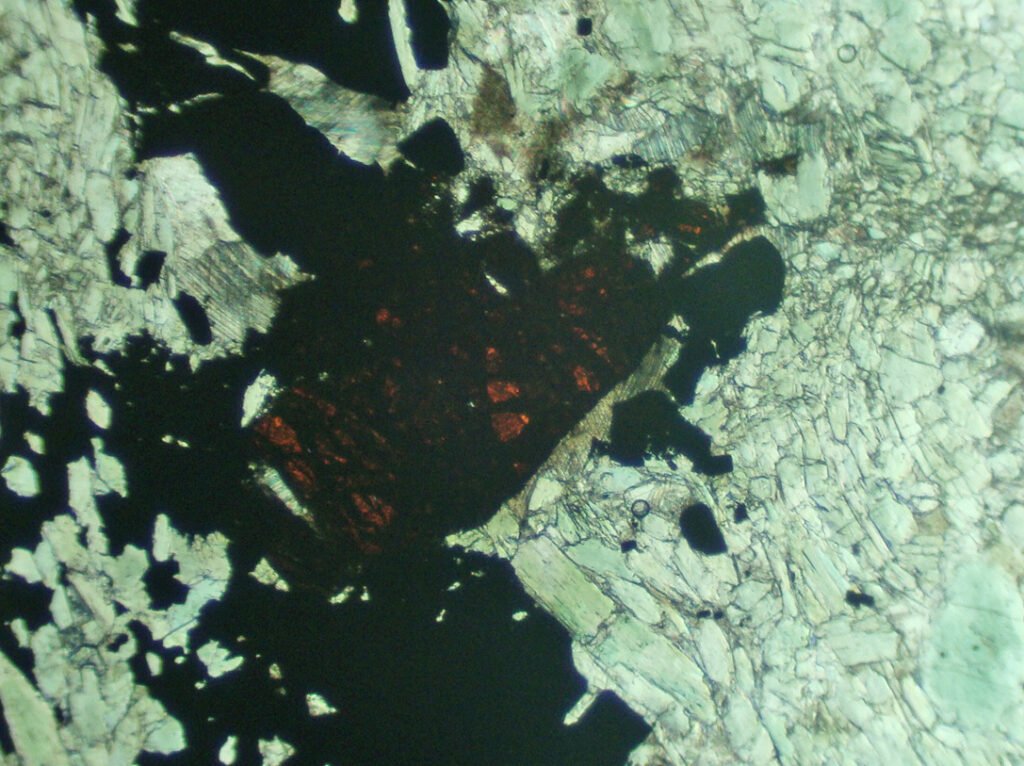
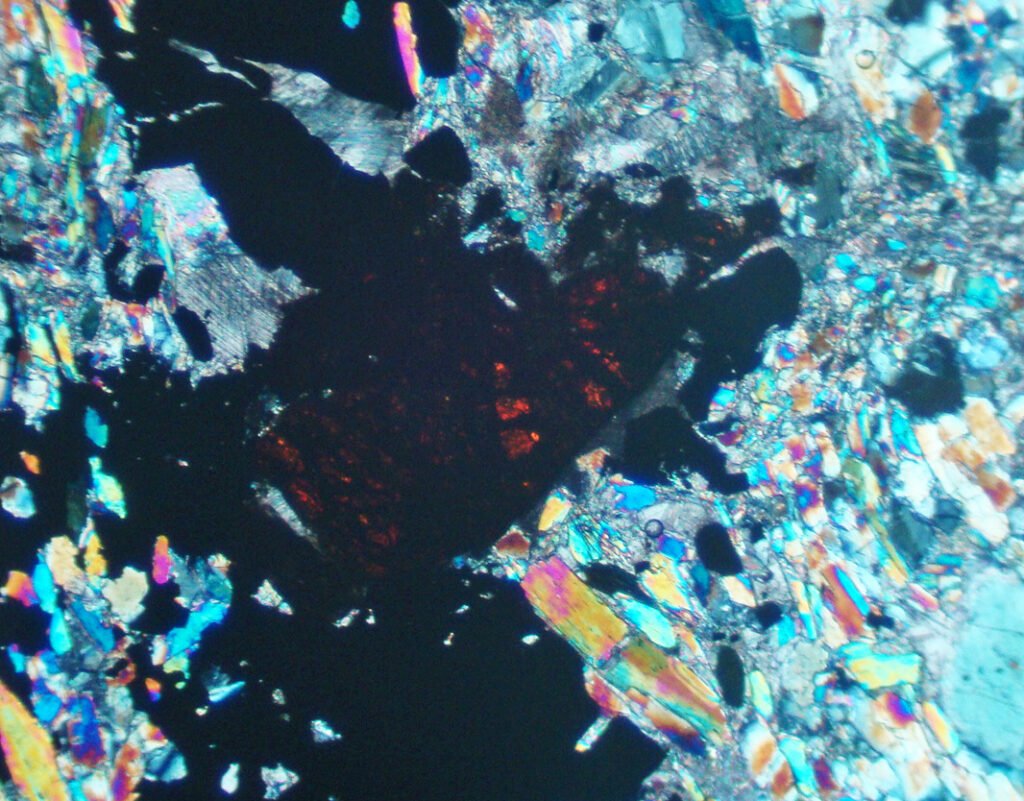
No literature provides optical data for pyrochlore.
Refraction indices: ne: no:
PLANE POLARIZED LIGHT – PPL
Color / Pleochroism:
Relief:
Cleavage:
Habits:
CROSSED POLARIZED LIGHT – XPL
Birefringence and Interference Colors:
Extinction:
Elongation sign:
Twins:
Zoning:
CONVERGENT LIGHT
Character:
2V angle:
Alterations:
May be confused with:
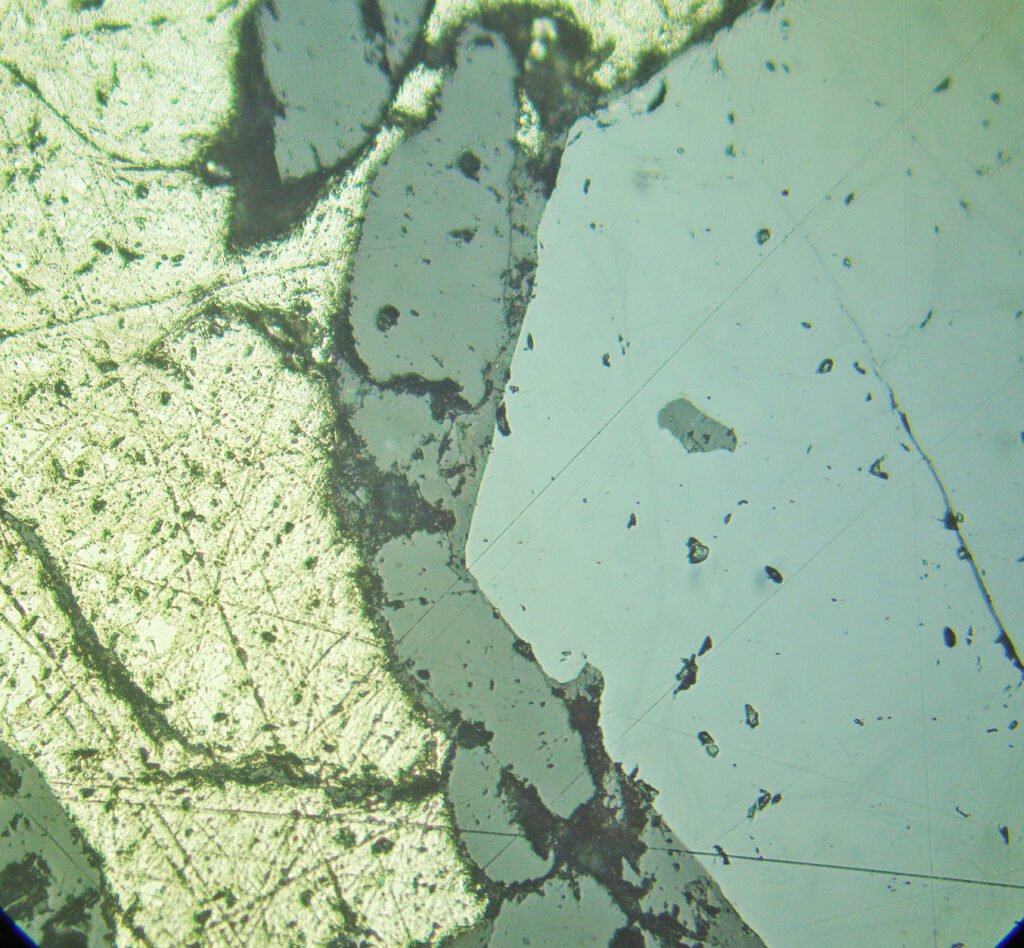
Reflected light microscopy is clearly not the recommended analytical method for identifying pyrochlore. However, it is important to prepare a polished slide or section to identify opaque minerals that occur associated with pyrochlore, such as magnetite, ilmenite, pyrite, chalcopyrite, and others.
Sample preparation: Pyroclore acquires an excellent polish without difficulty. While magnetite still has a poor polish, pyrochlore already exhibits an almost perfect polish.
PLANE POLARIZED LIGHT – PPL
Reflection color: Medium gray.
Pleochroism: No.
Reflectivity: 10,5%
Bireflectance: No.
CROSSED POLARIZED LIGHT – XPL
Isotropy / Anisotropy: Isotropic, it may exhibit weak anomalous anisotropy.
Internal reflections: Widespread, abundant, colorless, some already visible in PPL.
May be confused with: Many other minerals. Pyrochlores cannot be identified by reflected light. Once their existence is known, they are easy to recognize.