PYROMORPHITE
Pyromorphite – Pb5(PO4)3Cl – is a relatively common phosphate, a secondary mineral that integrates polymetallic oxidized ores. It is never the main ore mineral.
It is classified in the Apatite Group, a group of isomorphic hexagonal minerals. Forms an isomorphic series (is isostructural) with mimetite and vanadinite. In many cases, the minerals are so similar to each other that they can only be differentiated from each other through chemical analysis. It also forms a series with hydroxylpyromorphite. It can contain various impurities like Ca, Cr, V, As, Ra and F. There are three varieties (with Ca, with V and with As). When it is biaxial, it is piezoelectric. It may fluoresce in yellow or orange colors under both longwave and shortwave ultraviolet light.
Pyromorphite forms crystals easily, they can reach 8 cm. Typical are prismatic shapes and “hoppered” endings. Hexagonal prismatic crystals with curved prism faces, resembling a small barrel, are common. It also forms radiating aggregates or coating druses in the matrix.
As pyromorphite is neither a (transparent) rock-forming mineral nor one of the classic opaque ores, the information available in the literature on its microscopic characteristics is very scarce, almost absent. Classic mineralogy books simply do not mention it at all.
1. Characteristics
Crystal system: Hexagonal bipiramidal.
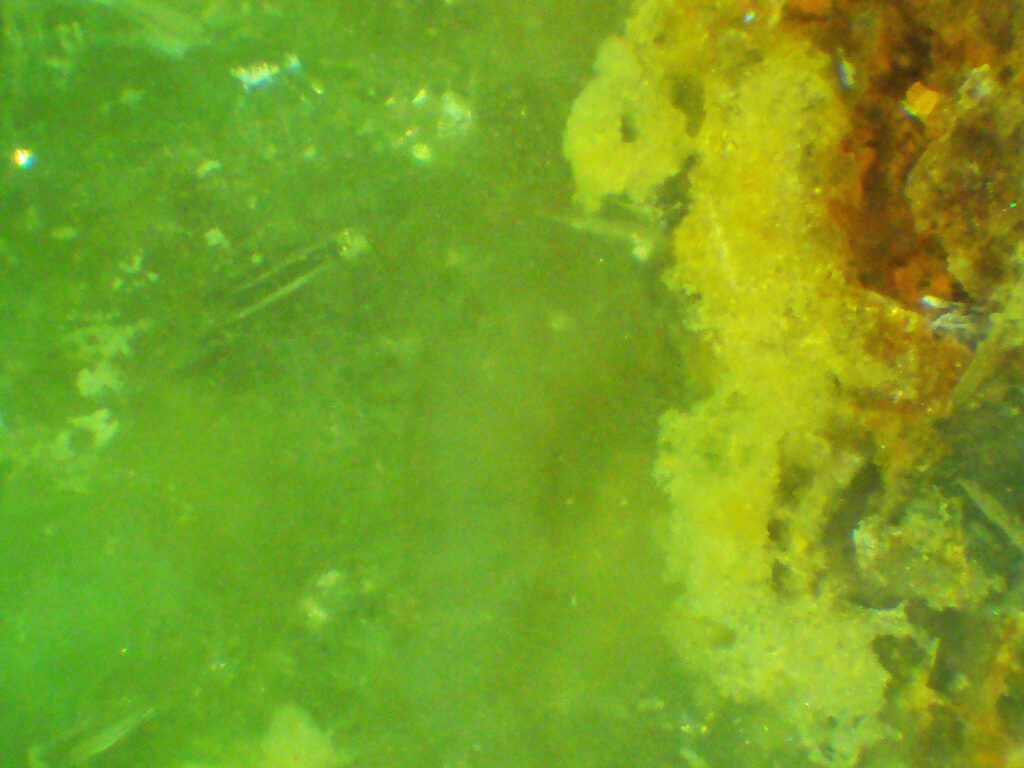
Color: Dark grass green, green, shades of yellow, orange, reddish or grayish brown. Colorless when pure.
Habit: Globular, reniform, botryoidal, prismatic. It can be acicular, tabular, globular or equidimensional.
Cleavage: {10-11} poor.
Tenacity: Brittle.
Twinning: Very rare on {11-22} and {10-10}.
Fracture: Irregular to subconchoidal.
Mohs Hardness: 3.5 – 4
Parting: No.
Streak: White.
Lustre: Resinous, subvitreous, subadamantine.
Diaphaneity: Transparent.
Density (g/cm³): 7.04
2. Geology and Deposits
Pyromorphite typically occurs as a secondary mineral in the oxidized zones of Pb deposits, constituting one of several minerals that form from galena.
It rarely occurs as a volcanic sublimate.
Forms as a stable Pb phase in contaminated soils, both urban and industrial.
3. Mineral Associations
Occurs with some common gangue minerals such as quartz, carbonates and barite.
It occurs with remains of galena, also with native silver and fluorite.
In the paragenesis of oxidized minerals are typical other:
– secondary Pb minerals (cerussite, vanadinite, anglesite, wulfenite, plumbogummite, crocoite),
– secondary Zn minerals (smithsonite, hemimorphite, willemite),
– secondary Cu minerals (malachite) and
– secondary Fe minerals (goethite (limonite)).
4. Transmitted Light Microscopy
Refraction indices: nω: 2.058 nε: 2.048
PLANE POLARIZED LIGHT – PPL
Color / Pleochroism: Colorless or almost colorless, with weak pleochroism.
Relief: Very high.
Cleavage: {10-11} poor, not visible under the microscope.
Habits: Globular, reniform, botryoidal, prismatic. It can be acicular, tabular, globular, equidimensional or massive.
CROSSED POLARIZED LIGHT – XPL
Birefringence and Interference Colors: Maximum birefringence of 0.010: colors between gray and white, reaching 1st order straw yellow.
Extinction: Paralell.
Elongation sign: No information available.
Twins: Very rare.
Zoning: No information available.
CONVERGENT LIGHT
Character: U(-), can be anomalous B(-), sectored.
2V angle: No.
Alterations: may alter to cerussite (in carbonate-rich, oxidizing environments), anglesite (in sulfate-rich, oxidizing conditions), mimetite (when arsenic-rich fluids replace phosphate with arsenate), vanadinite (when vanadate replace phosphate), plumbogummite (in strong weathering and hydration conditions when aluminium becomes available) and galena (in reducing environments).
May be confused with: related minerals of the Apatite Group, some of them almost indistinguishable.
– apatite, with similar low birefringence. comparable relief and without strong pleochroism, look nearly identical.
– mimetite has very similar optical properties and crystal habit.
– vanadinite also has high relief and weak birefringence,
– monazite also ocurrs in small grains, but is biaxial.
– cerussite has similar high relief, but much hogher birefringence and is biaxial.

5. Reflected Light Microscopy
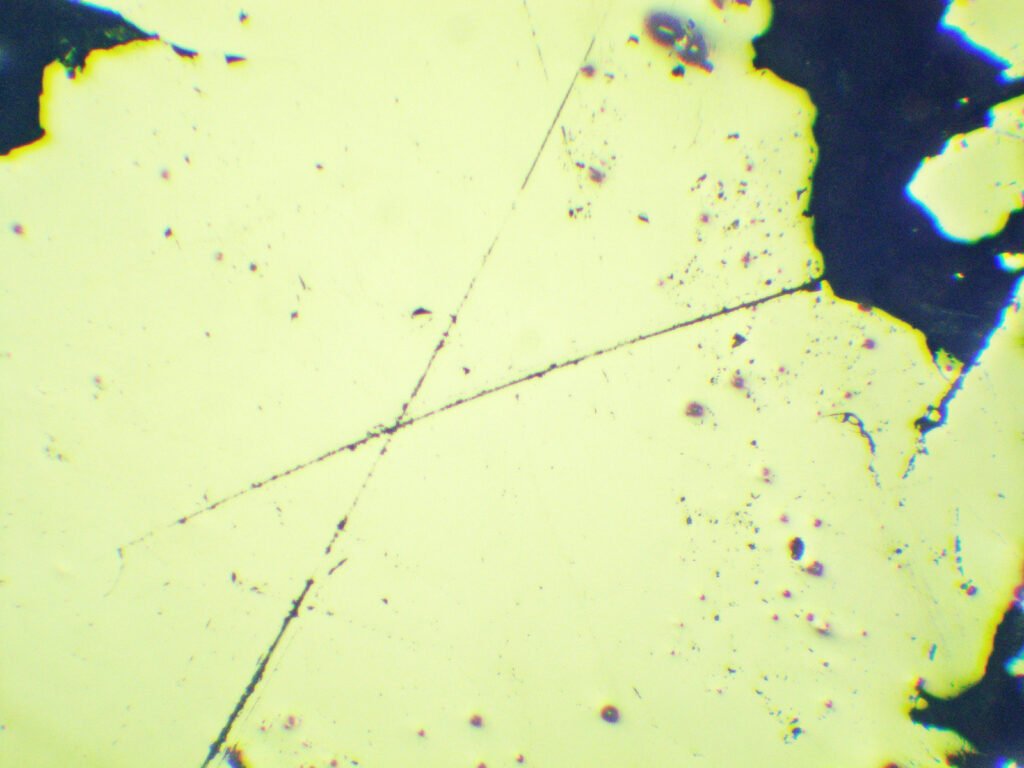
Reflected light microscopy is not the recommended analytical method for the identification of pyromorphite. However, it is important to make a polished thin section or a polished section to identify the opaque minerals that occur associated with pyromorphite.
Sample preparation: pyromorphite polishing presents no problems. The mineral is of medium to low hardness, without expressive cleavages and acquires an excellent polish.
PLANE POLARIZED LIGHT – PPL
Reflection color: Dark greenish gray.
Pleochroism: No.
Reflectivity: 4%.
Bireflectance: No.
CROSSED POLARIZED LIGHT – XPL
Isotropy / Anisotropy: Anisotropy was not observed.
Internal reflections: Diffuse and generalized in the same color as the hand specimen.
May be confused with: other light-colored transparent secondary minerals that occur associated.
General Characteristics:
Epitaxic films of galena on pyromorphite may occur.
Pseudomorphosis are frequent. Pyromorphite forms pseudomorphosis on galena and cerussite. Galena often forms pseudomorphosis on pyromorphite, with spongy intergrowths with fluorapatite. Other possible pseudomorphosis are apatite on pyromorphite and plumbogummite encrusted or replacing pyromorphite.