5. Reflected Light Microscopy
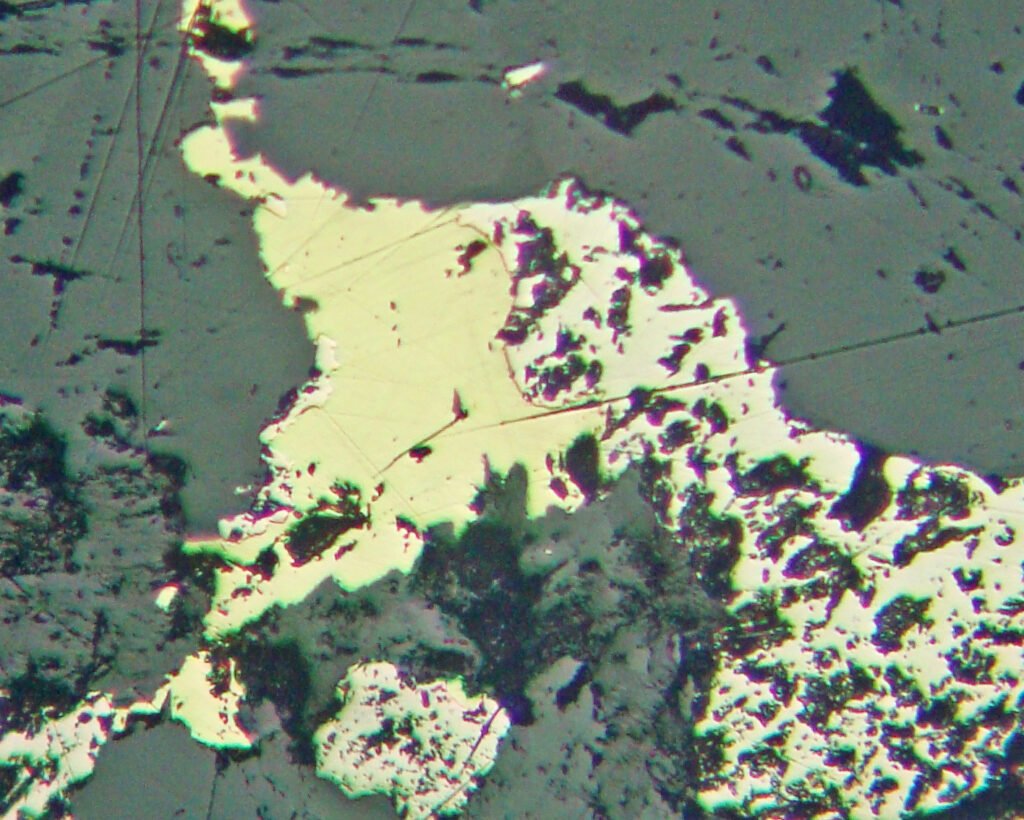
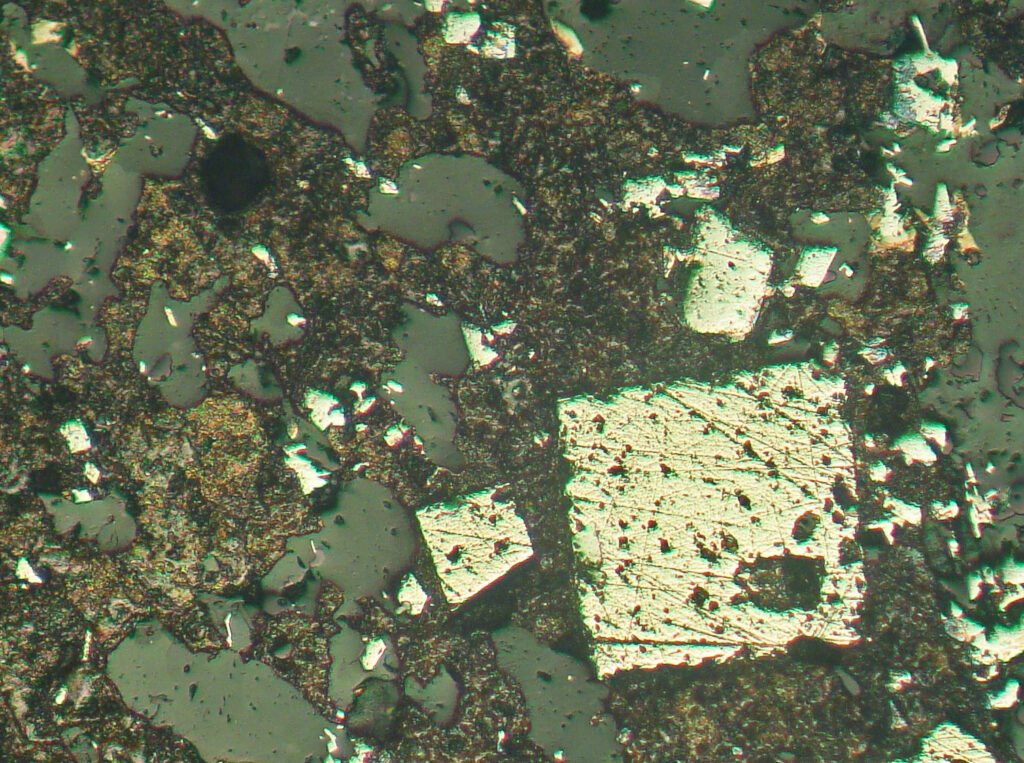
Sample preparation: it has a medium polishing hardness and acquires an excellent polish after a good quality pre-polishing. It is much harder than chalcopyrite and sphalerite and about the same hardness as pentlandite, perhaps a little harder. Smaller grains acquire a great polish with some ease, but larger aggregates maintain persistent holes and the final quality of the polish resembles that of magnetite, which generally acquires a much worse polish.
PLANE POLARIZED LIGHT – PPL
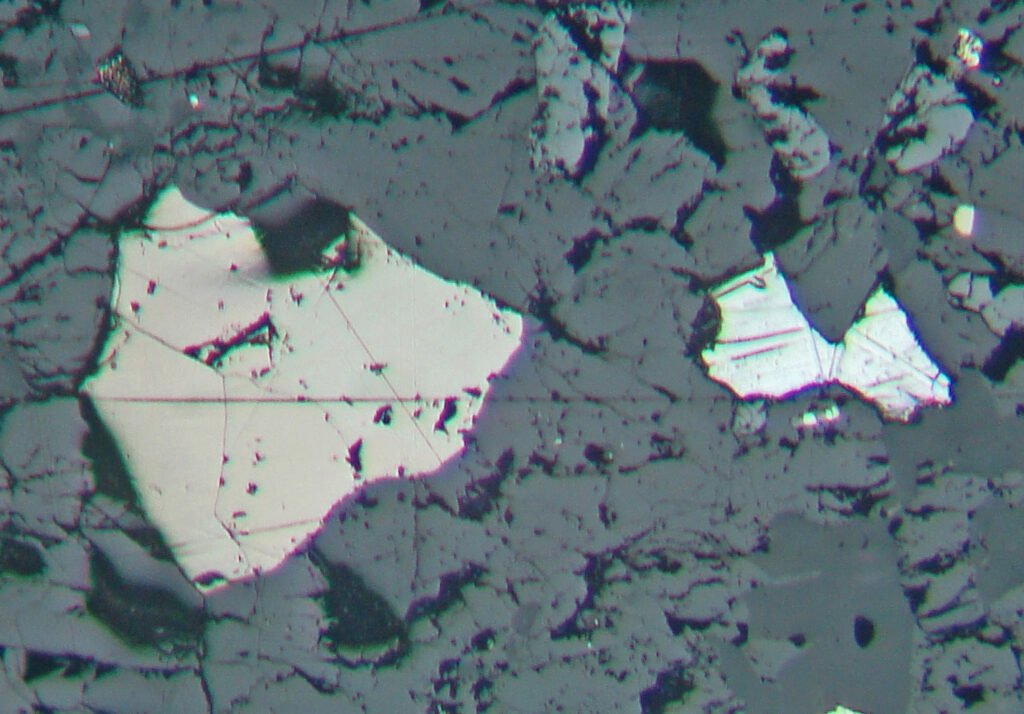
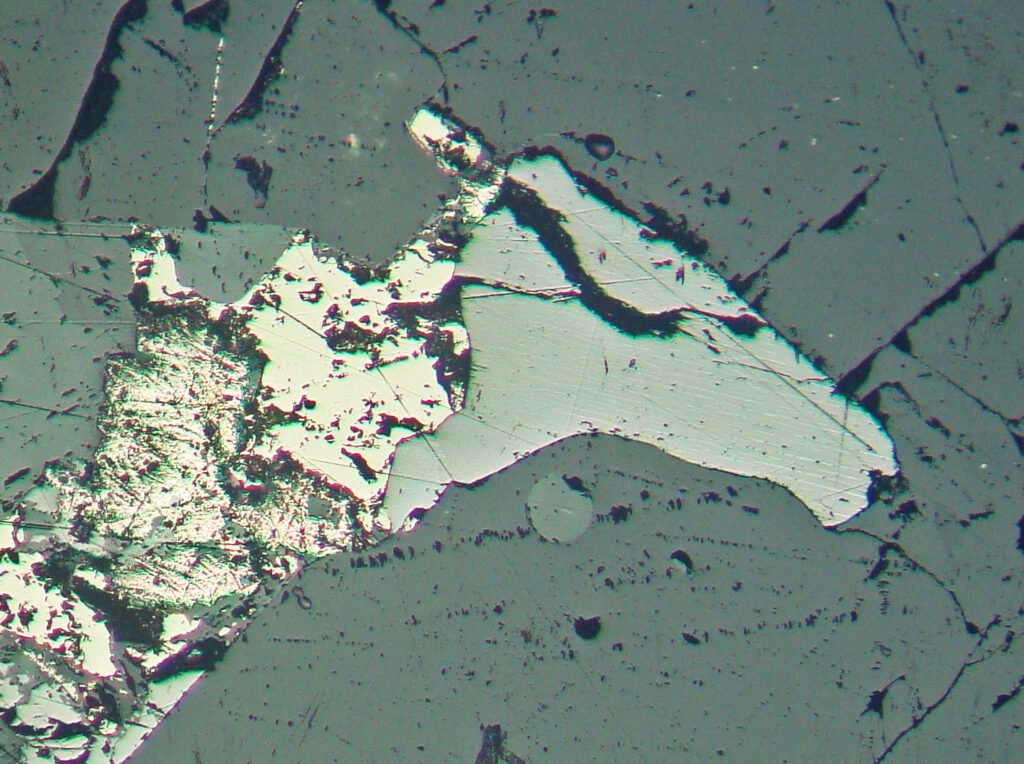
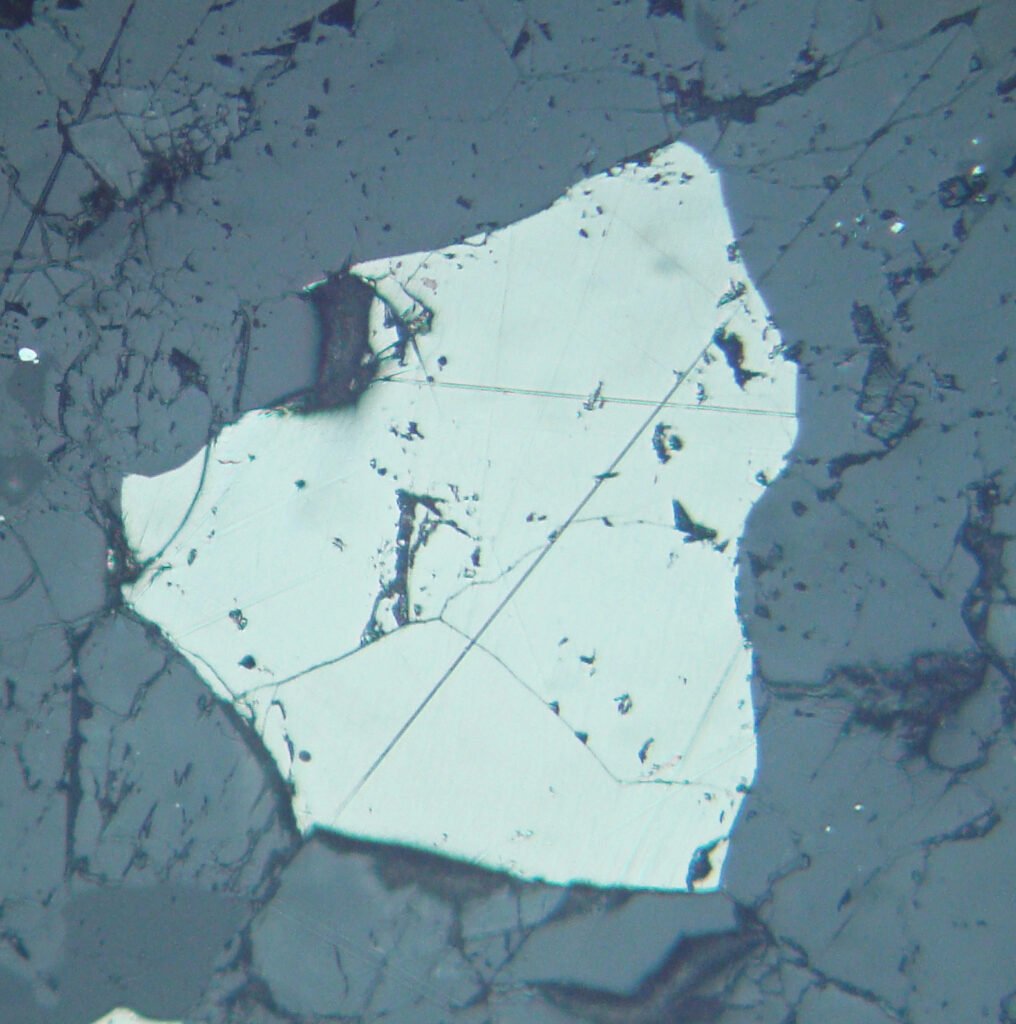
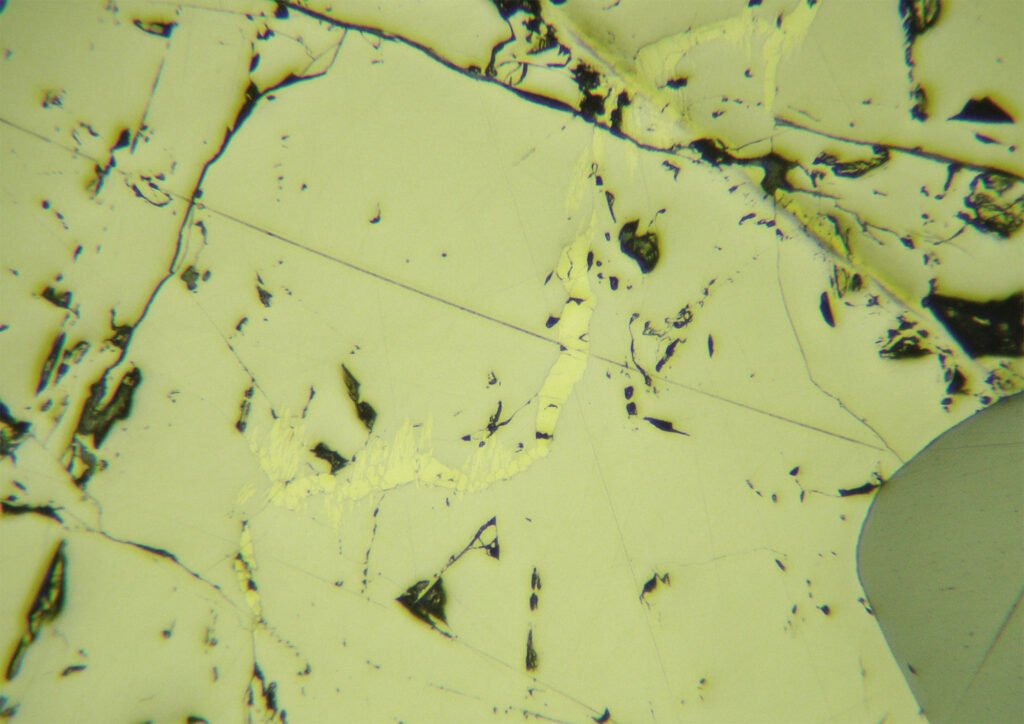
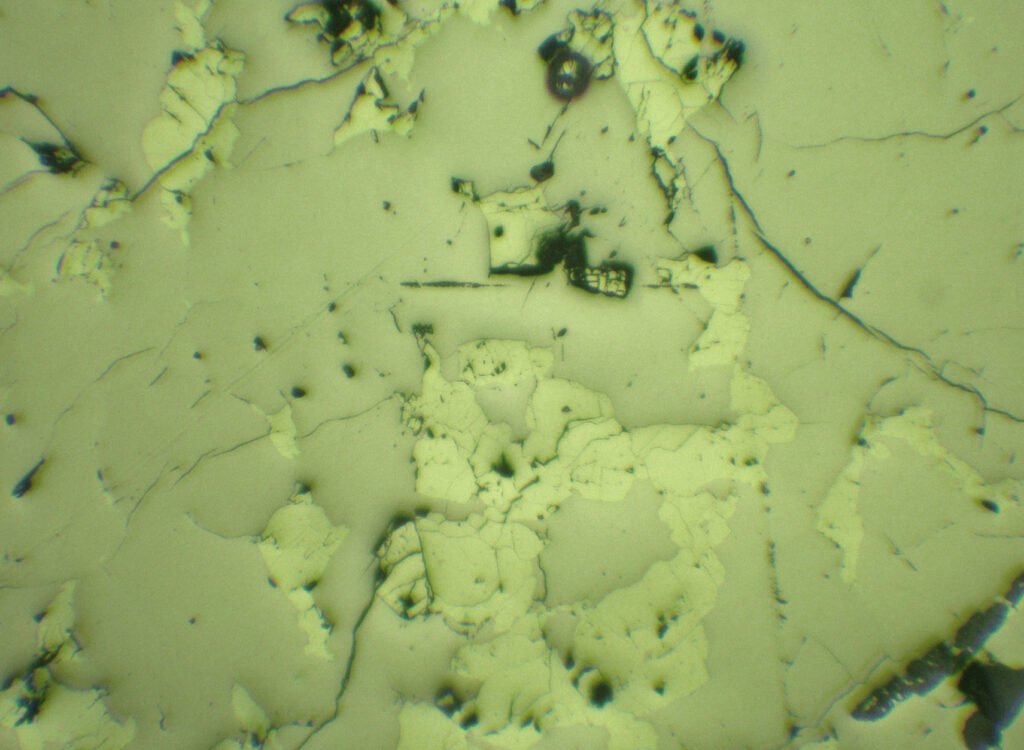
Reflection color: Color in brown and yellowish tones with pink, can be light yellow to pink brown, can be between yellowish brown and brown.
The color is very diagnostic, but only on freshly polished sections, because it quickly fades to brown by air oxidation (prismatic sections blur more, basal sections blur less).
Compared with the color of pentlandite, the color of pyrrhotite is darker and more brownish-pink.
Compared with the color of cubanite, the color of pyrrhotite is pinker and lighter.
Compared to the color of nickeline, the color of pyrrhotite is much darker and less pink.
Compared to the color of native bismuth, the color of pyrrhotite is cream-grey brown.
Pleochroism: Weak to absent; when present it is only visible at intergranular contacts, varies from darker reddish-brown to lighter cream-brown.
Reflectivity: 36.91 e 41.56%
Bireflectance: No.
CROSSED POLARIZED LIGHT – XPL
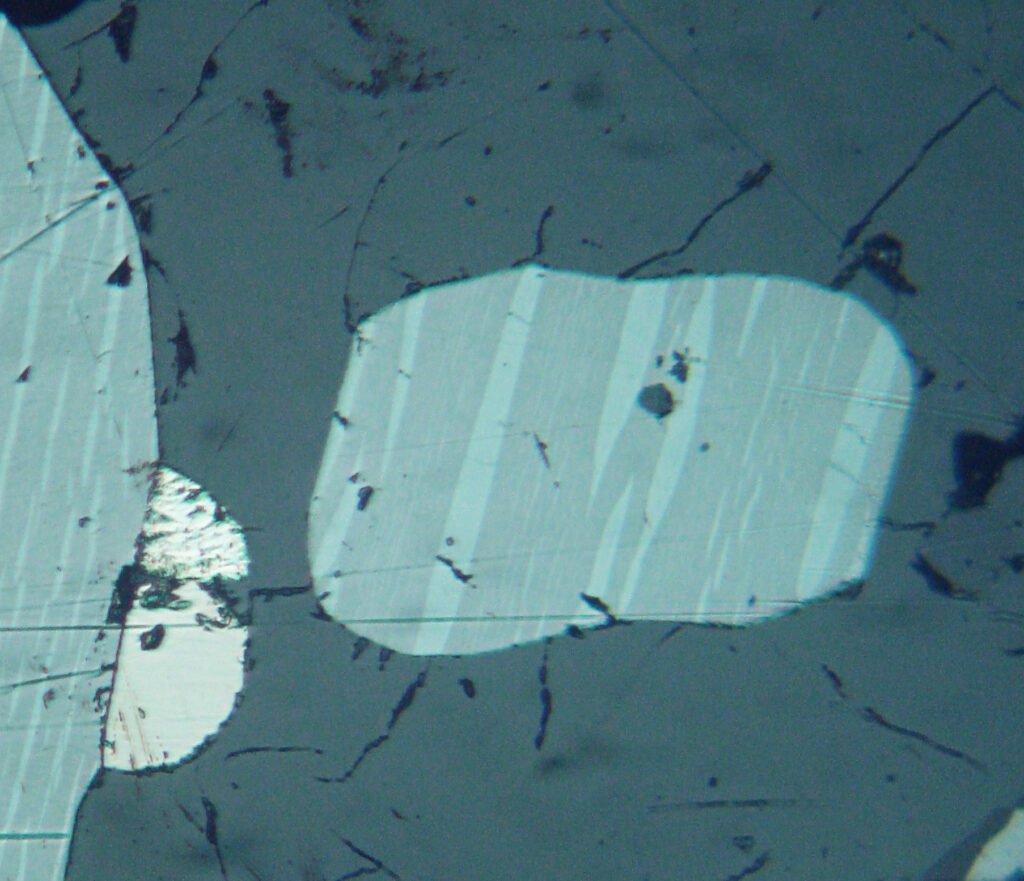
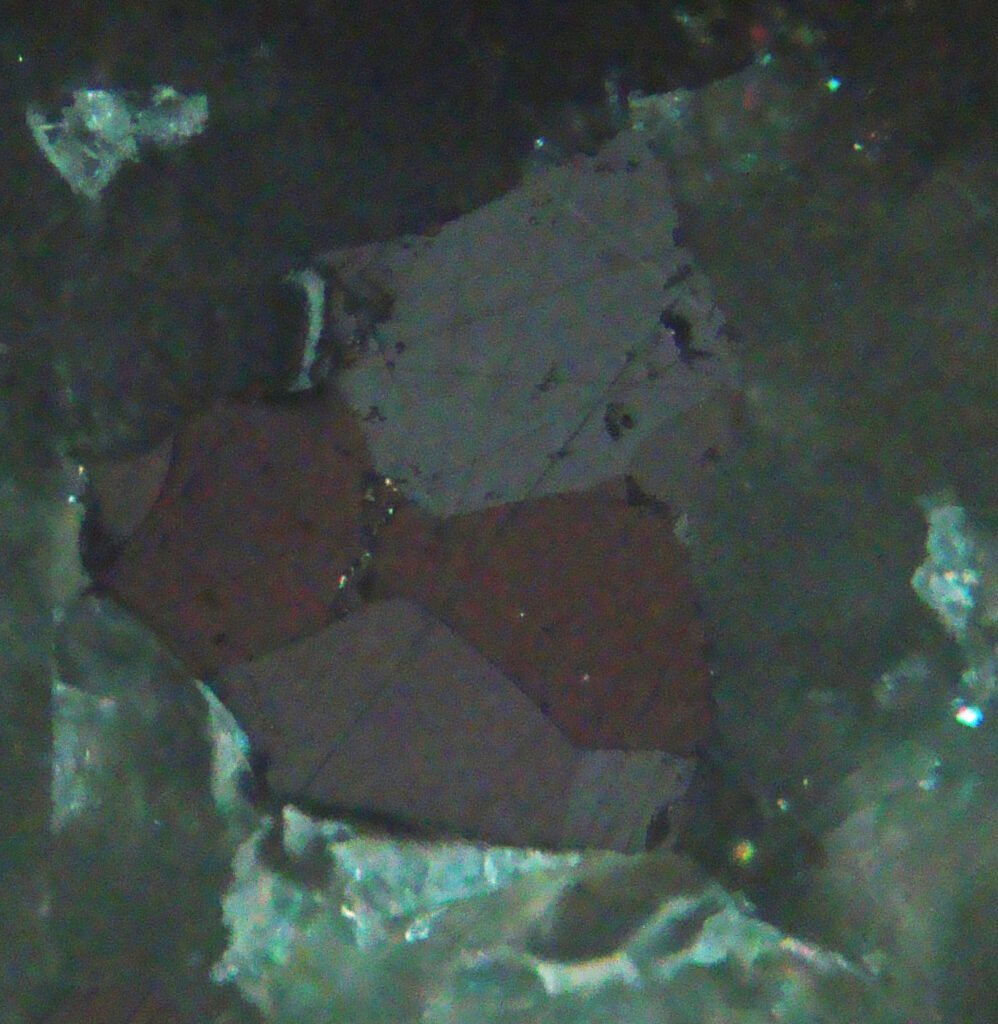
Isotropy / Anisotropy: Strong colored anisotropy, from yellow-gray to soft green to gray to brown-red. Bluish tones may occur.
Color effects vary according to grain orientation and may vary between different occurrences. Basal sections are isotropic.
Uncrossing the nicols a little (few degrees) it is possible to observe the anisotropy more easily.
Internal reflections: No.
May be confused with: magnetite and ilmenite at first glance, but it is much more yellow and its strong anisotropy distinguishes it from these two, with which it usually occurs.
Cubanite has stronger pleochroism and is softer (polishing scratches).
General Characteristics:
Grain shape: Well-developed crystals of pyrrhotite grown on other minerals or in cavities are rare, as are idiomorphic crystals in polymineralic aggregates. Idiomorphic crystals are tabular, sometimes arranged parallel to the texture of the ore, like micas in a mica-shale. Usually the aggregates are anhedral granular with very variable grain sizes and a certain preference for the development of (0001). The intergranular boundaries are simple polygonal and are not or are weakly toothed. In pegmatites and skarns the crystals can be large.
Partition, strong and parallel to (0001) is always visible, but in varying degrees of sharpness. In former literature this partition was called cleavage. When the mineral is not altered, this partition appears only in coarse-grained masses and in those pyrrhotites generated from pyrite. When the mineral is altered, the partition parallel to (0001) is always visible and the partition parallel to (10-10) becomes visible occasionally. The sharpness of this partition may depend on the amount of pentlandite exsolutions parallel to (0001); in this case a distinct partition indicates a high Ni content.
Twins are rarely present. When there are, they are pressure twin lamellae. The various twins observed in a hand sample are not recorded in a polished section.
Zonation is common in crystals that have formed freely (into cavities), but is rare in crystals of granular aggregates. The zoning can be expressed by discrete color variations and by a certain zoning in the amount of pentlandite flames, which can be more frequent at the edges of the crystals.
Inclusions in pyrrhotite, in a very general way and without focusing on the genetic aspect, can be chalcopyrite, arsenopyrite, sphalerite, marcasite, nickeline, cubanite, magnetite, cassiterite, native gold and ilmenite.
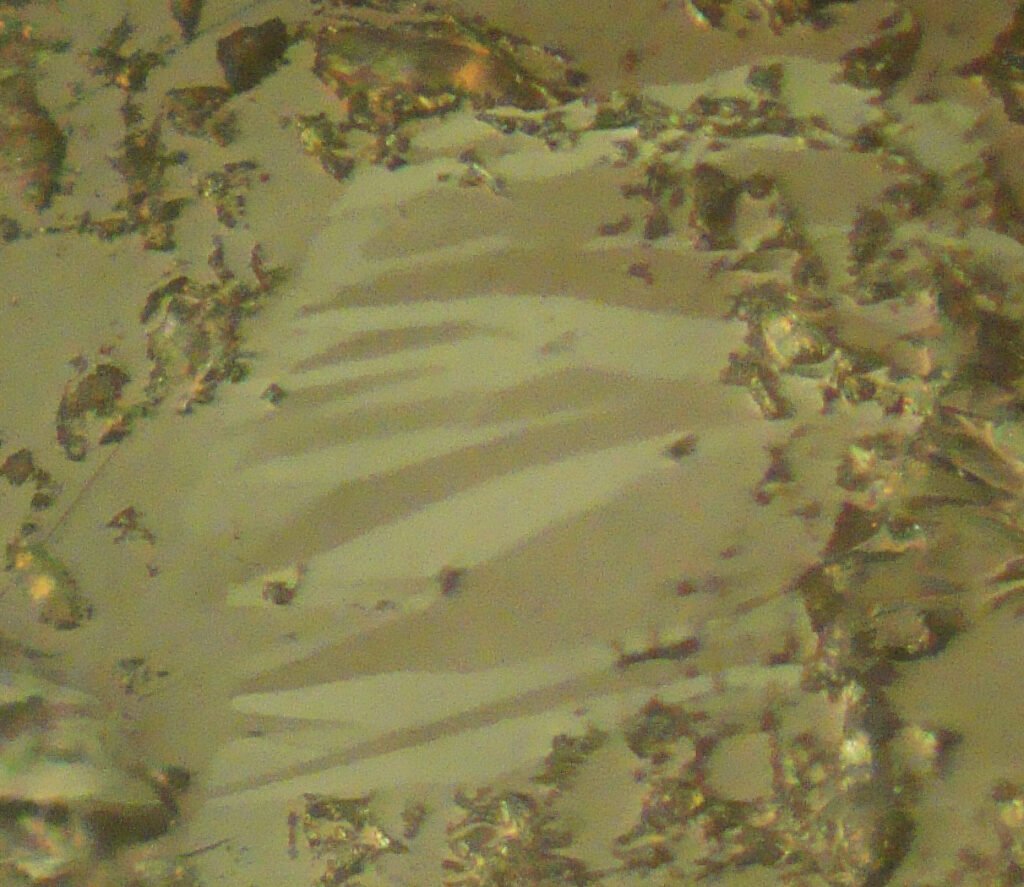
Deformations are very frequent and conspicuous, especially those by translation parallel to (0001), generating crumpled and wavy lenticular subparallel slices. These slices are well observable in CPL, sometimes even due to the orientation of the partition planes.
Oriented intergrowths of pyrrhotite occur with pentlandite, sphalerite, chalcopyrite, pyrite, marcasite, galena, arsenopyrite, cubanite and magnetite.
Cataclasis can be seen in pyrrhotite, with pyrrhotite filling fractures in harder minerals, such as cassiterite. In this case, the hard minerals cataclasis occurred and the softer pyrrhotite was “squeezed” into the fractures, generating a cataclastic texture that simulates a replacement texture.
Substitutions are frequent and diversified, due to the great reaction capacity of pyrrhotite. Pyrrhotite is replaced by galena, chalcopyrite, sphalerite, pentlandite, pyrite, marcasite, tetrahedrite-tennantite, stannite, native gold, magnetite, gudmundite, hematite, covellite, chalcocite, berthierite and many others. In many cases the replacement textures were actually generated by cataclasis (see cataclasis). Substitution of pyrrhotite for pyrite is very frequent and can be observed at all stages. The textures generated are excellent and show that even those pyrites apparently formed as a first phase are also substitution products from pyrrhotite. The opposite also occurs and is not uncommon: substitution of pyrite for pyrrhotite. Another occasional process is the replacement of pyrrhotite with magnetite (+ pyrite), usually by oxidation. The inverse, the replacement of magnetite by pyrrhotite, can be observed in several cases, when pyrrhotites preserve the ilmenite lamellae texture of the original titanomagnetite. Pseudomorphosis may occur on pyrrhotite, with pyrrhotite being replaced by pyrite, marcasite, chalcopyrite, arsenopyrite, magnetite and quartz. The pentlandite dismixtures that occur in pyrrhotite can be replaced entirely by violarite (Fe2+Ni3+2S4) or bravoite (pyrite-Ni).
Replacements due to alteration are very diverse. Pyrrhotite is the most sensitive iron sulfide to weathering destruction: pyrrhotites that have been left in the rain for just one day already show clear changes. Even in deep mines, far below the water table, the pyrrhotites are already altered, perhaps by the circulation of air and humidity in the mine itself. Two main evolutions can be distinguished: (a) change to marcasite + pyrite and (b) change to pyrite and magnetite.
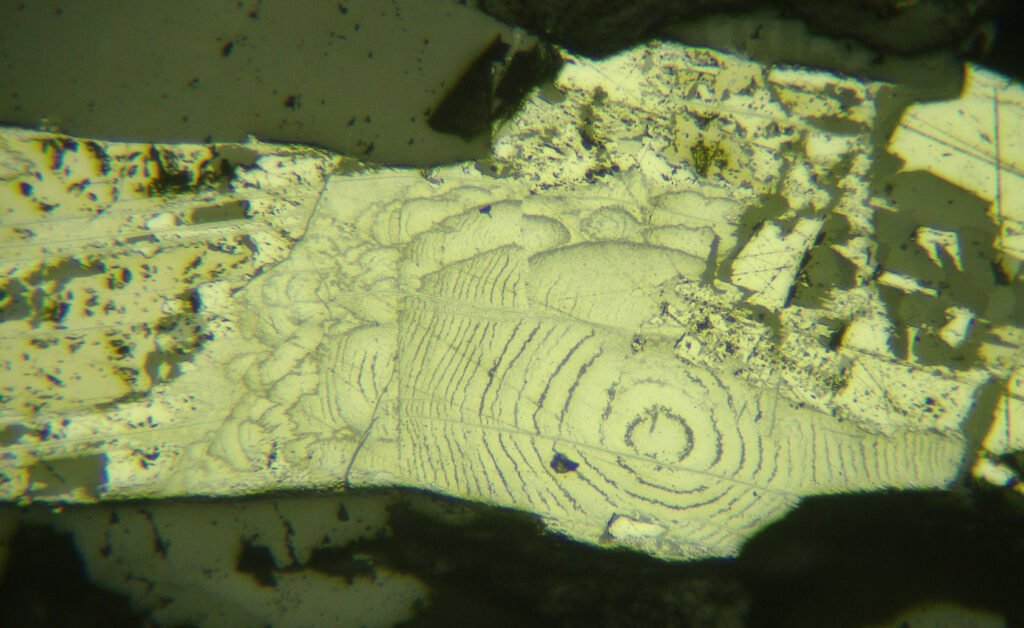
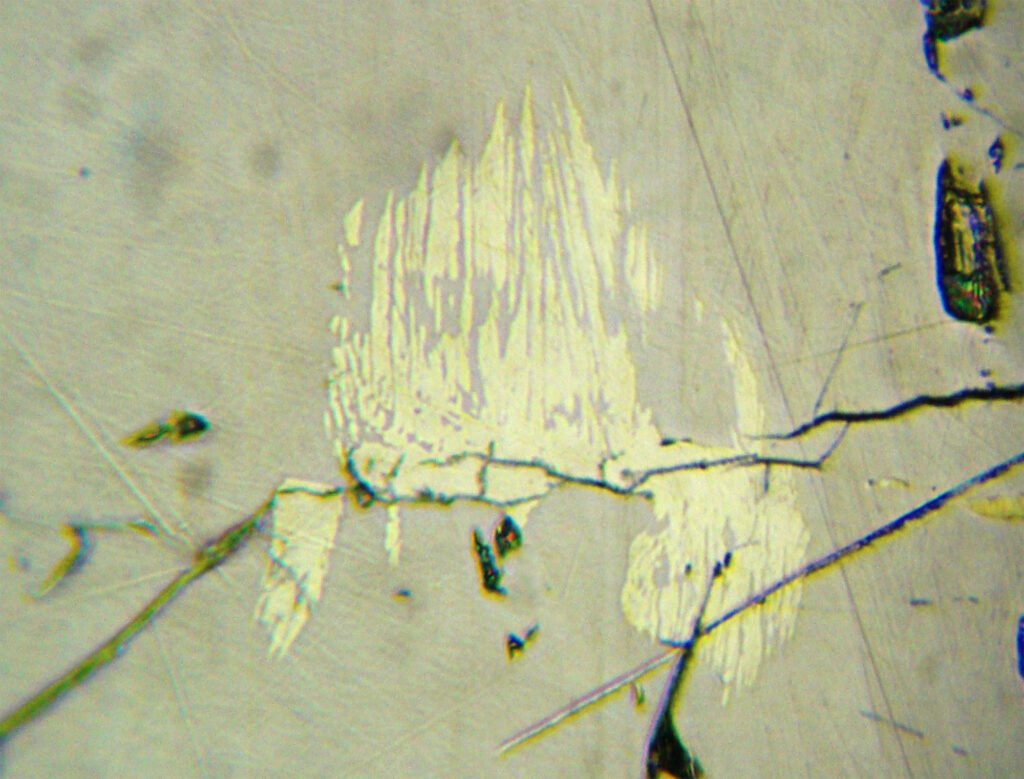
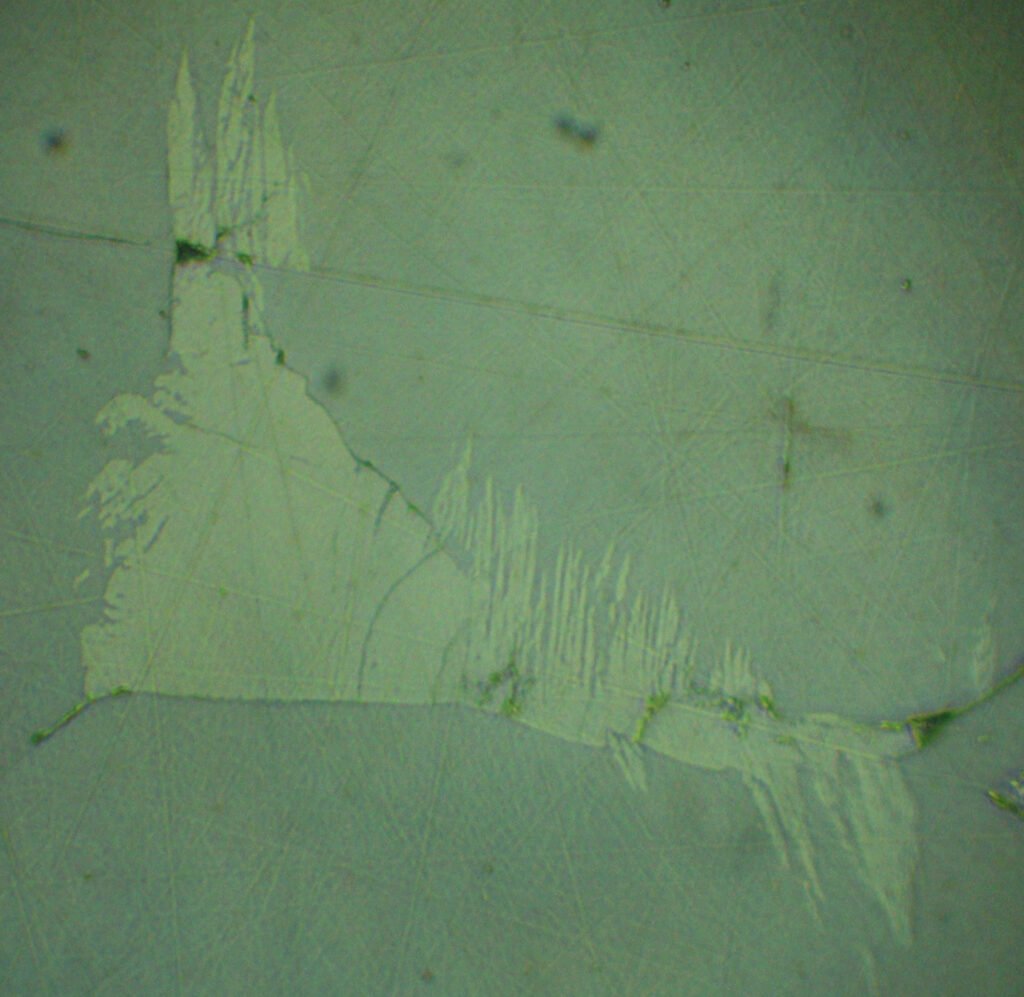
(a) The alteration (hypogenic transformation) from pyrrhotite to marcasite + pyrite takes place in 3 stages: (1) an intermediate product is formed initially, then (2) pyrite + marcasite with a “bird’s eye” texture and finally ( 3) ferrous sulfate or limonite (goethite) and sulfuric acid. (1) The intermediate product is quite frequent, it forms directly from pyrrhotite from partition planes and fractures and is formed by a gray-white material, quite anisotropic (very similar to Marcasite), a little harder than the pyrrhotite, interspersed with it in an excellent way. Reflectivity varies greatly, even within the same sample, and blurs in air very quickly; it is chemically very unstable. Reflection pleochroism varies from distinctly brownish (parallel to (0001)) to more olive gray (perpendicularly). X-ray diffractograms showed that it was probably Marcasite. (2) The most frequent stage, however, is the formation of marcasite (with or without pyrite) in the “bird’s eye” texture. These are oval bodies with a concentric banded structure, arranged parallel to (0001) of the pyrrhotite, formed by extremely fine-grained minerals, usually Marcasite and/or Pyrite. Marcasite formation is quite frequent in the form of linear or chordate aggregates, with very fine grains, without orientation, arranged parallel to (0001) of the pyrrhotite. They also evolve from fractures, have a very characteristic appearance and form tufts. With the evolution of the alteration, the marcasite and pyrite portions are preserved and the pyrrhotite is solubilized, generating a pseudomorphosis of cellular appearance, which still allows to see the original structure of the pyrrhotite. With the presence of carbonates, siderite is formed.
(b) The alteration of pyrrhotite to magnetite + pyrite forms delicate myrmekitic intergrowths. Often the newly formed pyrite is arranged in such a way that one face of its octahedron coincides with (0001) of the pyrrhotite, forming a checkered mosaic. In other cases, the intergrowths are coarse and irregular, but always with many indications of their formation from pyrrhotite. With more oxygen in the system, similar intergrowths of pyrite with hematite or of pyrite with goethite form. In both cases there is a lot of marcasite next to the pyrite, with transitions between both textures described above.
Unmixings are common and can occur in 7 types:
Unmixings 1: Pentlandite unmixings are the best known. Its most common form is “pentlandite flames”. They are fusiform unmixing bodies that resemble small flames. They can also take the form of spindles, lenses, drops, granular aggregates and veins. They usually start in fissures, fractures, intergranular boundaries or are oriented parallel to crystallographic directions; its distribution is rarely uniform. The flames are very small; with some experience they can be recognized with the medium magnification objective (10x), but are best observed with the maximum magnification objective (40x). The color difference between pyrrhotite and pentlandite flames is very discreet and requires a lot of attention from a beginner in the matter. As pentlandite is cubic, in CPL it is isotropic, which allows a better perception of the flames. Pyrrhotites without pentlandite flames do not contain significant nickel contents. The pentlandite unmixings that occur in pyrrhotite can be replaced entirely by violarite (Fe2+Ni3+2S4) or bravoite (pyrite-Ni).
Unmixings 2: in high temperature pyrrhotites of basalts and meteorites, but also in some nickel-bearing pyrrhotites, there are magnetite unmixings forming thin plates arranged parallel to (0001).
Unmixings 3: Unmixings of chalcopyrite in pyrrhotite may occur. The inverse case, unmixings of pyrrhotite in chalcopyrite, are not really unmixings, but are normally generated from the decomposition of unmixed cubanite in chalcopyrite.
Unmixings 4: Unmixings of pyrrhotite into sphalerite occur with some frequency, together with or instead of dismixtures of chalcopyrite, which are much more frequent. All iron-rich sphalerites from contact metamorphism deposits contain these pyrrhotite unmixings in abundance.
Unmixings 5: in alabandite, pyrrhotite unmixings occasionally occur, forming small and delicate crystals arranged parallel to (111).
Unmixings 6: Unmixings of pyrrhotite in pentlandite also occur.
Unmixings 7: by chemical attack, a type of alternating lamellae of different colors (lighter/darker) can be observed in almost all pyrrhotites, whose description and probable genesis as unmixing is discussed in the literature. The lamellae are thin discoids parallel to (0001) or thicker, fusiform or flame-shaped, wavy. The amount and appearance vary widely, but are roughly similar in individual occurrences. The lamellae are probably unmixings of pyrrhotite with different sulfur contents.