1. Characteristics
Crystal system: Monoclinic prismatic.
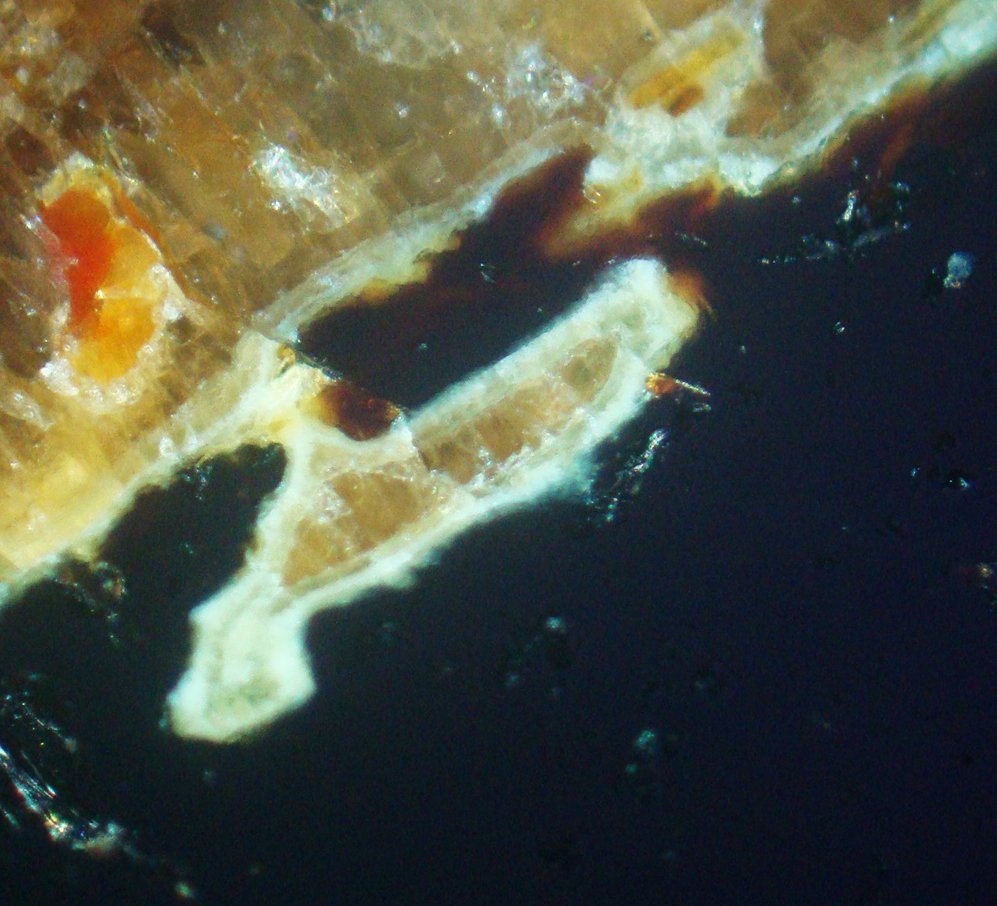
Color: Black, brown, blue. If it has a high U content, it is metamict and exhibits a yellow to brown outer crust.
Habit: Generally granular; it can be prismatic with square basal sections. Tabular, elongated, or massive.
Cleavage: {010} poor.
Tenacity: Brittle.
Twinning: No.
Fracture: Conchoidal to subconchoidal.
Mohs Hardness: 5 – 6
Parting: No.
Streak: Dark reddish-brown to black. Gray when altered.
Lustre: Vitreous, resinous, submetallic
Diaphaneity: Transparent. Macroscopically it appears opaque.
Density (g/cm³): 5 – 5.69
2. Geology and Deposits
Samarskite-(Y) occurs as an accessory mineral in rare-earth-rich granitic pegmatites. It is common, but not abundant.
It may also occur as a detrital mineral.
3. Mineral Associations
It is associated with minerals typical of granitic pegmatites: quartz, feldspars (albite, microcline), micas (muscovite, biotite), tourmaline, topaz, fluorite, zircon, corundum, fluorapatite, magnetite, pyrite, beryl, and garnet (almandine-spessartine).
Pegmatites containing samarskite-(Y) are characterized by a high content of rare-earth elements. Consequently, minerals such as columbite-(Fe), monazite-(Ce), uraninite, members of the Aeschynite Group, members of the Fergusonite Group, and euxenite are found in association with samarskite-(Y).
4. Transmitted Light Microscopy
Refraction indices: n = 2.1 – 2.2
PLANE POLARIZED LIGHT – PPL
Color / Pleochroism: Very dark brownish-orange, without pleochroism.
Relief: Very high.
Cleavage: It is not visible under a microscope.
Habits: Usually granular, very similar to granular rutile. It can be prismatic, tabular or massive.
CROSSED POLARIZED LIGHT – XPL
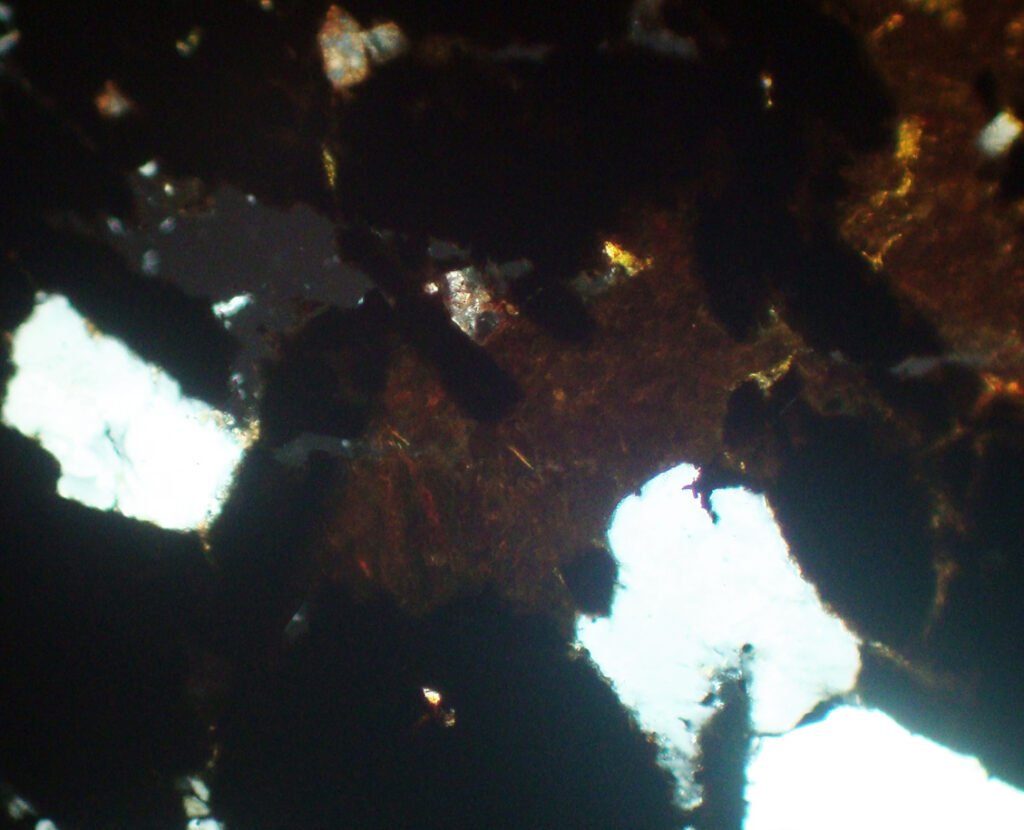
Birefringence and Interference Colors: As it is metamict, it does not present birefringence and behaves like an isotropic mineral.
Extinction: Isotropic.
Elongation sign: Isotropic.
Twins: Isotropic.
Zoning: Isotropic.
CONVERGENT LIGHT
Character: Isotropic.
2V angle: Isotropic.
Alterations: Due to its U content, it becomes metamict and, macroscopically, exhibits a yellow crust.
May be confused with: fergusonite, euxenite, and rutile, which occur in the same paragenesis and are very similar to samarskite-(Y).
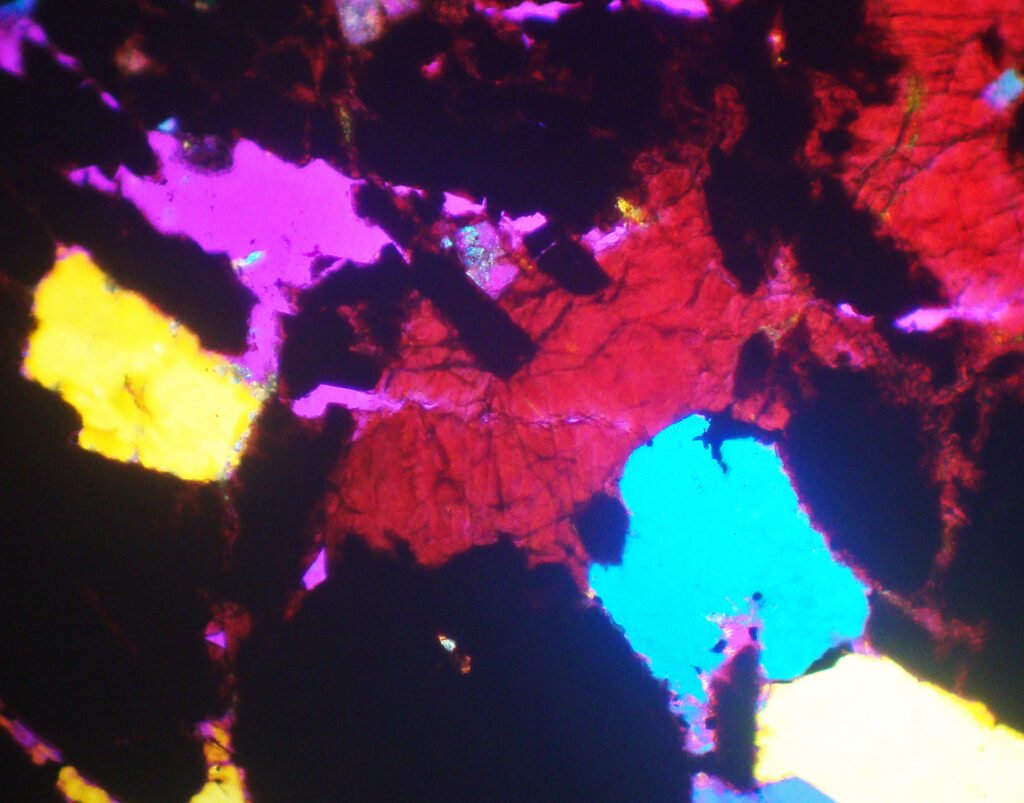
It may be possible to identify samarskite-(Y) once its presence in a thin section is known: cross the nicols and insert the compensator. Isotropic minerals will appear pink, while anisotropic minerals will exhibit a color change as the stage is rotated. Samarskite-(Y), being isotropic, will display a vivid, luminous pink color -corresponding to a retardation of ~530–560 nm (as provided by the compensator) on the Michel-Lévy interference color chart – without changing color upon rotation of the stage. The only other isotropic mineral that might be present is fluorite, which exhibits different characteristics under crossed nicols.