SCHEELITE
Scheelite – Ca(WO4) – is a restricted occurrence tungstate. It is, after wolframite, the second most important ore of tungsten, a strategic metal. Well-formed crystals are rare and fetch high prices among collectors. When devoid of inclusions, it can be used as a gem. Scheelite can be synthesized in laboratory (Czochralski process) and has been used as an imitation of diamond, for example.
It is classified in the Powellite-Scheelite Series and is isostructural with powellite. May contain Mo, Pr and Nd. Twins are common, of interpenetration or contact, by planes {110} and {001}. Epitaxy on wolframite may occur. There is a variety with Cu and another variety with Mo.
Macroscopically, scheelite can be confused with many other colorless, white, and light-colored transparent minerals. That’s why its fluorescence is so important: scheelite exhibits cathodoluminescence and intense fluorescence under short-wave and X-ray ultraviolet light, with light blue to bluish-white colors. When with Mo, the fluorescence is white to yellow, making it similar to the fluorescence of powellite (be careful!). When with Fe, the fluorescence is absent. It sometimes shows red fluorescence under longwave ultraviolet light, but this is rare.
1. Characteristics
Crystal system: Tetragonal bipiramidal
Color: Colorless, white, gray, brown, pale yellow, yellow-orange, pale orange, red, green, can be zoned.
Habit: Massive, columnar, granular. Bipyramidal (pseudo-octahedral) crystals up to 32 cm in diameter.
Cleavage: 101} distinct, {112} interrupted, {001} poor.
Striationscan occur on multiple faces.
Tenacity: Brittle.
Twinning: See above.
Fracture: Subconchoidal, irregular.
Mohs Hardness: 4.5 – 5
Parting: No.
Streak: White.
Lustre: Vitreous, adamantine.
Diaphaneity: Transparent.
Density (g/cm³): 5.9 – 6.1 (very high!)
2. Geology and Deposits
Scheelite is formed at temperatures of 200-500ºC, at pressures between 200 and 2,500 bars. It is typical as a primary mineral in contact metamorphic rocks (scarns or tactites) and in metasomatic rocks such as gumberites. It also occurs in greisen and in high temperature hydrothermal veins with Sn and Au.
Less commonly it occurs in granitic pegmatites and in mid-temperature hydrothermal veins, such as in gold-quartz-carbonate mesothermal veins, where it can be the gangue mineral.
Occasionally occurs in alluvial deposits.
3. Mineral Associations
In greisens it occurs with quartz, muscovite, cassiterite, stannite, wolframite (ferberite), topaz, fluorite, apatite and tourmaline.
In skarns (tactites) it is associated with carbonates (calcite, dolomite, siderite), garnets (grossular, andradite), diopside, vesuvianite, tremolite and sulfides (molybdenite, pyrite, chalcopyrite, pyrrhotite, arsenopyrite).
In pegmatites and veins it occurs with quartz, feldspar (albite, microcline), beryl (including var. aquamarine), apatite, fluorite, muscovite, chlorite (clinochlor), tourmaline, bismuth, bismuthhinite, molybdenite, etc.
4. Transmitted Light Microscopy
Refraction indices: nω: 1.918 – 1.921 nε: 1.935 – 1.938
PLANE POLARIZED LIGHT – PPL
Color / Pleochroism: Colorless to gray-brown.
Relief: Very high
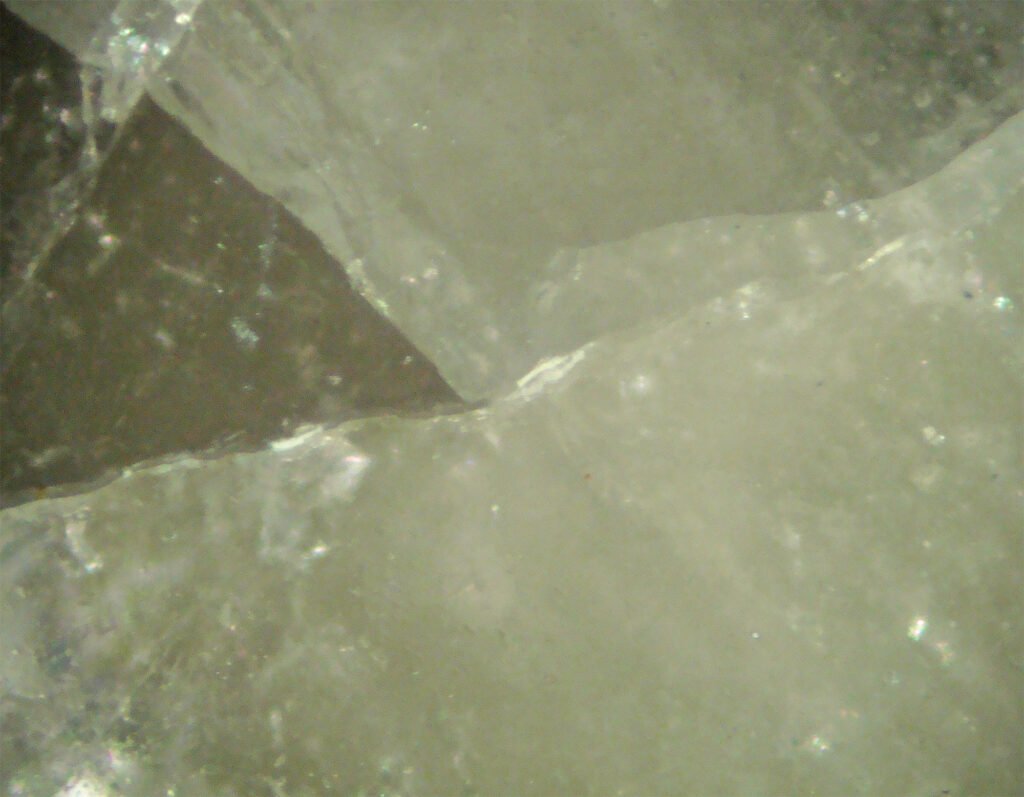
Cleavage: One distinct cleavage and two poor ones (diagnostic against powellite!)
Habits: Massive, granular, columnar. Crystals are rare, typically bipyramidal, pseudo-octahedral.
CROSSED POLARIZED LIGHT – XPL
Birefringence and Interference Colors: Maximum birefringence of 0.017, quite low, corresponding to interference colors between gray, white and at most 1st order orange, it does not reach blue.
May show weak anomalous birefringence.
Extinction: Must be parallel (tetragonal mineral), visible only in euhedral crystals.
Elongation sign: No information available.
Twins: Common, of interpenetration and contact (diagnostic against powellite!).
Zoning: May be zoned.
CONVERGENT LIGHT
Character: U(+)
2V angle: No.
Alterations: scheelite, through hydrothermal processes or surface weathering, form tungsten bearing minerals like tungstite, hydrotungstite or cuprotungstite, wolframite, reinite, stolzite, phyllotungstite, powellite, meymacite, raspite, rankachite and, finally, to calcite.
May be confused with: many other common cleavage-free and low-birefringence minerals. When massive, under the microscope it is identical to quartz and orthoclase, only the relief is high instead of low.
In this context, it is important to emphasize that its intense blue-white fluorescence is still present in the 30 micron thickness of the thin section, but only if the slide is without a coverslip. Coverslip cancels fluorescence.
The same goes for powellite. As a result, potentially scheelite and powellite-bearing ores need to undergo a fluorescence test on the macroscopic sample and on the uncoated thin section (without coverslip).

5. Reflected Light Microscopy
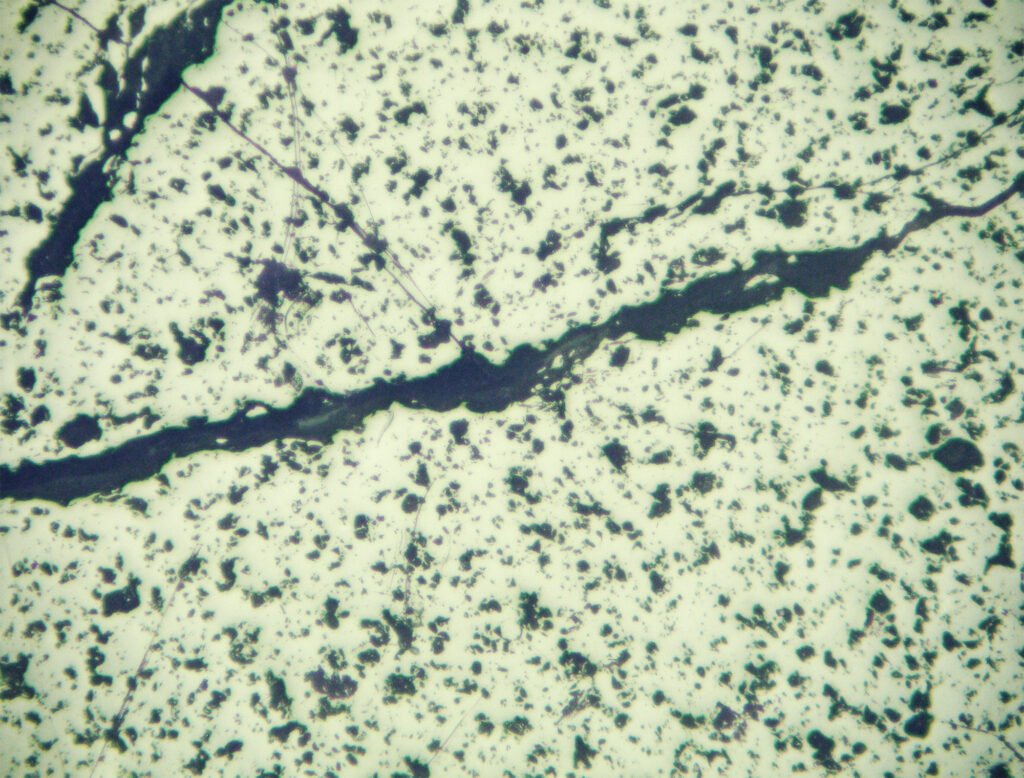
Reflected light microscopy is not the recommended analytical method for the identification of scheelite. However, it is important to make a polished thin section or a polished section to identify the opaque minerals that occur associated with scheelite.
Sample preparation: scheelite acquires a good polish, but sometimes persistent polishing scratches remain during section preparation. It has a large number of fractures. The polishing hardness of scheelite is high, but lower than the hardness of wolframite, cassiterite and pyrite.
PLANE POLARIZED LIGHT – PPL
Reflection color: Gray-white (or medium to dark gray).
Pleochroism: No.
Reflectivity: 9.68 – 10.05%, almost as the gangue minerals.
Bireflectance: Weak.
CROSSED POLARIZED LIGHT – XPL
Isotropy / Anisotropy: It does not show anisotropy.
Internal reflections: Abundant clear, colorless, yellow, pink or brown.
May be confused with: powellite, but powellite has indistinct cleavage (scheelite has distinct {101} cleavage), no twins (scheelite has twins) and powellite fluoresces in yellow tones, while scheelite fluoresces in bluish-white tones.
General Characteristics:
Grain shape: Often occurs in masses composed of large grains. Sometimes it is very inconspicuous. Idiomorphic (euhedral) it can occur in pseudo-octahedral shapes (rhombic and square sections). Lamellar forms may occur.
Cleavage is not visible.
Substitutions 1: scheelite replaces wolframite, a very common feature, it can be partial or complete.
Substitutions 2: scheelite can be replaced by quartz, kaolinite and bismutite. In rare cases it is replaced by wolframite