5. Reflected Light Microscopy
Sample preparation: skutterudite acquires an excellent polish with ease, something different depending on the zones. The hardness of the individual components and zones is so different that the internal structure of the crystals is already visible by polishing. The polishing hardness of skutterudite is greater than the hardness of nickeline, approximately equal to the hardness of safflorite and less than the hardness of pyrite. There are slight variations in hardness between Co-skutterudite, Ni-skutterudite and Fe-skutterudite.
PLANE POLARIZED LIGHT – PPL
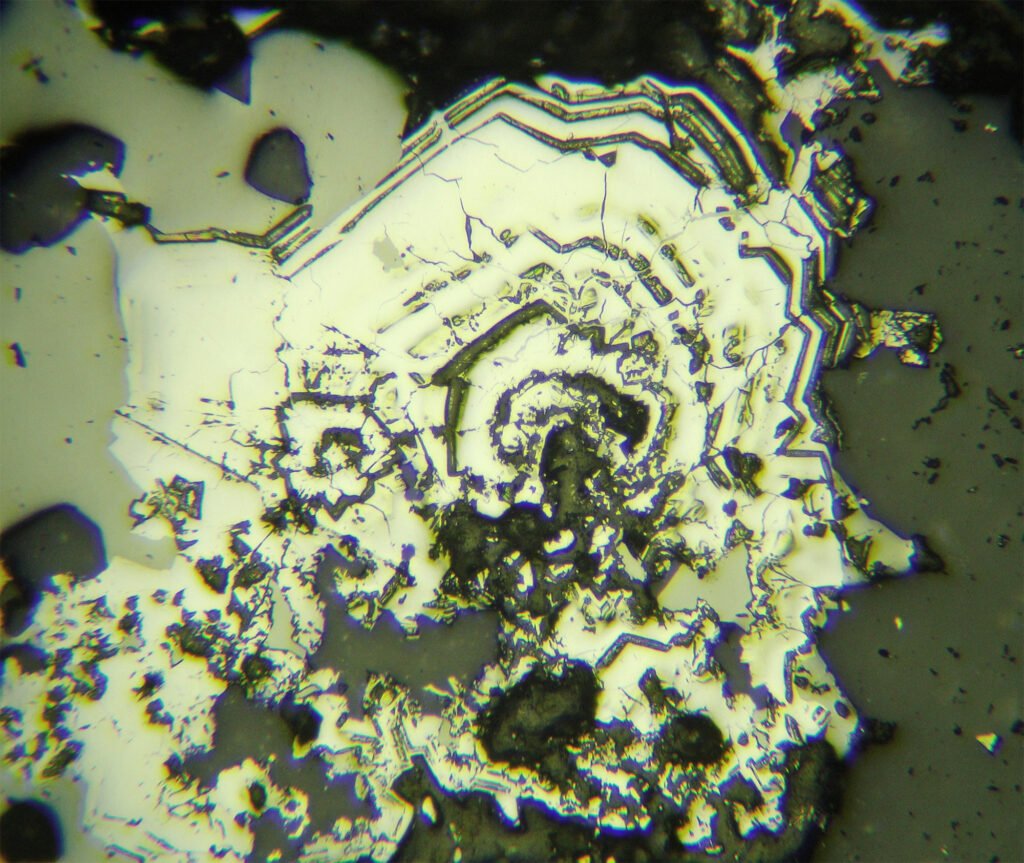
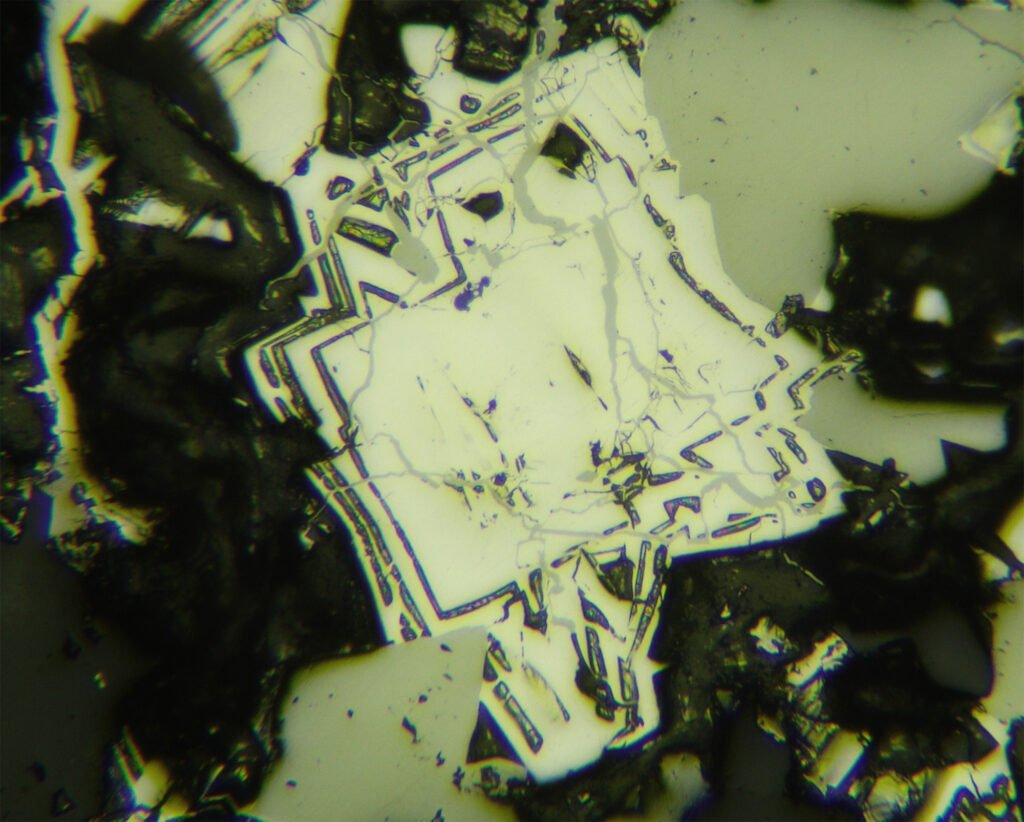
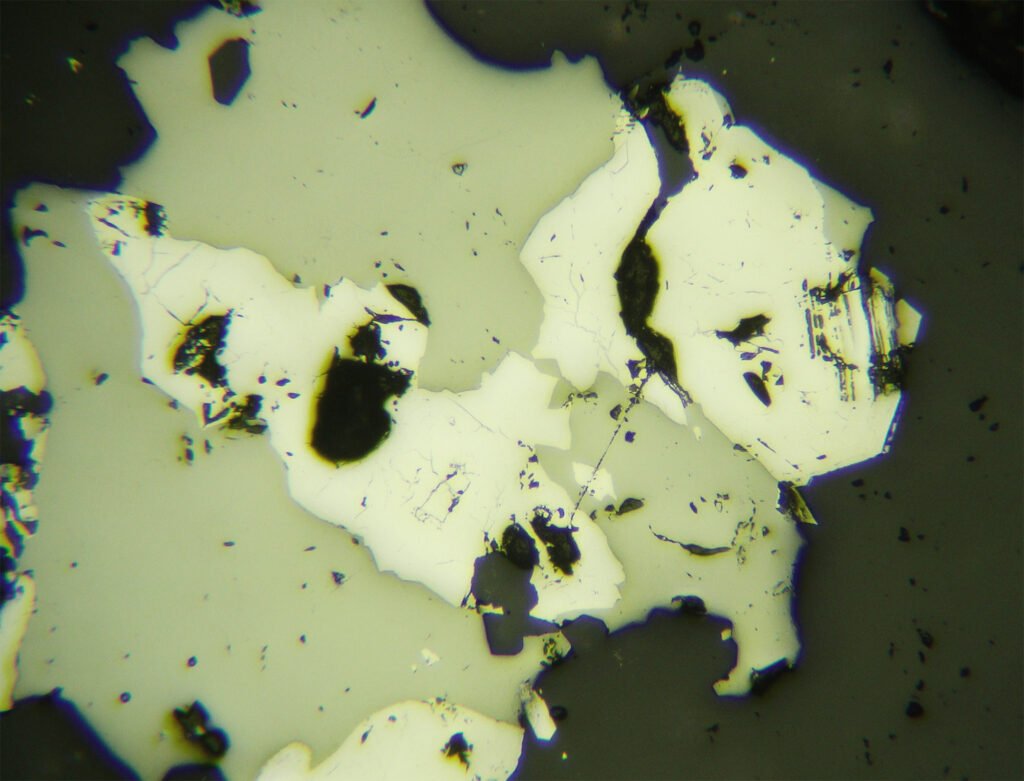
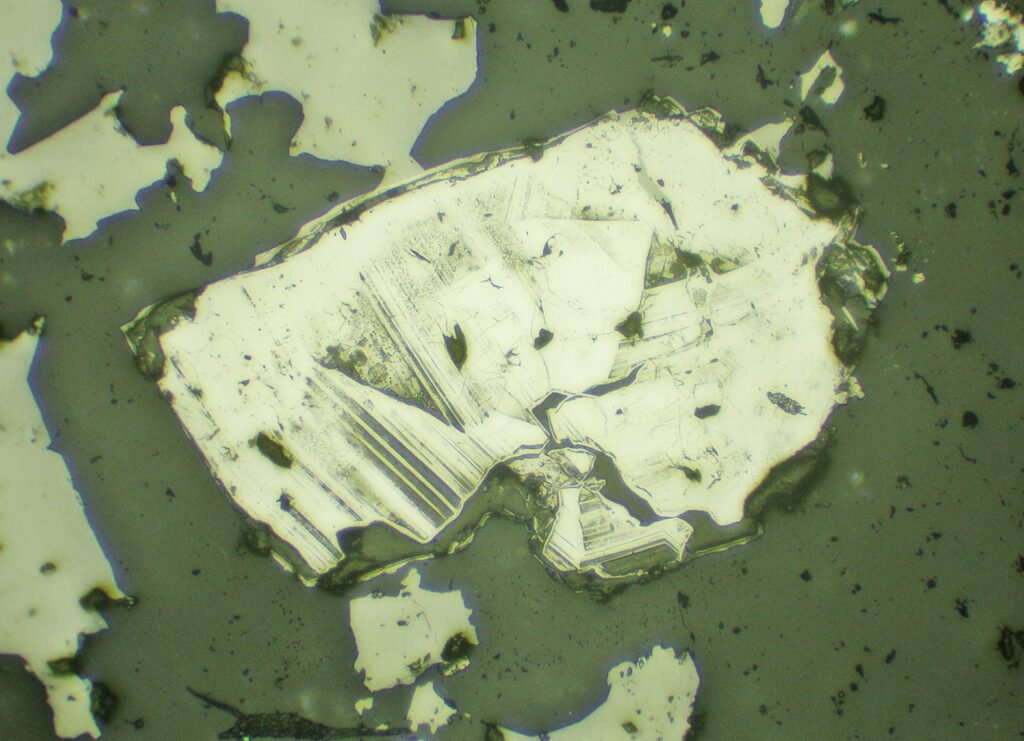
Reflection color: Cream white to cream gray.
Compared with the color of galena, the color of skutterudite is a dull bluish gray.
Compared with the color of pyrite, the color of skutterudite is pure white.
Compared with the color of nickeline, the color of skutterudite is bluish gray.
Compared with the colors of ullmannite and gersdorffite, the color of skutterudite is less yellow.
Compared with the color of maucherite, the color of skutterudite is white.
Compared with the color of cobaltite, the color of skutterudite is white.
Compared with the color of rammelsbergite and safflorite, the color of skutterudite is a little more yellowish.
Compared to the color of native bismuth, the color of skutterudite is whiter.
Compared to the color of native silver, the color of skutterudite is a dull bluish gray.
Pleochroism: No.
Reflectivity: 53,8% (High, like pyrite!)
Bireflectance: No.
CROSSED POLARIZED LIGHT – XPL
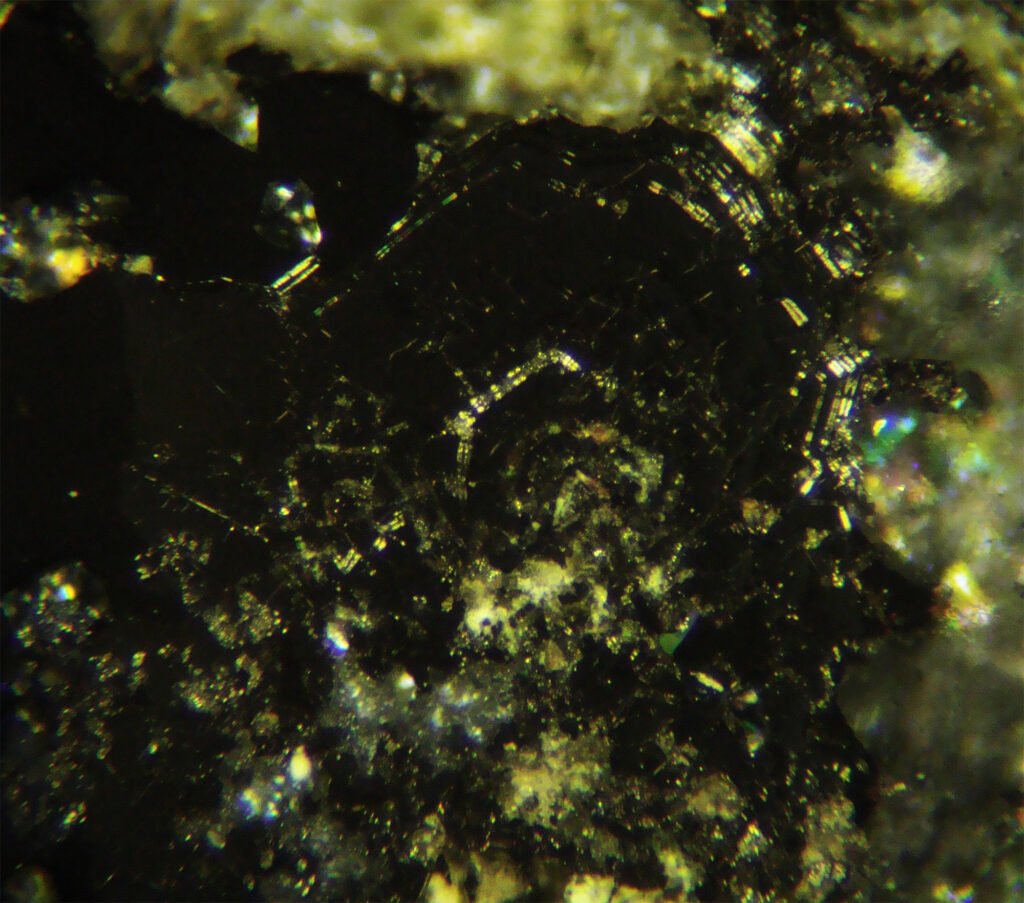
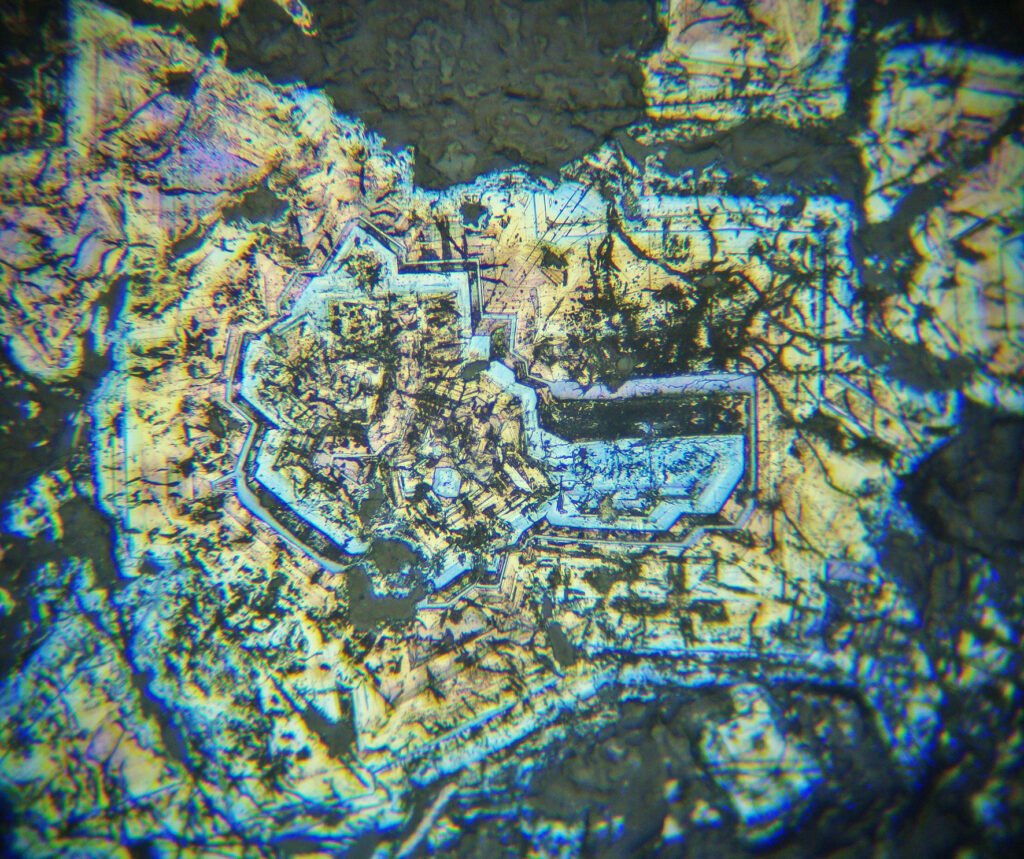
Isotropy / Anisotropy: Isotropic. Sometimes a weak anomalous anisotropy may be visible in heavily zoned crystals.
Internal reflections: No.
May be confused with: many other minerals. Paragenesis is important in its recognition. The typical fortress textures help a lot in their identification.
Cobaltite is harder, less zonar, slightly pink and slightly anisotropic.
Maucherite is pinker, a little softer and has a typical chemical attack.
Ullmannite and gersdorffite are yellower and harder.
Linnaeite and others in the group are softer, less zonal and a little pink.
General Characteristics:
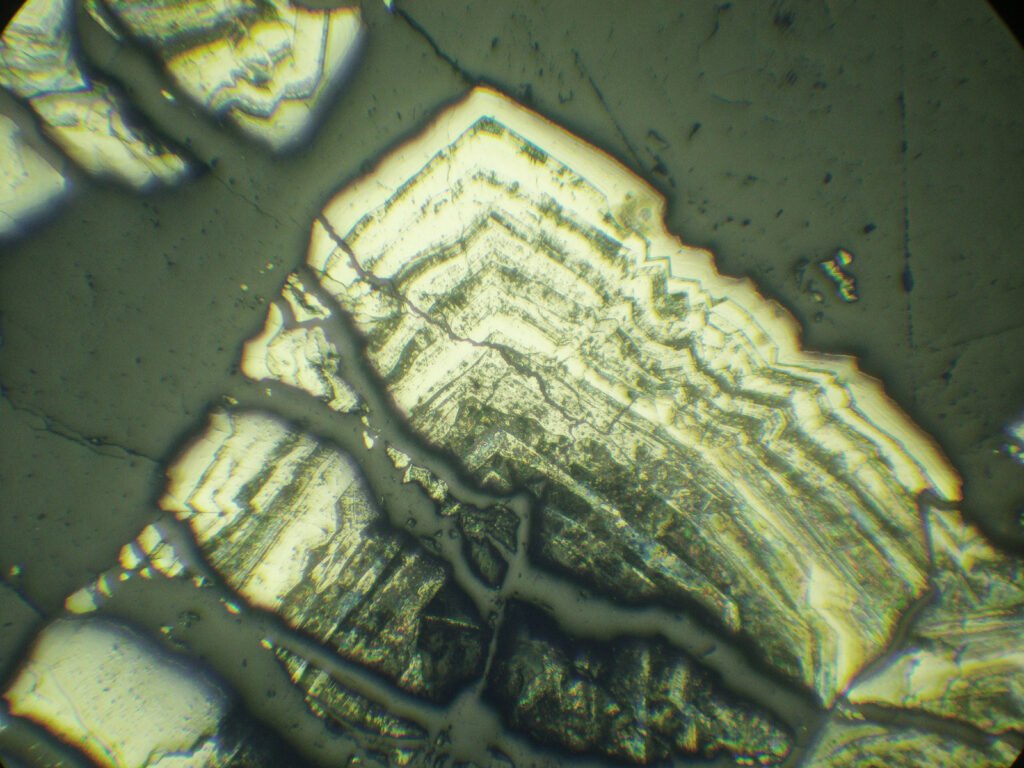
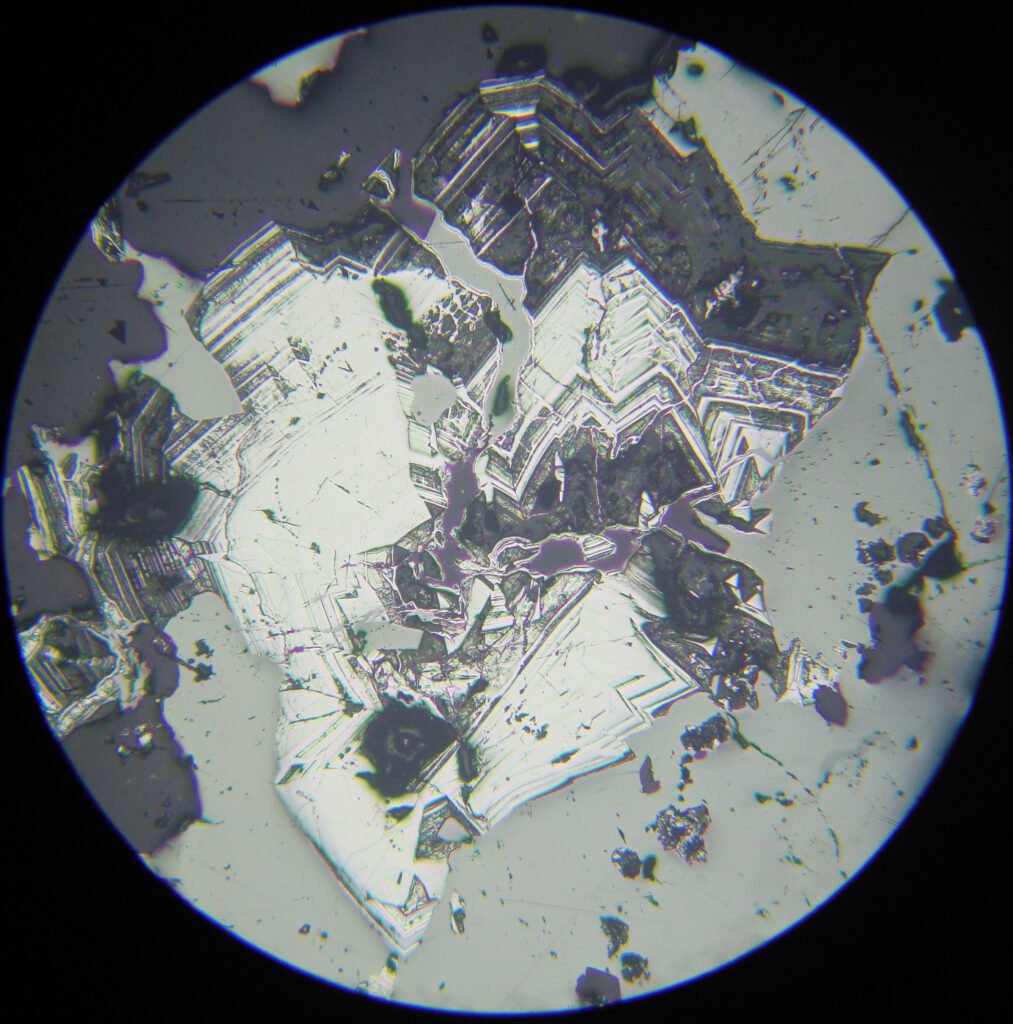
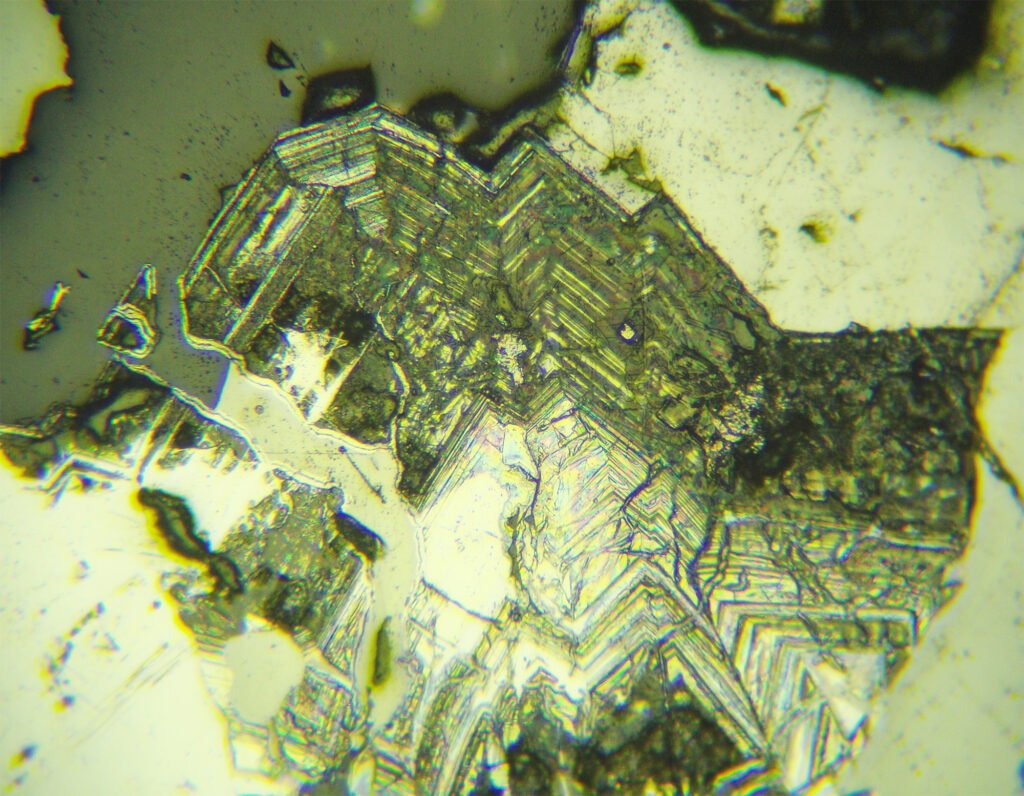
Grain shape of “normal”, “pure” eskutterudite is very often euhedral or subhedral, with single crystals (often octahedral) or space fillings between gangue and cobaltite. The zonation of the crystals shows that the grain shape varied several times during the growth. Frequently, crusts with a zoned structure occur, common are skeletal forms with native silver, native bismuth and acanthite. “Impure” skutterudites (with Co, Ni or Fe) form coarse crystals with a texture of very fine zonation or intergrowths with other members of the series or with rammelsbergite and safflorite. Later generations that replace older generations may be finer grained or even cryptocrystalline. Intergranular contacts are difficult to define, because the crystals originally grew individually on any substrate and then just touched each other, disturbing each other in their growth.
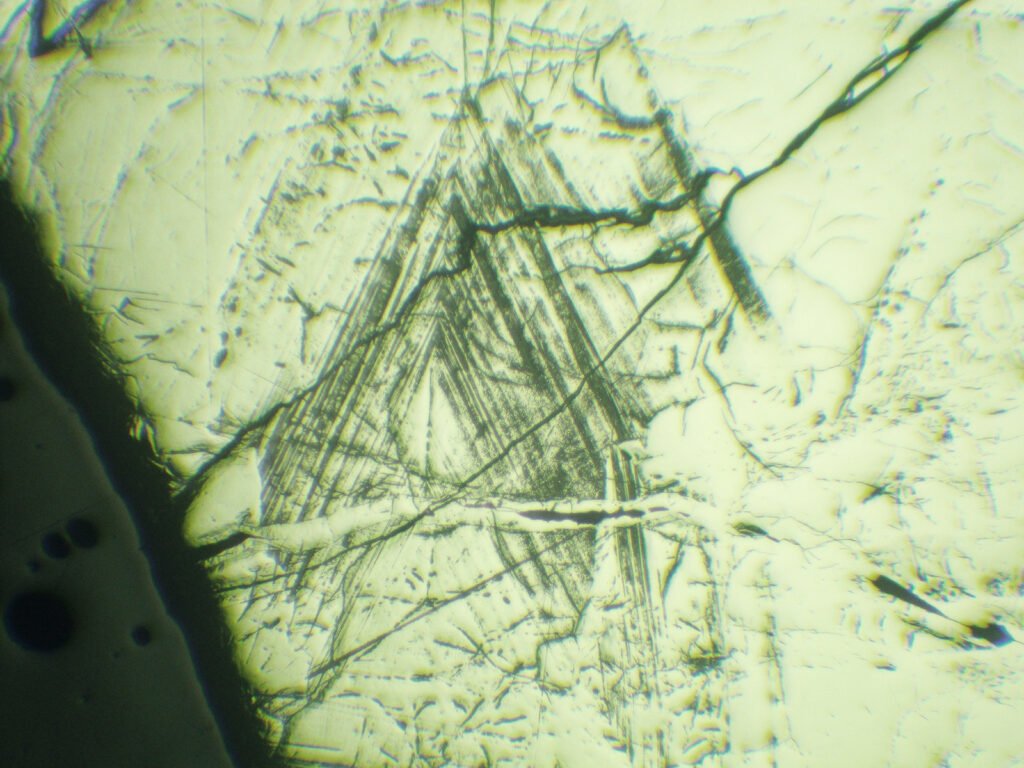
Fortress textures are an extremely diagnostic feature for skutterudite. It is a concentric banding/zoning that presents defined angles between the portions that make up an individual band (or zone), a well-defined zigzag. In these zones or bands the most nickel-rich portions are usually the inner ones. Practically pure zones of cobalt (+As) or nickel (+As) can occur. Fortress textures may have their origin from high temperature mixing processes of a complex crystal. This unmixing process was apparently accompanied by changes in volume, which explain other structures: deep fractures; sometimes the whole crystal burst. In the polished section, cracks in the form of channels or meanders are observed, whose edges are covered by neoformed safflorite, sometimes the fractures are completely filled by safflorite. In larger cracks, safflorite aggregates form in the shape of tumors. From the cracks, the replacement processes begin. As the areas that are chemically more sensitive to substitution are the innermost areas, it appears that the substitution takes place from the inside out.
Zonation: “pure” skutterudite is practically not zonar or zonation has been lost due to recrystallization. Arsenic-deficient skutterudites are always very zonal. Other skutterudites have complex structures, with up to five components with different optical characteristics that may be interwoven in complex ways. This produces different colors and reflectivities and a range of different hardnesses. In this way, the quality of the polish can reveal zoning.
Cleavage (100) may be visible, but in Co-skutterudite it is rare. There is a similar structure very evident, but it is not about cleavage, it is a structure generated by zonation.
Twins do not occur.
Unmixings of the classical type are rare.
Substitutions 1: substitutions are very common. Skutterudite can be replaced by native bismuth, bismuthinite, rammelsbergite, pararammelsbergite, löllingite, safflorite, nickel, native silver, acanthite, proustite, pyrargyrite, linnaeite, stannite, chalcopyrite and native arsenic. The replacement of individual zones (or bands) can proceed at different speeds; sometimes the zone is removed without filling the space, crystallizing there later a younger calcite, for example.
Substitutions 2: skutterudite can replace silver, forming pseudomorphoses. It also replaces pyrite.
Intergrowths occur with native bismuth and nickeline.
Fine veins may occur in skutterudite, filled with native arsenic, native bismuth or löllingite.
Inclusions 1: skutterudite may contain inclusions of native gold, native silver, native bismuth, nickel, valleriite, pyrrhotite, pentlandite, arsenopyrite, cobaltite, and löllingite.
Inclusions 2: skutterudite occurs as inclusions in cobaltite, pitchblende, arsenopyrite and gersdorffite.