5. Reflected Light Microscopy
Sample preparation: the polishing hardness of sphalerite is superior to those of chalcopyrite, galena, tetrahedrite, stannite and fluorite, but well below those of magnetite, ilmenite and pyrrhotite. The quality of the polish depends on the grain size. Fine grain aggregates acquire a good quality polish, while large grains, due to cleavage, show holes and grooves. In this way, polishing sphalerite is difficult. The hardness of individual grains varies with grain orientation
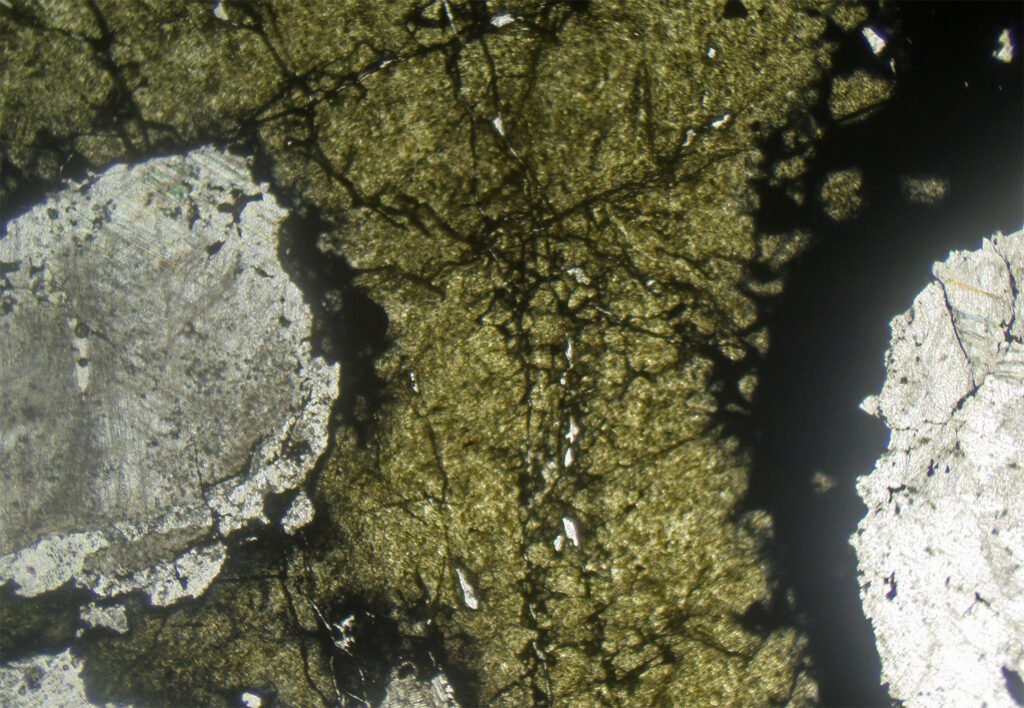
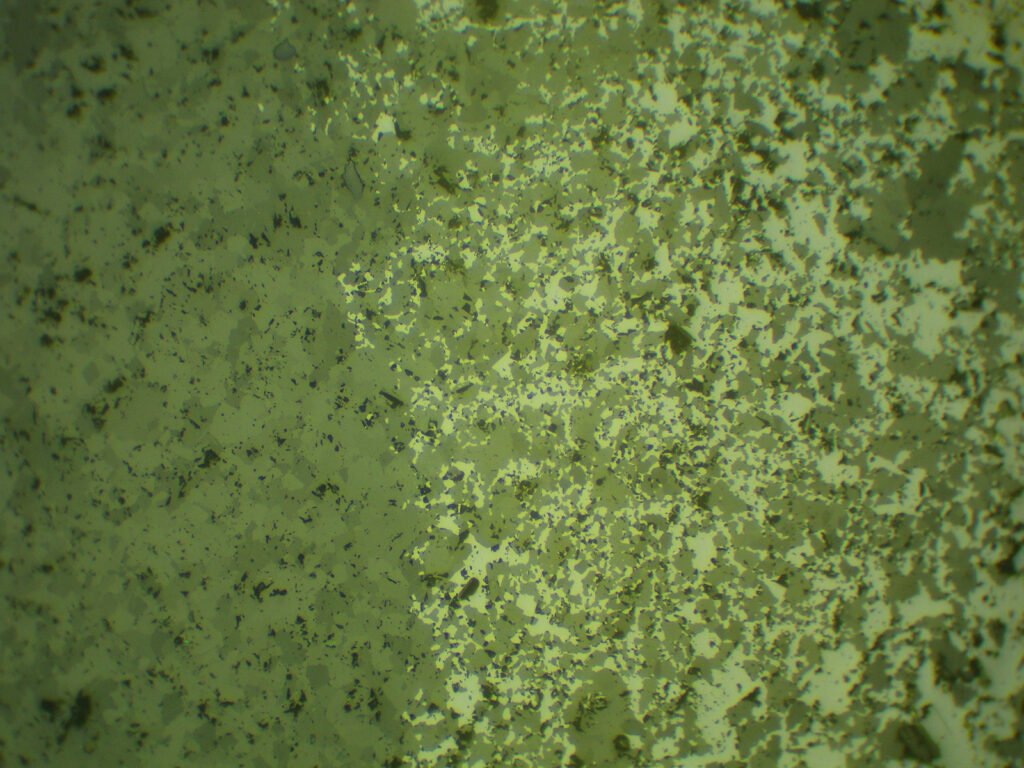
PLANE POLARIZED LIGHT – PPL
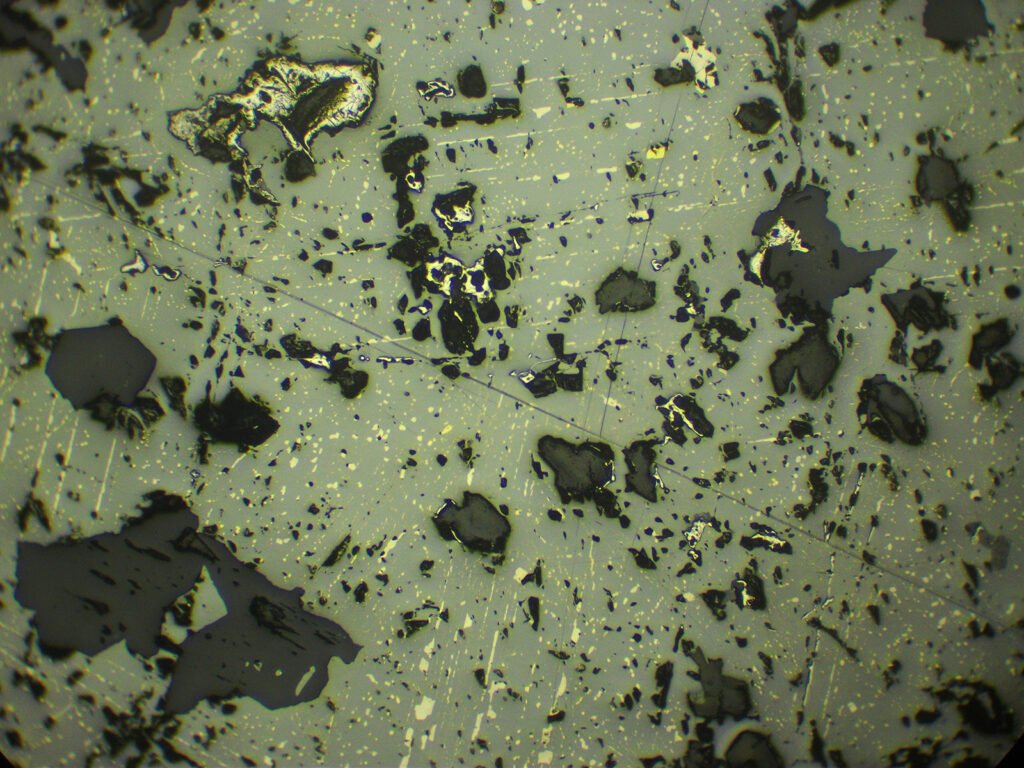
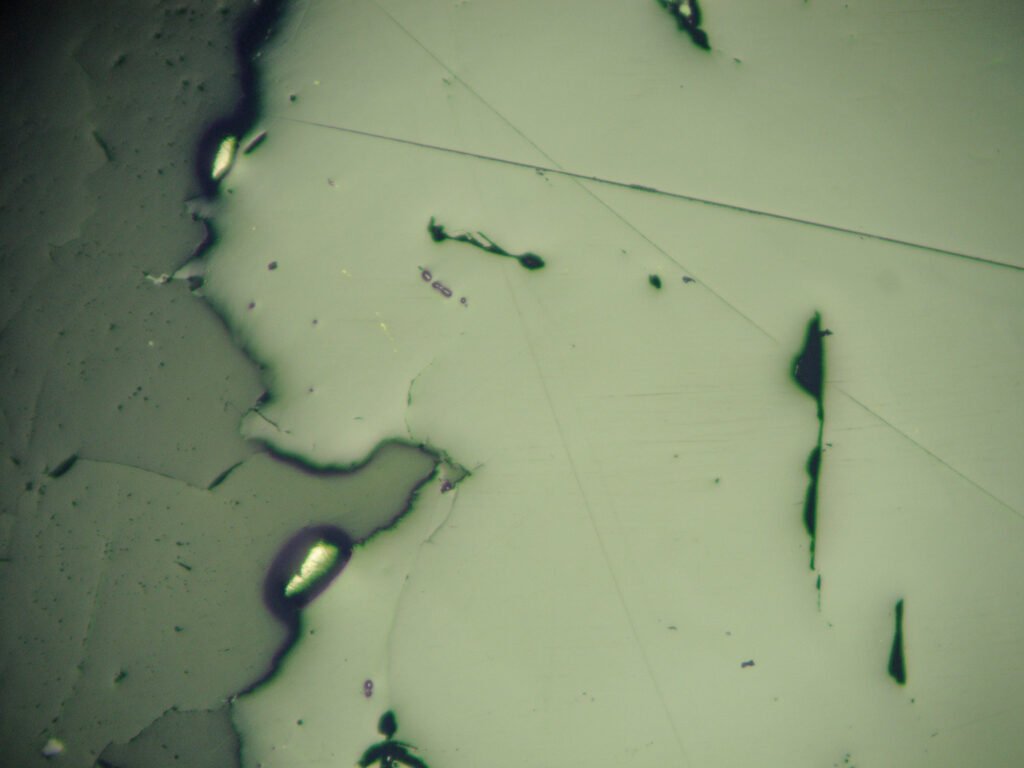
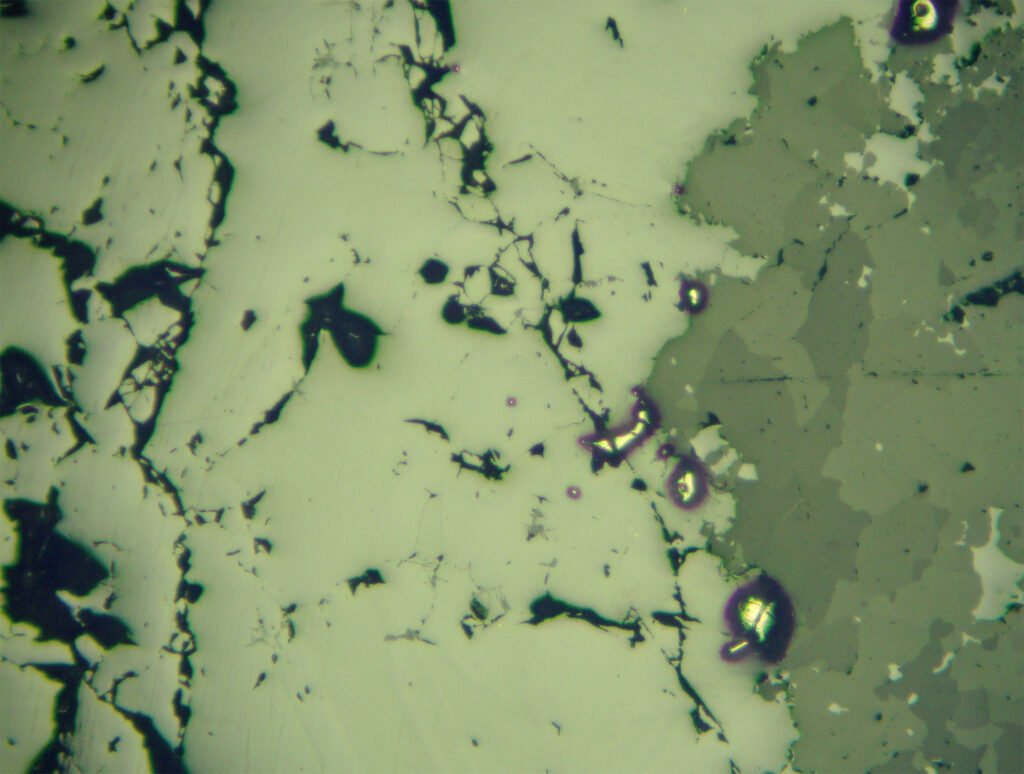
Reflection color: Medium light gray with a slight shade of blue, sometimes a slight shade of brown.
It is quite similar to the colors of silicates, magnetite and ilmenite.
Compared with the color of magnetite, the color of sphalerite is a little darker.
Pleochroism: No.
Reflectivity: Very low (16.4%), the lowest of sulfides, only slightly higher than the reflectivity of rock-forming silicates.
It increases with increasing Fe content.
Bireflectance: No.
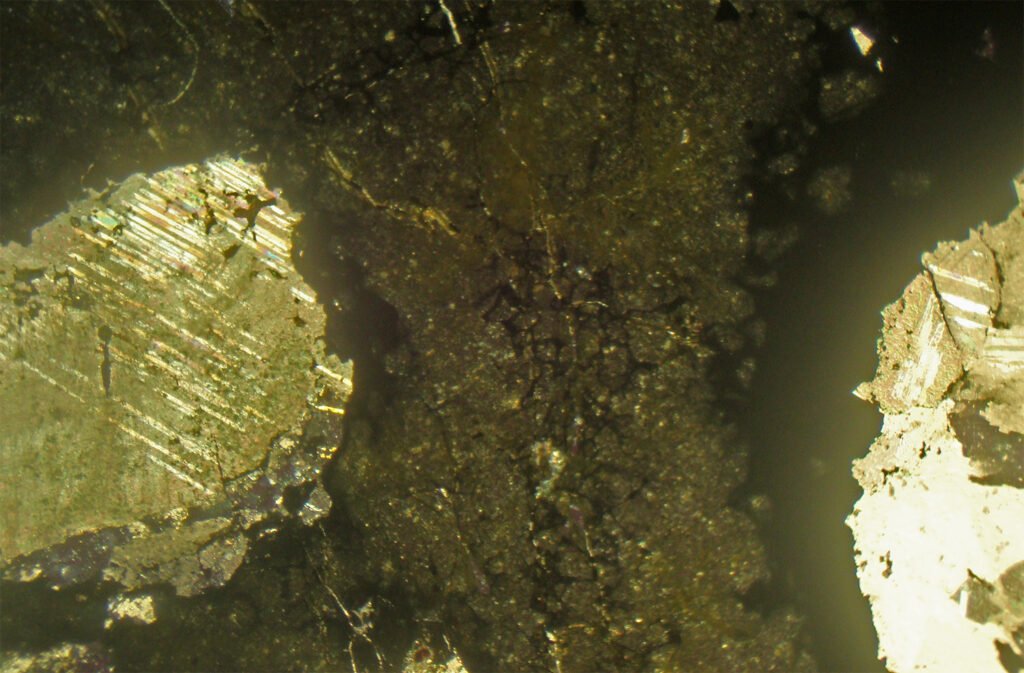
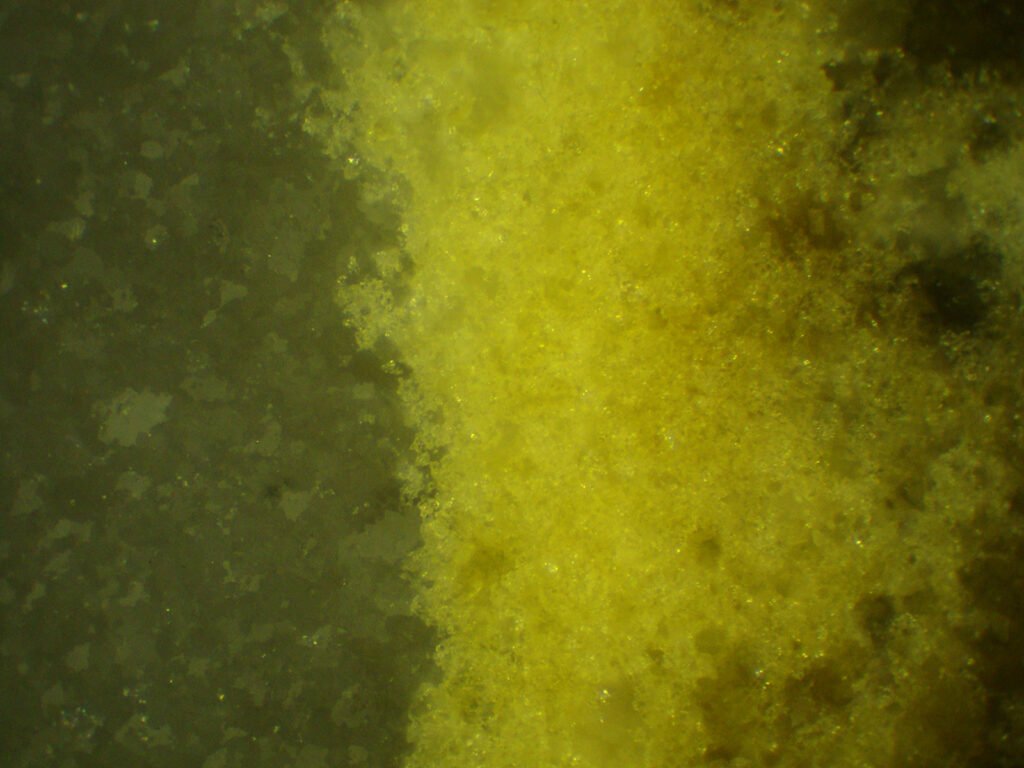
CROSSED POLARIZED LIGHT – XPL
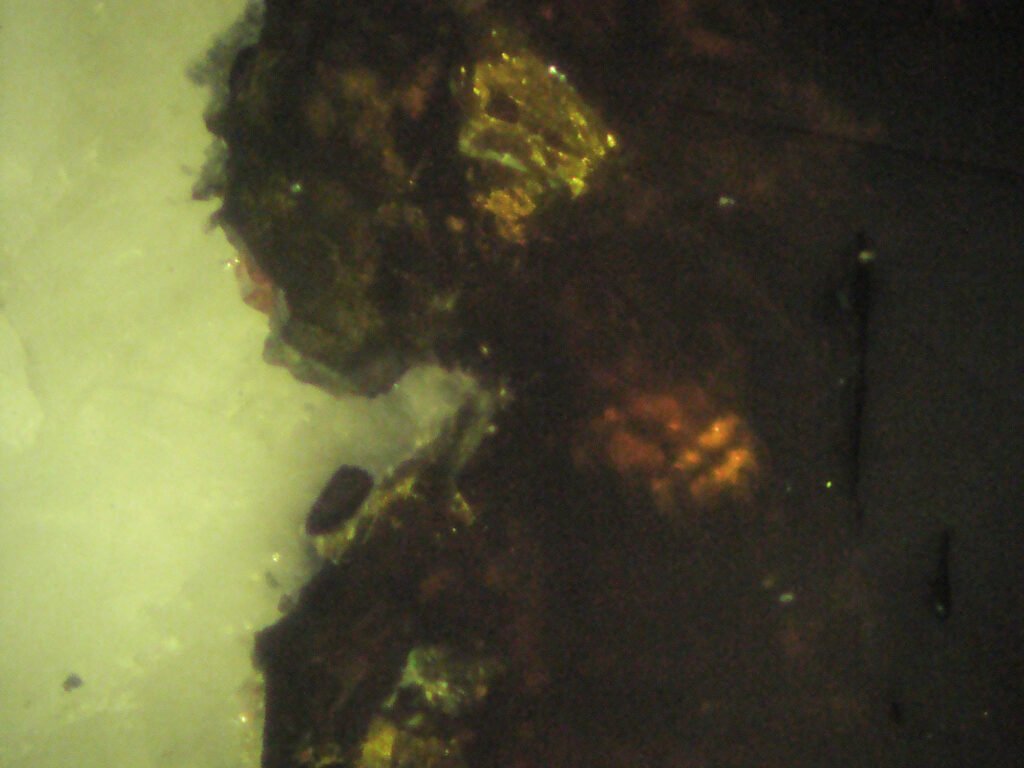
Isotropy / Anisotropy: Isotropic with well-crossed nicols. Internal reflections can get in the way of this observation, as they arise even in PPL.
It may show anomalous anisotropy between light gray and darker gray due to stresses or high Fe contents.
Strong pseudo-anisotropy can appear in sphalerites formed by very fine, submicroscopic grains, with stannite unmixings.
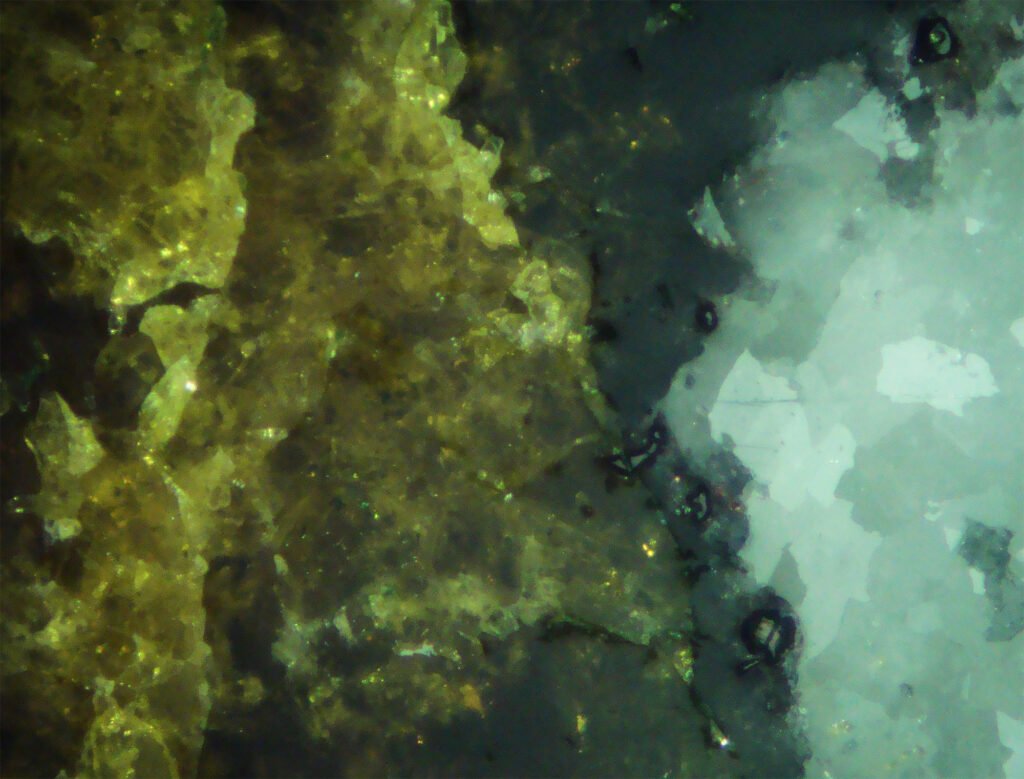
Internal reflections: Always with abundant internal reflections, whose color depends on the chemical composition: if the sphalerite contains little Fe, the internal reflections are colorless to white. With increasing Fe content the reflections progressively change to yellow, caramel, honey, red, dark brown to black.
Green internal reflections can occur but are rare; sphalerites that are macroscopically green have white internal reflections. If the polished section is of poor quality there is an increase in the amount of internal reflections.
May be confused with: sphalerite is easily overlooked or confused with other minerals if the observer is not attentive or inexperienced. It is a common mineral, with low reflectivity, isotropic, with many internal reflections, medium hardness and associated with other sulfides, with chalcopyrite exsolutions and vice versa. Precisely because it is a common mineral, it can be confused with other similar minerals.
Magnetite is often associated and in PPL is very similar: just a little lighter and brownish in color. In CPL, however, does not have internal reflections. If sphalerite is very rich in iron, its internal reflections are difficult to see and it is easy to mistake this kind of sphalerite for magnetite.
Cassiterite and rutile have similar reflective power, but are anisotropic and harder.
Titanite is similar in PPL, but in CPL shows strong anisotropy.
Alabandite has a darker color, greater reflectivity, and green reflections, but is much rarer.
Greenockite is rare, more bluish in color, but similar internal reflections.
Wolframite is anisotropic, has cleavage.
Perovskite has high hardness and presents twins, paragenesis of alkaline rocks and carbonatites.
Wurtzite is impossible to distinguish from sphalerite under a microscope.
General Characteristics:
Grain shape is very variable. In homogeneous aggregates the grains are rounded to polygonal with highly variable contacts (flat to intergrown). Recrystallized aggregates may exhibit grains of a few microns, some hydrothermal veins exhibit decimeter crystals. Some highly requested occurrences (high pressure) exhibit crumpled grains, forming subparallel grain aggregates. Cataclastic textures are frequent. In SEDEX (“sedimentary exhalative”) and VMS (“volcanogenic massive sulphides”) ores, sphalerite usually forms bands made up of extremely small grains, below microscopic visibility, usually accompanied by galena, marcasite, pyrite and wurtzite.
Cleavage {011} is only observable in aggregates of large grains, even those with very good polish. In fine-grained aggregates the cleavage is not visible.
Twins parallel to (111) and (211) can almost always be found in the form of abundant polysynthetic lamellae in various directions. Often, however, they are not visible; may become visible due to the relief generated during polishing or by chemical etching. Twin lamellae are of very variable widths, from the limit of visibility to 1 cm in very coarse-grained aggregates. The lamellae often do not go through the entire grain, but end up against a set of lamellae with another orientation and continue after this, slightly offset. Very small grains usually do not show twins. Cleavage generates a discrete oblique banding on the twin lamellae: this banding has the same orientation on even or odd lamellae.
Zonation is often visible, even to the unaided eye.
Deformations are very frequent with the formation of lamellae of sliding and translation twins. The deformations, flexures and other signs of deformation thus formed are much better visible after chemical attack. The cataclased portions are very susceptible to substitution as other minerals enter through the fractures.
Cataclasis is frequent, as many of the associated minerals are softer (galena, chalcopyrite) and sphalerite is consequently cataclased. Sometimes it is possible to follow from areas with intact grains to areas with very cataclased grains. Grains with these features readily undergo recrystallization, resulting in a very fine-grained aggregate that is difficult to identify as sphalerite.
Pseudomorphoses of sphalerite on galena, tetrahedrite, pyrite, marcasite and calcite can occur. The inversion of hexagonal ZnS (wurtzite) to cubic ZnS (sphalerite), which is the stable form, can preserve the shapes and structures of wurtzite. As the deposition of sphalerite and wurtzite can occur in thin alternating bands, it is possible to find these pseudomorphoses of wurtzite mixed with the typical textures of sphalerite. Rhythmic depositions are very common and very well developed in the sphalerites of some deposits, forming the “Schalenblende”. These Schalenblende consist mainly of sphalerite, accompanied by wurtzite, marcasite, pyrite and galena.
Oriented intergrowth can occur with many minerals, it is often difficult to verify whether it is an actual intergrowth, a replacement texture or a cataclase product with subsequent introduction of new minerals. Minerals that form oriented intergrowths with sphalerite are quartz, pyrite, chalcopyrite, covellite, enargite, millerite, bournonite, stannite, tetrahedrite-tennantite, cubanite, pyrrhotite and shandite.
Unmixing bodies can be of various types and it is sometimes difficult to differentiate oriented intergrowths from unmixing. Sphalerites containing zones with and without unmixings may occur; in these cases, the optical properties of the two types of portions can be quite different from each other.
Unmixings of chalcopyrite occur very frequently and can show various forms. They can be (i) extremely small oval bodies, up to the limit of visibility under the microscope, (ii) tabular or elongated bodies arranged parallel to crystallographic directions, especially parallel to twin boundaries, (iii) round droplets of varying sizes that form “clouds”. ” localized or (iv) irregular lumps that are especially concentrated at the grain boundaries. An international term for these chalcopyrite bodies in sphalerite is “chalkopyrite disease”.
Unmixings of pyrrhotite and cubanite, with or without chalcopyrite unmixings, can be found in some occurrences, developing the same forms as the chalcopyrite demixes. They may be aligned along the sphalerite cleavage directions.
Unmixings of stannite have been found in some sphalerites. Very well developed concentric banded aggregates may occur.
Unmixings of tetrahedrite may occur.
Unmixings of sphalerite, on the other hand, occur in stannite, bornite, chalcopyrite (forming “starlets”), cubanite (forming “starlets”), perhaps in tetrahedrite-tennantite and some other minerals.
Inclusions 1: Inclusions in sphalerite can be bravoite and cattierite.
Inclusions 2: inclusions of sphalerite occur in bornite, chalcopyrite, tetrahedrite, stannite, pyrite, pyrrhotite and cubanite.
Substitutions 1: substitutions in sphalerite are very common. Sphalerite can be substituted for sulfides (bornite, enargite, chalcopyrite, galena, tetrahedrite-tennantite, chalcocite, pyrite, argentite, covellite, and marcasite), Ag-Sb sulfosalts, native silver, and electrum. These new minerals develop in sphalerite following its cleavage planes and fractures, forming very well-developed replacement textures.
Substitutions 2: substitutions of sphalerite can also occur, when sphalerite replaces other sulfides such as pyrite, pyrrhotite, arsenopyrite and alabandite. It can replace magnetite too.