Tenorite – CuO – is a fairly common oxide, used for centuries as a copper ore (~80% Cu).
It is a mineral without distinct and/or diagnostic macroscopic characteristics, as it is black, usually massive to earthy, and typically has a high impurity content. Crystals are very rare, reaching a maximum of 2 mm, and are known from volcanic-exhalative sublimates of Mount Vesuvius (Italy). Tenorite is also formed by heating malachite.
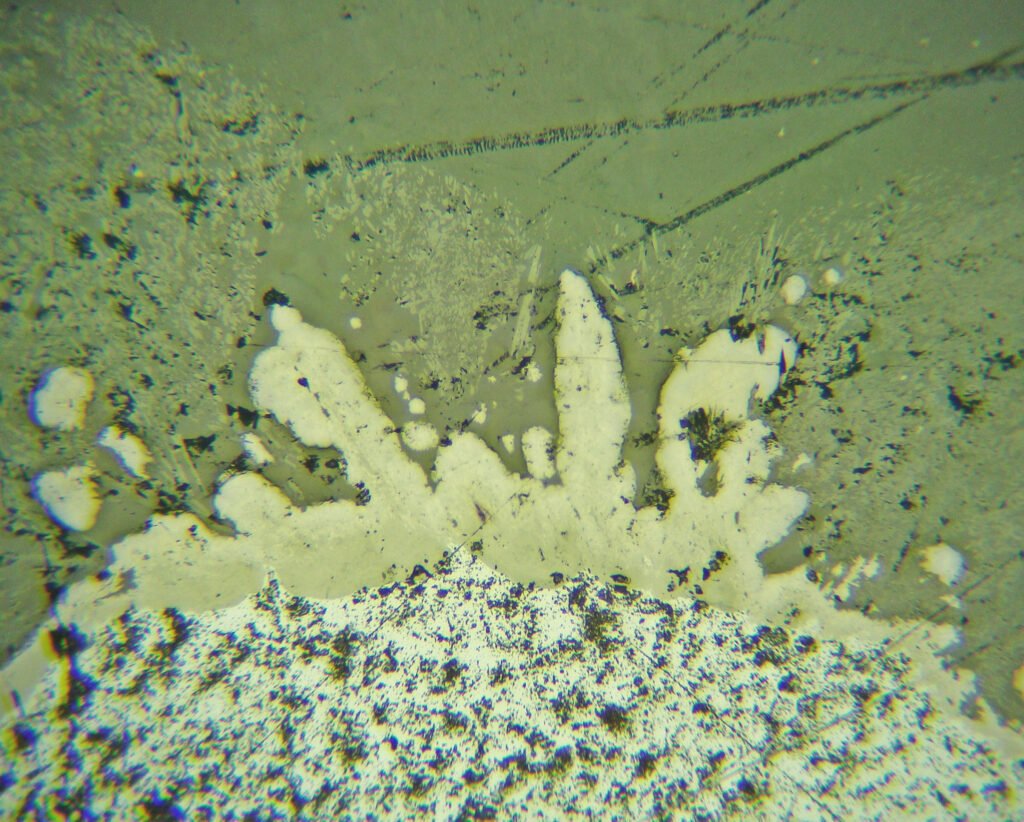
Among its various habits, it can form fibrous tuffs, mammillated and botryoidal aggregates, very fine-grained mosaics, skeletal aggregates, or layers enveloping cuprite cubes, which at the end of the process are completely replaced by tenorite. It can be intergrown with limonite, forming masses of concentric bands; some bands are composed partly of tenorite, and partly of limonite.
Associated delafosite may occur, making differentiation between tenorite and delafosite difficult. Finely dispersed manganese oxides may be present, which greatly diminishes the reflection pleochroism of tenorite. Gel forms are very frequent at all stages of tenorite crystallization.
5. Reflected Light Microscopy
Sample preparation: Tenorite polishes without great difficulty. Its hardness upon polishing is greater than that of chalcocite and less than that of cuprite and goethite. Massive botryoidal aggregates polish well. The hardness upon polishing is somewhat anisotropic, as can be seen in aggregates with lamellar twinning.
PLANE POLARIZED LIGHT – PPL
Reflection color: Yellowish-brown or light grayish-white with a yellow tint.
Pleochroism: Distinct in color, ranging from gray to grayish-white (or light brown to dark brown), and is most easily observed in twin lamellae.
Reflectivity: 19,46 – 29,41%
Bireflectance: Strong.
CROSSED POLARIZED LIGHT – XPL
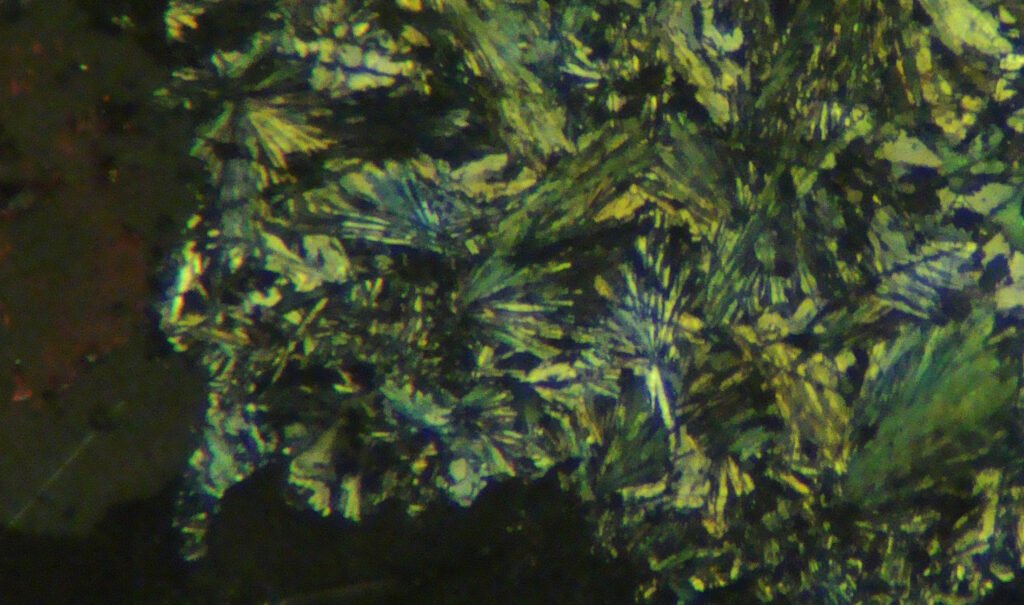
Isotropy / Anisotropy: Strong anisotropy between white and blue (or blue and gray-cream). Clear oblique and incomplete extinction. At the point of maximum darkening, it shows many grooves from old polishing.
Internal reflections: Rare, thin, and red, found only on the finest lamellas.
May be confused with: Other secondary Cu minerals.
Delafossite is similar, but paragenesis helps in distinguishing them.
General Characteristics:
Grain shape is often acicular, in radial or concentric aggregates. It can form fine-grained mosaics or pseudomorphs. Forms derived from gel crystallization are abundant in all stages of crystallinity; they may be constituted by or derived from geltenorite, a variety of tenorite that occurs in gel form.
Twinning may be well developed. They are often lamellar and can be very conspicuous. Some of the lamellae apparently originate during the polishing process, others are primary. They form swallowtail-type indentations.
Substitution of cuprite by tenorite may occur.
Concentric banding formed by alternating layers of tenorite and goethite may occur, as well as bands composed partially of tenorite, partially of goethite. Delafosite probably also occurs in these bands.