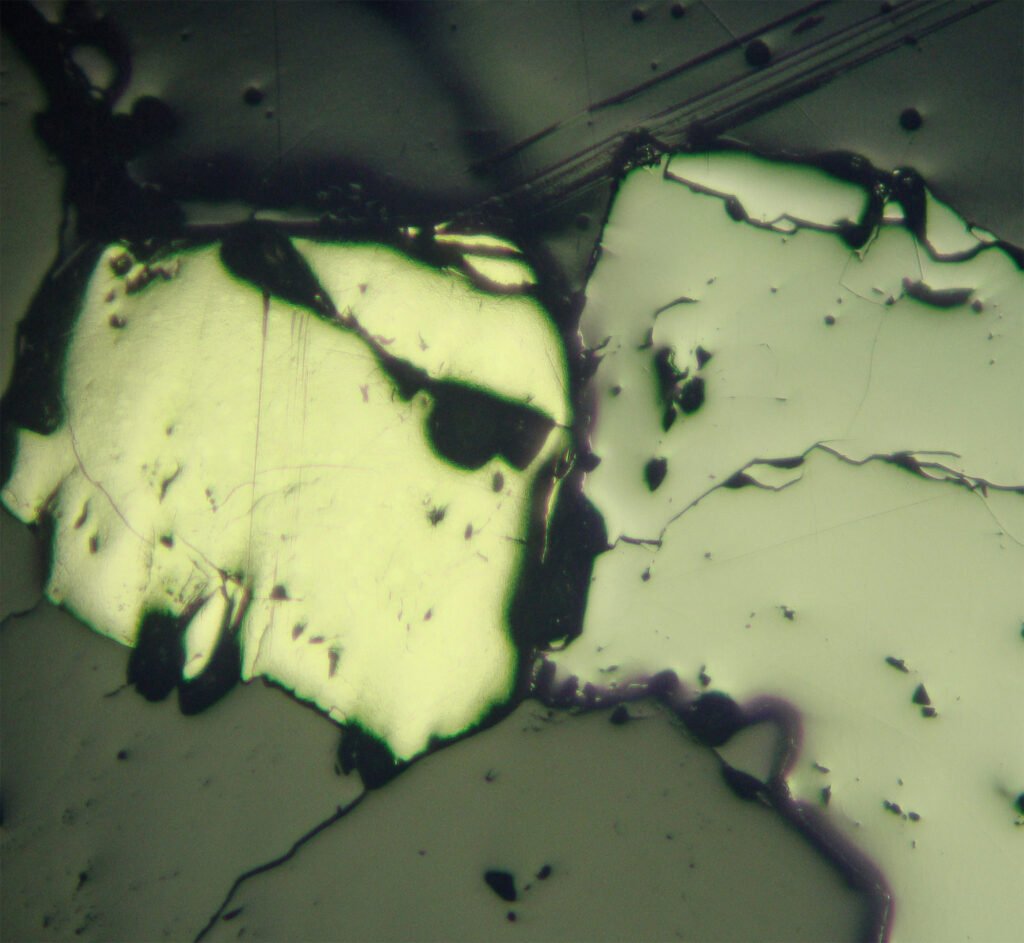
5. Reflected Light Microscopy
Sample preparation: The polishing hardness of “fahlores” is moderate, equivalent to the hardness of chalcopyrite and bournonite. They acquire an excellent polish, which is diagnostic to some extent. Its polishing hardness is higher than those of digenite, galena, pyrargyrite, polybasite, miargyrite and stibnite. It is lower than that of sphalerite and pyrrhotite.
Characteristics of tetrahedrite, with details of tennantite:
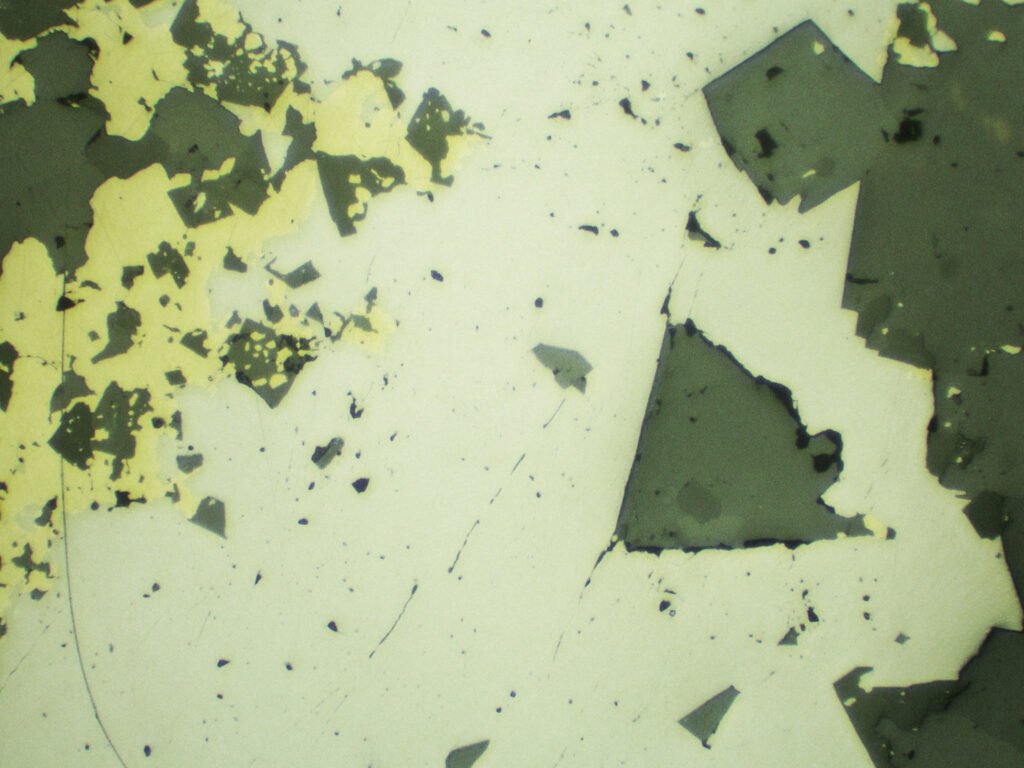
PLANE POLARIZED LIGHT – PPL
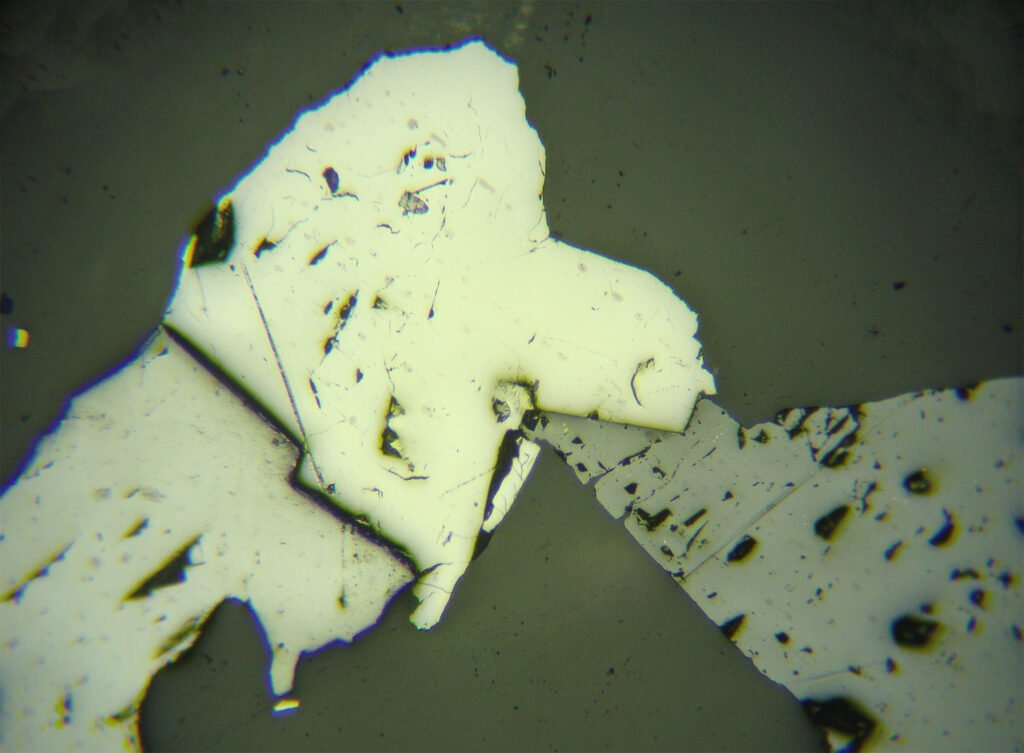
Reflection color: Medium gray with a greenish to olive brown tone.
(Tennantite: greenish tone is stronger. According to other sources, bluish tones are more expressive).
Compared to the color of galena, the color of tetrahedrite is gray-brown.
Compared to the color of bournonite, the color is almost the same.
Compared to the color of stannite, tetrahedrite is a little lighter.
Compared to the color of sphalerite, tetrahedrite is lighter.
Pleochroism: No.
Reflectivity: 32,78%.
With Ag: 31.2%. With Zn: 31.9%. With Hg: 33.1%
Tennantite: 26,9%
With Zn: 28.5%. With Pb: 28.9%. With Bi: 29.6%. With Hg: 30.4%.
Bireflectance: No.
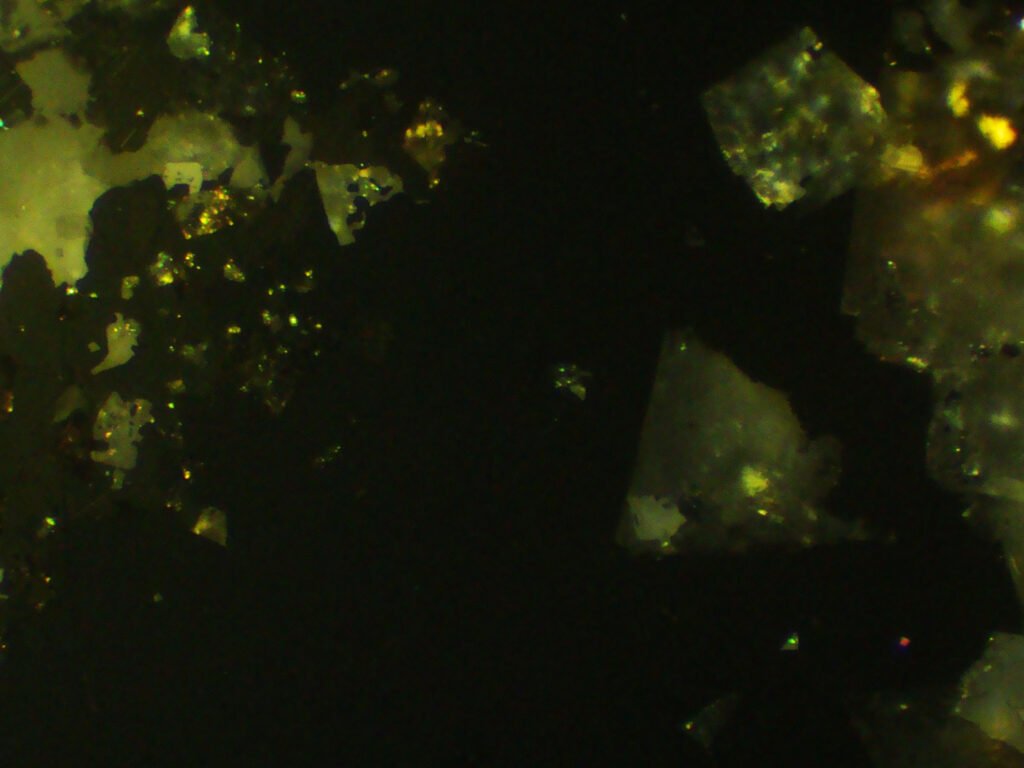
CROSSED POLARIZED LIGHT – XPL
Isotropy / Anisotropy: Isotropic, completely black with well-crossed nicols.
Internal reflections: Red-brown, weak and rare, its amount increases with As content and decreases with high levels of Ag, Hg and Bi. They are visible only with close observation, along fine fractures. Some “fahlors” subjected to high stresses are clearly anisotropic.
(In tennantite, internal reflections are much more common, occurring in various shades of red)
The literature presents conflicting data on the internal reflections of “fahlores”.
May be confused with: the identification of minerals in the Tetrahedrite-Tennantite Group is relatively easy and safe; characteristic is the association with galena, chalcopyrite or bournonite.
Similar minerals (annivite, complex sulfosalts) are anisotropic.
General characteristics:
Grain shape: usually tetrahedrite-tennantite occur in massive, anhedral shapes and it is not possible to recognize the size and shape of the grains and the type of intergranular contacts. After chemical etching, isometric, rounded, poorly interconnected (toothed) grains of varying sizes, often large, are often observed. It can form grains in the form of stars.
Cleavage is not observed, according to some sources (even because tetrahedrite and tennantite do not show cleavage). Other sources report that cleavage is not always visible.
Conchoidal polishing pits appear in low-quality polished sections.
Twins were not observed in massive aggregates, despite being macroscopically common in isolated crystals.
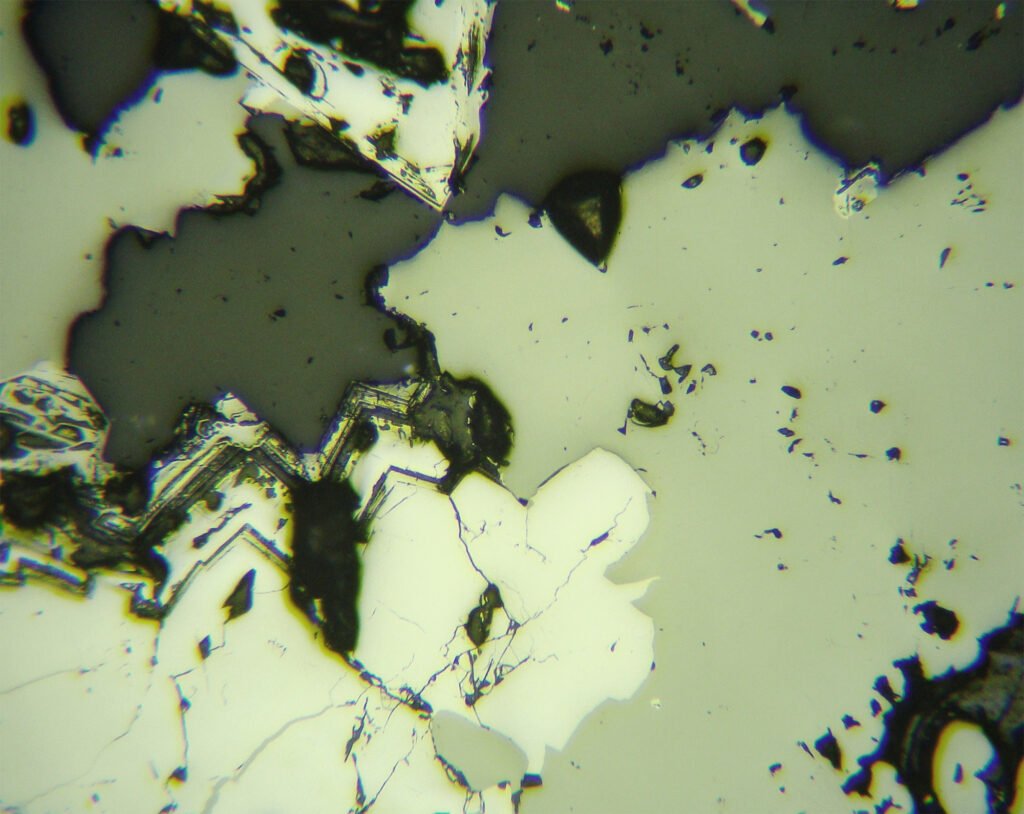
Zonation is very common, very frequent, sometimes excellently developed in As-rich members and noted for slight color differences even without chemical attack. With chemical attack the zoning becomes very evident.
Deformations are very common and easily lead to cracks and well-developed cataclastic structures.
Recrystallization textures are sometimes recognized.
Unmixings are very rare. Bismuthinite needles oriented parallel to (111) of tetrahedrite are likely demixtures. Small sphalerite and sphalerite demixes can occur, the inverse (tetrahedrite as a star in sphalerite) as well.
Inclusions 1: Fahlore inclusions in other minerals are common, in the form of very small grains and lamellae. They also occur in the form of stars. They occur in pyrrhotite, chalcopyrite, sphalerite, galena, stannite and bornite. In high temperature galenas there are inclusions of fahlores, accompanied or not by bournonite, polybasite, acanthite and many others. The silver contents of the ore are often due to these fahlor inclusions. Close to the intergranular boundaries of galenas, especially in the immediate vicinity of chalcopyrite, fahlore droplets are especially abundant.
Inclusions 2: inclusions in fahlores can be of sphalerite, stannite, pyrrhotite, pyrite, galena, gold, chalcopyrite, arsenopyrite, pyrargyrite and tellurides.
Substitutions 1: tetrahedrite-tennantite replace miargirite, pyrargirite, proustite, polybasite, arsenopyrite, gersdorffite, magnetite, cobaltite, marcasite, sphalerite, chalcopyrite, pyrite, stibnite, bornite and galena. When replacing pyrite, there may be a bornite reaction edge between pyrite and tetrahedrite. Generally speaking, one fahlore can replace another fahlore. Several of these minerals, when cataclastic, are often cemented by fahlors and replaced to varying degrees by fahlors. A special substitution is the transformation of enargite (“pink enargite”) to tennantite, known from many enargite deposits.
Substitutions 2: tetrahedrite-tennantite can be substituted for chalcopyrite, galena, bournonite, sulfosalts of Ag and for native silver.
Graphical oriented intergrowths (epitaxies), well known from collectibles, in polished sections are of minor importance. They can often be seen with galena, sphalerite, chalcopyrite and bornite. In some deposits, concentric edges of bournonite occur on the fahlores.
Alterations: in the oxidation zone, the transformation of fahlors is very varied. Normally, the formation of chalcocite and covellite occurs initially, then the formation of oxidized ores occurs. The structures that form are very varied. Goethite, cuprite, azurite and malachite are formed. Fahlors with high levels of mercury are always altered by supergenic processes and contain abundant cinnabar and mercury.
Fahlore myrmekites of varying degrees of development (finer/coarser) are known in many minerals. Some can be explained by unmixings.
“Eyes” of fahlore, with a pyrite rim, can be found in some deposits.