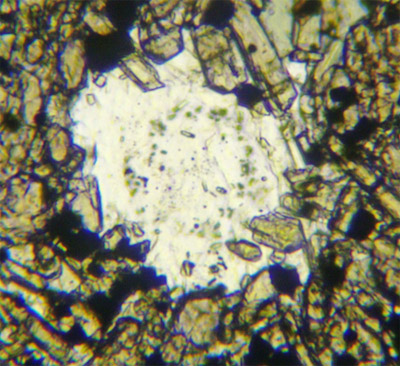
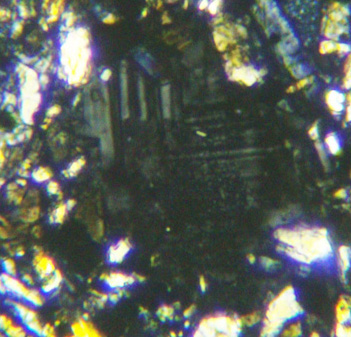
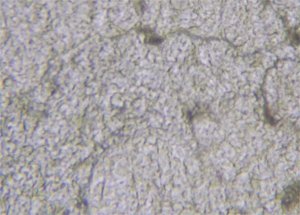
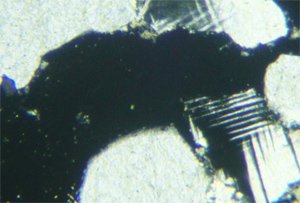
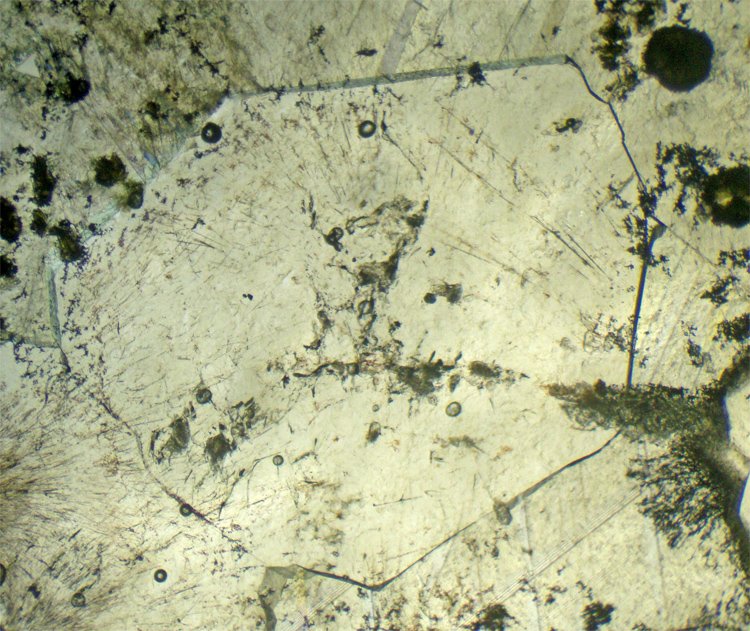
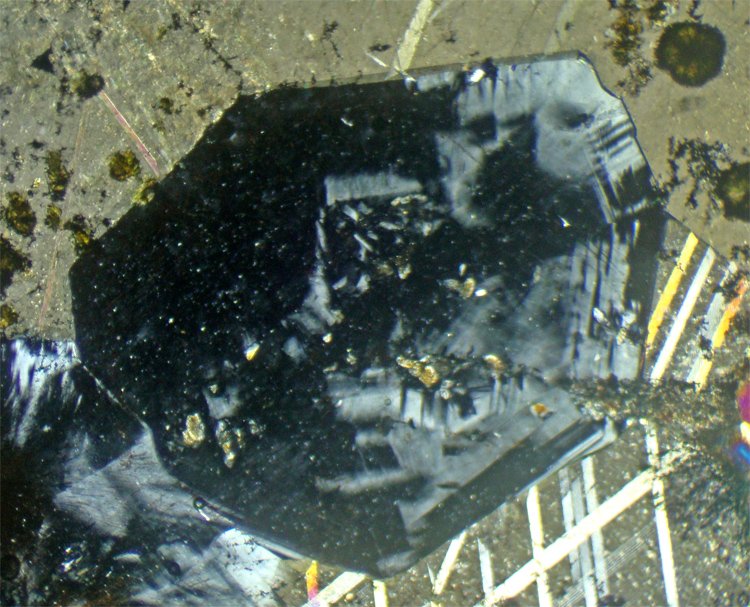
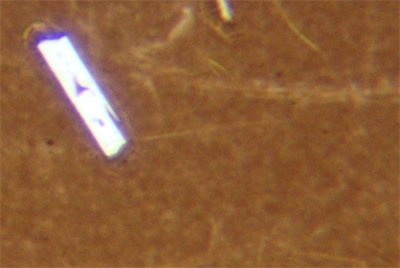
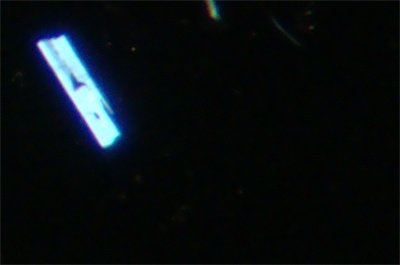
PPL: Relief very low, colorless, cleavage not visible. Crystals roundish or with 8 sides, 2 generations are possible. Many inclusions are typical.
XPL: Very low birefringence (very dark). Always polysynthetic twinning (looks similar to microcline, but is much darker and more irregular.). U(+), may be B(+).
Cubic tectosilicate (feldspatoid), rather rare, of sodic volcanic rocks.
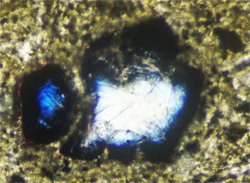
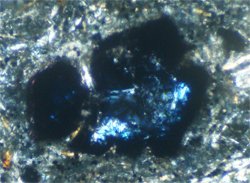
PPL: Relief very low. Colorless to blue. Visible cleavage is possible. Cubic, euhedral grains, octahedrons, sections with 6, 8 or 10 sides.
XPL: Completely isotropic (black). Black borders or zonation of black inclusions is possible. Alters to zeolites and clay minerals. Similar to sodalite, nosean, leucite and analcime.
Cubic tectosilicate (feldspathoid), rather rare, of Si-low igneous rocks.
PPL: Relief low,. Colorless, rarely gray. Cubic. Cleavage usually not visible. Sections with 6, 8 or 10 sides, but normally as anhedral interstitital masses. Pseudohexagonal twins possible. Altered borders are possible.
XPL: Isotropic (completely black), may even be confused with a hole in the thin section!
Images: Sodalite (center) surrounded by feldspars, in PPL and in XPL.
Cubic tectosilicate (feldspatoid) of alkaline volcanic rocks.
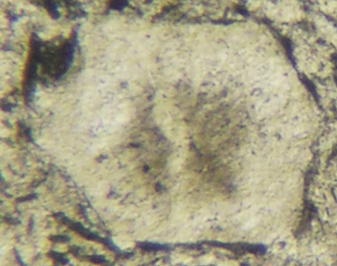
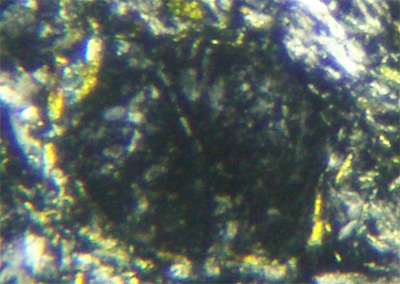
PPL: Relief very low. Colorless, gray or pale bluish. Euhedral grains, pseudo-hexagonal ou rounded. Cleavage not visible. “Haze” of inclusions in sectors, in the center or at the edges.
XPL: Isotropic (completely black), inclusions may simulate weak birefringence. Easy to confuse with analcime, leucite, sodalite and haüyne.
Symmetry-complex uncommon tectosilicate of the Zeolite Group.
PPL: Relief very low. Colorless. Cleavage not visible. Anhedral or 8-sided sections. As phenocrysts or in cavities, may show concentric or sectorized structure. Twins rare.
XPL: Isotropic or very dark gray color. May be anomalously B(-). Somewhat similar to leucite.
Images: Analcime with twinned calcite in PPL and in XPL.
Amorphous (or not so!) very common tectosilicate (Dana, 8th ed.).
PPL: Relief very low. Colorless, yellow or red. Fills vesicles, fractures and interstitial spaces. Massive, reniform or botrioidal, perfect spheres are possible. No cleavage, but contraction fractures may occur.
XPL: Isotropic, but incipient recrystallization to chalcedony is possible. May be "dirty", brownish, due to included clay minerals.
Very common amorphous rock-matrix forming material of lavas and sub-volcanic rocks.
PPL: Relief low. Colorless or yellow or brown or red. No cleavage. May show perlitic (concentric) fractures, devitrification crystallites and/or spherulites, pseudo-flow structures and shard textures.
XPL: Completely isotropic if without incipient recrystallization.
Images: Red volcanic glass with a plagioclase crystal in PPL and XPL.
Isotropic or weakly anisotropic minerals, with low relief.