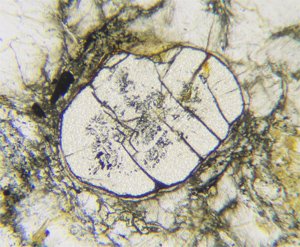
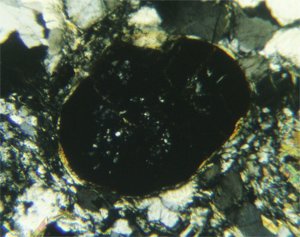
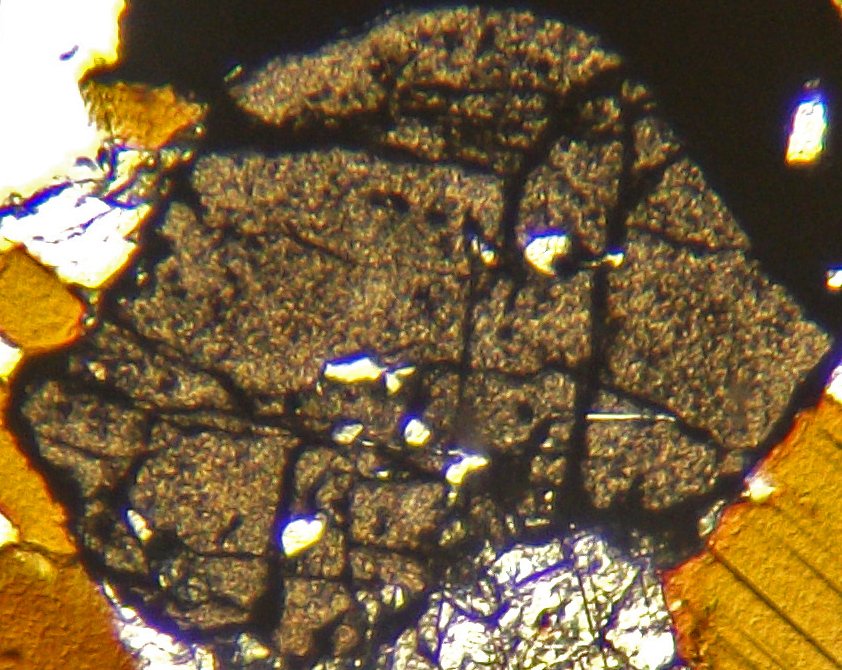
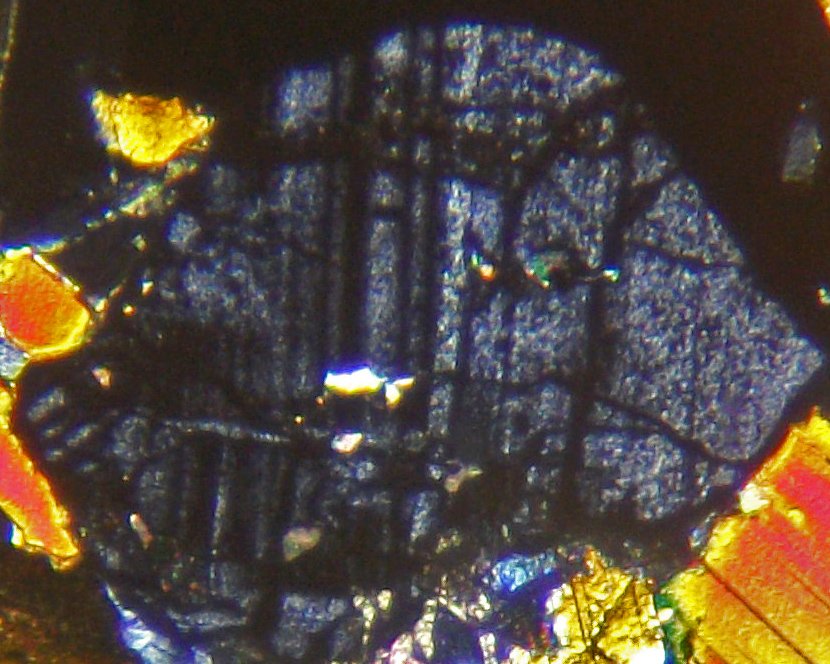
PPL: Relief high or very high. Usually colorless, may be gray, pinkish or brown (melanite), but never with pleochroism. Usually in rounded grains. High relief, very fractured and without cleavage. It can have many inclusions.
XPL: Almost always isotropic (completely black), but may be anisotropic and sectorized. Rarely altered.
Common cubic oxide occurring in magmatic and metamorphic rocks.
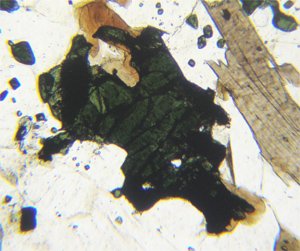
PPL: Relief very high. Most commonly gray-green to dark green, may be colorless, pale to pink or blue. When colorless or pink, it is similar to garnet (which does not have triangular sections). No pleochroism. No cleavage. Anhedral grains, cubes or octahedrons, may show zonation. No twinning.
Rare cubic Mg-oxide, typical of dolomitic marbles.
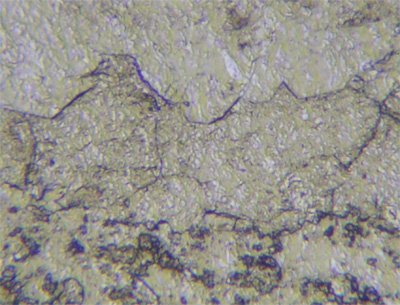
PPL: Relief high. Colorless (if with Fe, yellowish to brown, without pleochroism). Cubic, anhedral grains, octahedrons, granular or massive. Cleavage {001} perfect and {111} good.
Very common cubic halide, often associated to granites, but can occur in many types of rocks.
PPL: Relief moderate. Colorless, but very commonly exhibits irregular blue or violet zonation. Simulates pleochroism in blues, but is not pleochroic. Perfect (111) cleavage: or two cleavages intercept at 70º/110º or three at 60º/120º. Usually anhedral crystals, sometimes cubes.
XPL: As it is a cubic mineral, it is isotropic (completely black). Anomalous birefringence is possible.
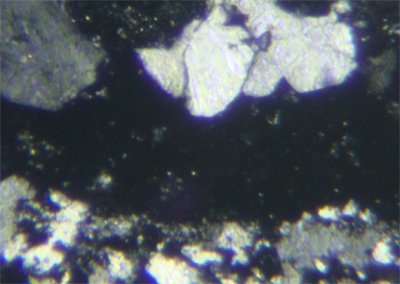
Images: Horizontal fracture in granite filled with fluorite, in PPL and in XPL.
Rather common monoclinic sorosilicate, of the Allanite Group.
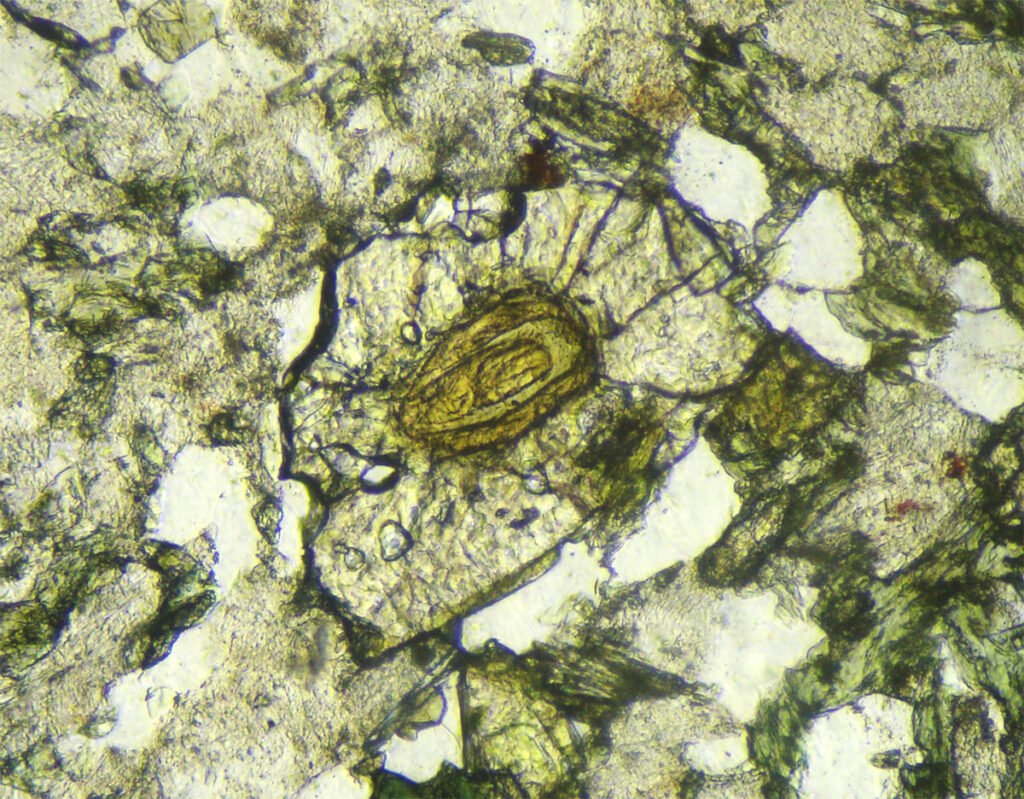
PPL: If unaltered, with high relief and usually pleochroic in red-brown (in green is possible). No visible cleavage. Anhedral or tabular grains. Zoning common.
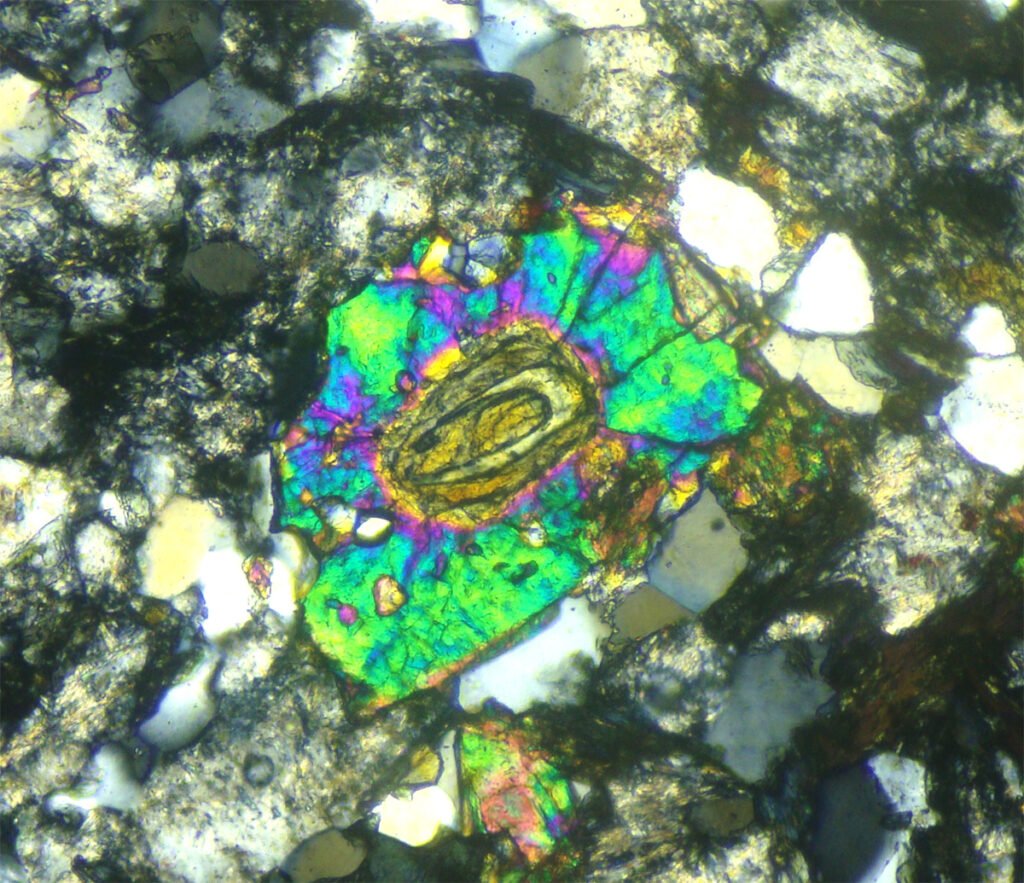
May have undergone metamictization: destruction of its structure due to radiation from the Rare Earth Elements it contain. The relief becomes progressively lower, the pleochroism is much weaker (relict), the mineral turns more and more isotropic, swells, may develop radial fractures and an epidote corona.
XPL: If unaltered, colors up to 3rd order, masked by the mineral color. Dark halos around the grains may occur. Twins are common. B(-/+). Similar to brown hornblende. If metamictized, isotropic.
Images: Partially altered allanite with an epidote corona in PPL and in XPL.