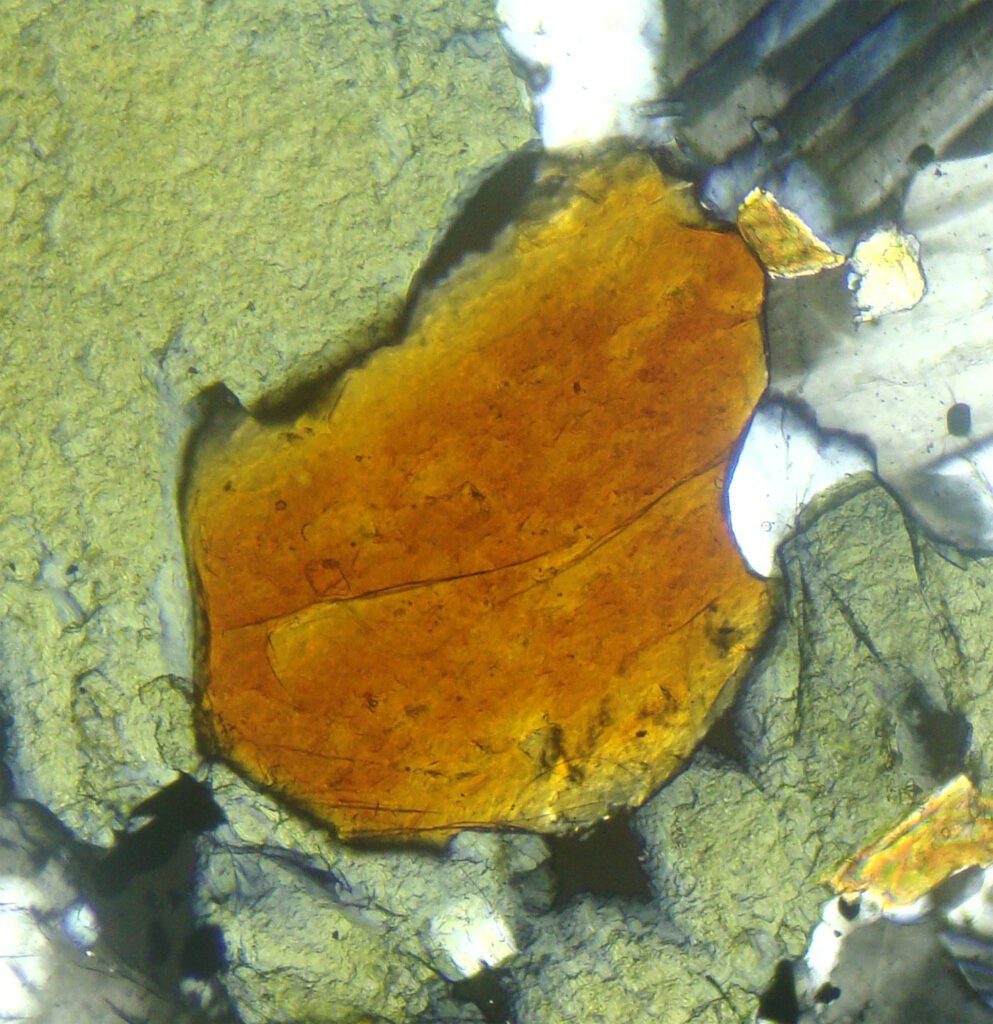
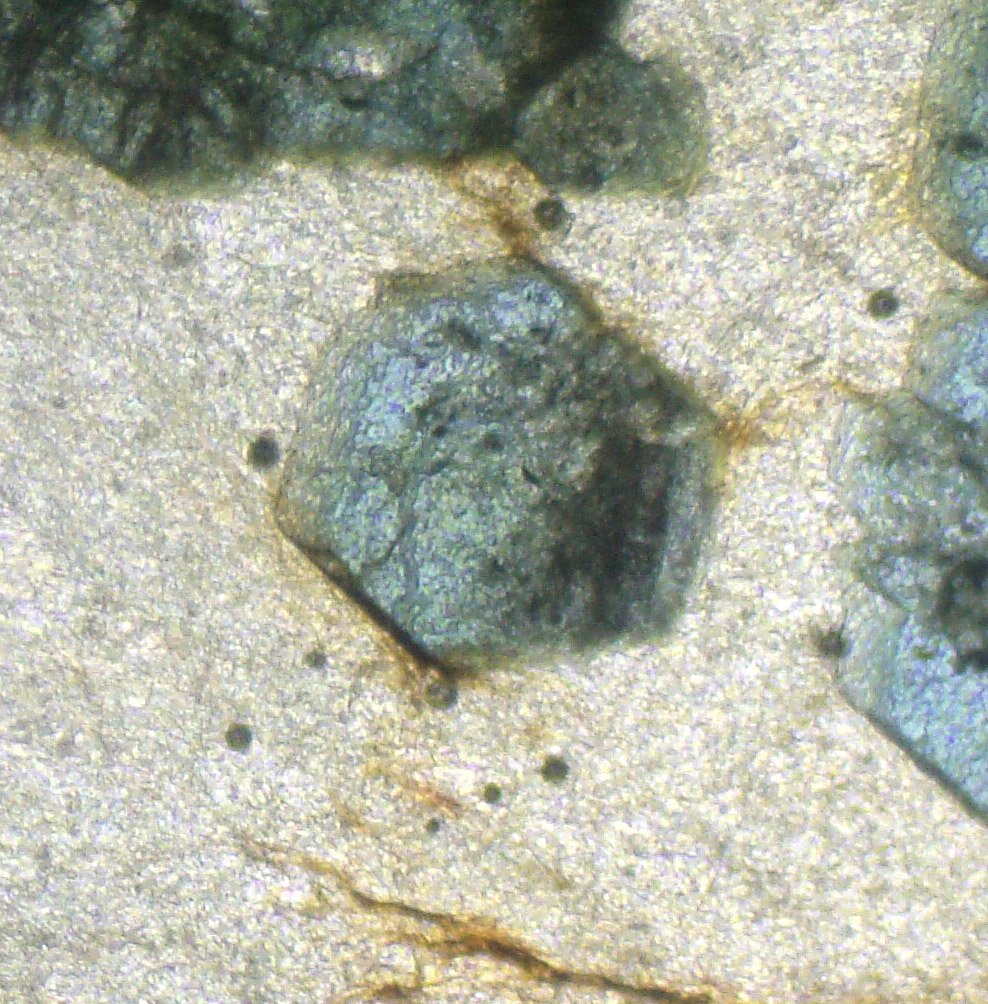
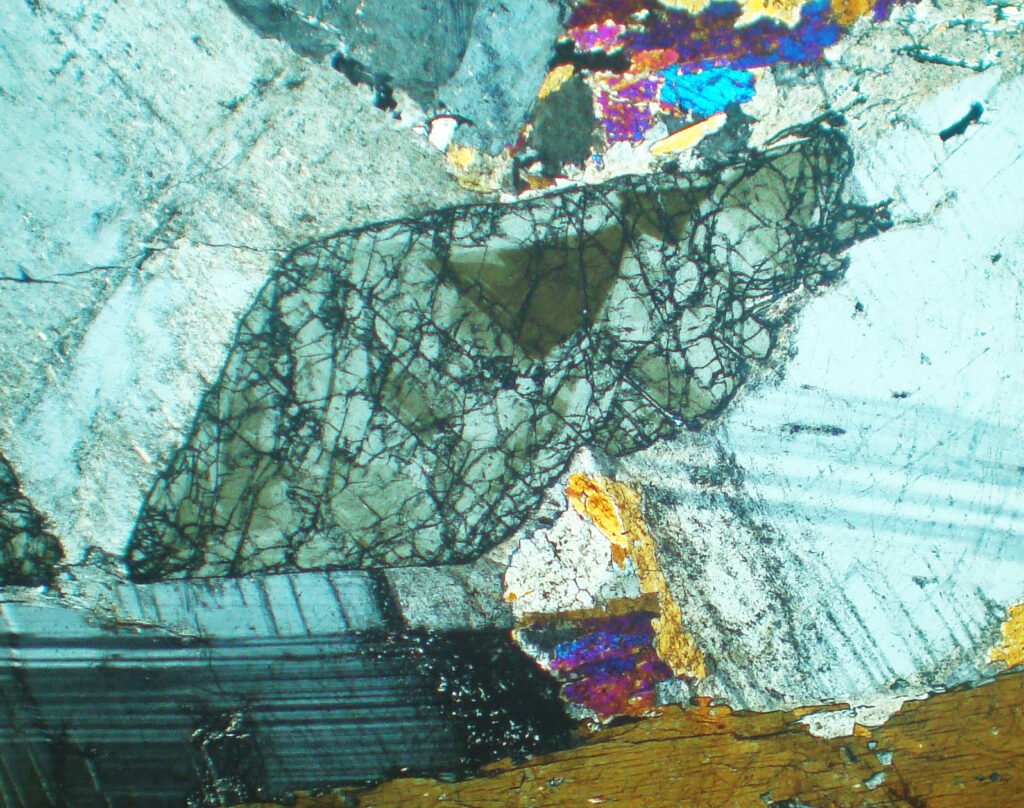
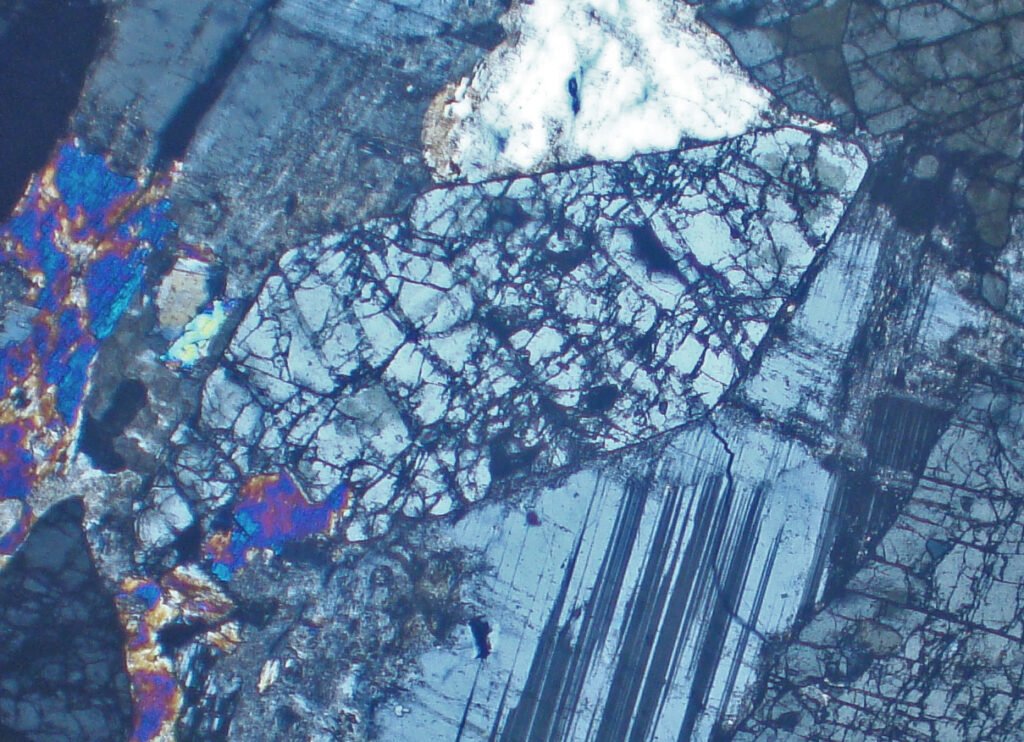
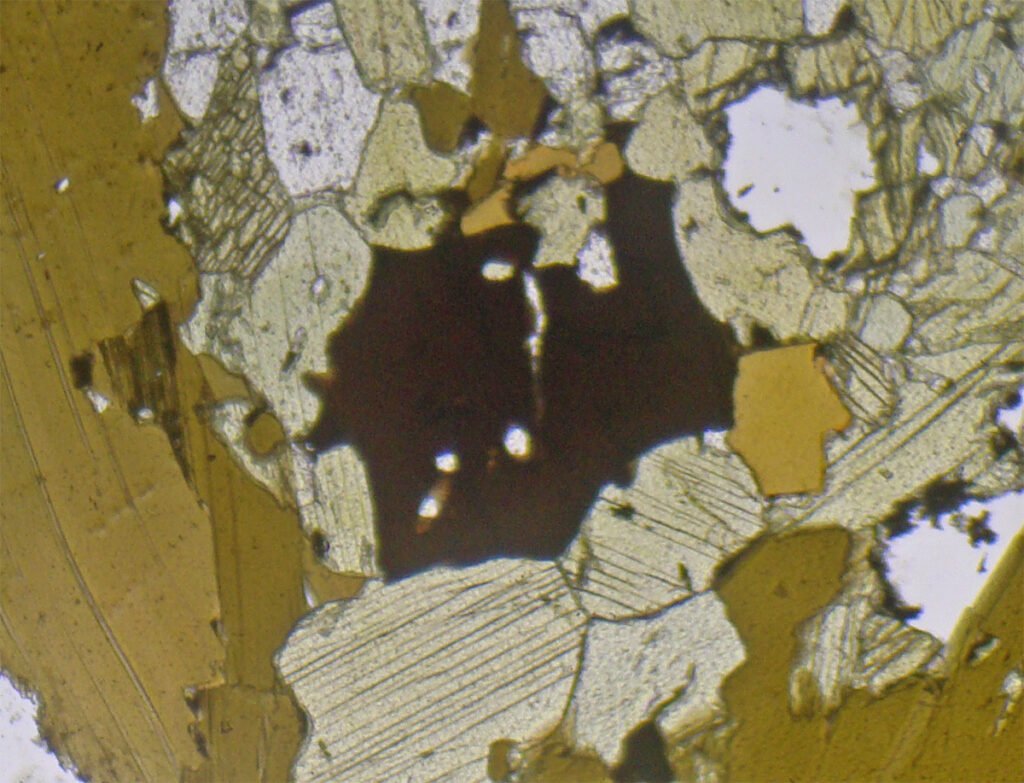
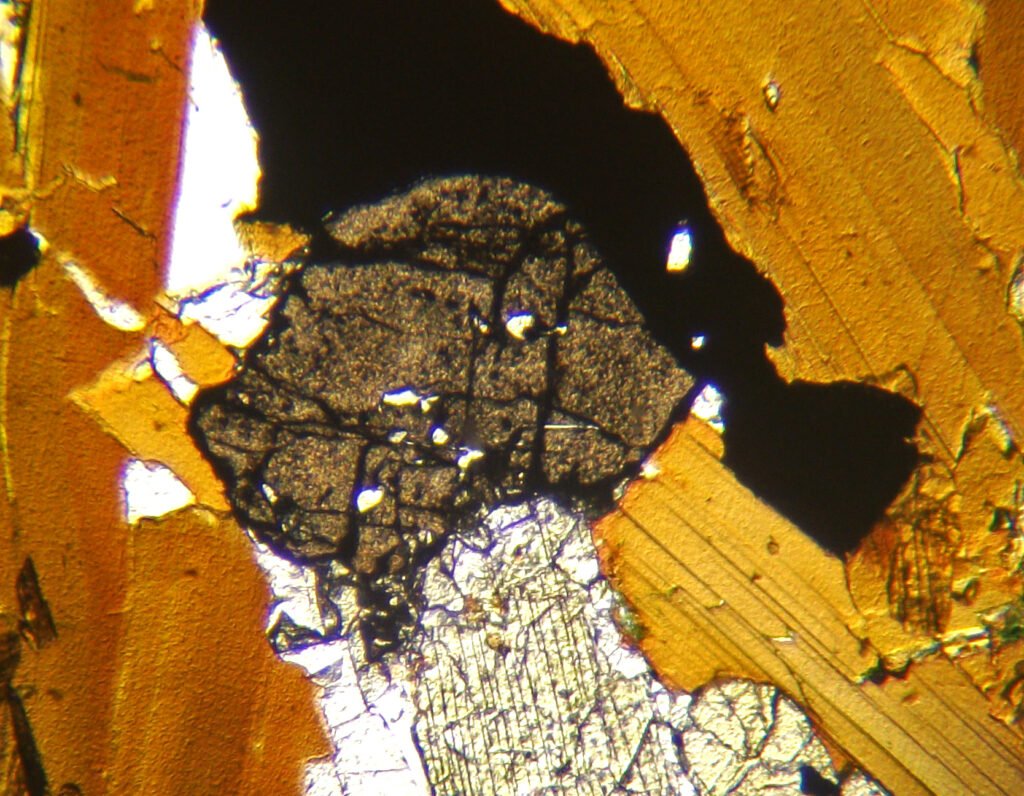
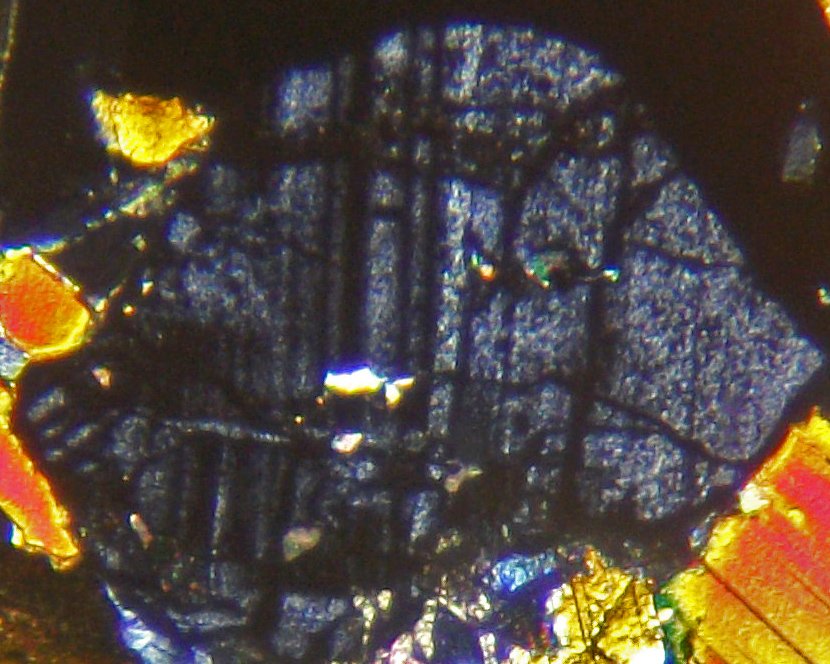
In uniaxial minerals like tourmaline, the sections more or less perpendicular to the main crystallographic axis corresponds to the basal (isotropy) section and will not show any pleochroism.
In biaxial minerals, there will be two isotropic sections, each one perpendicular to one of the optical axes, also without pleochroism.
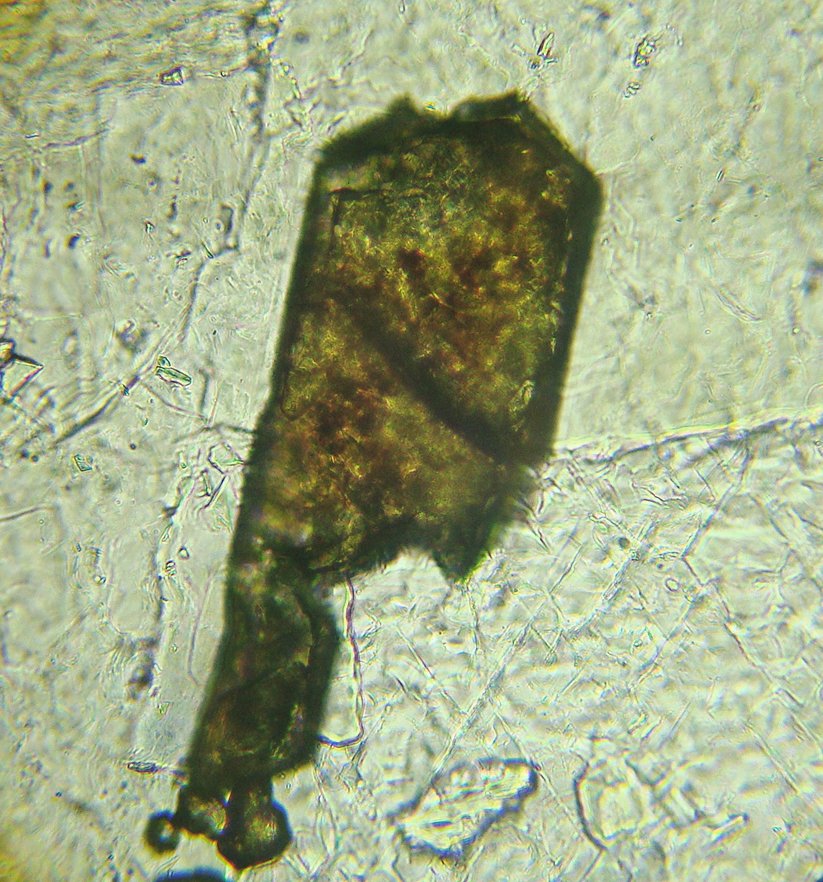
Images: Basal sections of biotite (brown) and tourmaline (bluish).
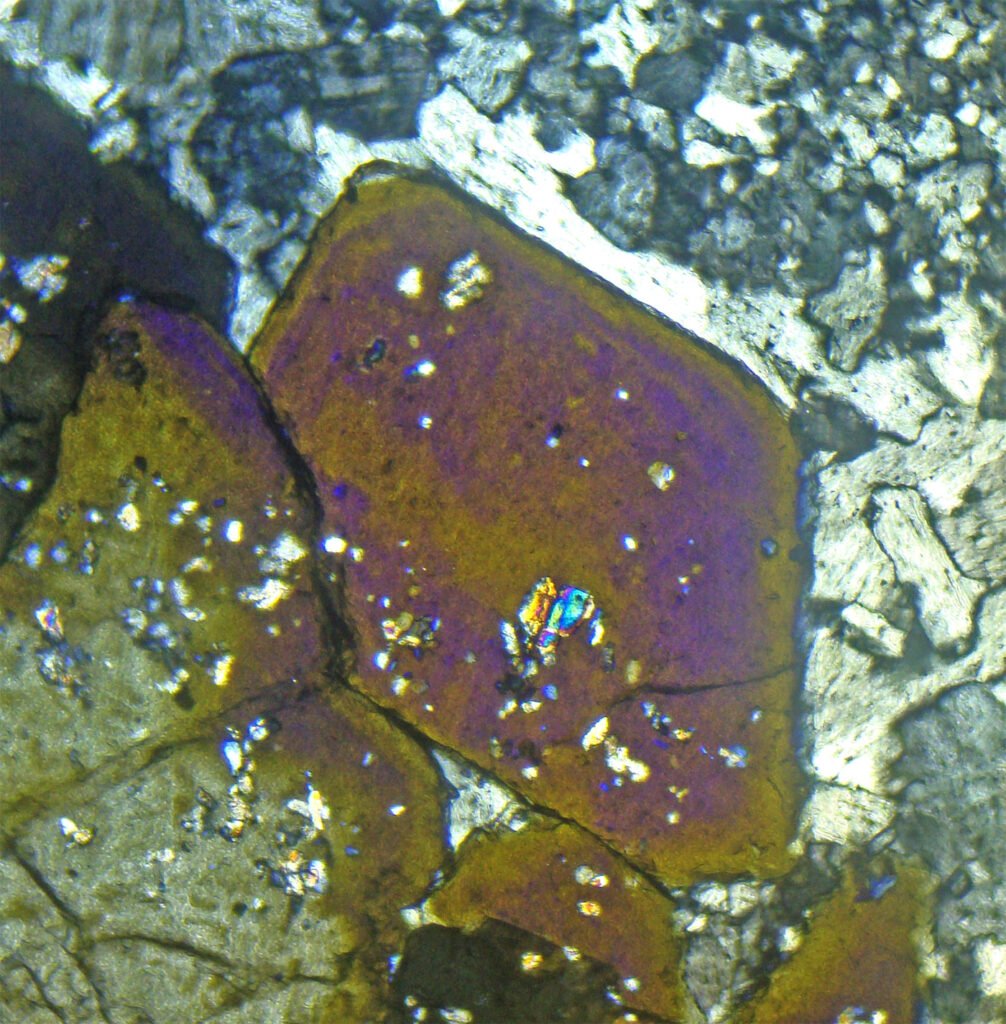
A very common monoclinic nesosilicate found in many types of rock.
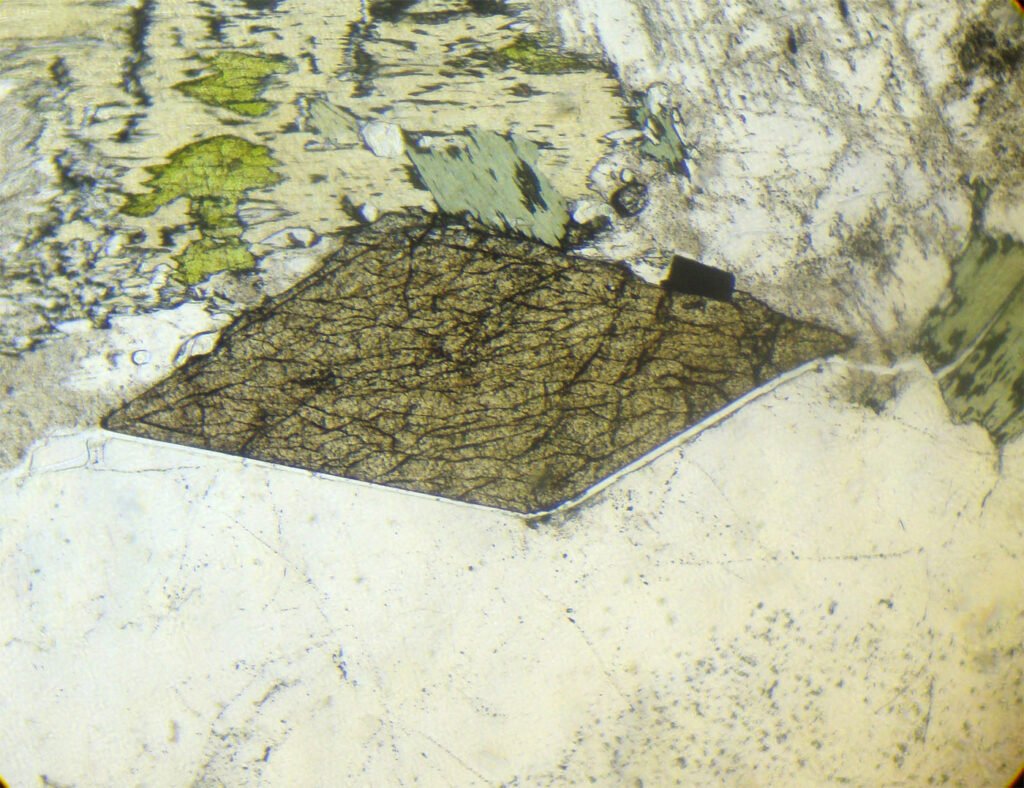
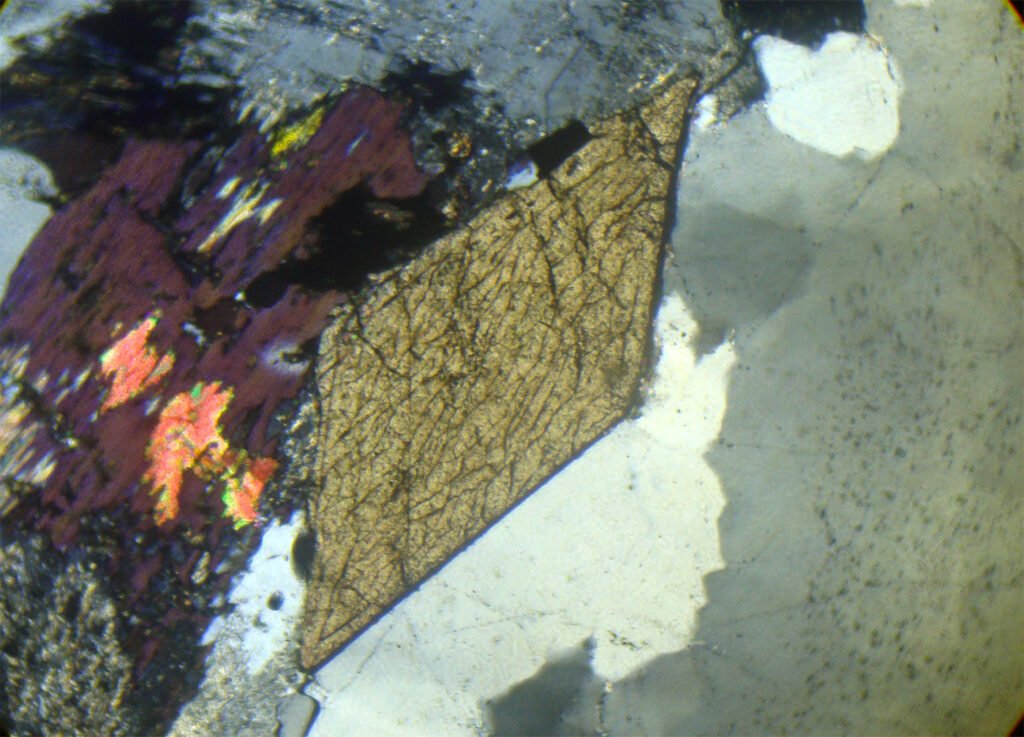
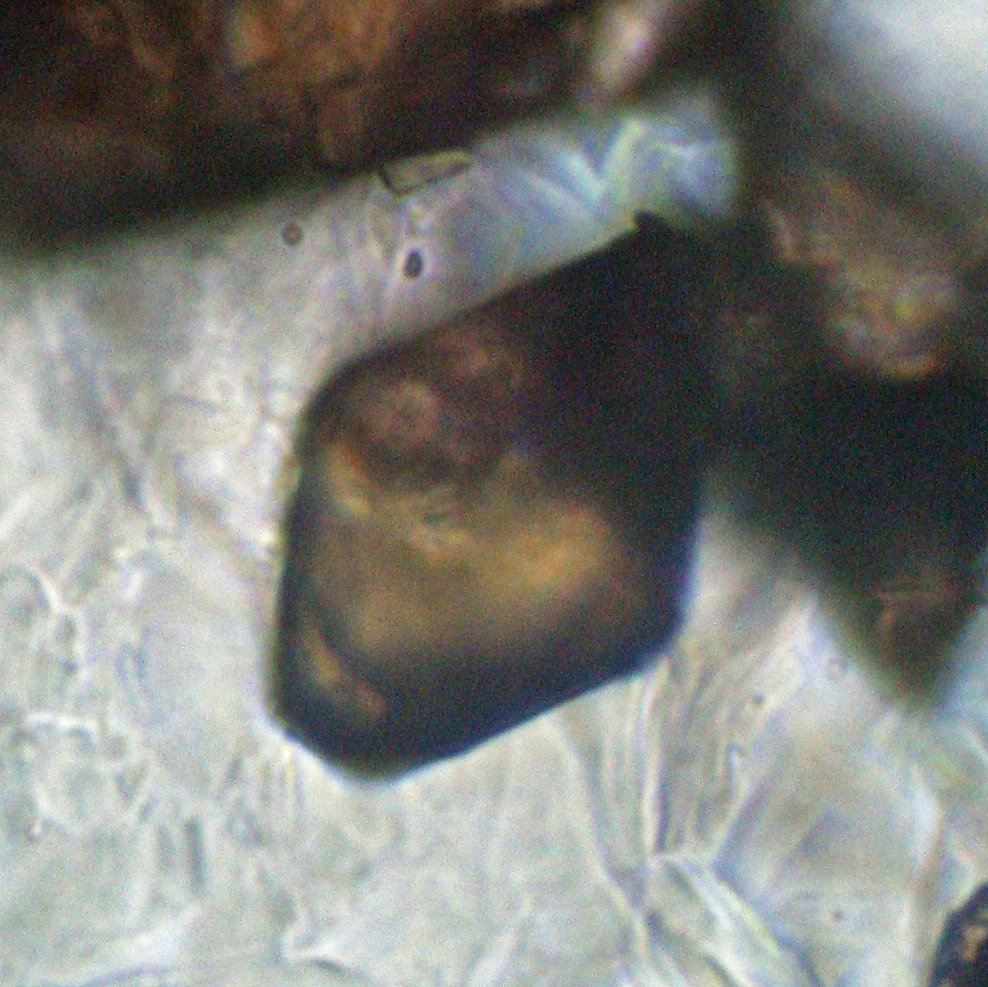
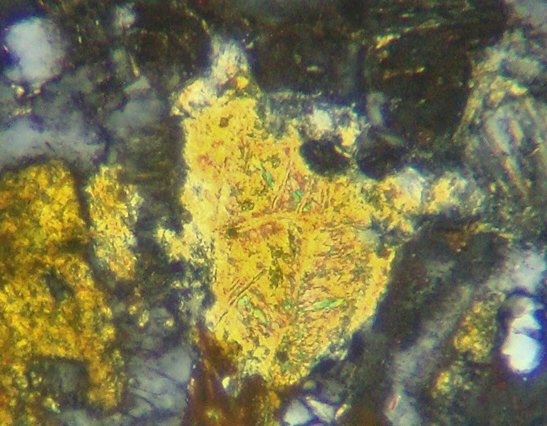
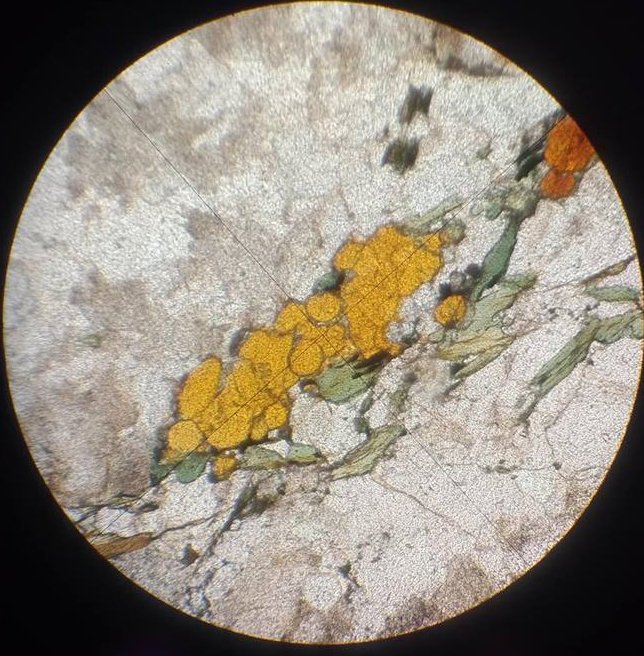
PPL: Brown color, may have gray or yellow tones, may have weak pleochroism. Granular, only sometimes with rhombic basal sections as in the images below. High relief. Fractured, 1 good cleavage, often absent.
XPL: Its color is almost the same as in PPL. Zoning and twins occur. B(+), (2V=17-56º). The strong color make it difficult to see the interference figure.
Less common orthorhombic sorosilicate, mainly of metamorphic rocks.
PPL: Colorless, may show soft pink color without pleochroism. Only the thulite variety, of Mn, shows moderate pink to yellow pleochroism. High relief, rhombic or hexagonal basal sections. One perfect cleavage. I
XPL: Anomalous colors (blue-gray, brown) or of lower 1st order. Parallel extinction, ES(-), B(+) with 2V 0-69º.
Tetragonal sorosilicate of contact metamorphic impure marbles.
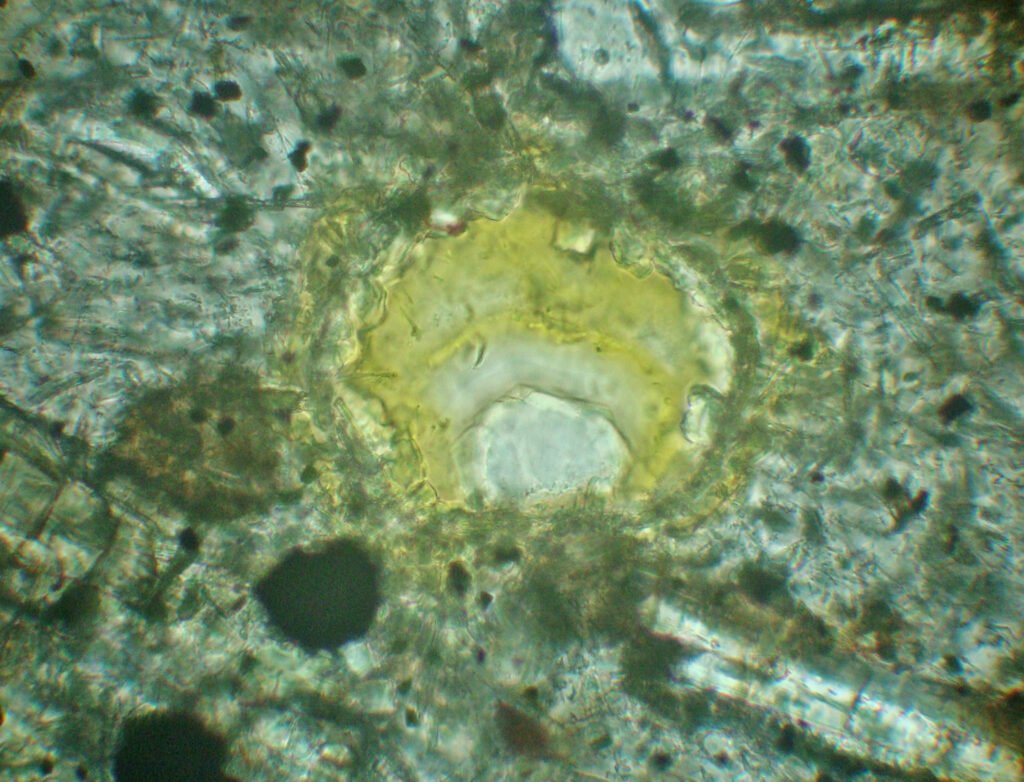
PPL: Colorless, but may show pale colors in green, brown or yellow without pleochroism or with very weak pleochroism. High relief, bad cleavage, granular or in short prisms.
XPL: Anomalous colors (blue, brown, purple, etc.). Extinction tends to parallel, ES(-), zonation common. U(-), can be anomalous B(-) with 2V from 17-33º.
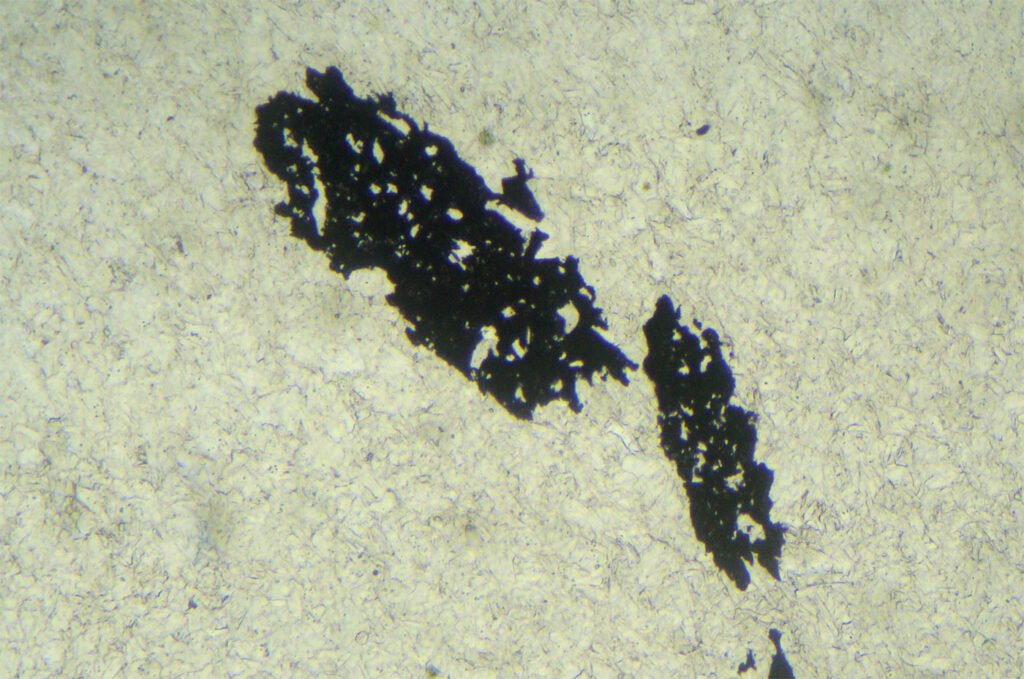
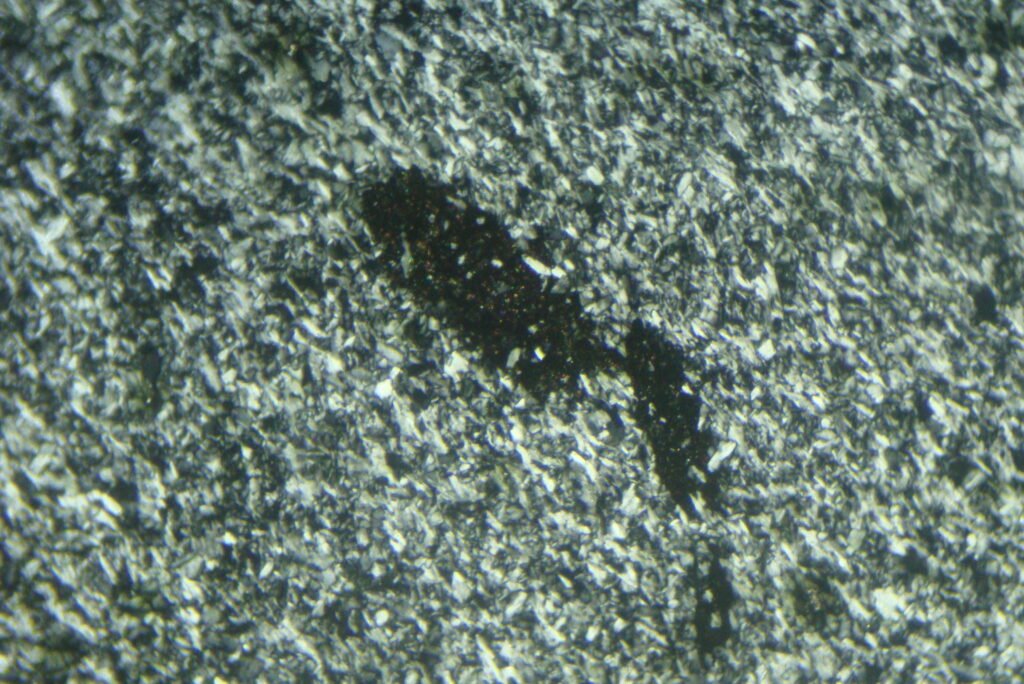
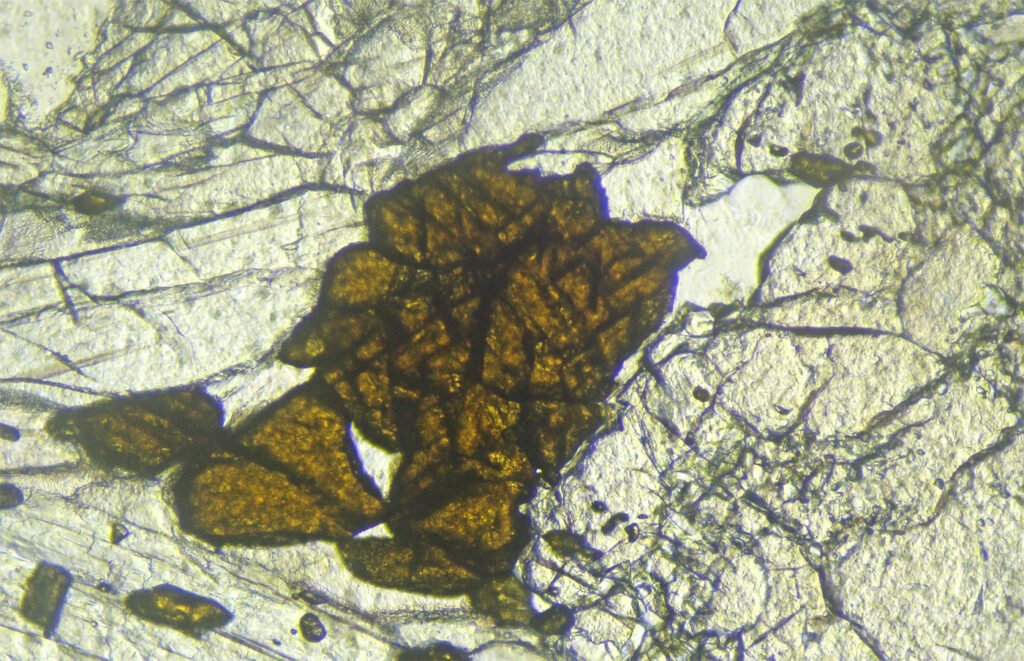
Common tetragonal accessory Ti-oxide in magmatic and metamorphic rocks, easily goes unnoticed.
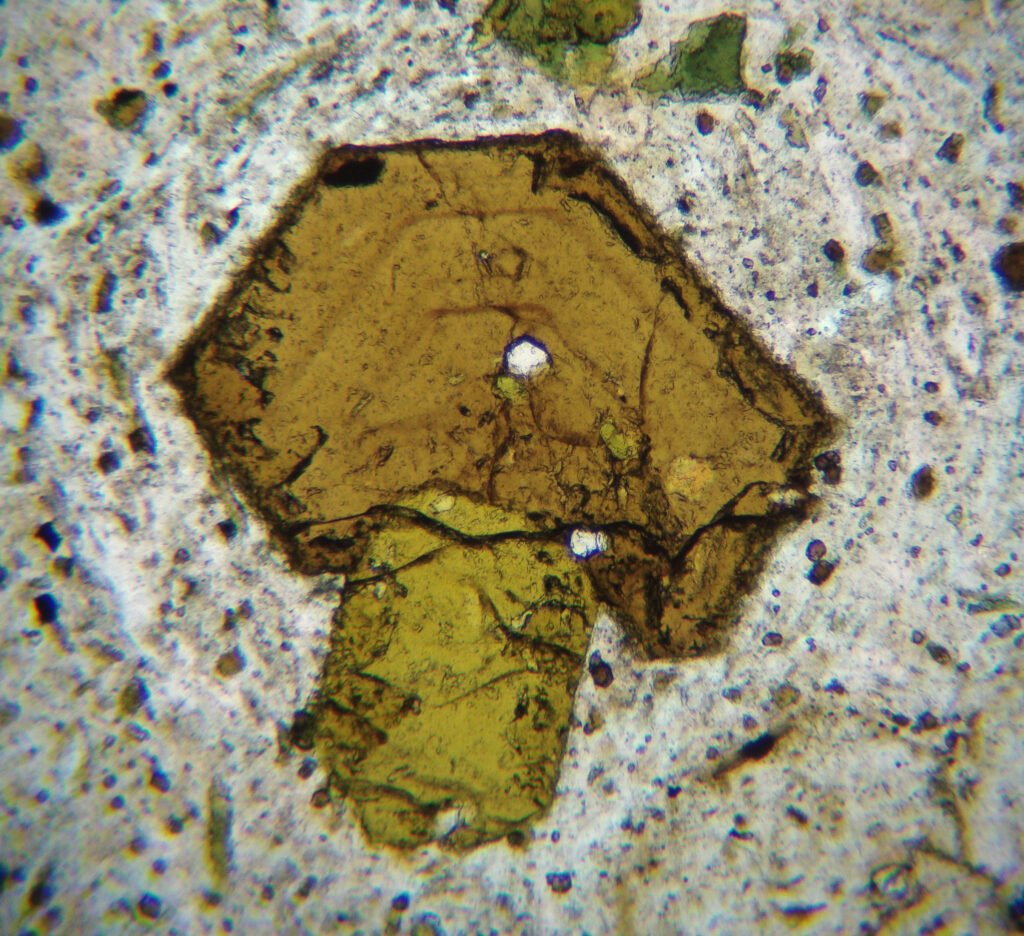
PPL: Varied and well-defined colors: yellow, yellow-brown, brown, dark blue, pale green, black. Weak pleochroism possible, stronger if colors are more intense. Very high relief.
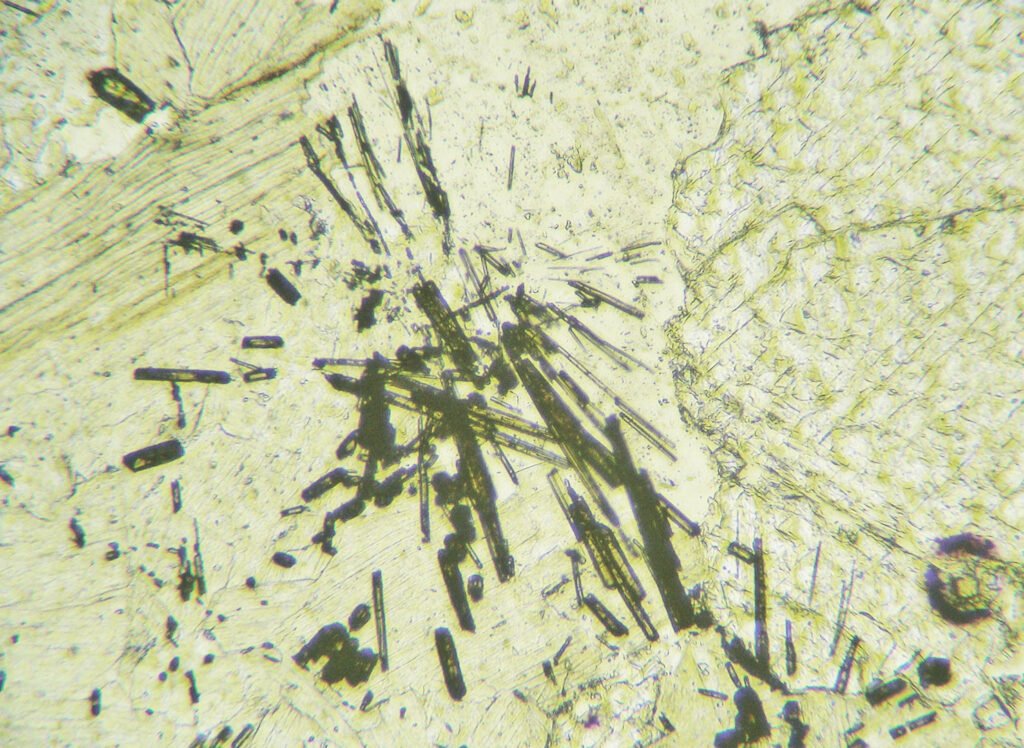
Very common tetragonal Ti-oxide, accessory in many types of rocks.
PPL: Weakly pleochroic in red-brown to yellow-brown. Very high relief, granular or acicular crystals. The color is almost the same in PPL and in XPL (like titanite).
XPL: Parallel extinction, ES(+), twins possible. No zoning, no alteration, dark halos around it is possible. U(+).
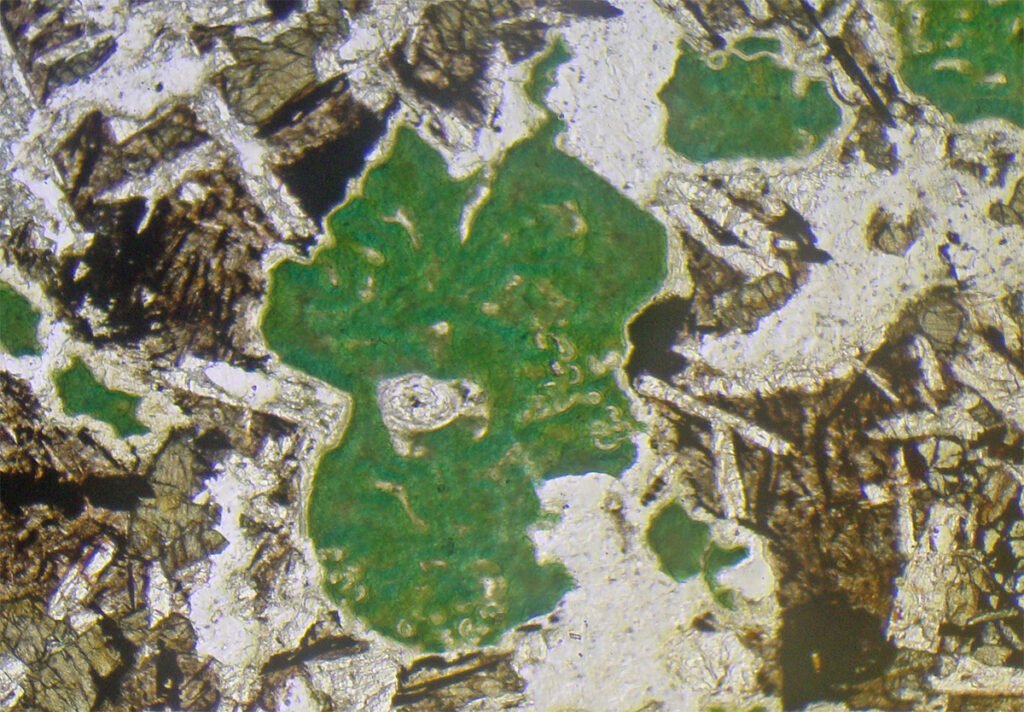
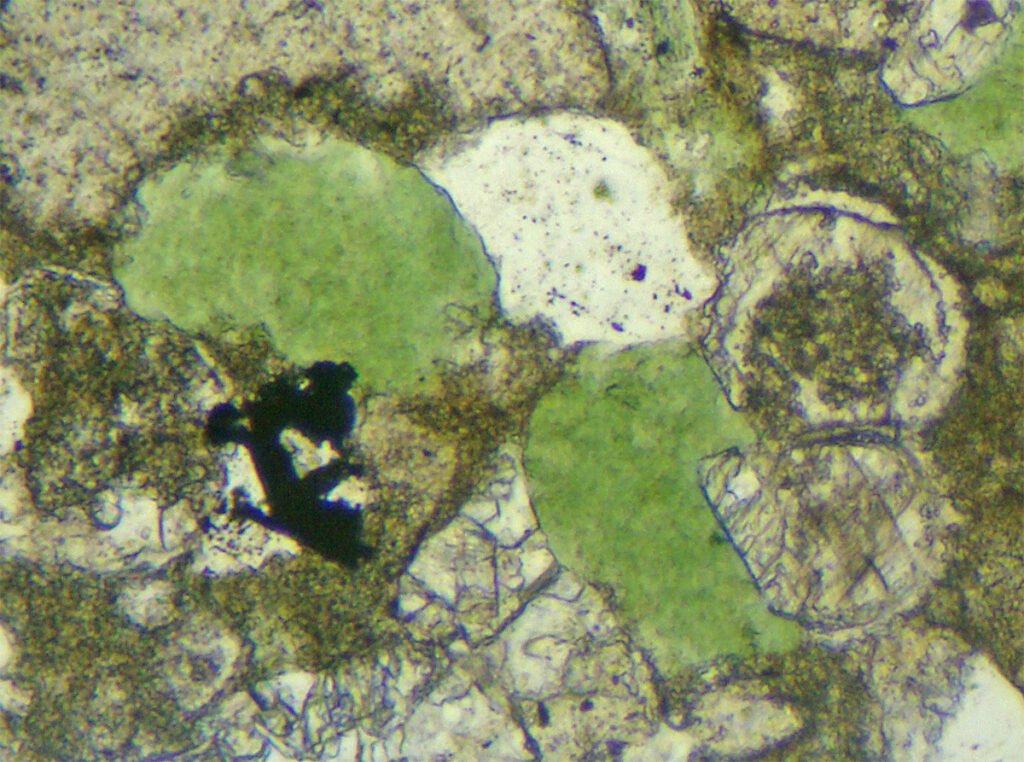
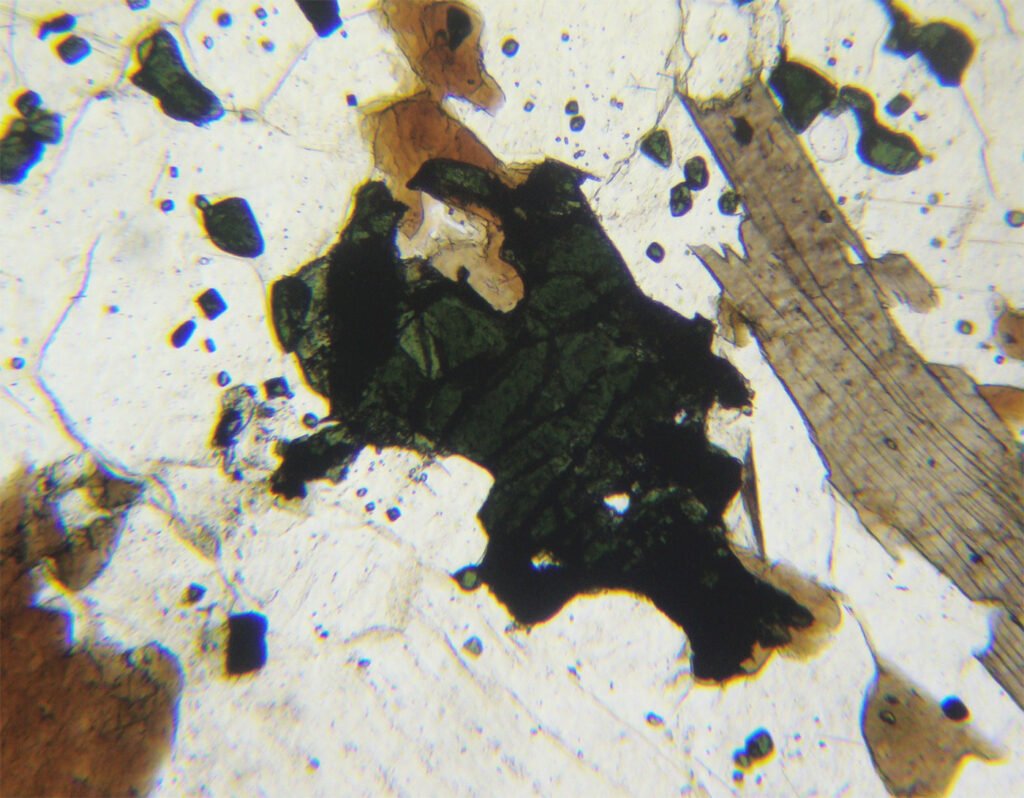
Common cubic oxide occurring in magmatic and metamorphic rocks.
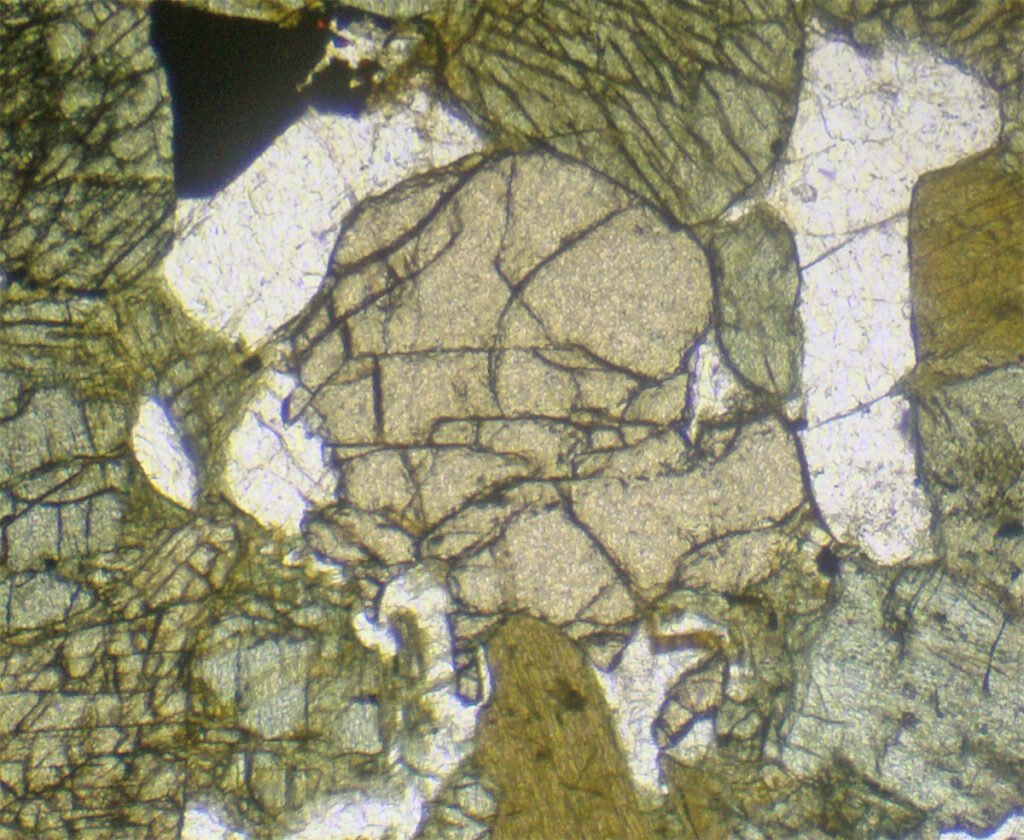
PPL: Most commonly gray-green to dark green, may be colorless, pale to pink or blue. No pleochroism. Relief very high. No cleavage. Anhedral grains, cubes or octahedrons, may show zonation. No twinning.
XPL: Isotropic, completely black. When colorless or pink, it is similar to garnet (which does not have triangular sections).
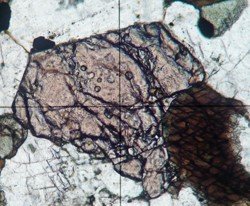
PPL: Sometimes garnets show a well-defined pink color, may suggest pleochroism, but does not. Usually in rounded grains. High relief, very fractured and without cleavage. It can have many inclusions.
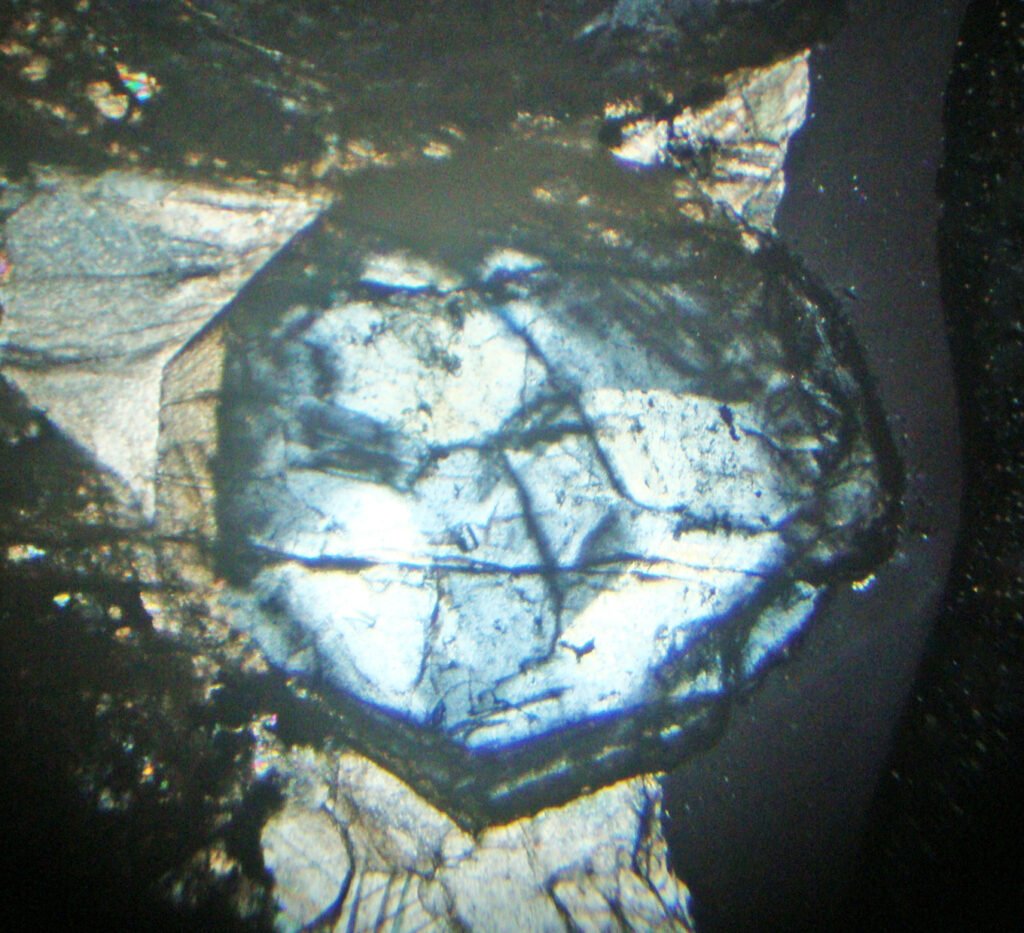
Cubic garnet exclusive to alkaline volcanic rocks.
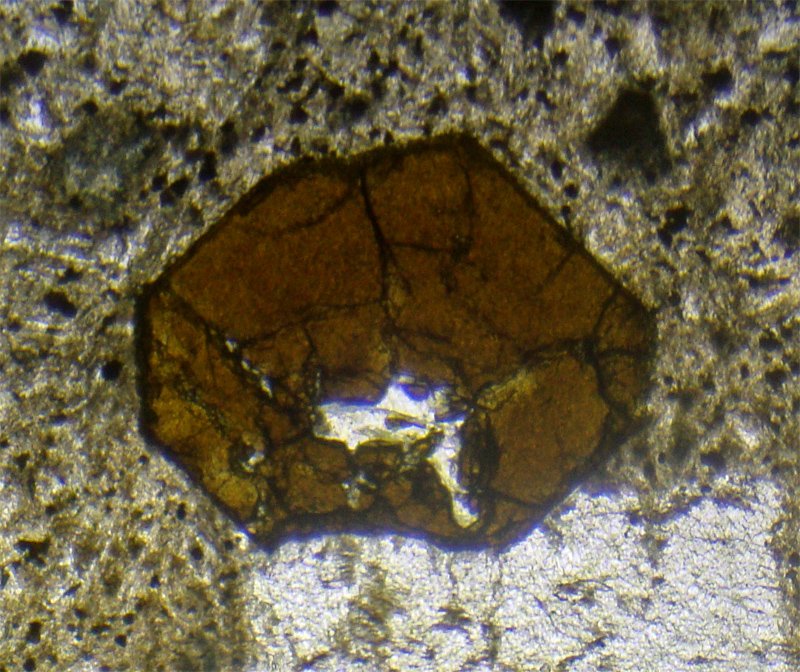
PPL: Strong brown color, may suggest pleochroism, but does not. Mineral generally in polygonal grains of high relief, without cleavage. May have inclusions.